Sterling Silver Identification Guide: How to Read Hallmarks and Know What You Have
A practical, image-by-image guide to reading the marks on the back of a spoon, the inside of a ring, or the bottom of a tea pot — including the four-mark British system, US 925/STERLING marks, the commonly misidentified Dutch lion-with-numeral, German crescent-and-crown, French Minerva head, and Russian kokoshnik.
Pick up the spoon. Turn it over. Look at the back of the handle, near the bowl.
If you see a tiny row of stamped pictograms — a lion, a leopard's head, a single letter, the number 925, a profile of a goddess — you are holding the punch-coded résumé of the piece. The country it was made in, the year it was assayed, the silversmith who made it, and the silver content all live in that 1-cm strip of marks.
This is the guide for reading them. Real photos of real hallmarks throughout — because if you misidentify a Dutch lion-with-numeral as a British lion passant, you misprice the piece by a factor of three.
What Hallmarks Are and Why They Exist
A hallmark is a series of small punched stamps on a precious-metal object that legally certifies its silver (or gold) content. The system started in London in 1300, when King Edward I required that every silver object be tested ("assayed") at Goldsmiths' Hall and stamped with a leopard's head if it passed. The word "hallmark" literally comes from "Goldsmiths' Hall mark."
Different countries developed their own systems, but every legitimate hallmarking system answers the same four questions:
- What is the metal purity? (the standard mark)
- Where was it assayed? (the assay office or town mark)
- When was it assayed? (the date letter)
- Who made it? (the maker's mark or sponsor's mark)
A piece marked with all four is fully hallmarked. A piece marked with only one or two — usually just "925" or "STERLING" — is silver, but the maker chose not to (or was not required to) submit it for full assay. Both are real silver. Only fully hallmarked pieces let you date and source them precisely.
US Sterling — 925, STERLING, and Maker Marks
The United States never adopted a national assay system. There is no US equivalent of the London Assay Office. Instead, in 1906 the federal Stamping Act made it illegal to mark a piece "STERLING" or "925" unless it actually contained at least 92.5% silver — and that's effectively the entire US system.
What you'll see on US sterling:
- STERLING — the most common US mark, spelled out in capitals
- 925 — the modern numeric equivalent, increasingly common from the 1970s onward
- 925/1000 — same thing, expressed as a ratio
- Sterling Silver — sometimes spelled out in full
- A maker's mark next to the standard mark — Tiffany & Co., Gorham (anchor), Reed & Barton, Wallace, International Silver, Towle, etc.
- Often a pattern number or design name
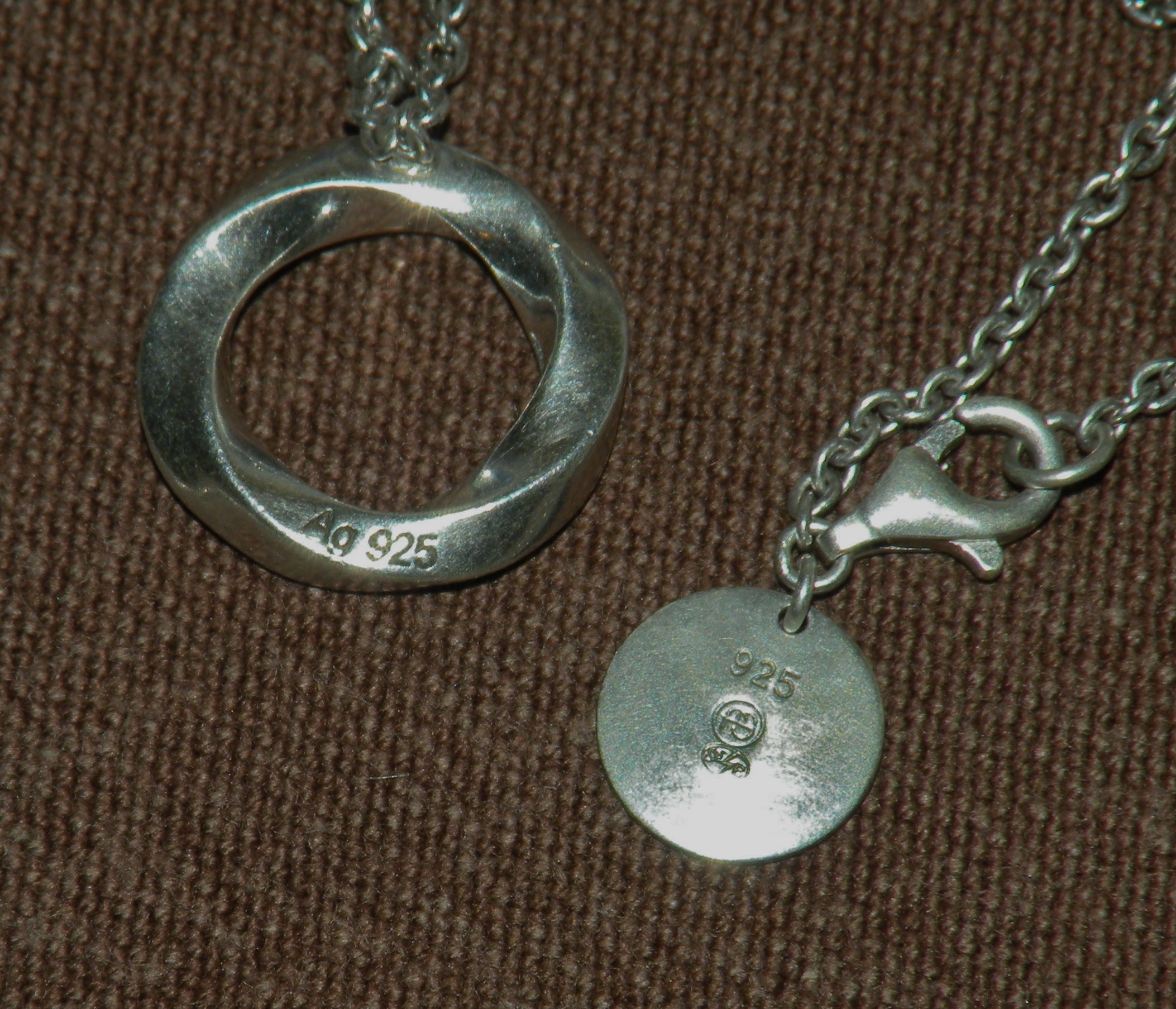
The "925" stamp shown above is the international numeric standard for sterling. You'll see the exact same mark on European, Asian, and Latin American silver — it's not country-specific. To narrow down origin on a 925-only piece, look for an accompanying maker's mark or country of origin stamp.
British Hallmarks — The Four-Mark System
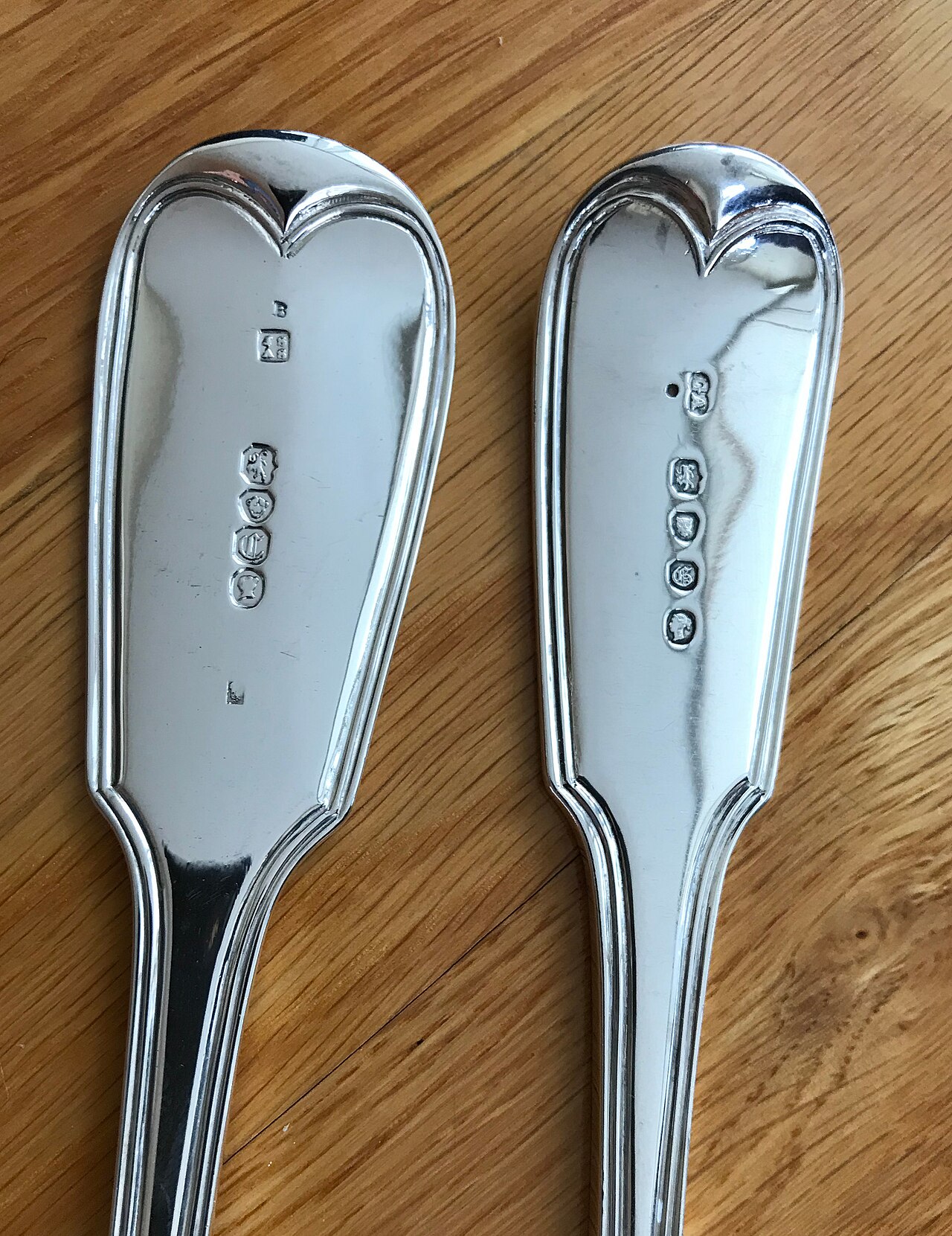
British silver is the gold standard of hallmarking. Every fully hallmarked piece carries four (sometimes five) symbols stamped in a row, and each one tells you something exact.
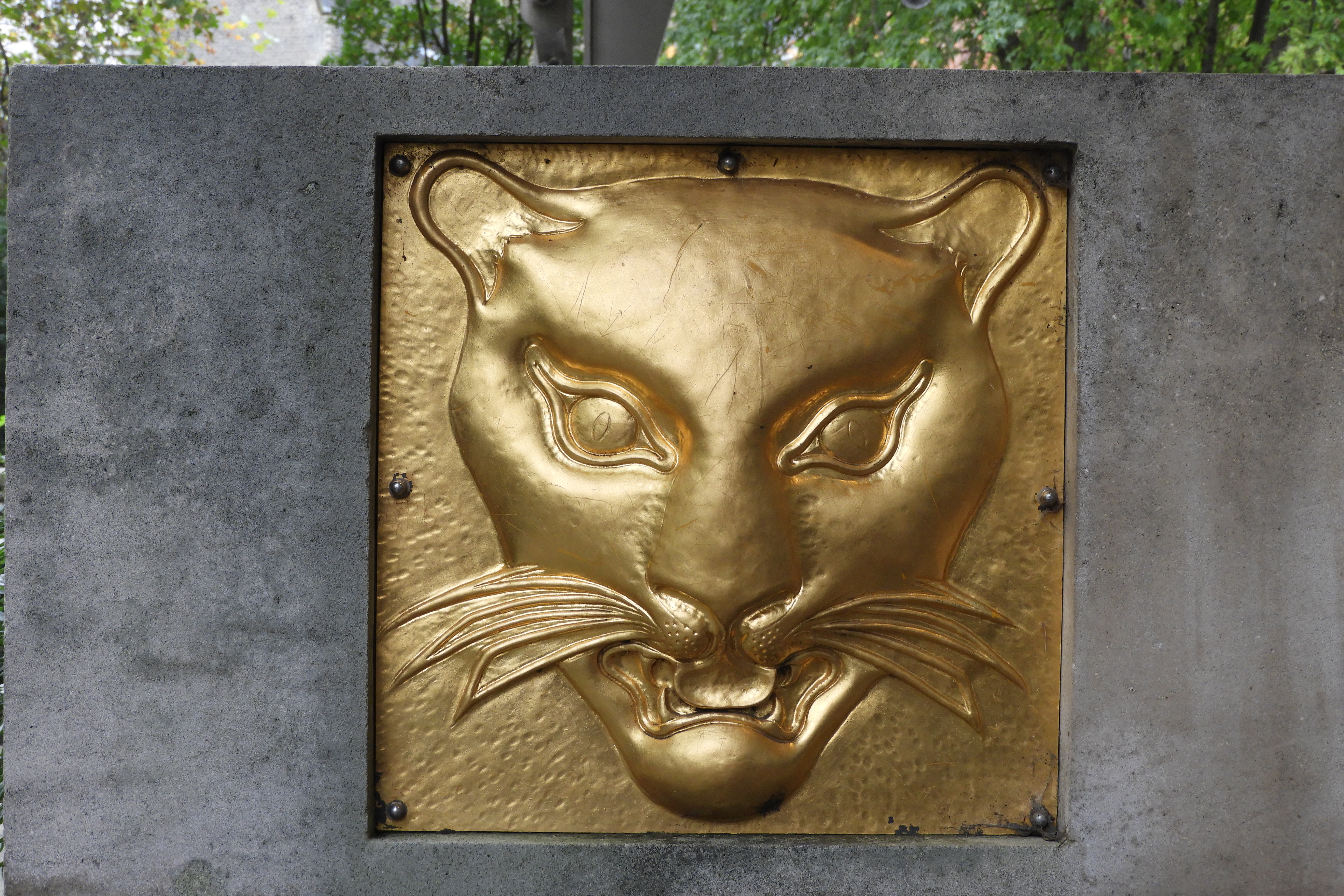
Reading this set left to right, you can decode an English piece in under a minute:
1. The town mark (assay office)
- Leopard's head — London (the original assay office, used since 1300)
- Anchor — Birmingham (since 1773)
- Crown — Sheffield (1773 to 1974; replaced by a rose in 1975)
- Castle — Edinburgh
- Three wheat sheaves with a sword — Chester (closed 1962)
2. The standard mark — the lion passant
A small lion walking left, right paw raised. This is the mark that certifies sterling silver (.925) in England. It has been used continuously since 1544.
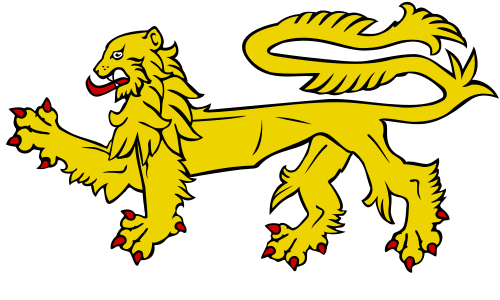
If you see a lion rampant (standing on its hind legs) instead, you are looking at a Scottish mark, not English. If the lion is looking out at you over its shoulder (lion passant guardant), the piece pre-dates 1822.
3. The date letter
A single letter inside a shield. The letter cycles through the alphabet over a 20- or 25-year period, and the shape of the shield and the style of the letter (Gothic, Roman, italic) tell you which cycle. A reference table will pinpoint the exact year — for example, a London Gothic capital "n" in a shield of a specific shape = 1888.
4. The maker's (sponsor's) mark
The silversmith's initials, usually in an oval or rectangular punch. "W&H" is Walker & Hall, "JD" with a specific shield could be one of dozens of John Davids — this is where you cross-reference a hallmark database.
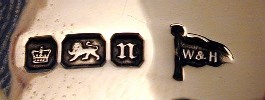
A fifth mark — a sovereign's head in profile — appears on British silver made between 1784 and 1890. It indicates the duty tax was paid. If you see Queen Victoria's head, the piece is between 1837 and 1890.
Dutch Silver — The Most Commonly Misidentified Category
This is where most people make their most expensive mistake. Dutch silver uses a lion as its standard mark — but it is not the British lion passant. Dutch lions stand upright (rampant), face the viewer, and crucially, are stamped with a numeral 1 or 2 inside the punch.
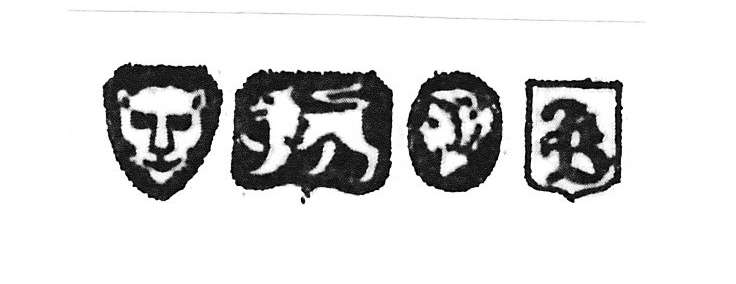
What the numerals mean:
- Lion with "1" — first standard, .934 silver (higher than sterling)
- Lion with "2" — second standard, .833 silver (lower than sterling)
- Sword (Dutch sword mark) — used 1814 onward as an alternative for small pieces and machine-made wares
- Minerva head (introduced 1953) — the modern Dutch state mark
The reason this gets misidentified: at a glance, a Dutch lion-with-numeral looks like a British lion passant. The numeral inside the shield is the tell. If you see a "1" or a "2," it is Dutch, not English. Dutch silver is generally less valuable per ounce than British sterling because the .833 standard is below sterling, and the Dutch market for antique silver is thinner than the British one. Misidentifying Dutch silver as English silver routinely doubles or triples the asking price by accident.
German, French, and Russian Marks
Germany — crescent moon and crown ("Halbmond und Krone")
After 1888, all German silver was required to carry the imperial state mark: a crescent moon next to a crown, followed by a numeric standard (most commonly 800 for .800 silver, sometimes 925 for sterling).
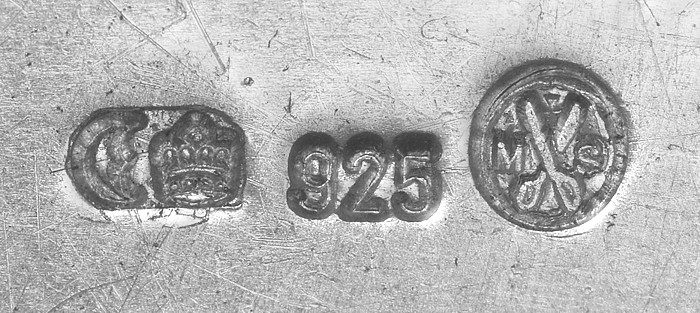
The .800 standard is the German default — lower than sterling (.925), but the most common silver content for German antiques. WMF, Koch & Bergfeld, Bruckmann & Söhne, and Wilkens are the big maker names to recognize.
France — the Minerva head
French silver is unmistakable. The state guarantee mark is the head of the goddess Minerva in profile, helmeted, facing right. There are two grades:
- Minerva head, no numeral — first standard, .950 silver (higher than British sterling)
- Minerva head with a small "2" — second standard, .800 silver
French .950 silver is the highest national standard in common use anywhere — better than English, German, or American sterling. Combined with the legacy of French silversmithing (Christofle, Puiforcat, Odiot), French Minerva-marked silver is consistently desirable. If you find a Minerva mark with no numeral, treat the piece as serious.
Russia — the kokoshnik and zolotnik standards
Russian silver is marked using the zolotnik system, not parts-per-thousand. The standard you'll see most often is 84 zolotniki = .875 silver (slightly below sterling). Other standards include 88 (.916), 91 (.947), and 96 (.999 pure).
From 1896 to 1908, Russian silver was marked with the first kokoshnik mark — a woman's head in profile, wearing the traditional Russian kokoshnik headdress, facing left. From 1908 to 1917 the kokoshnik faces right. Both are accompanied by a numeric standard (84, 88, 91, etc.) and an assay master's initials.
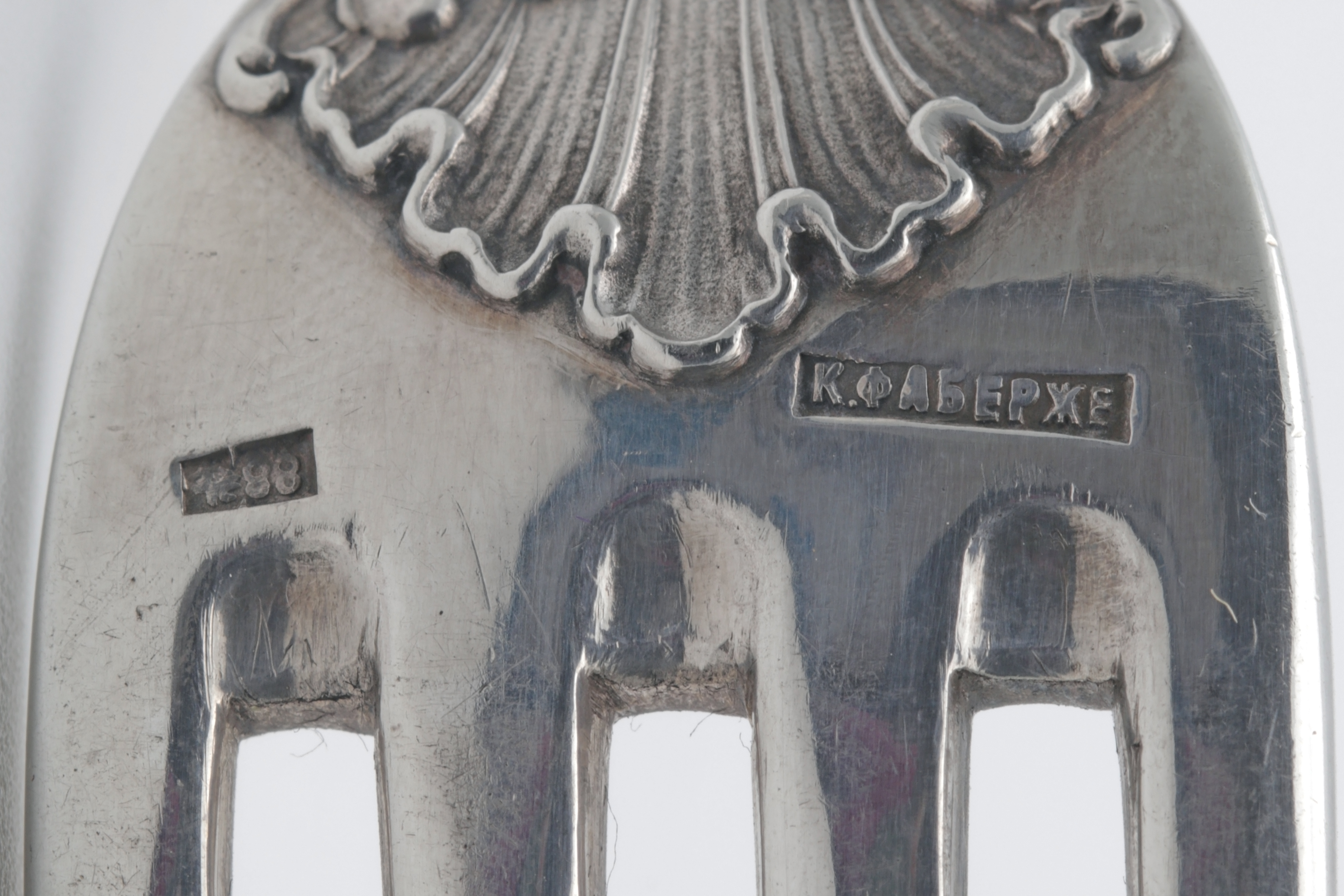
If you see Cyrillic letters in any silver mark, you are almost certainly looking at Russian (or occasionally Bulgarian) silver. The Fabergé example above shows "К.ФАБЕРЖЕ" — Cyrillic for "K. Fabergé." A Fabergé maker's mark on a confirmed-authentic piece can transform a $200 sticker into a five-figure piece. Get a second opinion before pricing or selling.
The Difference Between Sterling and Silverplate
This is the question that costs people the most money — at every estate sale, every weekend.
Sterling silver is at least 92.5% pure silver, all the way through the piece. It will carry one of the marks above: 925, STERLING, lion passant, Minerva head, etc.
Silverplate is a base metal (usually copper, brass, or "nickel silver" — which contains no silver) coated with a thin electroplated layer of silver. It is not sterling, and a 1,200-gram silverplate tea service is worth a fraction of what a 600-gram sterling tea service is worth.
How to tell them apart:
- EPNS = "Electroplated Nickel Silver" — silverplate, not sterling
- EP or EPBM ("Electroplated Britannia Metal") — silverplate
- A1, A1 Plus, Quadruple Plate — silverplate quality grades, not silver content
- "German Silver," "Nickel Silver," "Alpaca," "Argentan" — these contain zero silver, despite the name. They are nickel-copper-zinc alloys.
- "Silver soldered" — usually silverplate
- A piece marked only with a maker's name and no purity number — usually silverplate
When in doubt, weigh it. Sterling silver is heavy for its size. Silverplate over a hollow base feels light and tinny.
How to Test Silver at Home
Three quick tests anyone can run before sending a piece to a jeweler:
1. The magnet test. Silver is not magnetic. If a strong rare-earth magnet sticks to your "silver" piece, it has a steel core and is silverplate or fake. (A non-magnetic result doesn't prove silver — copper and nickel aren't magnetic either — but a positive result rules silver out.)
2. The ice test. Silver has the highest thermal conductivity of any metal. Place an ice cube on the piece. On real silver, the ice will melt visibly faster than on the same-shape steel or pewter object next to it. Useful for confirming flatware.
3. The smell test. Real silver has no odor. Silverplate over copper or brass often gives off a faint metallic "penny" smell when you breathe on it warmly.
For absolute confirmation, jewelers and pawn shops will run an acid test or use an XRF (X-ray fluorescence) gun, which gives a non-destructive read-out of exact metal content in seconds.
What to Do When You Can't Identify a Mark
Hallmark identification requires reference. There are 200+ years of date letters across multiple cycles for London alone. There are thousands of registered maker's marks. The encyclopedia at 925-1000.com is the standard reference, and Bradbury's Book of Hallmarks is the print equivalent. Both work, both take time.
The faster path: photograph the mark in good light, upload it, and let an AI trained on hallmark references identify it.
The EstateSaleFinder Analyzer accepts a close-up photo of any hallmark and identifies the country, era, standard, assay office, and (where possible) maker — usually in under 30 seconds. We built it specifically because we kept watching estate sale companies, resellers, and families sticker-price sterling silver as silverplate (or vice versa) just because they didn't have time to research.
Photo tips for the best AI read:
- Hold the camera 4–6 inches from the mark
- Use a small light source from the side to make the punches cast a shadow
- Get the entire row of marks in one frame
- A solid-color background (white paper, dark cloth) helps
FAQ
What does 925 mean on silver?
925 means 92.5% pure silver — the international numeric mark for sterling silver. The other 7.5% is usually copper, added for hardness (pure silver is too soft for everyday use). The mark "925," "Ag 925," "S925," and the word "STERLING" all mean the same thing. It is the modern global standard, used by jewelers and silversmiths worldwide. A 925 mark on its own does not tell you the country of origin — for that, look for accompanying maker marks or assay marks.
How do I know if my silver is real?
The fastest at-home checks: (1) look for a hallmark — 925, STERLING, lion passant, Minerva, crescent-and-crown, or a numeric standard like 800 or 950; (2) test with a strong magnet — silver isn't magnetic; (3) rub gently with a soft white cloth — real silver leaves a faint black mark from oxidation, silverplate doesn't. For absolute certainty, any jeweler with an XRF gun can confirm exact silver content non-destructively in seconds. Pieces marked only with EPNS, EP, A1, "Quadruple Plate," "German Silver," or "Nickel Silver" are not sterling silver.
What is a lion passant?
A lion passant is a heraldic symbol — a lion shown walking, with three paws on the ground and one (the right forepaw) raised. On British silver, the lion passant is the standard mark certifying sterling silver (.925), used continuously since 1544. It always faces left in profile. A lion passant guardant (looking at the viewer over its shoulder) was used before 1822; a plain lion passant has been used ever since. Do not confuse the British lion passant with the Dutch lion rampant (standing on hind legs), which is stamped with a numeric "1" or "2" inside the punch and indicates Dutch silver, not English.
If you remember nothing else from this guide: turn the piece over, find the marks, and read them left to right. The standard mark tells you the silver content. The town mark tells you where. The date letter tells you when. The maker's mark tells you who. Four answers in 1 centimeter of stamped metal.
Upload a photo of your hallmark and let AI identify it for you →
Keep exploring
Ready to start your own treasure hunt?
Discover estate sales near you and find incredible deals.
Explore Sales Near Me
About the author
Andy
Founder, EstateSaleFinder.net
Hi, I'm Andy — a retired commercial photographer turned developer with a five-year (and counting) obsession with estate sales. I started EstateSaleFinder.net because I knew there had to be an easier, smarter way to find and list estate sales. Now I get to chase treasure and build the tool I always wished existed.