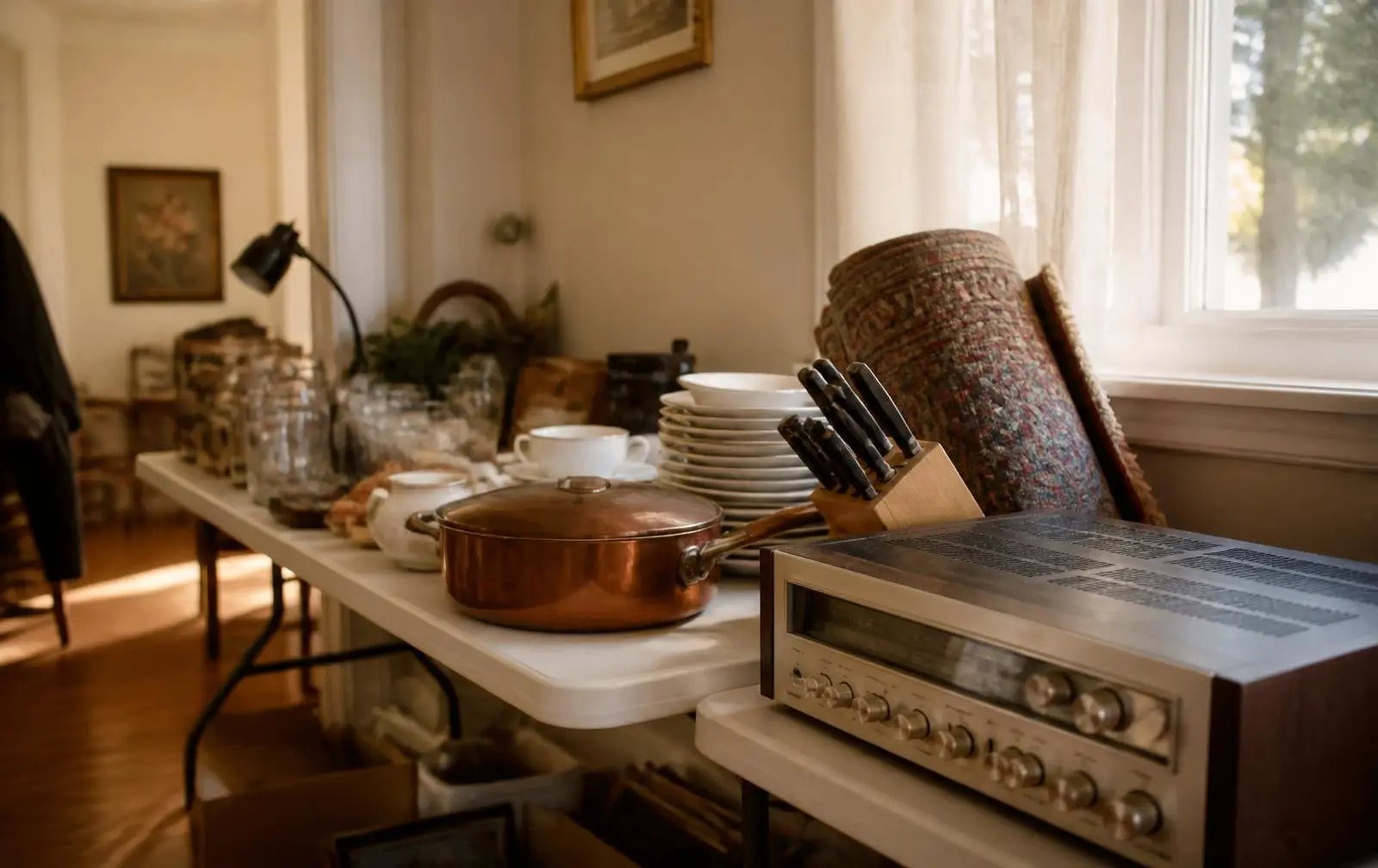

How to Use Ai to Price Estate Sale Finds in 5 Seconds (Stop Overpaying, Stop Underselling)
I once stood in a stranger's driveway, snapped a photo of a teacup, and walked away $340 richer. Here's exactly how Ai pricing works at estate sales — and why the buyers who've figured it out aren't telling anyone.
It was a Tuesday morning in May. I was standing in a stranger's driveway in suburban Maryland, holding a teacup. White porcelain, hand-painted blue flowers, a small chip on the rim. The sticker said $6.
The man running the sale was watching me like I was either a serious buyer or a thief — he hadn't decided yet. I pulled out my phone, snapped a photo of the teacup, and tapped twice. Five seconds later my screen told me it was 1890s Meissen, that the chip dropped the value but didn't kill it, and that completed sales for similar pieces in similar condition averaged $346.
I paid the six dollars. I tried very hard not to walk back to my car too fast.
That moment — that five second moment — is what this whole post is about.
What Ai Pricing Actually Is (Without the Marketing Fluff)
Let's strip out the buzzwords. Ai pricing for resale items works like this:
You point your phone at a thing. The Ai does three things, very fast: 1. Identifies what the object is (porcelain teacup, brand of camera, type of pottery) 2. Estimates the era and maker based on visual cues — shape, glaze, marks, materials 3. Pulls comparable recent sales from real marketplaces (eBay sold listings, primarily) to give you a realistic price range
That's it. No magic. Just very fast pattern-matching trained on millions of resale listings, plus live access to what stuff is actually selling for right now.
The reason this matters: until about two years ago, this exact workflow took an experienced antique dealer 20 minutes per item, often with reference books. Now it takes five seconds. The information gap that made dealers wealthy for fifty years just collapsed.
You're early to it. Most people at estate sales still aren't using this. Use that to your advantage.
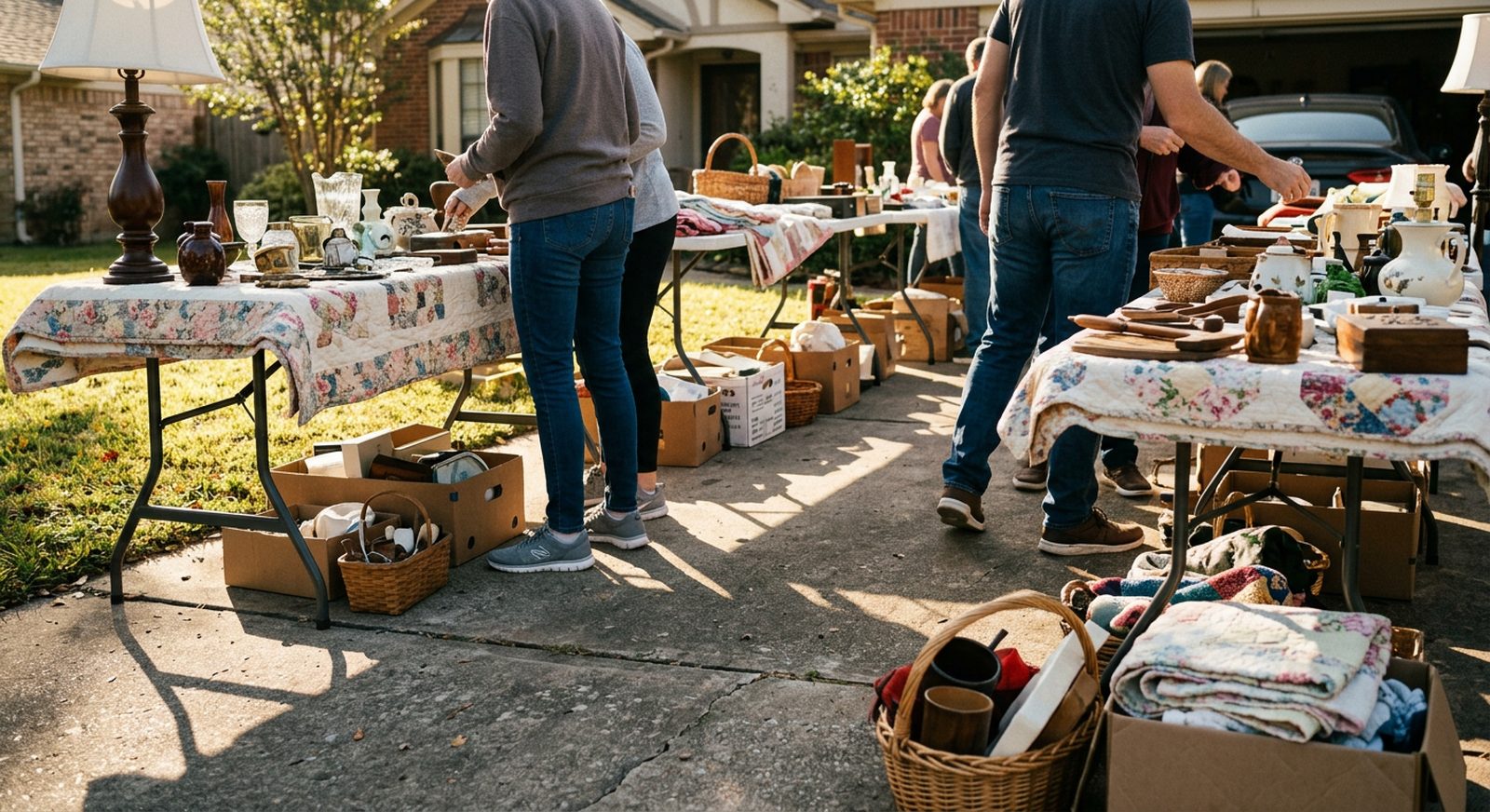
The "Should I Buy This?" Workflow (Use This At Every Sale)
Here is exactly what I do at every estate sale now, in order:
Step 1: Walk the perimeter, eyes only.
No phone. No buying. Just looking. Scan for density anomalies — anything that looks heavier, older, or weirder than its neighbors. Mid-century lamps next to plastic ones. A single piece of cast iron in a sea of nonstick. Costume jewelry mixed in with a kid's bracelet box.
Step 2: Pick up anything interesting. Flip it over.
You're not committing to anything. You're just inspecting. Look for stamps, signatures, country of origin, model numbers.
Step 3: Photograph it.
Get one photo of the whole item, one of the bottom/mark, one of any damage. Three photos, ten seconds.
Step 4: Run it through an Ai pricing tool.
This is where the magic happens. A good appraisal tool will give you:
- A best-guess identification
- Estimated retail / resale value range
- Recent comparable sales
Total time per item: about 30 seconds, including photos.
Step 5: Make the math decision.
- Asking price < 30% of low estimate? Buy it immediately.
- Asking price 30–60% of low estimate? Buy it if you have room.
- Asking price > 60% of low estimate? Pass. No margin.
That's the whole game. Reduced to a checklist your phone helps you run.

What Ai Is Actually Good At (And What It Still Can't Do)
I want to be honest with you, because some of this stuff gets oversold.
Ai is excellent at:
- Identifying common-but-valuable categories (Pyrex, McCoy, cast iron, costume jewelry brands, mid-century furniture)
- Pulling up comparable recent sale prices from major marketplaces
- Giving you a realistic price range (not a single number — anyone promising a single number is lying)
- Spotting fakes vs. authentic when there are clear visual cues
- Saving you from overpaying on stuff you'd otherwise impulse-buy
Ai is still imperfect at:
- Authenticating ultra-high-end items ($5K+ — get a human for those)
- Reading some hand-painted or worn marks (still try, but don't bet your house)
- Distinguishing a $200 Roseville from a $2,000 rare-form Roseville (that's a specialist's job)
- Anything where condition assessment requires touch (true fabric quality, structural soundness of furniture)
The rule of thumb: Ai pricing is a flashlight, not an x-ray. It illuminates a lot of things you'd otherwise miss. It does not see through walls.
Three Real-World Examples From Last Month
I went back through my own estate sale photos from March 2026 to pull three actual examples. Here's what Ai pricing told me, what I paid, and what happened.
Example 1: The "ugly" lamp. Big brass mid-century lamp with a weird cylindrical shade. Asking price: $25. Ai identified it as a 1965 Stiffel design. Comparable sales: $180–$320. I paid $25, sold it on Facebook Marketplace in three days for $240.
Example 2: The mystery vase. Squat green ceramic vase, no obvious mark. Asking price: $8. Ai flagged it as possibly McCoy, but with low confidence. Comparable McCoy sales: $80–150. I paid $8, flipped it, found a faint MCCOY USA stamp, sold for $95.
Example 3: The disappointment. Beautiful old camera, looked German, looked expensive. Asking price: $80. Ai identified it as a 1970s East German consumer model with a small collector market. Comparable sales: $40–90. I did not buy it. The Ai literally saved me $80.
That last one matters. Most people overrate the wins and underrate the losses they avoided. Ai pricing prevents bad buys at least as often as it finds great ones.

The Etiquette Question (Because You're Going to Wonder)
People ask me this all the time: "Is it rude to pull out your phone and look up prices in front of the seller?"
Short answer: no, but be smart about it.
Long answer: estate sale companies expect this now. Resellers have been doing it with eBay searches since 2010. What's changed is the speed — five seconds instead of two minutes. Sellers used to know you were checking. Now they often don't.
A few rules of thumb:
- Don't be obvious about it at the table. Walk a few steps away or turn slightly.
- Don't haggle using your Ai estimate. ("But the Ai says it's only worth $40!" makes you look like an idiot, and the seller knows the Ai doesn't account for everything.)
- Don't broadcast your wins. Pay calmly, leave calmly, celebrate in your car.
- At a private/family-run sale (someone's actual mom's stuff), be especially gracious. This isn't a game to them.
The dealers and pros use Ai quietly. So should you.
Building a Wishlist (The Move That 10x's Your Hit Rate)
Here's the next-level move most people skip: don't just price stuff in the moment. Tell the Ai what you're looking for in advance.
If you build a wishlist of items you want — say, "vintage Pyrex," "Stiffel lamps," "Singer Featherweight sewing machines" — you can get notified the moment those items show up at sales near you. You stop hunting in the dark and start hunting with a flashlight. ...
- Bookmark a smart appraisal tool on your phone's home screen
- Set up a wishlist of items you want to be alerted about
- Browse upcoming sales for the weekend and pick 3 to hit
- Charge your phone (sounds dumb, but I've left a sale empty-handed because my battery died at 8% on the third item)
- Bring cash. Bring a tote bag. Bring a flashlight for inspecting marks.
That's it. You're now operating at a level that, two years ago, only working dealers had access to.
Final Thought: Don't Tell Everyone
Look. The reason this still works is that most buyers at estate sales aren't doing it. The information gap is real and it's wide. The dealers who figured this out first are quietly making real money.
You're early. Stay early. Use the tools. Be quiet about it. Have fun.
And if you find something incredible, save the details to your own notes so you recognize the pattern next time.
Try It on Your Next Find
The fastest way to learn this is to do it. Open the smart appraisal tool, point it at literally anything in your house — a mug, a lamp, a watch — and see what comes back. Then take it to a sale Saturday morning.
You'll never browse the same way again.
Keep Reading
If you missed it, the post that pairs with this one is the field guide to what to look for. Twenty specific item types that turn up at estate sales constantly and routinely sell for $500+. Read both, and you've got the complete kit.
20 Things at Estate Sales That Are Secretly Worth $500+ →
Happy hunting.
Keep exploring
Ready to start your own treasure hunt?
Discover estate sales near you and find incredible deals.
Explore Sales Near Me
About the author
Andy
Founder, EstateSaleFinder.net
Hi, I'm Andy — a retired commercial photographer turned developer with a five-year (and counting) obsession with estate sales. I started EstateSaleFinder.net because I knew there had to be an easier, smarter way to find and list estate sales. Now I get to chase treasure and build the tool I always wished existed.