20 Things at Estate Sales That Are Secretly Worth $500+ (And How to Spot Them in Under 10 Seconds)
A $4 turquoise Pyrex bowl paid my friend's mortgage that month. A $12 cast iron pan turned out to be a $480 Griswold. Here are the 20 items you're walking past every Saturday — and exactly how to spot them.
My friend Alana paid her mortgage one month with a mixing bowl.
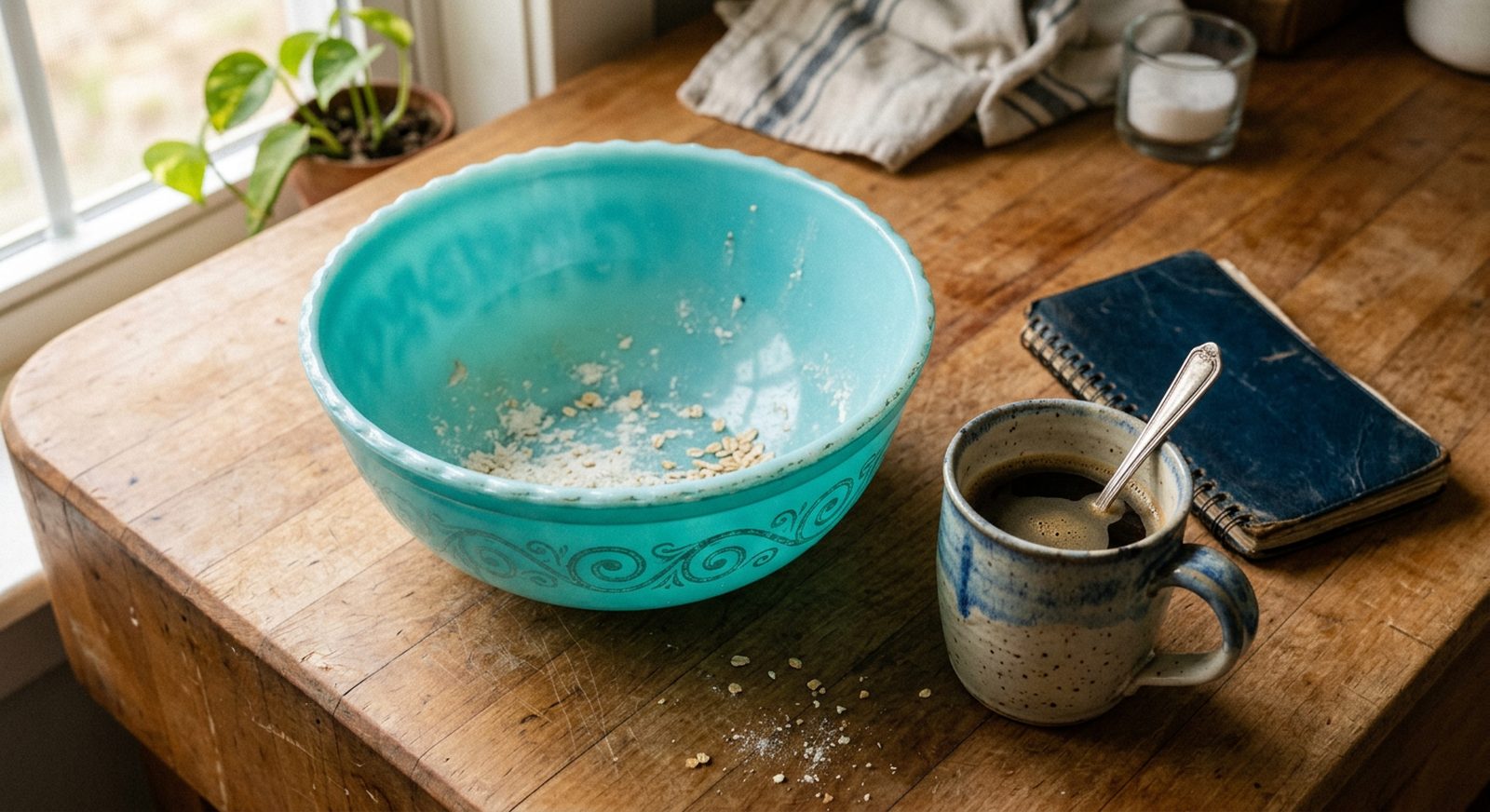
She bought it for four dollars at an estate sale in Ohio. It was turquoise, mid-century, and sitting on a card table next to a stack of TV trays. She thought it would look cute on her shelf. She also thought it might be worth something. She was right. It was a 1957 Pyrex "Amish Butterprint" cinderella bowl in a discontinued color, and a collector in Pennsylvania paid her $1,840 for it within 48 hours.
Four bucks to one thousand eight hundred and forty bucks.
I asked her how she knew. She shrugged and said, "It just looked older than it should."
That's the whole game. After you read this, you'll start "just looking older than it should" too.
The 10-Second Test (Use This Before You Read Anything Else)
Before I give you the list, here's the framework. At any estate sale, every item gets one quick scan against three questions:
- Does it weigh more than it looks like it should? (Old stuff is denser. Real wood, real metal, real glass. Modern stuff is hollow, light, plasticky.)
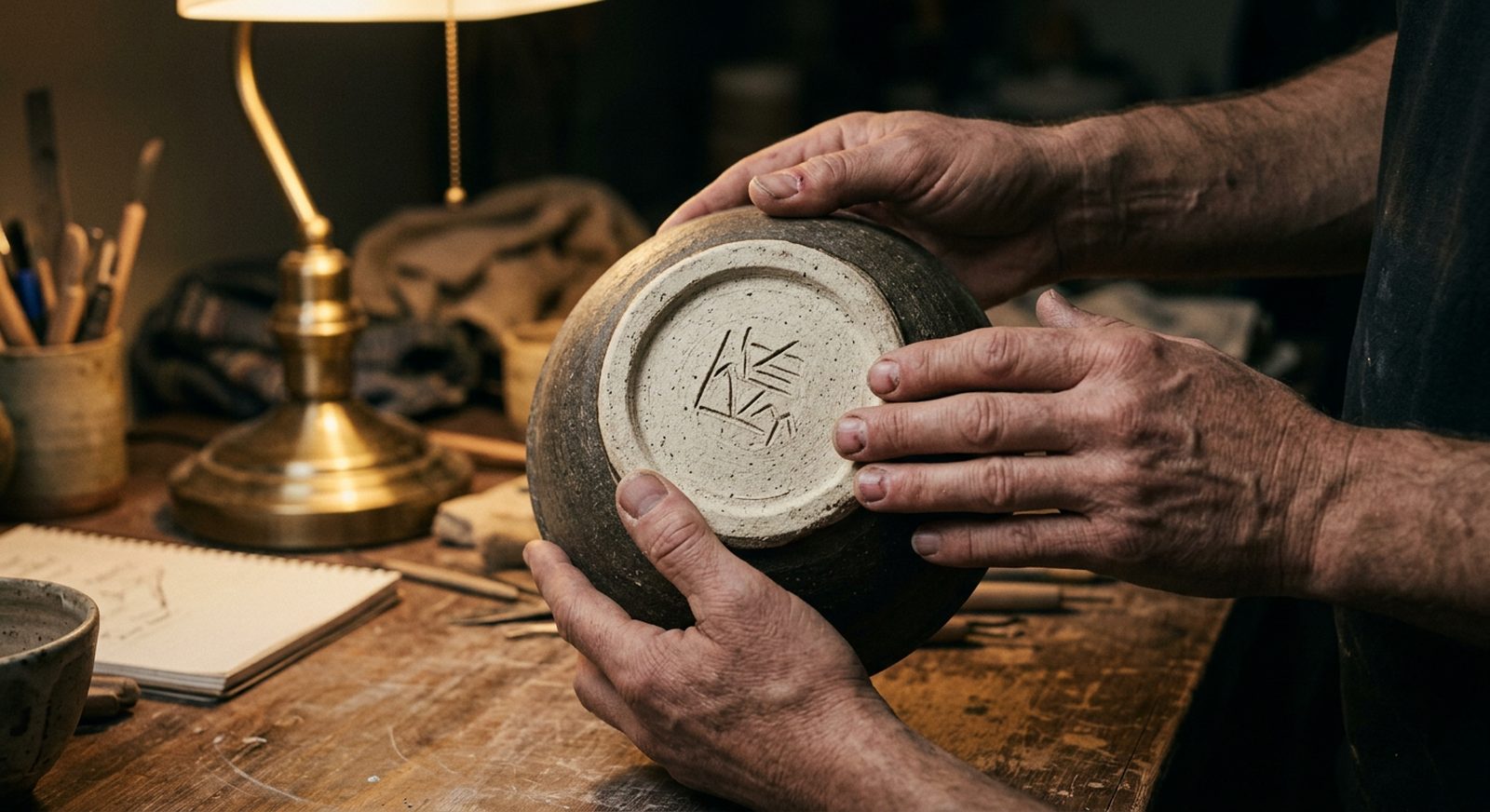
- Is there a maker's mark, stamp, or signature on the bottom? (Flip it. Always flip it.)
- Would it look at home in a 1965 photograph? (If yes, it's probably worth more than $20. Sometimes a lot more.)
That's it. Three questions. Ten seconds. Now let's go shopping.
The 20 (In Roughly Descending Order of "Holy Crap" Potential)
1. Vintage Pyrex (Especially Turquoise, Pink, or Promotional Patterns)
Spot it: Pastel color, opaque (not clear) glass, "PYREX" stamped on the bottom in block letters. Worth: Common pieces $30–80. Rare patterns (Lucky in Love, Gooseberry pink, Atomic Eyes) $400–$2,000+. Pro tip: The "cinderella" bowls (with handle/spout shape) command higher premiums.
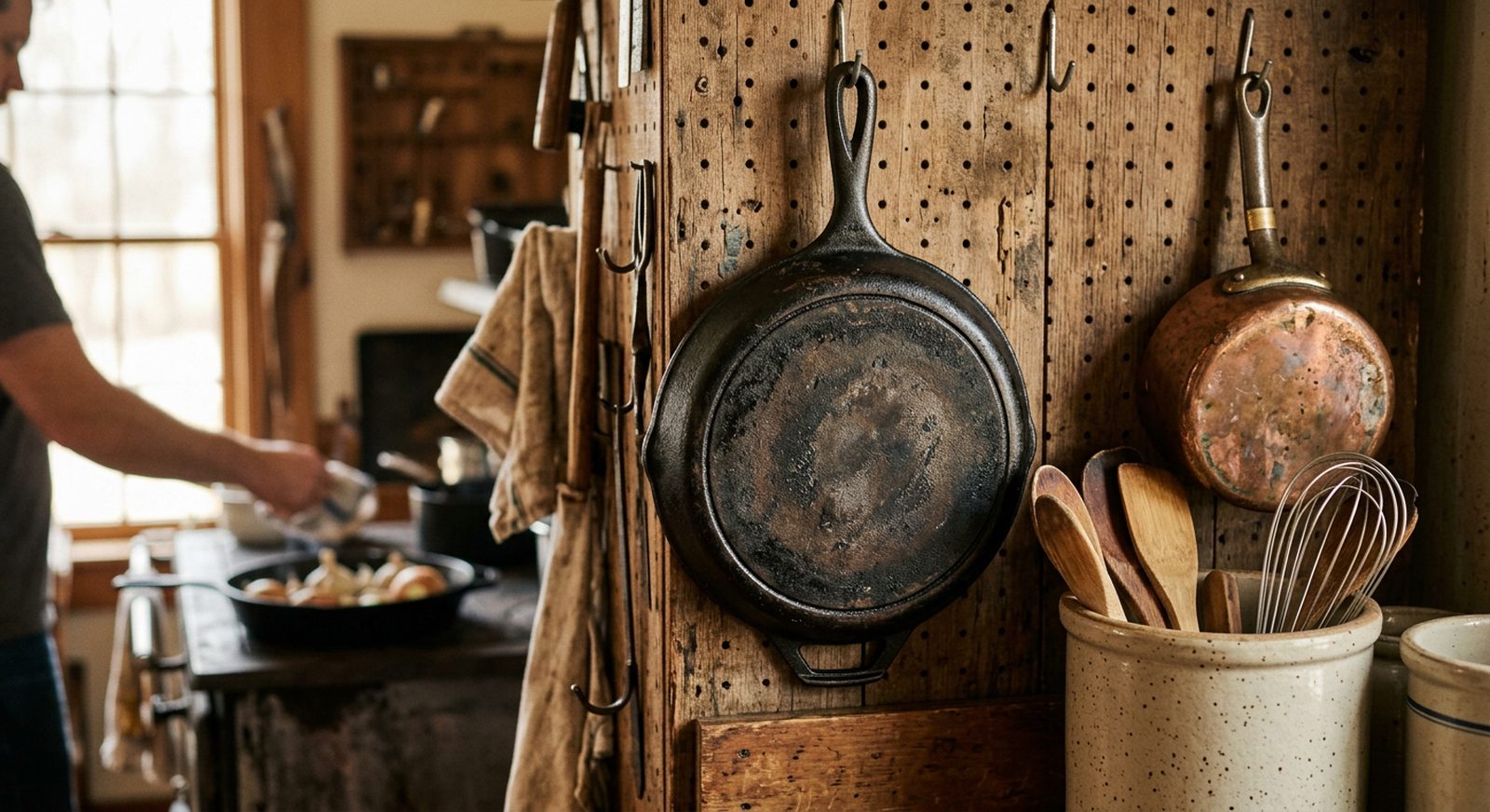
2. Cast Iron Cookware (Pre-1960)
Spot it: Smooth (not pebbly) cooking surface. Lighter than modern cast iron. A logo on the bottom — Griswold, Wagner, Wapak, Favorite Piqua. Worth: Modern Lodge: $20. Vintage Griswold #8: $150–$500. Rare sizes: thousands. Pro tip: Flip it and look at the heat ring on the bottom. A perfect, smooth ring almost always means pre-WWII.
3. Mid-Century Modern Furniture
Spot it: Tapered legs, teak or walnut wood, simple geometric forms, no fussy ornamentation. Brand stamps on the underside (Drexel, Lane, Heywood-Wakefield, Knoll). Worth: A "boring brown chair" can be a $1,200 Eames-style accent. A teak credenza? $800–$3,000.
4. Costume Jewelry (Real Brands, Not "Looks Old")
Spot it: Heavier than you'd expect. Marked on the back: Trifari, Coro, Eisenberg, Hobé, Weiss, Miriam Haskell. Worth: Marked Trifari brooches $40–300. Eisenberg figurals $200–$1,500. Pro tip: A drawer of "junk jewelry" is rarely junk. Always ask the price on the whole drawer — sometimes you can buy it all for $20.
5. Vintage Tools (Especially Pre-1980 Craftsman, Stanley, Snap-On)
Spot it: Heavy, with the brand stamped or etched into the metal. "Made in USA" is the magic phrase. Worth: A vintage Stanley plane: $80–400. Old Craftsman socket sets: $150–600. Vintage Snap-On wrenches go borderline criminal.
6. Sterling Silver Flatware
Spot it: Marked "STERLING" or "925" on the underside of every piece. Heavier than plate. Tarnishes black, not green. Worth: Even broken-up sets sell by weight at $20–30/oz. A full place setting can be $400–$1,200. Pro tip: If a flatware set looks "too perfect" and feels light, it's probably silver-plate. Skip.
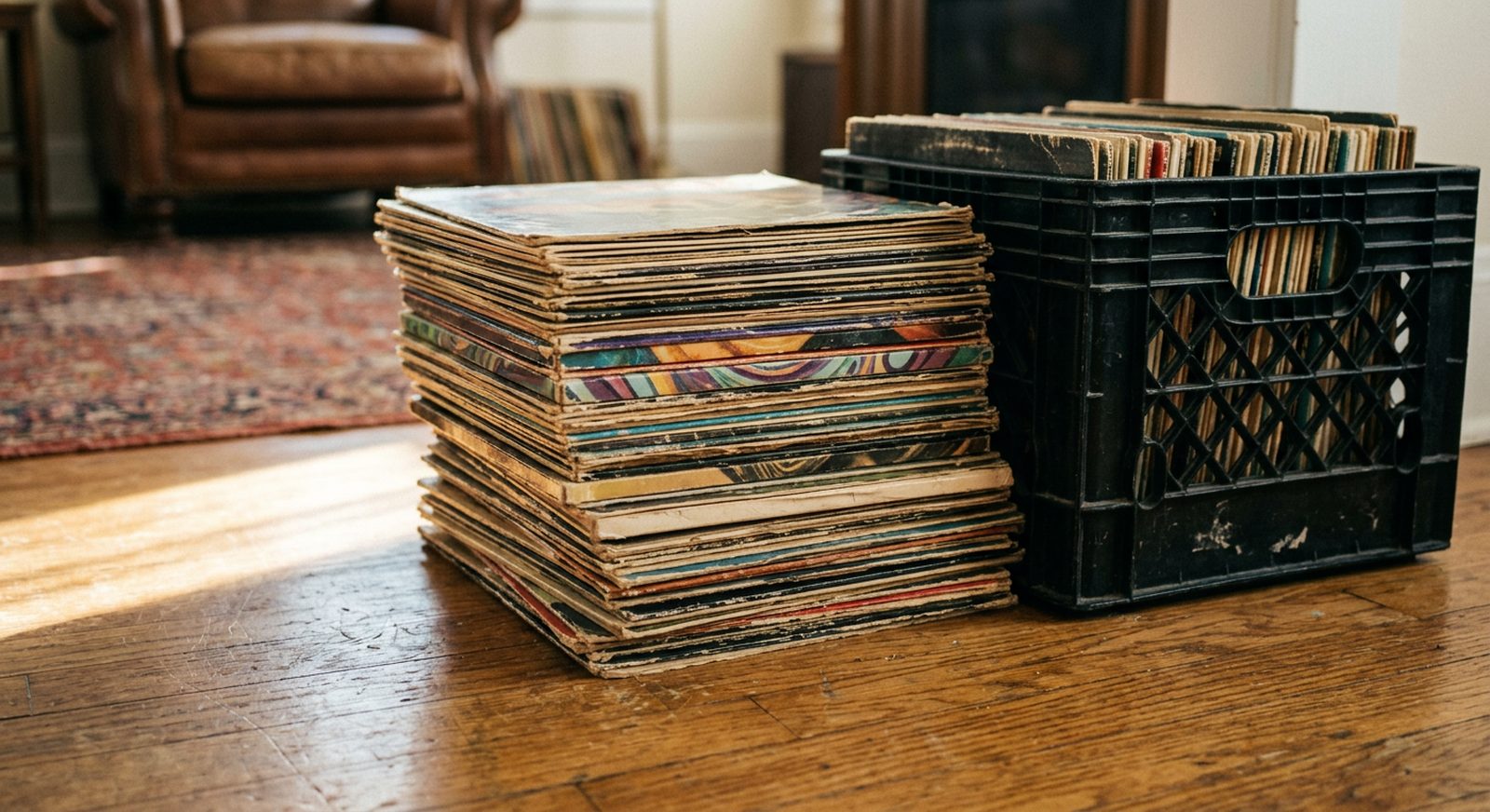
7. Old Vinyl Records (Specific Genres)
Spot it: First-pressings of jazz (Blue Note label), early rock, specific punk (Misfits), reggae, and obscure private-press funk. Worth: Mainstream classics $5–20. First-press jazz/punk/funk: $200–$5,000+. Pro tip: Look at the runout groove — the etching near the label. That's where pressing info hides.
8. Vintage Cameras (Leica, Hasselblad, Rolleiflex)
Spot it: Heavy metal body. German or Swedish names on the lens. Worth: Leica M3 bodies: $800–$2,500. Hasselblad 500 series: $1,000–$3,000. Pro tip: Even a "broken" Leica is worth $300+ for parts. Don't pass.
9. Wristwatches (Mechanical, Especially Swiss)
Spot it: No battery. Crown winds smoothly. Brand names: Omega, Longines, Hamilton, Bulova, Seiko (yes, Seiko). Worth: A vintage Omega Seamaster: $600–$3,000. Hamilton dress watches: $200–700. Pro tip: Hold it to your ear. Ticking = mechanical = worth flipping over.
10. Pottery — McCoy, Roseville, Hull, Weller
Spot it: Matte glazes in earthy colors. Marked with the maker name and a number on the bottom. Worth: McCoy planters $30–150. Roseville vases $200–$1,500. Rare Roseville: $5,000+.
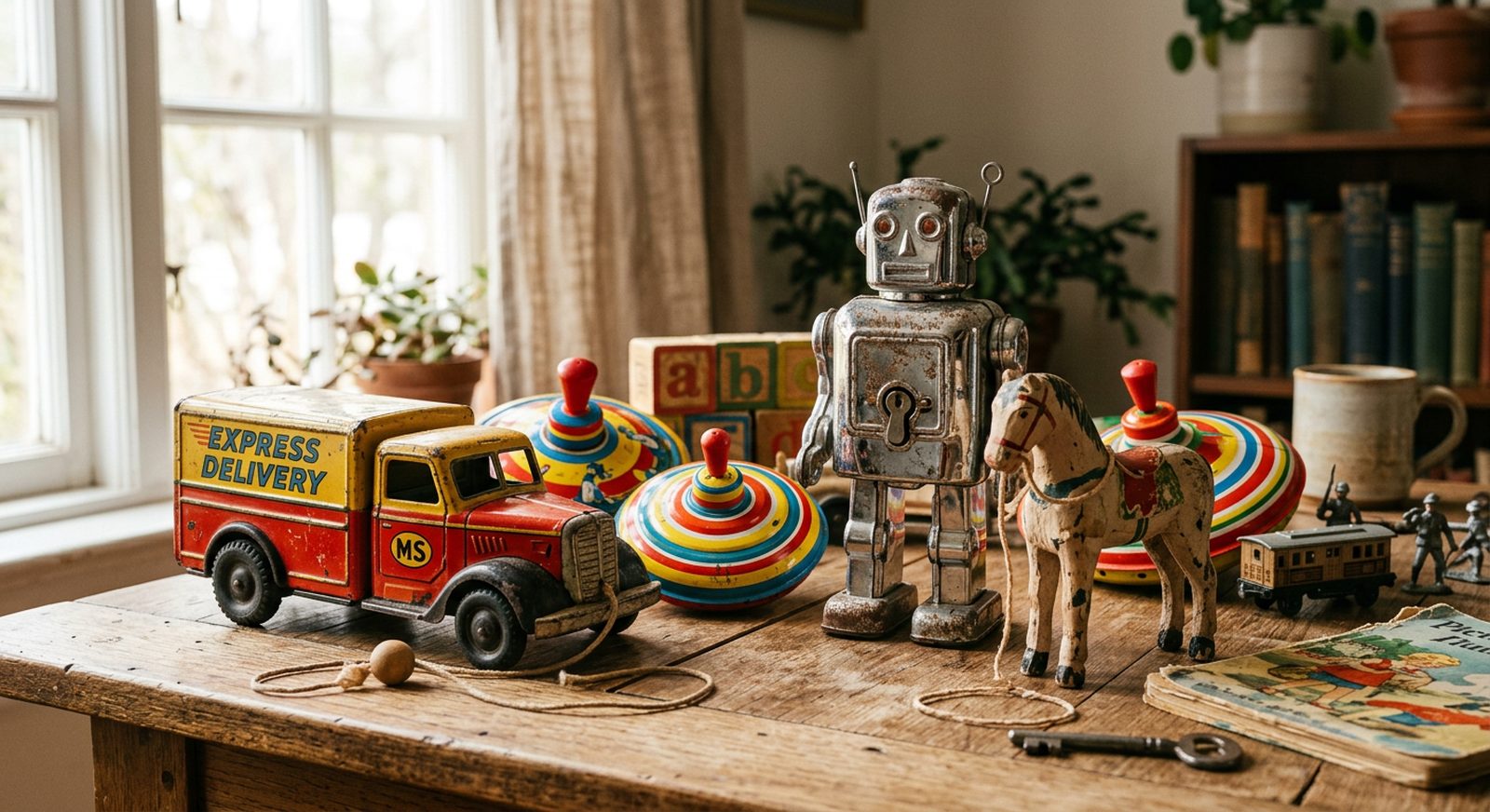
11. Vintage Toys (Original Boxes Especially)
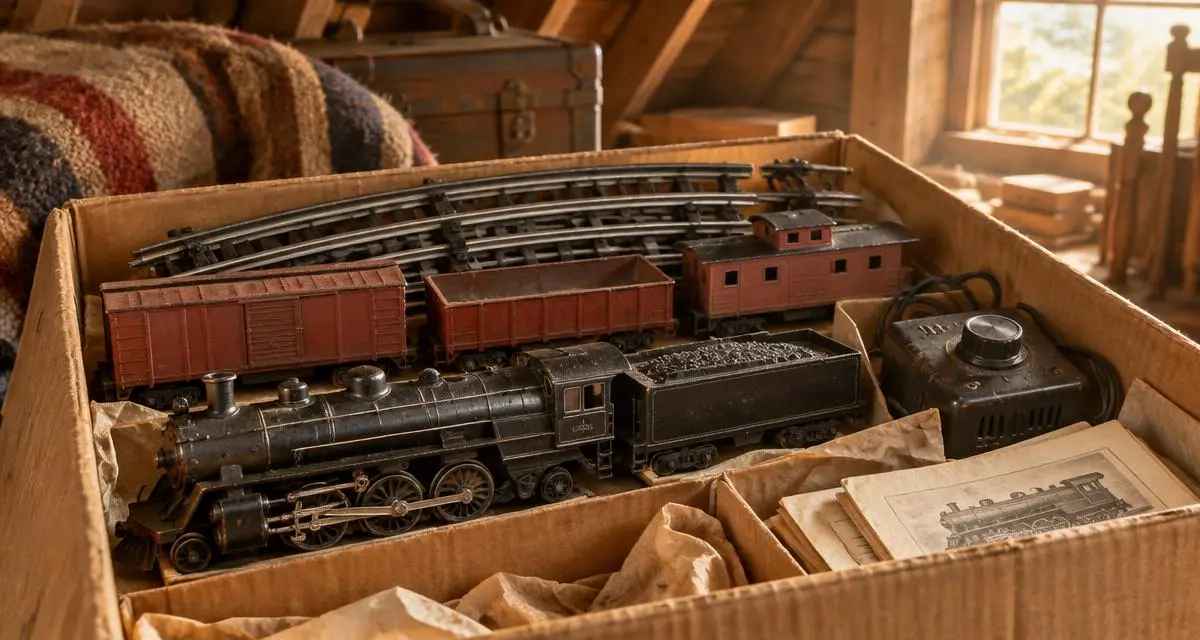
Spot it: Pre-1985 metal or plastic toys. Star Wars (any), GI Joe, Barbie, He-Man, Transformers. Original packaging multiplies value 5–20x. Worth: Loose Star Wars figure: $5–50. Boxed: $100–$3,000.
12. Cast Iron Cookware Lids
Yes, separately. Original lids for old Griswold/Wagner pieces are more valuable than the pans themselves sometimes. A matched lid alone can be $80–$300.
13. Vintage Linens (Hand-Embroidered)
Spot it: Hand-stitching (not machine — look at the back). Tablecloths, runners, hand-embroidered pillowcases. Worth: Most $10–40. Rare patterns or perfect condition $100–400. A pile of "old napkins" is sometimes a $300 pile.
14. Fountain Pens (Pre-1970)
Spot it: Heavy. Often marbled or jeweled finish. Names: Parker 51, Sheaffer Snorkel, Montblanc, Waterman. Worth: Parker 51: $80–400. Vintage Montblanc: $400–$3,000.
15. Mid-Century Lamps
Especially anything brass, ceramic, or "atomic" shaped. Stiffel, Laurel, Maurizio Tempestini designs. Often $80 marked, $400 retail.
16. Old Quilts (Hand-Stitched, Pre-1950)
Spot it: Hand-stitching (tiny, slightly imperfect). Calico or feed-sack fabrics. Faded but intact. Worth: Common patterns: $80–250. Rare or signed: $500–$3,000.
17. Original Art (Even by Unknown Artists)
Spot it
Real brush strokes (not printed dots when you look up close). Signed. Even modest oil paintings by unknown regional artists sell for $200+.
18. Vintage Christmas Ornaments
Spot it: Mercury glass, Shiny Brite boxes, German hand-blown figurals. Worth: Boxed Shiny Brite sets: $40–200. Pre-WWII German glass: $100–600 for one ornament.
19. Sewing Machines (Specific Models)
Singer Featherweight 221: looks like a tiny black machine. Sells for $300–800 all day long. Heavier vintage Singers in cabinets: usually $50–150.
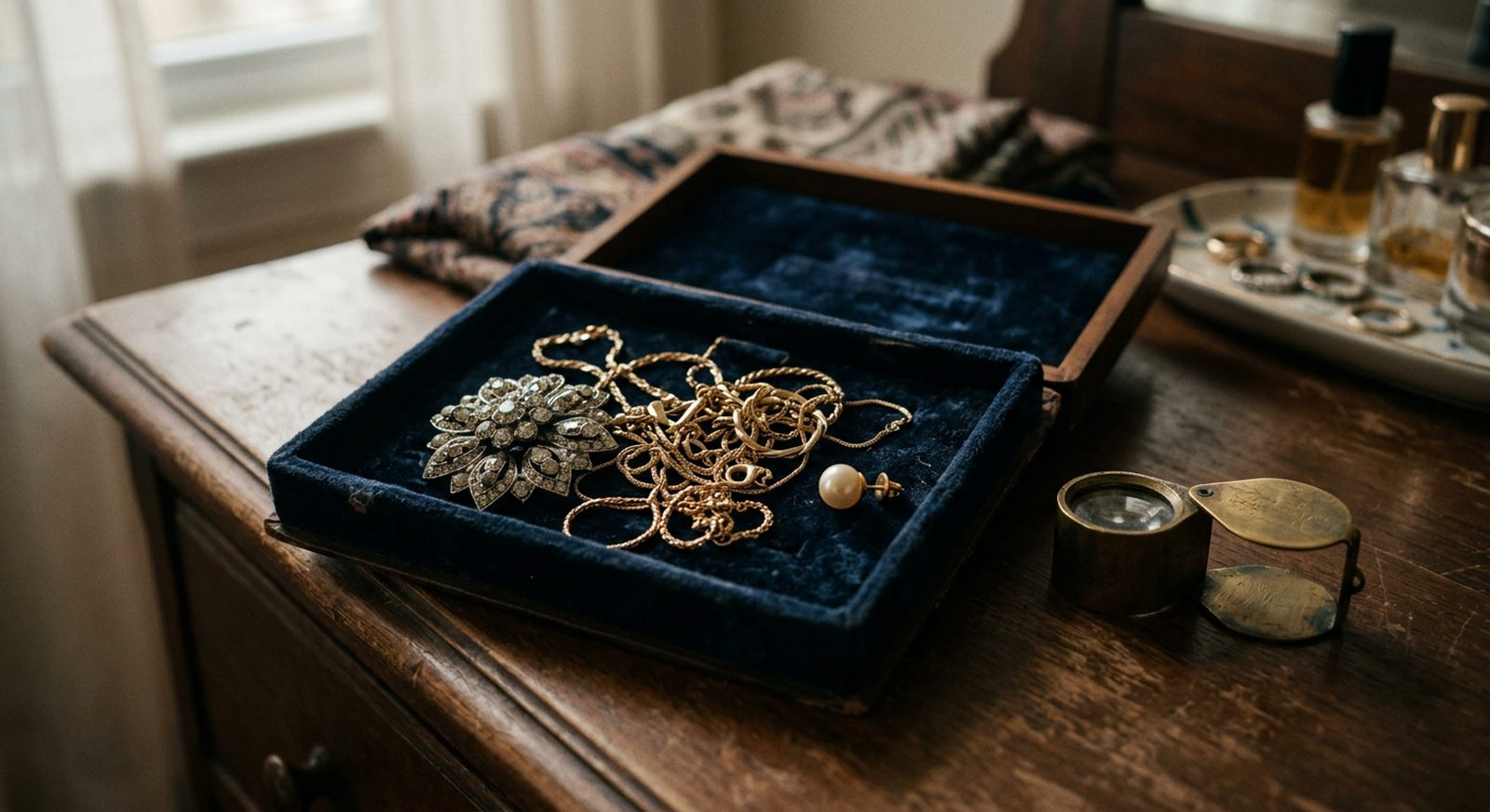
20. The "Junk Drawer" Itself
I'm serious. Old keys, military pins, foreign coins, costume rings, ticket stubs, matchbooks. Resellers will buy entire junk drawers for $30–100 sight unseen, and the contents often resell for 5–10x that on eBay.
If a sale has a "$5 to fill a bag" table, fill the bag. Sort it at home.
How to Actually Spot This Stuff in Real Time
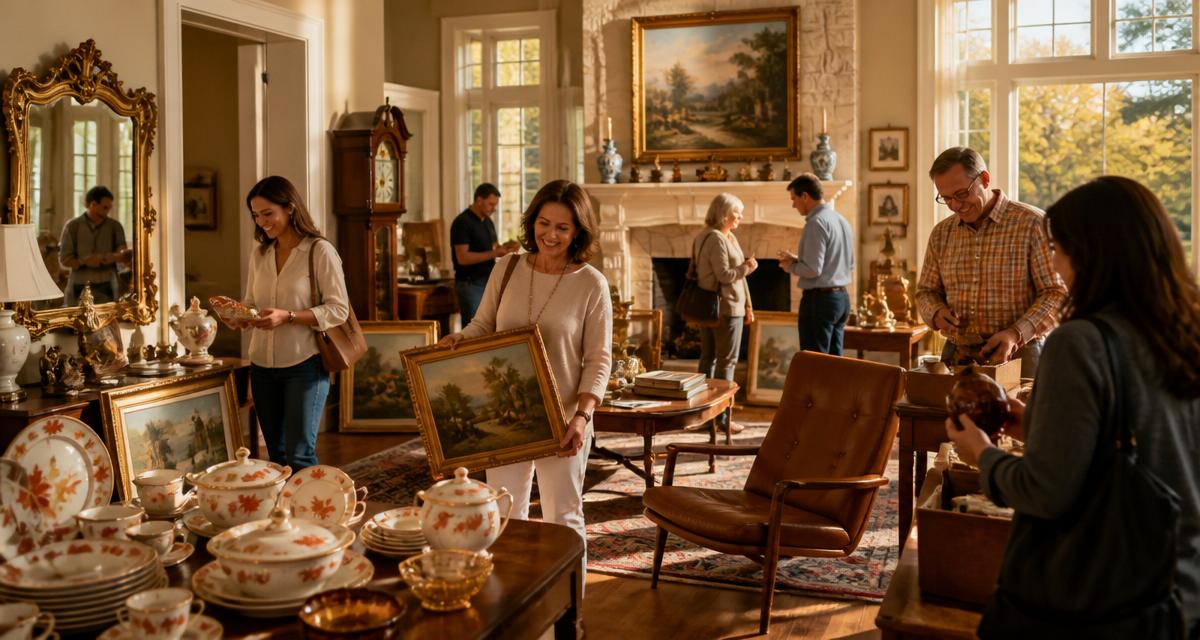
Reading a list is one thing. Standing in a stranger's garage at 7:43 AM with eight competing buyers behind you is another.
Here's the rhythm:
Walk the perimeter first. Don't dive into the busiest table. Scan corners, floors, the underside of tables. The good stuff is usually mispriced because the company didn't recognize it — and it's hidden.
Pick up everything that's heavy. Density is the single best signal. If you grab something expecting plastic and your wrist drops, slow down.
Flip everything over. Marks live on the bottom. I've found Roseville pottery on a "miscellaneous vase" table because nobody bothered to flip it.
When in doubt, snap a photo. This is where modern technology becomes your unfair advantage. There are now Ai tools that can identify and price an item from a single photo in about 5 seconds. You don't need to memorize every maker's mark anymore. You just need to be the person who checks.
The Mindset Shift That Changes Everything
Here's the thing nobody tells beginners: most estate sale items are priced by tired humans on a Friday afternoon, looking at a houseful of stuff they don't understand. They guess. They underprice the weird stuff because it looks weird. They overprice the obvious stuff because it looks obvious.
This is not a flaw in the system. This is the system. And it means that on any given Saturday, somewhere in your zip code, someone is selling a $400 piece of pottery for $8 because they don't know.
You don't have to be an expert. You just have to be curious. Pick stuff up. Flip it over. Take photos. Ask "is this older than it should be?"
Do this fifty times and you'll start finding things. Do it five hundred times and you'll start finding things every single weekend.
Learn From What You Find
If you do find something amazing — and you will — run it through the free Ai Photo Appraiser. Comparing the estimate, comps, and item details is one of the fastest ways to train your eye.
Plus, a $4 Pyrex bowl that turns out to be worth $1,800 deserves an audience. Don't be shy.
Ready to Start Hunting?
Estate sales are happening near you this weekend. Right now. Some of them have a Roseville vase on a folding table for $12.
Bring a tape measure, a flashlight (for inspecting marks), cash, and the patience to flip everything over. New to this? Start with our Beginner's Guide or sharpen up with the full Buyer's Guide.
Keep Reading
You don't have to memorize all 20 of these. The pros don't either. They use a much faster trick: Ai-powered pricing in their pocket. The next post breaks down exactly how it works — and why it's quietly turning hobbyist buyers into part-time pros.
How to Use Ai to Price Estate Sale Finds in 5 Seconds (Stop Overpaying, Stop Underselling) →
This is the post that levels the playing field. Don't skip it.
Keep exploring
Ready to start your own treasure hunt?
Discover estate sales near you and find incredible deals.
Explore Sales Near Me
About the author
Andy
Founder, EstateSaleFinder.net
Hi, I'm Andy — a retired commercial photographer turned developer with a five-year (and counting) obsession with estate sales. I started EstateSaleFinder.net because I knew there had to be an easier, smarter way to find and list estate sales. Now I get to chase treasure and build the tool I always wished existed.