
How to Clean Out a Parent's House After Death (Without Losing Your Mind or Your Memories)
Nobody warns you about the shoebox. The one with every birthday card you ever made, kept for forty years. This is the guide I wish someone had handed me — practical, gentle, and honest about how hard it gets.
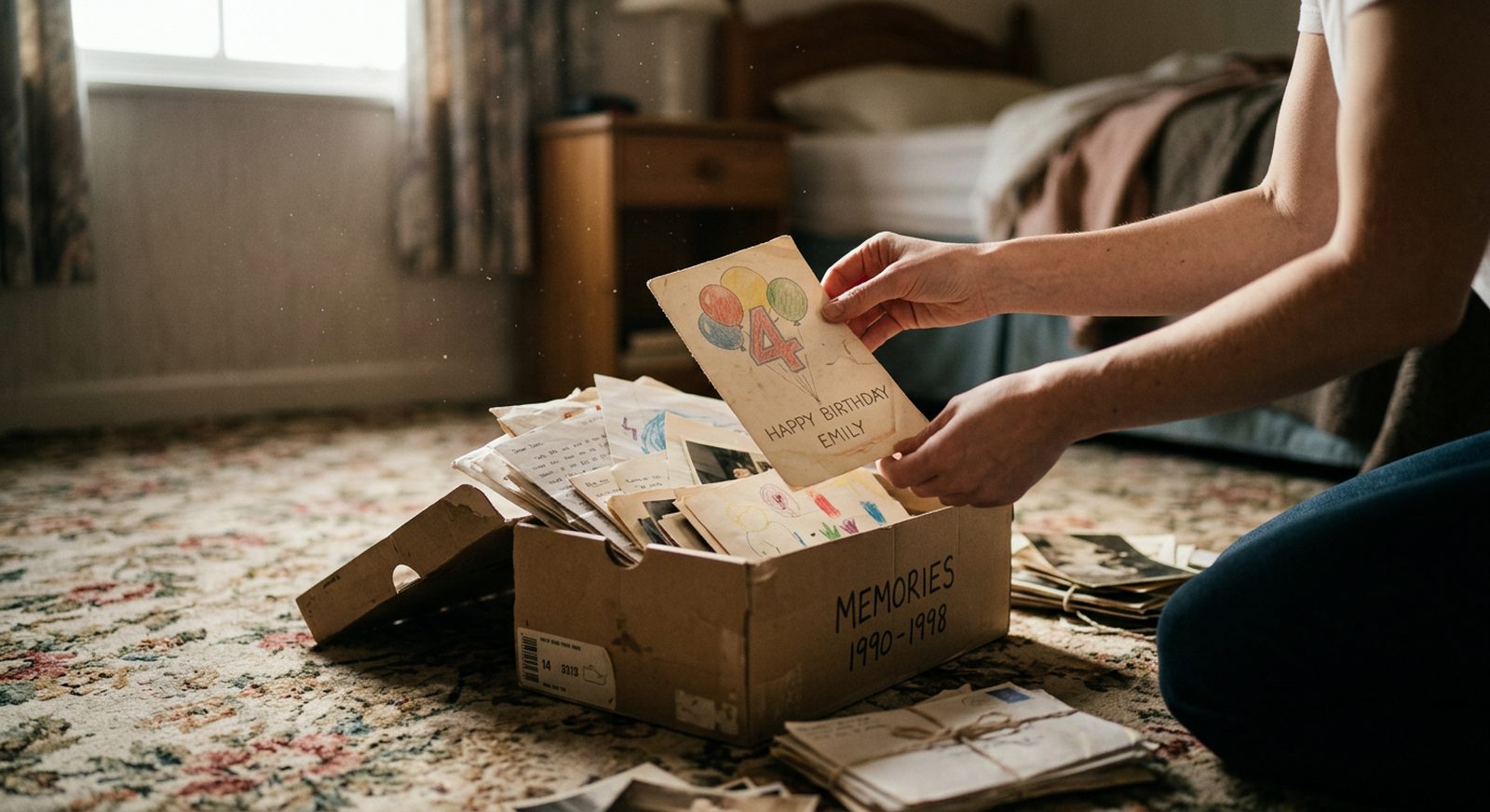
The first thing I found was the shoebox.
It was on the top shelf of my mom's closet, behind a wool coat she hadn't worn since 2008, wedged between a photo album and a hatbox full of buttons. I pulled it down expecting old tax returns. Instead, I found every birthday card I'd ever made her. Every one. Forty-three years of construction paper and crayon and a kid's terrible cursive that says "I LOVE YOU MOM" in glitter glue that has somehow survived four presidential administrations.
I sat on the floor of her closet and cried for an hour.
If you're about to clean out a parent's house — or you're standing in the middle of one right now, paralyzed — I want to tell you something nobody told me: this is going to take longer than you think, hurt more than you expect, and end with you somehow standing in an empty hallway feeling things you don't have words for yet.
That's normal. That's the whole job. Let's get you through it.
Before You Touch a Single Thing
Three rules. Tape them to the front door if you have to.
Rule 1: Don't throw anything out for the first 48 hours. You will be tempted. The grief brain wants to fix something, and the only thing in front of you to fix is a house. Resist. The Goodwill pile you make on day one is the pile you'll spend day three crying over because you accidentally tossed Dad's barbecue apron.
Rule 2: You are not on a deadline. (Even if you are.) Yes, the realtor wants the house listed. Yes, your siblings have flights home. Yes, the lawyer needs the inventory. Move forward steadily, but do not let anyone — especially not yourself — convince you that speed equals strength. It doesn't. Speed equals regret.
Rule 3: Take photos before you touch anything. The arrangement of objects on a parent's nightstand is a kind of writing. Photograph it. Their fridge magnets. Their bookshelf. The exact way they piled mail. You will want this later. I promise.

The 5-Box System (The Only System That Actually Works)
After helping three friends through this and doing it twice myself, I'm convinced there is exactly one sorting method that doesn't fall apart by Tuesday afternoon. Five boxes. That's it.
- KEEP — Things you, personally, want.
- FAMILY — Things you'll offer to siblings, kids, cousins.
- SELL — Things with real monetary value.
- DONATE — Useful but no value/sentiment.
- TRASH — The obvious stuff. Expired food. Broken hangers. The 1992 phonebook.
Notice what's missing? A "decide later" box. There is no decide later. Decide later is how you end up with a storage unit you pay $180/month for, for nine years, because you can't bring yourself to open it.
Here's the trick: when you're holding something and you don't know what box, ask yourself one question: "If I saw this at someone else's estate sale, would I buy it?" If the answer is no, it does not belong in your house. Even if it belonged to your mom.
This is hard. Do it anyway.
Room-by-Room (In the Order That Hurts the Least)
Don't start in the bedroom. Whatever you do, don't start in the bedroom.
Day 1–2: Garage, basement, attic. Cold zones. Tools, holiday decorations, old paint cans. Easiest emotional load. You'll build momentum and confidence.
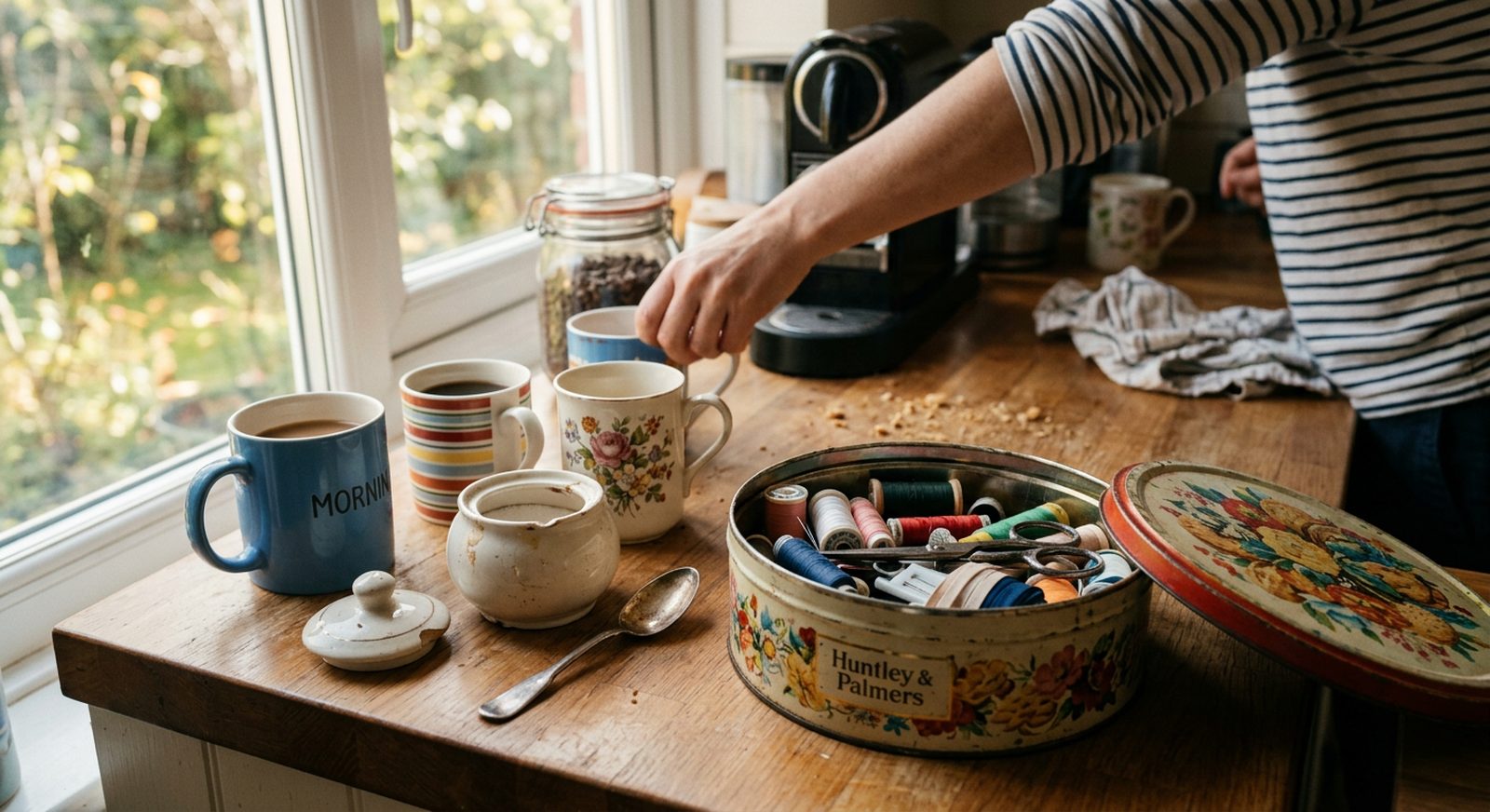
Day 3–4: Kitchen and dining room. Medium emotional load. Yes, those are her wedding china and his coffee mug and the spatula that flipped a thousand pancakes. But kitchens are also full of obviously-trash items (the back of the spice cabinet alone), so progress feels visible.
Day 5–7: Living room, office, bookshelves. Books are heavy and emotional and full of dedications and pressed flowers and grocery lists from 1987 used as bookmarks. Budget extra time. Also: a lot of mid-century furniture is way more valuable than people realize. Don't toss before you check.
Day 8+: Bedrooms and personal spaces. This is the hardest. Their nightstand. Their closet. The drawer with the watch they wore every day. Save it for last, when you have the most practice and the least delusion that any of this is "just stuff."
What to Keep (When You Want to Keep Everything)
The grief brain says: all of it. All of it is precious. All of it carries her smell, his handwriting, their life.
The grief brain is lying. Or rather, it's telling a true thing in a way that will ruin your spare bedroom.
Here's what actually matters, in my experience and the experience of every person I've talked to who's been through this:
- Anything in their handwriting. Recipes, lists, marginalia in books, the post-it on the fridge. Especially the mundane stuff. You think you'll remember the way they wrote a 7. You won't.
- One or two items of clothing they wore often. Not the fancy ones. The cardigan. The jacket. The thing that smells like them, until it doesn't anymore.
- Photos. All the photos. Don't sort them yet. Box them up and deal with them in two years when you can.
- One "useless" object you loved. The chipped mug. The weird ceramic frog. The thing that has zero value to anyone but you.
- Any letters. Especially any letters they kept. Those are a window into who they were before they were your parent.
That's your keep list. Be brave about everything else.
The Sibling Conversation (Have It Early)
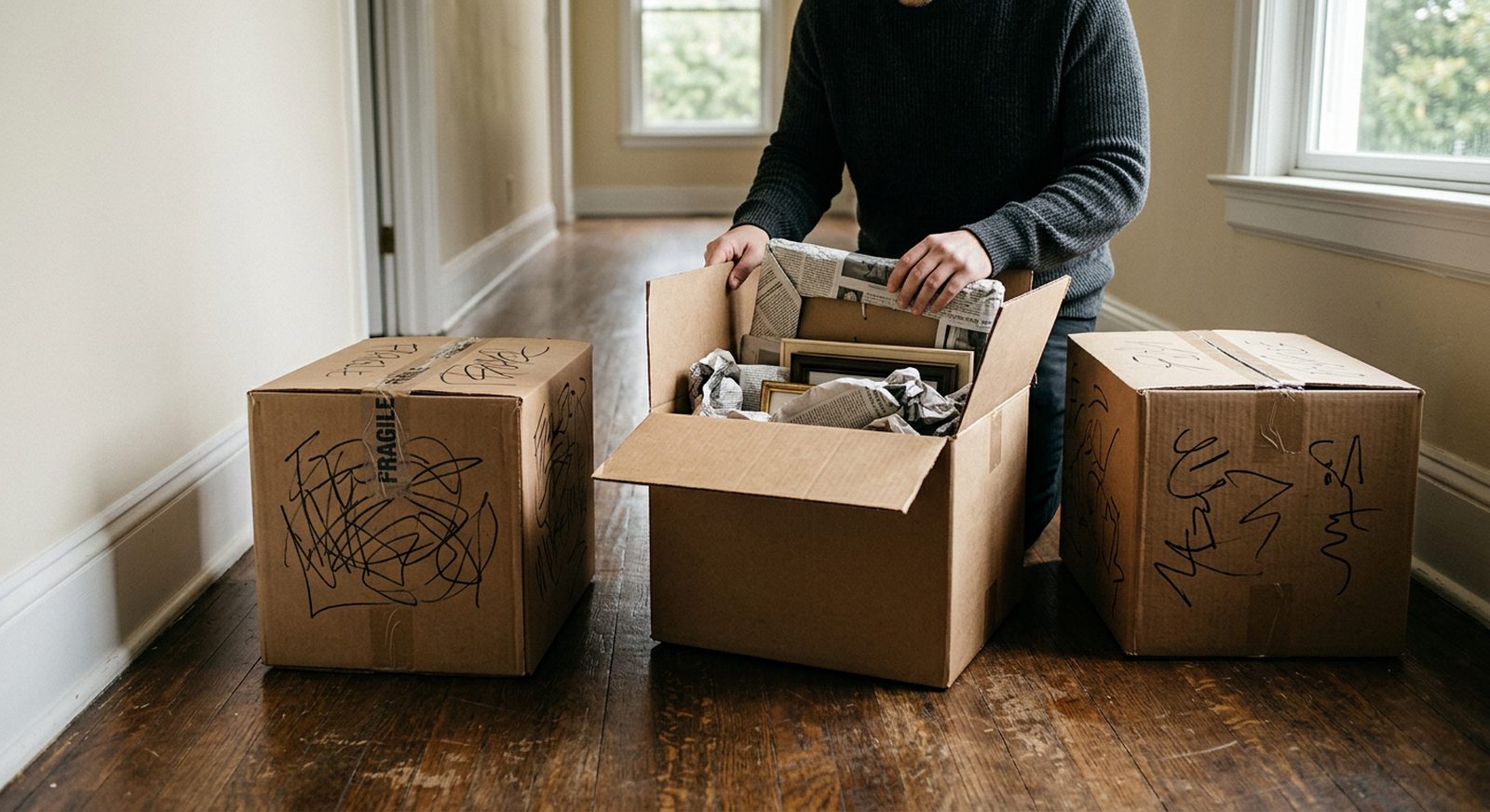
I'm going to be honest: more families are damaged by estate cleanouts than by the deaths themselves. Not because anyone is greedy. Because everyone is grieving differently, and grief looks like greed when you're tired.
Have one early call. Set ground rules:
- Anyone who wants something specific gets to claim it first (in writing, group text counts).
- Disputes get resolved by coin flip, not argument. This sounds dumb. It saves Christmases.
- Money is split evenly. Sentimental items are not bartered against money.
- Whoever is doing the physical work gets first pick of unclaimed items. (This is the rule nobody talks about and everyone secretly resents the absence of. Make it explicit.)
If you can't agree, hire a neutral estate sale company to inventory and sell everything, then split the proceeds. Sometimes the kindest thing is to take all the objects out of the conversation entirely.
Speaking of which — if you haven't read it yet, our breakdown of what estate sale companies actually charge in 2026 is required reading before you sign anything. There are fees in those contracts that will make you cry, and not in the good way.
What's Actually Valuable (You'll Be Surprised)
Three categories of things in your parents' house are almost always worth more than you think:
1. Anything from the 1960s–1980s in good condition. Furniture, lamps, dishware, jewelry. Mid-century is having a moment that is somehow now thirty years long. Pyrex bowls regularly sell for $50–$300. Cast iron pans? Sometimes $200+.
2. Tools. Vintage Craftsman, Stanley, Snap-On. Even basic hand tools from the 70s outlast anything sold today and have a devoted resale market.
3. Costume jewelry. Yes, costume. Trifari, Coro, Eisenberg — these brands have collectors. That drawer of "junk jewelry" might be $400.
Three categories that are almost always worth less than you think:
- China sets (sorry, the market collapsed 15 years ago)
- Hummel and Precious Moments figurines
- Encyclopedias and most older books
If you're not sure what's valuable, take photos and use a smart appraisal tool before you donate anything. It takes 30 seconds and can change a Goodwill bag into a $600 check.

When to Hire Help (Permission Granted)
You are allowed — encouraged — to hire help for this. It is not a moral failing. It is a kindness to yourself and to the memory of the person you lost.
Hire an estate sale company if:
- The volume is overwhelming
- You live out of town
- You're physically or emotionally unable to do it
- The estate has significant value
Hire a junk hauling service for the last 10%. No matter how thorough you are, there will be a final pile of stuff nobody wants and nobody knows what to do with. A $400 haul-away on day fourteen is the best money you will ever spend.
Hire a therapist. I'm not joking. A few sessions during and after this process is better than a year of grief tangled up with resentment about a chair.
The Last Day
Here is what I did not expect: the last day is the worst day.
You walk through empty rooms. You pull the door shut. You put the key in an envelope for the realtor. And you stand in the driveway in the late afternoon light, realizing you are no longer a person who has a parent's house to come home to.
This part will not be made easier by being prepared for it. But you should be prepared for it anyway.
Take a picture of the empty rooms. Bring a friend. Cry in the car. Order something terrible for dinner. Keep going.

The Quietly Helpful Checklist
- Photograph every room before touching anything
- Locate the will, deed, insurance docs (often in a fireproof box, file cabinet, or freezer — yes, freezer)
- Stop mail forwarding / cancel subscriptions
- Five-box every room (Keep, Family, Sell, Donate, Trash)
- One sibling call to set ground rules early
- Don't toss anything in writing or with your name on it without reading it
- Photograph the contents of every drawer before emptying
- Get jewelry, art, watches, and "old stuff" appraised before donating
- Save one mundane item that smells like them
- Last day: bring a friend, take pictures, drive away gently
You Are Doing a Beautiful, Brutal Thing
Cleaning out a parent's house is one of the last acts of love you'll ever do for them. It is tedious, exhausting, and quietly sacred. You are sorting a life. You are deciding what survives.
Be kind to yourself. Eat. Sleep. Take Tuesdays off. Cry in closets. Save the shoebox.
And when you're finally ready to figure out what to do with all the things that turned out to be worth something — the Pyrex, the costume jewelry, the cast iron skillet that's been making cornbread since 1971 — that's where the next piece comes in.
Keep Reading
The next post is for the part of this you didn't expect: discovering that some of "Mom's old stuff" is worth real, surprising money. Spoiler: that turquoise mixing bowl in the cabinet might be worth $300.
20 Things at Estate Sales That Are Secretly Worth $500+ →
You did the hard part. Now let's make sure you don't accidentally give a fortune away.
Keep exploring
Ready to start your own treasure hunt?
Discover estate sales near you and find incredible deals.
Explore Sales Near Me
About the author
Andy
Founder, EstateSaleFinder.net
Hi, I'm Andy — a retired commercial photographer turned developer with a five-year (and counting) obsession with estate sales. I started EstateSaleFinder.net because I knew there had to be an easier, smarter way to find and list estate sales. Now I get to chase treasure and build the tool I always wished existed.