Common Estate Sale Scams to Avoid: A Buyer and Seller's Field Guide for 2026
From fake estate sale signs and silverplate-priced-as-sterling to phantom companies that disappear with the cash, here are the 12 most common estate sale scams in 2026 — what they look like, how to spot them in under 30 seconds, and the exact steps to protect yourself whether you're hunting bargains or hiring a company to liquidate a family home.
Most estate sales are exactly what they look like — a family selling a lifetime of belongings, or a licensed company running a clean, well-priced sale on their behalf. But every weekend, a small percentage of sales are something else: a flea-market dump using the words "estate sale" to draw a crowd, a fake company that takes a cleanout fee and vanishes, or a perfectly legitimate sale where a single mispriced item costs you (or makes you) thousands.
This guide covers the 12 most common estate sale scams and pricing traps in 2026 — the ones we see reported in our community every month. Each one includes the tell, the fix, and where to verify before you hand over cash.
Why Estate Sale Scams Work
Estate sales create a perfect storm for fraud and pricing mistakes:
- Time pressure. Doors open at 8 a.m., the good stuff is gone by 9, and people make snap decisions with cash in their pockets.
- Information asymmetry. Sellers may not know what their grandmother's silver is worth. Buyers may not know what they're looking at.
- Cash culture. A lot of sales are cash-only, no receipts, no returns.
- Trust signals are easy to fake. A magnetic sign, a folding table, and a printed price list look identical whether the company has been running sales for 20 years or set up yesterday.
Knowing the patterns is most of the protection. Let's get into them.
Scam #1 — The "Estate Sale" That's Really a Flea Market
You drive to the address. Half the items are clearly used Amazon returns, dollar-store decor, and clothes still on Walmart hangers. There is no estate. Someone is using the phrase "estate sale" because it pulls 5–10x more search traffic than "garage sale" or "yard sale."
The tell
No older furniture. No personal items (no family photos in frames, no monogrammed linens, no handwritten cookbooks). Lots of identical packaging. Bins of small new items at the front.
The fix
Before you drive out, look at the listing photos. A real estate sale has layers — china in the dining room, tools in the garage, books on real bookshelves. A fake one looks like a single-table flea booth. Use our verified estate sale browser to filter for sales with photos and seller verification badges instead of pulling from a no-vetting bulletin board.
Scam #2 — The Phantom Estate Sale Company
A homeowner finds a "company" online that quotes a great rate to clear out a parent's house. The company shows up, runs a "sale," takes a 35% commission plus a $1,500 cleanout fee — and the family later realizes that the most valuable items (jewelry, sterling silver, a small painting) "didn't sell" and were taken to "donation." They were taken to the company's other resale channels.
The tell:
- No physical business address (just a P.O. box or a cell number)
- No business license number on the contract
- No insurance certificate
- Refuses to provide a written, itemized inventory list before the sale
- "Verbal contract is fine"
The fix
Always require a written contract, a business license number, and proof of liability insurance before signing. Search the company's name plus "complaints" and "reviews" — and check the American Society of Estate Liquidators member directory. Better yet, hire through a vetted directory where companies have verified reviews from real families who've used them.
We covered this in depth in How Much Does an Estate Sale Company Cost in 2026? — including the contract clauses every family should require.

Scam #3 — Cash-Only "Sterling Silver" That's Actually Plated
This one is everywhere. A piece is priced like sterling — $400 for a tea pot, $80 for a candlestick, $25 for a "silver" spoon — but a quick look at the bottom shows EPNS, EP, A1, Quadruple Plate, Silver on Copper, or just a maker name with no purity stamp at all. That's silverplate. It is worth a small fraction of sterling.
The tell
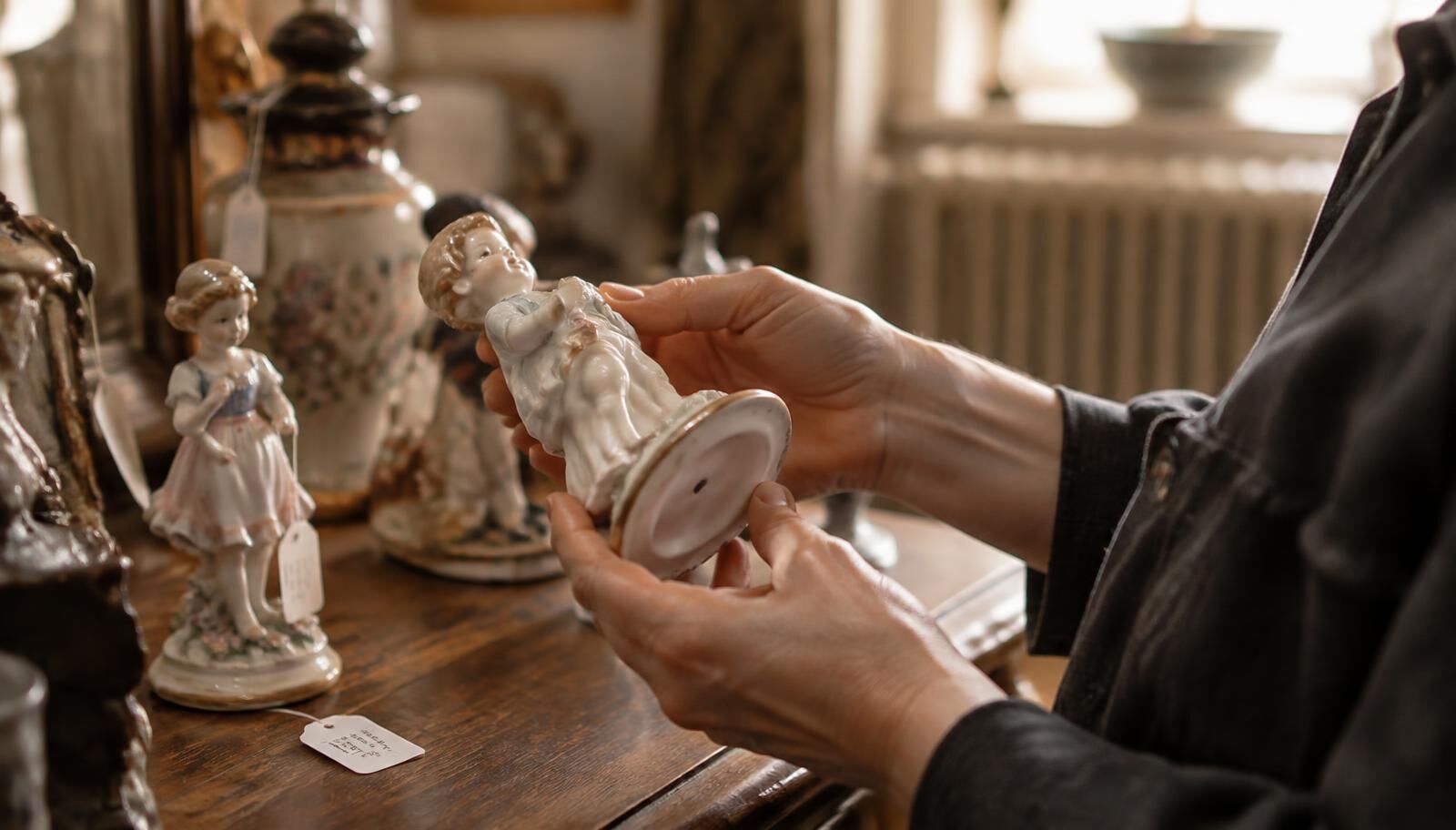
No "925," no "STERLING," no lion passant or other national hallmark. If you see "EPNS," "EP," or "Silverplate," it is not sterling. If a piece is feather-light for its size, it is almost certainly plate over a hollow base.
The fix
Learn the marks. We wrote the full reference guide here: Sterling Silver Identification Guide: How to Read Hallmarks and Know What You Have. Or — much faster in the field — snap a close-up of the hallmark with your phone and let the EstateSaleFinder Analyzer identify the country, era, and silver content in under 30 seconds. It will tell you whether you're looking at $40 of plate or $400 of sterling before you walk to the cash table.

Scam #4 — The "Reproduction" Sold as an Antique
Tiffany lamp reproductions. Fake Hummel figurines. "Antique" cast iron skillets that are modern reproductions from China, intentionally distressed and rusted. "Rookwood" pottery with a faked mark. These exist in volume on the wholesale reproduction market, and they end up at estate sales either by mistake (the seller inherited it and assumed it was real) or on purpose.
The tell
Casting seams that the original wouldn't have. Marks that are etched or acid-stamped rather than molded or impressed. Weight that's off (modern reproduction cast iron is often noticeably lighter or heavier than the original era). Patina that looks even and applied rather than worn naturally.
The fix
Photograph the maker's mark and any unusual details, then run it through the AI Analyzer before paying. Cross-reference any high-dollar piece (anything over $200) with completed eBay sold listings — not active asks. If the same piece is being sold new on Alibaba for $40, you're looking at a reproduction.
Scam #5 — Bait-and-Switch Pricing on Listed Items
The online listing shows a beautiful Persian rug, a mid-century Eames chair, and a Tiffany lamp. You drive an hour. None of those items are at the sale. Either they "sold to a private buyer the day before" or they were "added to the listing by mistake."
The tell
Listings that look too good — multiple high-value items but no clear photos of them in the actual house. Companies that won't answer specific questions about specific items by phone or message.
The fix
Before you drive, message the seller through the platform and ask for a photo of the specific item in situ in the house, or ask whether they hold items aside. On EstateSaleFinder, sellers can mark items as "still available" up to the morning of the sale, and verified-seller badges flag the companies with track records of accurate listings. You can also save the sale to your alerts and we'll ping you if items get marked as sold or held.
Scam #6 — The Fake Diamond Ring (or "Real" Gold That Isn't)
Estate sale jewelry is a minefield. Cubic zirconia in a sterling setting marked "diamond ring." Gold-plated brass marked as "14k." "Costume jewelry" rings that are actually solid gold and priced at $5 (this one cuts the other way — and pros prowl jewelry boxes specifically looking for it).
The tell:
- A "diamond" with rounded facets and zero internal inclusions under a loupe
- A "gold" ring that's magnetic (real gold isn't magnetic; gold-plated steel is)
- A green discoloration where the ring has touched skin (gold doesn't oxidize; brass does)
- "14k" stamps that are crooked, off-center, or hand-engraved rather than die-stamped
The fix
Look for the metal stamp inside the band: 10K, 14K, 18K, 925, PLAT, .585, .750. Anything marked "GP," "GE," "GF," "RGP," "1/20 12K GF," or "HGE" is plated or filled — it is not solid precious metal. For diamonds, use a jeweler's loupe and look for natural inclusions; CZs are usually too perfect. When in doubt, photograph the ring and the inside-band stamp and run it through the Analyzer — it will identify the marks and flag whether the metal is solid or plated.
Scam #7 — "Antique" Furniture That's Actually Mass-Market Reproduction
A "Victorian" dresser priced at $1,200. Up close, the joinery is butt-jointed and stapled rather than dovetailed. The "wood" drawer bottoms are MDF. The hardware is uniform across all six drawers, with no patina differences. This is a 1990s reproduction worth $150–250, not a 19th-century antique.
The tell:
- No dovetail joints in the drawers
- Phillips-head screws (didn't exist before 1933)
- Particle board, MDF, or plywood anywhere structural
- Perfectly uniform hardware with no oxidation differences
- Saw marks that are circular (post-1850) on a piece sold as "1820s"
The fix
Pull a drawer out and look at the bottom and sides. Check the back of the piece — repros almost always have factory-grade stapled-on backing. For a deeper dive, our guide on the 15 most-hunted items at estate sales covers the exact period markers that separate real antiques from reproductions.
Scam #8 — The "Estate" Where Nothing Was Marked Down
Estate sales are supposed to clear a house. By Sunday afternoon, prices should be 50% off, sometimes more. A "sale" that holds full asking price all weekend, refuses to negotiate at all, and packs up unsold items to "the next sale" is usually a permanent reseller running the same inventory in a new driveway every weekend — not an estate.
The tell
Same company, different address every weekend. Same furniture and home goods recycled across multiple "sales." No willingness to discount on Sunday.
The fix
Negotiation is normal at real estate sales — Sunday is the day to ask. Our complete script for negotiating at estate sales covers the exact words to use. If a "company" never marks down, that is a strong signal it is a permanent inventory operation rather than a one-time estate liquidation.

Scam #9 — The Fake "Number System" at the Door
A real numbered-entry system: a sign-up sheet that goes up the morning of the sale, or numbers handed out by company staff in the order people arrive. A scam version: a "host" charges $10 per person for a "guaranteed early entry number" that everyone else got for free.
The tell
Anyone asking for cash for entry to a free public sale.
The fix
Estate sales are free to enter. If someone is collecting money at the curb, walk away and message the company. Real companies do not charge admission.
Scam #10 — The "Charity Estate Sale" That Isn't
"50% of proceeds go to a local children's charity." The name of the charity is vague or made up. There is no IRS 501(c)(3) registration, no receipts available, no actual donation ever happens. The "charity" framing exists to discourage haggling and to make buyers feel good about overpaying.
The tell
A charity name you can't verify on the IRS Tax Exempt Organization Search or Charity Navigator. No documented partnership announcement on the charity's actual website.
The fix
Verify the charity exists and that they have a public partnership with the company before you let "charity" change your pricing decisions. Real charity sales will provide a receipt for the donation portion of your purchase.
Scam #11 — Fake or "Lost" Receipts on Big-Ticket Items
You buy a $1,400 piece of furniture. The "company" gives you a handwritten receipt on a generic carbonless pad with no business name, no address, no tax ID. Two weeks later, the piece breaks because it was repaired with hidden screws covering a structural crack. There is no way to find the company again. There is nothing to dispute.
The tell
Receipts without a business name, federal EIN, sales tax license number, or a real return address.
The fix
For any purchase over $100, require an itemized receipt with the company's legal business name, license number, and contact info. Photograph the receipt before you leave. Pay with a credit card if accepted (most legitimate companies now take cards) — credit card chargebacks are your only recourse if the item is materially misrepresented.
Scam #12 — The "Just Walk Away From the House" Scam (Targeting Sellers)
This one targets families, not buyers. A "service" offers to "take everything off your hands" for a flat fee — say, $2,000 — and "deal with all the contents" so the family can close on the house quickly. The family pays. The "company" then runs a full estate sale on the contents, pockets the entire proceeds (often $20,000+), and the family has no recourse because they signed everything over.
The tell
A flat upfront fee with no commission split, no inventory list, and no accounting of proceeds. Contracts that transfer "all rights, title, and interest" in the household contents to the service.
The fix
Never sign over title to household contents without first getting a written inventory and an estimated value range from a second, independent appraiser. A legitimate estate sale company works on commission (typically 30–45%), not a flat-fee buyout — and they always provide a final accounting. We walk through the right structure in How to Run a Successful Estate Sale and Estate Sale vs. Auction vs. Cleanout.

A 30-Second Pre-Purchase Checklist for Buyers
Before you hand over cash for anything over $50:
- Look for the mark. Hallmark on silver, karat stamp on jewelry, maker's signature on art, brand stamp on furniture.
- Photograph the mark. Even if you don't recognize it, you'll have it for later research.
- Run it through the AI Analyzer if you have signal. Country, era, real or reproduction, sold-comp price range — in 30 seconds.
- Check completed eBay sold listings (not active asks) for a quick price-range sanity check.
- Ask for the receipt with the company's business name and address printed on it.
- Pay with a card if possible for purchases over $100.
A Pre-Hire Checklist for Families
Before you sign with an estate sale company:
- License + insurance. Ask for both, in writing, with policy numbers.
- Written commission structure. Standard is 30–45% on commission, not a flat-fee buyout.
- Itemized inventory before the sale starts with photos of high-value items.
- Final accounting after the sale showing what each numbered item sold for.
- References from three recent sales — and call them.
- Read the contract. Specifically the clauses about unsold items, donation/disposal rights, and dispute resolution.
For the deeper version of this checklist, see our step-by-step guide to preparing your home for an estate sale company.
How EstateSaleFinder Helps You Avoid These Scams
We built EstateSaleFinder specifically because the buyer-side and seller-side problems above kept showing up in our inbox week after week. A few of the things baked into the platform:
- Verified seller badges on companies with documented reviews from real customers
- Photo-required listings so buyers can see real items before driving out
- AI Analyzer for hallmark identification, period dating, and live sold-comp pricing on anything you photograph
- Saved sales and alerts so you can track items between listing and sale day
- Vetted "Hire an Estate Sale Company" directory for families looking to liquidate a home with people who've actually been reviewed
- Wishlist matching so the right pieces get flagged to you before they sell
Most estate sales are honest. The handful that aren't follow predictable patterns — and once you know the patterns, they're easy to spot.
FAQ
Are estate sales legitimate?
The vast majority are completely legitimate — either run by a family clearing out a home directly, or by a licensed estate sale company on the family's behalf. Problems concentrate in two places: (1) "sales" that use the words "estate sale" to draw search traffic but are really flea booths or permanent reseller inventory operations, and (2) unlicensed "companies" that target families looking to liquidate a home quickly. Verifying the seller before you drive out, and verifying the company before you sign, eliminates almost all the risk.
How can I tell if "silver" at an estate sale is real sterling?
Look for one of these stamps on the bottom or back of the piece: 925, STERLING, Sterling Silver, the British lion passant, the French Minerva head, the German crescent and crown, or a numeric standard like 800 or 950. If you see EPNS, EP, A1, Quadruple Plate, Silver Soldered, German Silver, or Nickel Silver, the piece is silverplate or contains no silver at all. The fastest way to verify in the field is to photograph the mark and run it through the EstateSaleFinder Analyzer, which identifies country, era, and silver content in seconds. Our full sterling silver identification guide walks through every major hallmarking system.
What's the safest way to pay at an estate sale?
Credit card if accepted — chargebacks give you recourse if an item is misrepresented. Cash is fine for small purchases (anything under $50 or $100, depending on your comfort level), but always get an itemized receipt with the company's business name, address, and license or tax ID number printed on it for anything bigger. Avoid Zelle, Venmo Friends-and-Family, or wire transfers to a personal account — those are not reversible if something goes wrong.
How do I know if an estate sale company is legitimate before I hire them?
Ask for: (1) state business license number, (2) liability insurance certificate with policy number, (3) written commission contract (30–45% is standard — be skeptical of flat-fee buyouts), (4) an itemized inventory of high-value items photographed before the sale, (5) references from three recent sales you can actually call. Cross-check the company name on the American Society of Estate Liquidators directory and search the business name plus "complaints." Or use a pre-vetted directory where companies have documented reviews from real families.
Can I return items bought at an estate sale?
Almost never. Estate sale purchases are sold "as-is, where-is" — there are no returns, no warranties, and no implied guarantees about condition or authenticity. This is exactly why pre-purchase verification matters. Photograph the maker's marks, check sold-comp prices on your phone, and use the AI Analyzer for anything over $50 before you pay. If a company materially misrepresents an item (calls it sterling when it's plate, calls it antique when it's a reproduction), you may have a fraud claim — but only if you have a real receipt and can find the company afterward.
The 12 scams above account for the overwhelming majority of estate sale fraud and pricing mistakes we see reported. Memorize the tells. Use the checklists. And when you're not sure about a piece — silver, jewelry, art, furniture, ceramics — let the AI Analyzer do the heavy lifting before you decide.
Keep exploring
Ready to start your own treasure hunt?
Discover estate sales near you and find incredible deals.
Explore Sales Near Me
About the author
Andy
Founder, EstateSaleFinder.net
Hi, I'm Andy — a retired commercial photographer turned developer with a five-year (and counting) obsession with estate sales. I started EstateSaleFinder.net because I knew there had to be an easier, smarter way to find and list estate sales. Now I get to chase treasure and build the tool I always wished existed.