How to Fill Your Next Estate Sale Using Social Media (The 2026 Playbook for Companies Who Hate Marketing)
Most estate sale companies have bad social media — not because they don't care, but because they're too busy running sales to figure it out. Here's the exact playbook: what to post, when to post it, and the tool that writes most of it for you.
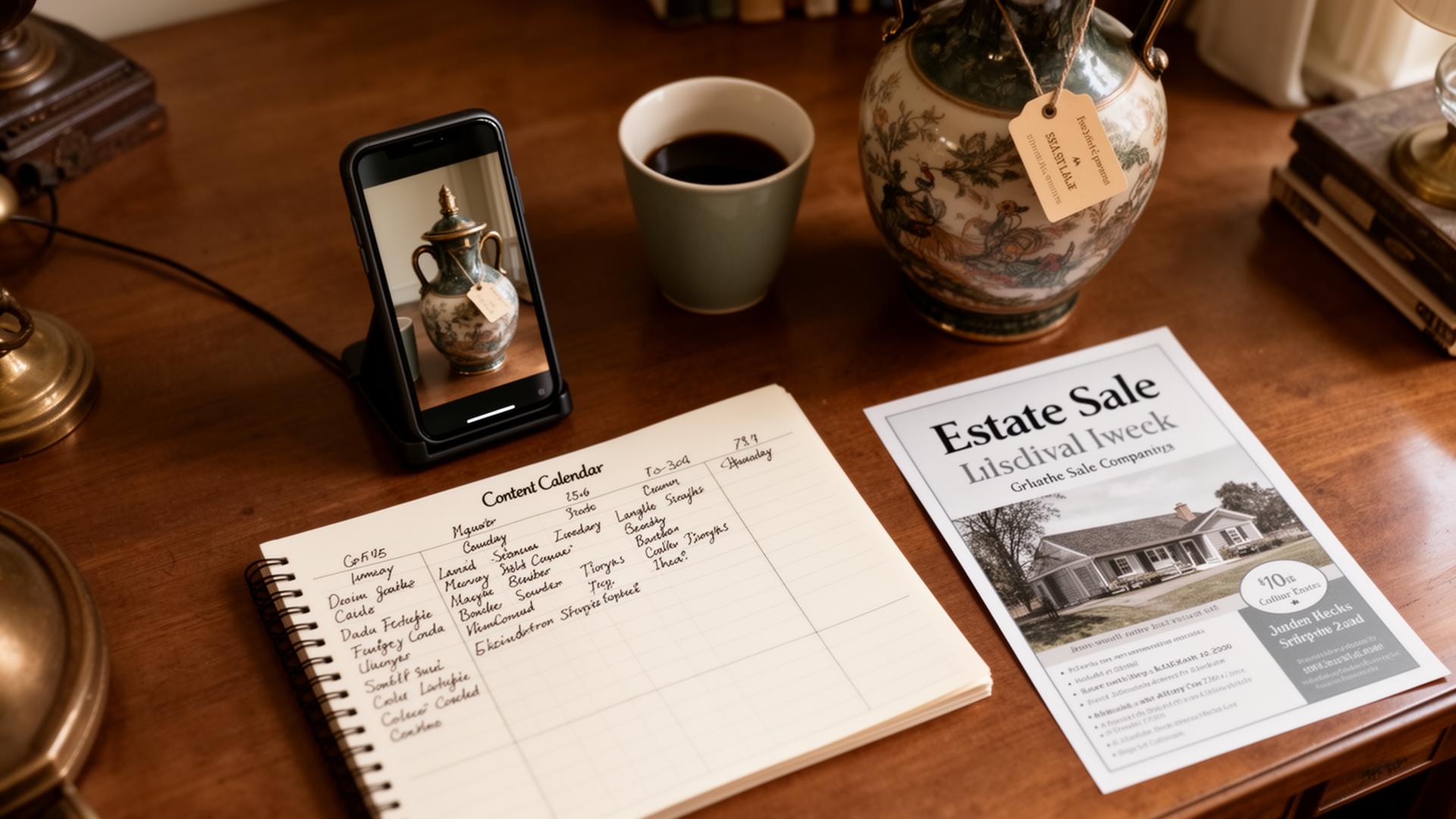
You're at a sale property on Wednesday morning. You've got two days to photograph, price, and stage 40 years of someone's life before a hundred buyers walk through Friday at 8 a.m. You have exactly zero minutes to think about Instagram.
I know. I've talked to enough estate sale companies to understand that social media falls into the same category as "reorganize the office" and "update the website" — things that would probably help but never feel as urgent as everything else.
The problem is that social media for estate companies is not optional in 2026. The companies in your market that consistently fill their sales and build a following of hundreds of repeat buyers did it through Facebook and Instagram, mostly. And the good news is that it doesn't require creativity, consistent inspiration, or anything more than 15 minutes during setup week — if you know exactly what to post and when.
This is that guide.
Why It Works (and Why Most Estate Companies Get It Wrong)
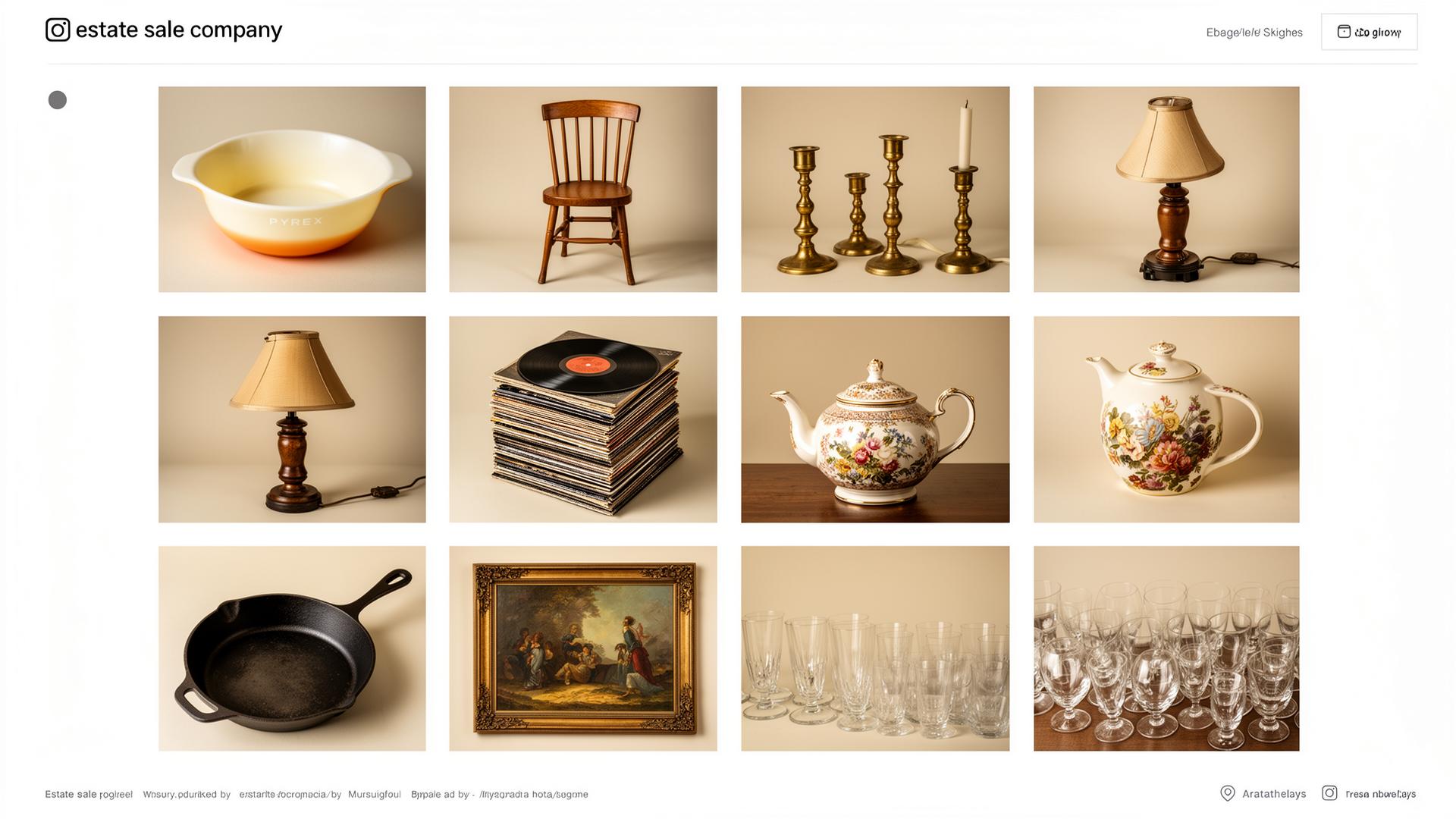
The companies with large followings aren't posting inspirational quotes or "estate sale tips." They're posting the items. That's it. A photo of a piece of Roseville pottery with a price. A video walking through the living room the day before the sale. A shot of the Griswold skillets with the question "which size would you grab first?"
Their followers aren't following them for content. They're following them for early access to the inventory. The buyer who sees your Thursday Reel of the MCM credenza is already planning their Friday morning route. That's the only reason social media works for estate companies — and it works extremely well for exactly that reason.
The mistake: posting once, two days before the sale, with a generic "Come shop our estate sale this weekend!" graphic. That gets 4 likes from staff accounts and 0 new buyers.
The Three Platforms That Actually Matter
You don't need to be everywhere. You need to be on the right three platforms for this specific business.
Facebook — your most important platform
Your buyers are on Facebook. The estate sale audience skews 40–65, and that demographic is still the core of Facebook's daily active users. More importantly, Facebook Groups are where the treasure hunting community organizes. Local estate sale shopper groups exist in every major metro and are active. Joining them as a page and posting your upcoming sales in them — when the group rules allow — can add 50–200 attendees to your opening day.
Post your sale listing, your best photo each day of setup week, and your discount schedule for final day.
Instagram — your growth platform
Instagram reaches a younger buyer demographic and, crucially, the reseller and collector community that drives your high-ticket sales. Reels — short videos of 15–60 seconds — consistently outperform static posts in reach. An iPhone video walking through a staging area set to trending audio can reach people who have never heard of your company.
Instagram is also where the "item reveal" format thrives. Pick one interesting piece per day during setup week. Post a close-up of it. Name it, describe it briefly, give a price range. Your followers will engage — comments, shares, "I need this" — and that engagement extends your reach for free.
TikTok — the largest untapped audience in estate sales
TikTok has an enormous subculture around thrifting, estate sales, and vintage finds. Serious collectors, resellers, interior designers, and first-time estate sale attendees all live there. The content that performs on TikTok for estate companies is different from Instagram: it's more storytelling, more personality, and more "let me show you something surprising."
The "guess what this is worth" format is tailor-made for TikTok. Pick a piece, show it, ask the question, reveal the answer. The comment section fills itself.
If video feels like too much, start with Facebook and Instagram only. Add TikTok when you've built a rhythm.
The Seven-Day Content Calendar
Here's the posting schedule that works. Adjust the specific days to fit your sale schedule — the logic is what matters.
Five days before opening day (usually Sunday or Monday):
Post your EstateSaleFinder listing link on all three platforms. Include 2–3 of your best photos from the property. Caption: what city, what date, what's the highlight category. Tag your location.
Four days before (Tuesday):
One photo of a furniture piece or large item staged in the room it came from. Natural light. Clean background. Include the piece's approximate era and price range in the caption. This is your "anchor item" post — the thing buyers are already mentally arranging in their living room.
Three days before (Wednesday):
One close-up video — 20–30 seconds — walking slowly through one room. No narration needed. Good lighting, steady phone, trending audio. Caption: "Setup day at [city]. Come find this before someone else does. Sale opens [date]."
Two days before (Thursday):
Your "item of the day" reveal. One collectible or unusual piece. Show the front, show the bottom or back, show any markings. Name it specifically. Give a price. Ask a question to drive comments ("Anyone know what pattern this Pyrex is?" or "First person to name this maker wins nothing but our respect."). This post almost always becomes your highest-engagement post of the week.
Day before opening (Friday if you run Friday-Saturday-Sunday):
Your final preview post. Your 3–5 best photos from the whole setup. "Doors open tomorrow at [time]. [City] [address]. Here's a preview of what's waiting." Include your discount schedule if you run one.
Sale morning:
One post, opening time, from in front of the property. "We're open. Come find your treasure." A photo of buyers at the door works well here and creates social proof.
Final day:
Post your discount announcement. "Today is [X]% off day. Doors open at [time]. Everything must go." This post will get shared by buyers to their friends more than any other post you write all week.
The Hashtag Strategy That Reaches Real Buyers
Hashtags matter most on Instagram. Use a mix of specific and broad tags:
Specific (reach the active community):
`#estatesale` `#estatesalefinds` `#estatesalehunter` `#thrifted` `#antiquehunting` `#vintagehunting` `#reseller`
Location-specific (reach local buyers):
`#[yourcity]estatesale` `#[yourcity]vintage` `#[yourcity]thrift` — people actively searching their city for sales use these
Item-specific (reach collectors):
When you post a specific collectible, add its category hashtag: `#pyrex` `#mccoy` `#midcenturymodern` `#castironcooking` — these are searched by collectors who don't follow you yet
10–12 hashtags per post on Instagram. On Facebook, 2–3 is enough. TikTok uses a different algorithm — focus on trending sounds and the specific hashtags like `#thrift` and `#estatefinds` that the community already uses.
The Part That Takes 30 Seconds Instead of 30 Minutes
The reason most estate sale companies don't post consistently isn't laziness. It's the friction of having to write a caption while standing in a house that smells like old books and has to be ready in 36 hours.
EstateSaleFinder's AI Social Studio does this for you. Upload photos from your sale, tell it the category (furniture, kitchenware, collectibles, clothing), and it generates ready-to-post captions for Instagram, Facebook, and TikTok — including the hashtags, the call to action, and the specific item description pulled from AI identification of your photo.
You're already photographing the items. The AI turns those photos into posts in under two minutes.
For the companies using it, the workflow is: photograph items during setup → upload to EstateSaleFinder → generate posts for the week → schedule or copy-paste. The entire social calendar for a sale weekend takes about 15 minutes instead of two hours.
What to Do About Followers You Don't Have Yet
Every company starts at zero. The fastest paths to a real following:
1. Ask every satisfied buyer to follow you. At checkout, at the end of the sale, on your closing-time post: "We do this every weekend — follow us on Instagram and you'll never miss a sale." This is your warmest possible audience.
2. Post in local estate sale shopper groups on Facebook. Search "[your city] estate sale" on Facebook. The groups are there. Ask to join. When the group allows sale posts, post yours. These groups have thousands of local buyers who are exactly your audience.
3. Tag the property neighborhood and city in every post. Location-tagged posts on Instagram and TikTok show up in local discovery feeds.
4. Engage with other estate sale content. Comment on buyers' posts when they tag items from your sales. Repost TreasureGrams from buyers who photographed items at your sale (with permission). This signals to algorithms that your account is part of an active community.
You don't need 10,000 followers. You need 500 followers in your market who show up reliably every weekend. That's a year of consistent posting away. Start this weekend.
The One Thing That Matters More Than Any of This
Post regularly. Not brilliantly — regularly.
The companies with the most consistent buyer attendance aren't the ones with the most polished feeds. They're the ones their buyers have trained themselves to check every Tuesday and Wednesday for the new sale preview. Consistency creates habit. Habit creates buyers who show up before the doors open.
One post per day during setup week. Every week. That's the whole strategy.
Set up your social studio → · List your next sale → · See how other companies are using EstateSaleFinder →