

The "Labor Trap": The Hidden Logistical Hazards That Quietly Drain an Estate Liquidator's Profit Margin
A brutally honest look at the operational math of setup week. Multi-story stairs, narrow driveways, gated-community rules, and unorganized hoards can quietly erase a commission in pure labor hours — before you sell a single item. Here's how the Pre-Sale Walkthrough tool turns a house tour into an upfront profitability report, so you know your real margin before you ever sign the contract.
Every estate liquidator has walked into a house, seen a living room full of mid-century furniture and a china cabinet packed with sterling, and felt their pulse quicken. This one's a winner. You quote your commission, shake hands, and drive home already spending the check in your head.
Then setup week arrives. The "gorgeous mid-century credenza" lives on the third floor of a townhouse with a switchback staircase so tight you have to pull the drawers and turn it on its side to get it down. The driveway fits one car, so your crew double-parks and loses twenty minutes every trip to move for neighbors. The gated community won't issue enough guest passes, so half your buyers get turned away at the gate on Saturday morning. And the "packed" china cabinet? It's the tip of a hoard — every closet, the attic, and a shed out back are wall-to-wall boxes nobody mentioned on the phone.
You still run the sale. You still hit your gross number. But when you tally the hours — the extra crew day, the two guys you had to add just to move furniture, the afternoon lost to the gate — your actual profit is a fraction of what you quoted yourself. The commission was fine. The labor ate it alive.
This is the Labor Trap. And it's the single most under-discussed reason good liquidators have bad months.
The commission is a percentage. The labor is a fixed cost.
Here's the uncomfortable math at the heart of this business. Your revenue is a percentage of what the house sells for. But your biggest cost — labor — is largely fixed to the difficulty of the house, not the value of the goods inside it.
A clean, single-story ranch full of $30,000 in merchandise might take a 2-person crew four days to set up and run. A cluttered, three-story house with the same $30,000 in merchandise can eat a 5-person crew eight days — before you account for the stairs, the parking, and the gate.
Same gross. Same commission. Wildly different profit. One is a great month; the other is you paying your crew to break their backs so you can break even.
The trap is that both houses look profitable during the initial walkthrough, because we instinctively price the stuff and completely ignore the logistics of moving, staging, and selling the stuff. The value is loud and visible. The labor is silent until it's a payroll line.
Let's break down the four hazards that do the most damage — and then look at the tool that makes them impossible to miss.
Hazard #1: The vertical house (stairs and multi-story layouts)
Stairs are the most expensive feature in any estate sale, and it's not close. A heavy dresser that takes ninety seconds to walk out a ground-floor door can take fifteen minutes and three people to safely bring down a steep staircase — and that's per piece. Multiply that across every piece of furniture in a two- or three-story home and you've added an entire crew-day of pure lifting before anything gets priced.
Steep or "treacherous" staircases also carry a hidden second cost: shopper safety. During the sale itself you have to station someone near the stairs, add hazard signage, and slow the whole flow of foot traffic — which means fewer buyers moving through, which means softer sell-through on your discount days.
Hazard #2: The narrow driveway and the parking problem
Nobody thinks about parking until it's Saturday at 8:55 a.m. and there's a line of cars and nowhere to put them. A narrow driveway or street-only parking does two things to your margin: it slows your crew during setup (every load-out becomes a shuffle), and it caps your buyer volume during the sale. If people can't park, they leave. The item priced at $200 that needed the right buyer to walk in never gets its buyer, because that buyer circled the block twice and drove home.
Hazard #3: Gated communities and HOA rules
Gated communities are deceptively brutal. The homes are often beautiful and full of quality goods — which is exactly why liquidators say yes without asking the operational questions. Then reality hits: guest-pass limits that throttle how many buyers can even reach the sale, HOA rules restricting signage (so nobody can find you), quiet hours that shrink your setup window, and sometimes a flat ban on "commercial activity" that turns into a fight three days before the sale. Every one of these is a solvable problem — if you know about it before you sign. Discovered mid-setup, each one is a fire drill that costs hours and goodwill.
Hazard #4: The unorganized hoard
The most dangerous house is the one where the client says "it's mostly cleaned out" and it absolutely is not. Boxed, unsorted, floor-to-ceiling contents don't just add volume — they add research and sorting time, the most invisible labor cost of all. Someone has to open every box, decide what's trash and what's a $400 sleeper, and stage it. A genuine hoard can double your setup timeline and require specialists for pieces you didn't even know were there. If you quoted the job based on the three tidy rooms the client showed you, the other nine rooms are coming straight out of your profit.
The fix: turn the walkthrough into a profitability report
Here's the thing — none of these hazards are hidden. They're all sitting right there during your initial walkthrough. The problem is that a walkthrough done from memory, or on a legal pad, quietly forgets to weigh them. You see the sterling and the stairs, but only the sterling makes it into your mental math.
That's exactly why we built the Pre-Sale Walkthrough into EstateSaleFinder. It's a structured intake tool that walks you through the house room by room and hazard by hazard, and then hands you back something a legal pad never could: an upfront, visual difficulty report that scores the real profitability of the job before you sign anything. Think of it as an insurance policy against the Labor Trap.
Let me show you how it works, using a real report.
Step 1: A guided intake that asks the questions you'd forget
Instead of a blank notepad, you get a structured checklist that deliberately surfaces the expensive stuff. It asks about the value categories — jewelry, art, antiques, collectibles — and it asks the operational questions that protect your margin: research level, volume of items, furniture-removal difficulty, staircase layout, occupancy, parking, gated community, HOA, attic and garage access, and more.
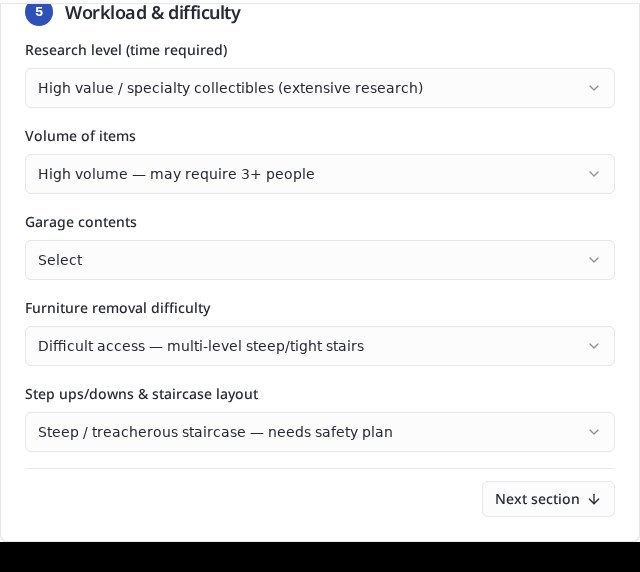
Notice what these fields are really doing. "Furniture removal difficulty → Difficult access: multi-level steep/tight stairs" isn't trivia — it's a labor multiplier. "Volume of items → High volume, may require 3+ people" isn't a note — it's a payroll forecast. The tool is quietly translating what you're seeing into what it's going to cost.
Step 2: The price estimate analysis — a realistic revenue range, not a fantasy
This is the section that changes how liquidators quote. Most people estimate gross revenue by eyeballing the "good stuff" and guessing a number. The walkthrough builds a grounded range from the home's size and the value categories present — and then, crucially, it applies the actual markdown schedule an estate sale really runs on.
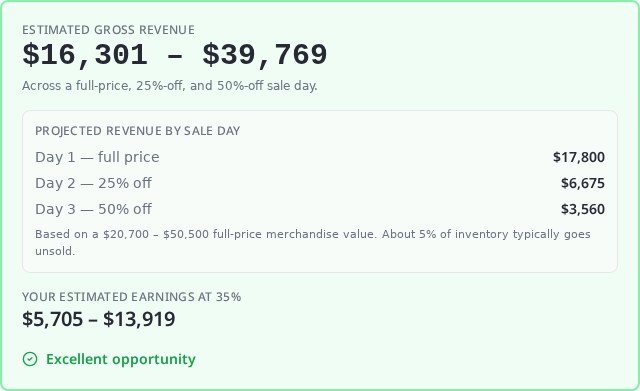
Read what it's doing here, because this is the honest math nobody does by hand:
- It starts from a full-price merchandise value (here, ~$20,700–$50,500 based on the home and its categories).
- Then it spreads that across a real three-day markdown schedule — Day 1 at full price, Day 2 at 25% off, Day 3 at 50% off — because that's how inventory actually sells, and it assumes ~5% simply goes unsold.
- The result is a realistic estimated gross revenue ($16,301–$39,769), not the fantasy number you'd get by pretending everything sells at sticker.
- Finally, it applies your commission rate to show your estimated earnings ($5,705–$13,919) — the number that actually lands in your pocket.
For an even sharper estimate, you can snap photos of each room during the walkthrough and let the built-in AI room scan identify items and value them, folding that signal straight into this revenue range. It's the difference between "eh, feels like a twenty-thousand-dollar house" and a defensible number you can build a contract around. (Curious how our AI values individual pieces? That same engine powers our Ai Appraiser across the whole platform.)
Step 3: The difficulty report — the Labor Trap, made visible
Here's the section that earns the whole tool its keep. Alongside the revenue estimate, the walkthrough produces an Operational Difficulty & Logistics report that scores the job and tells you, in plain terms, what it's going to take to run it.
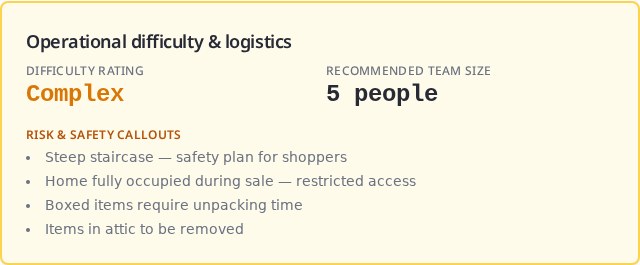
Look at how directly this maps to the four hazards we just walked through:
- Difficulty rating: Complex — the tool weighed the stairs, volume, occupancy, and access and told you flatly this is a hard job. That single word changes your quote.
- Recommended team size: 5 people — not the 2 you might have guessed. There's your real labor cost, calculated before you priced the commission.
- Risk & safety callouts — "Steep staircase — safety plan for shoppers," "Home fully occupied during sale — restricted access," "Boxed items require unpacking time," "Items in attic to be removed." Every one of those is a Labor Trap hazard, caught on the walkthrough instead of on setup day.
Now the "$30,000 house" reveals its true nature: it's a Complex, 5-person, 9-to-11-day job. Maybe it's still worth it — but now you can quote it that way, or negotiate a higher commission, or set a firmer cleanout fee, or politely pass. You're making a business decision with numbers instead of a gut feeling with optimism.
Step 4: The whole picture on one screen
Put it together and you get a single Sale Potential Report — revenue, earnings, prep-time estimate, recommended staffing, rooms assessed, value categories, and every risk flag — that you can save to the client's pipeline, print, or hand to your team.
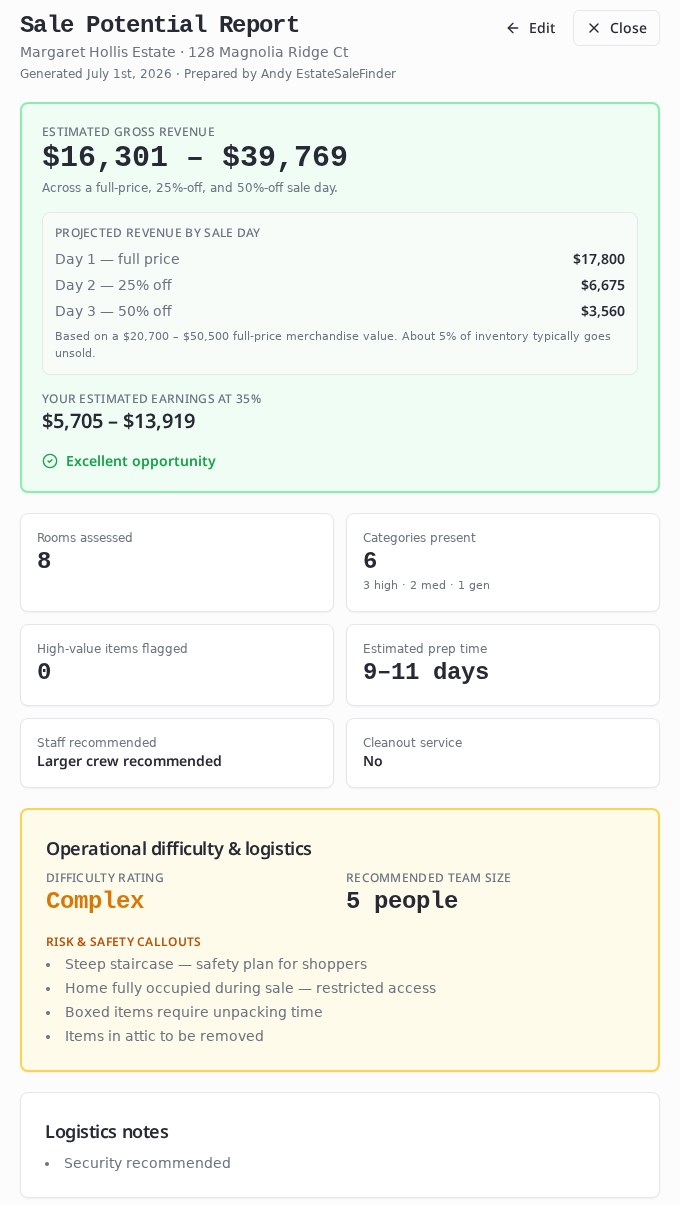
This is what a walkthrough is supposed to produce. Not a vague memory of "seemed like a good house," but a document that says: here's the money, here's the labor, here's the risk, and here's whether the math works.
Why this is the difference between a listing site and a growth partner
Let's be honest about what most platforms do for an estate sale company: they take your address, put it in a directory, and collect a fee. You're a line item. Your margins, your crew, your profitability — not their problem.
That's not what we're building. EstateSaleFinder exists to help estate sale companies run more profitable sales and grow, and the Pre-Sale Walkthrough is the clearest proof of that philosophy. It's a tool that protects your money before you've earned a dollar — because a job you smartly declined, or re-quoted, is often worth more than a job you took blind.
And it doesn't stop at the walkthrough. Every walkthrough you save flows straight into your built-in CRM and client pipeline, so a house you toured today becomes a tracked lead, then a signed client, then a live sale — without re-typing a thing. When that sale goes live, our Sale Marketing Report reads your inventory and hands you the exact buyers, trends, and posts to promote it. It's one connected system for the whole lifecycle of a sale, built specifically for professional estate liquidators.
The bottom line
The best liquidators aren't the ones who take every job. They're the ones who know their real margin on every job — and price, staff, and negotiate accordingly. The Labor Trap catches everyone who quotes on merchandise and forgets the stairs. The Pre-Sale Walkthrough is how you stop getting caught.
Do your next walkthrough with it. Watch a "sure thing" turn out to be a Complex 5-person grind — or watch a "meh" house reveal a clean, one-story, high-margin gem. Either way, you'll be running your business on numbers, and that's how a company grows.
Keep exploring
Ready to start your own treasure hunt?
Discover estate sales near you and find incredible deals.
Explore Sales Near Me
About the author
Andy
Founder, EstateSaleFinder.net
Hi, I'm Andy — a retired commercial photographer turned developer with a five-year (and counting) obsession with estate sales. I started EstateSaleFinder.net because I knew there had to be an easier, smarter way to find and list estate sales. Now I get to chase treasure and build the tool I always wished existed.