How to Price Estate Sale Items: The 2026 Pricing Playbook
How to price estate sale items without losing sleep. Too high and it collects dust. Too low and you watch someone walk out with grandma's tea set for the price of a sandwich. Here's the modern, Ai-assisted way to price every item — fast, fair, and without the guilt.
My first estate sale, I priced a brass lamp at $12. A man bought it without making eye contact, walked it to his car, and drove away like he'd just robbed a bank. I looked it up that night. It was a Stiffel from the 1960s. The going rate was $240.
That lamp is, to this day, the most expensive lesson I've ever learned.
If you're about to price an estate — yours, your parent's, or one you're running for a client — this guide is the conversation I wish someone had had with me before that lamp left the driveway.
The One Sentence That Will Change How You Price
Estate sale pricing is not about what an item is worth. It's about what someone will pay for it on a Saturday morning between 8am and 2pm in your specific zip code.
Read that twice. It's the most useful frame I can give you.
A first-edition book might be "worth" $400 on a specialist auction site. At an estate sale, in a suburb, on a folding table next to a stack of National Geographics? You're getting $40 if you're lucky. Estate sale pricing lives in a specific market with specific math. The pros respect that. Beginners fight it.
The 30% Rule (Your North Star)
Here's the number every estate liquidator knows by heart: most items at an estate sale should be priced at roughly 25–35% of their full retail or "perfect-condition eBay" value.
Why? Because: 1. Buyers are taking on risk (no returns, no warranty). 2. Buyers are doing the work (loading, hauling, sometimes restoring). 3. Estate sales are inherently a discount venue — buyers are there for deals, not retail. 4. You want it gone by Sunday.
So if a similar lamp sells for $200 on eBay, your starting price is roughly $50–$70. Not $200. Not $20. Find the middle.
Step 1 — Build Your Pricing Workflow Before You Touch a Single Tag
This is the part beginners skip. They walk into the house, grab a sharpie and a stack of sticker dots, and start tagging. Three hours later they realize they've been guessing. Don't do that.
Set up:
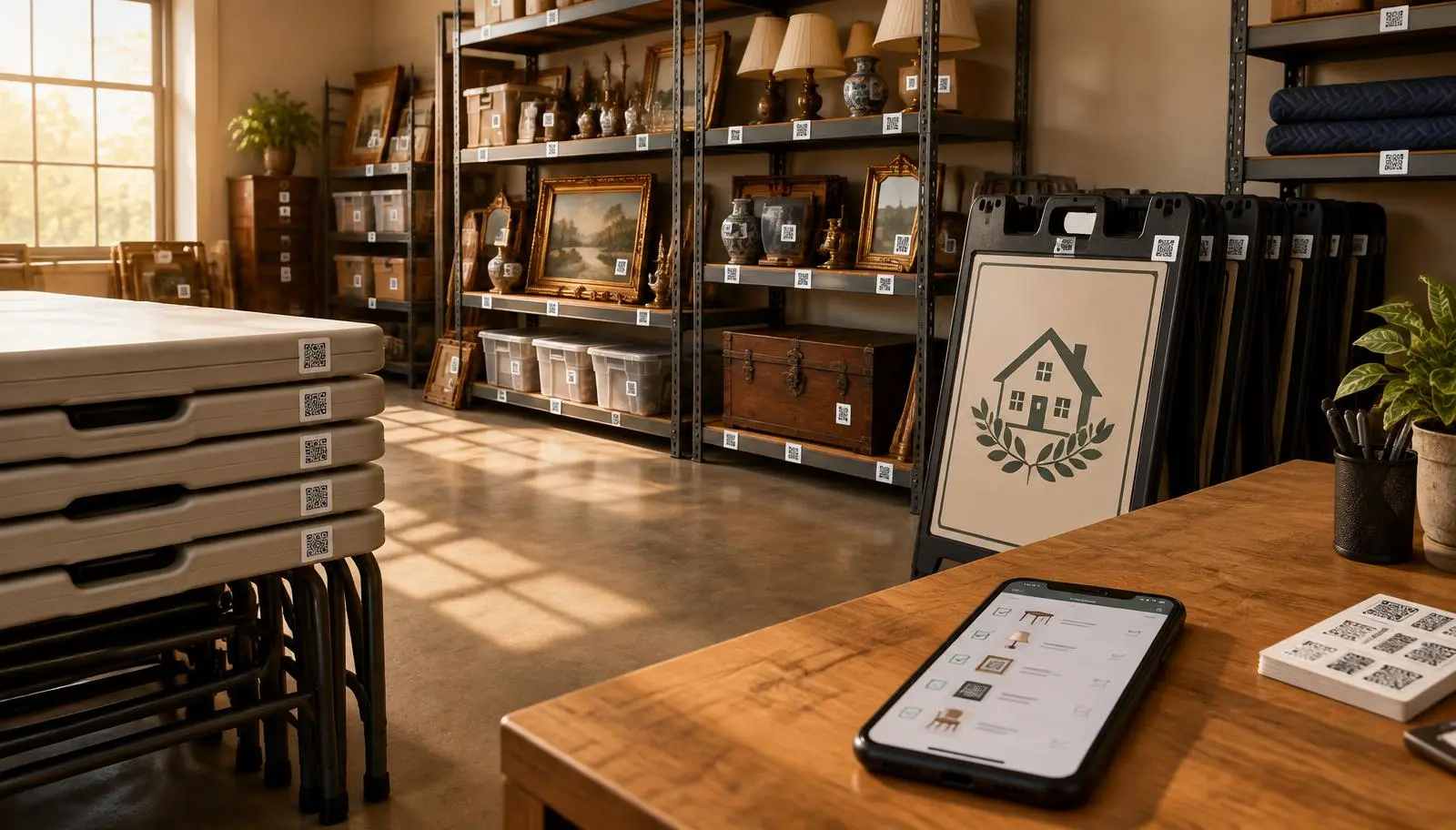
- A camera or phone to photograph everything before tagging.
- A spreadsheet or notebook with columns for Item, Estimated Value, Tagged Price, Sold Price.
- Two color-coded tag systems — one for "firm," one for "open to offers."
- A reference table in the corner for items you need to research before pricing.
That last one is the difference between an amateur and a pro. Anything that might be valuable goes on the reference table — never on the floor untagged, never priced on instinct alone.
Step 2 — Use Ai to Price the 80%
In 2026, you have a tool that didn't exist five years ago: Ai photo appraisal that pulls real sold-comparable data.
Our free Ai Photo Appraiser lets you snap a photo of any item and get:
- Item identification (down to brand and era when possible)
- Estimated price range pulled from real eBay sold listings, Etsy, and Google Shopping
- Suggested estate-sale price (the Ai already does the 30% math for you)
Even better — if you list your sale on EstateSaleFinder, our Ai runs on every photo you upload automatically and pre-prices your entire inventory. You just review and adjust. See our full Ai tools page for everything it can do, or read How to Use Ai to Price Estate Sale Finds in 5 Seconds for the workflow walkthrough.
For the 80% of your inventory that's recognizable (lamps, dishes, furniture, tools, kitchenware), Ai gets you a defensible starting price in seconds. That frees up your brain for the 20% that actually matters.
Step 3 — Hand-Price the 20% That Actually Matters
Some items demand human eyes:
- Jewelry (especially anything that might be karat gold or sterling — test it)
- Original artwork (signatures matter; print vs. original matters more)
- Antique furniture (provenance, maker's marks, hardware)
- Mid-century modern designer pieces (Knoll, Eames, Saarinen, Heywood-Wakefield — Google every label)
- Vintage rugs (handmade vs. machine-made changes value 10x)
- Anything with a maker's mark you don't recognize (always flip it over)
For items in this category, a deeper read of Pricing Antiques: What Sellers Need to Know is required reading. And if you're truly unsure on a piece — pay an appraiser an hour of their time. A $150 appraisal that catches a $4,000 piece is the best money you'll ever spend.
Step 4 — Build the Day-by-Day Discount Plan
The single most powerful pricing tool you have is time.
The standard estate sale discount schedule:
- Day 1 (usually Friday): Full price. Firm.
- Day 2 (Saturday): Full price for first 2 hours, then 25% off everything.
- Day 3 (Sunday): 50% off everything. By 1pm, all reasonable offers accepted.
Tell buyers this schedule upfront. Post a sign at the door. Some buyers will pay full price on Friday because they're afraid the item won't be there Sunday. Others will roll the dice and come back. Both are fine — both put money in your pocket.
Step 5 — Pricing Categories: Quick Reference
Here are 2026 estate-sale-realistic prices for common categories. Adjust for region (coastal cities run 20–30% higher).
Furniture
- Generic dressers, beds, dining tables: $50–$200
- Mid-century pieces with provenance: $300–$1,500
- Vintage upholstered (re-upholstery needed): $25–$75
- Outdoor furniture sets: $75–$300
Kitchen
- Pyrex (vintage colored): $15–$60 per piece, more for rare patterns
- Cast iron skillets (Wagner, Griswold): $35–$120
- Vintage Tupperware: $3–$15
- Crystal stemware sets: $20–$80
- China sets (full service for 8): $60–$200 (sad but true)
Decor
- Mid-century lamps: $40–$200
- Original framed art: $25–$150 (more if signed)
- Brass and silver candelabras: $15–$60
- Vintage clocks: $20–$150
Tools & Garage
- Vintage hand tools (Stanley, Craftsman): $5–$40
- Power tools (working): 30–40% of new retail
- Toolboxes (full): price by the box, $50–$200
The "Just Make It a Buck" Pile
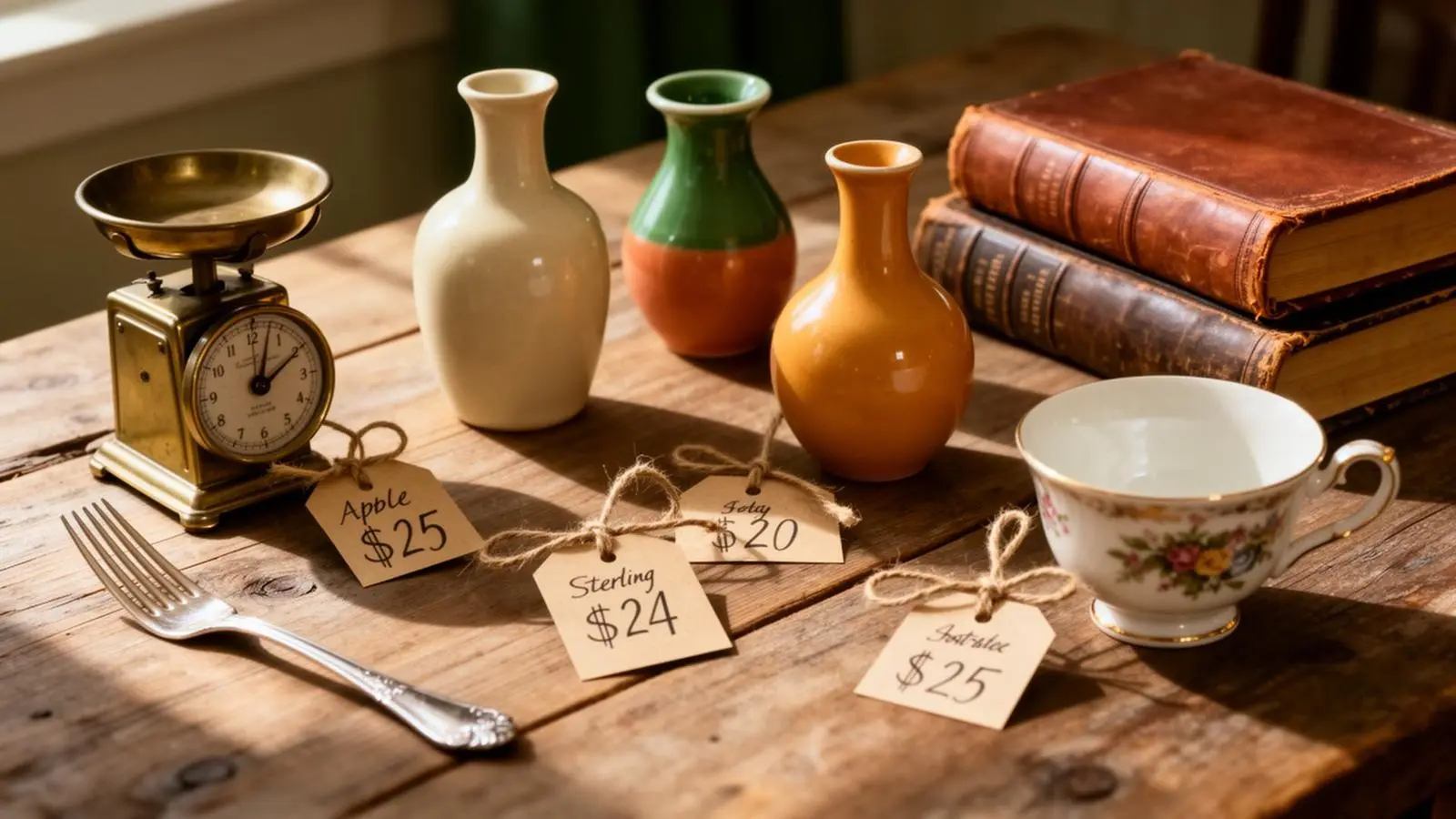
Everything else. Books, knickknacks, costume jewelry, half-used craft supplies — bag-sale them, dollar-each them, or grab-bag them. The goal is gone, not maximized.
For the full hot-and-cold list of what's worth your time to price carefully (and what's not), see What Items Sell Best at Estate Sales (And What Doesn't).
The Soft Skills
Pricing isn't just math. It's also:
- Telling the story. A handwritten note next to an item ("This vase belonged to my grandmother and went with her from Brooklyn to Chicago in 1957") will sell that vase faster than any price tag. Buyers love provenance.
- Being available without hovering. Stand near the cash table. Smile. Answer questions. Don't follow people around.
- Knowing when to say yes to an offer. A buyer offering 80% of your tag price on day 1 is a buyer you say yes to. A buyer offering 50% on day 1 is a buyer you say "let's talk Sunday" to.
Should You Just Hire an Estate Sale Company?
Maybe. If your estate is large, valuable, or emotionally heavy, hiring an estate sale company is often the right call. They handle pricing, staffing, marketing, and cleanup — and most of them know the market a lot better than you do.
But if you're running a small or mid-size sale yourself, the workflow above will get you 90% of what a pro would charge for, at zero commission. Most of our seller plans on EstateSaleFinder are free or under $30/month, which is the most cost-effective way to get the Ai tools and listing reach without giving up 35% of your gross.
A Final Story
Last summer I helped a friend price her late father's estate. We used the Ai tool on every photo. We hand-priced his vintage watch collection with an appraiser. We built a three-day discount plan. We told stories about every weird item.
She made $8,400 in three days. The week before, she'd been Googling "average estate sale revenue" and hoping for $3,000.
The system works. The brass lamp is still out there somewhere, but at least now you won't be the one selling it for $12.
Good luck. Price boldly. Tell stories. And for the love of God, flip the lamp over before you tag it.
Keep exploring
Ready to start your own treasure hunt?
Discover estate sales near you and find incredible deals.
Explore Sales Near Me
About the author
Andy
Founder, EstateSaleFinder.net
Hi, I'm Andy — a retired commercial photographer turned developer with a five-year (and counting) obsession with estate sales. I started EstateSaleFinder.net because I knew there had to be an easier, smarter way to find and list estate sales. Now I get to chase treasure and build the tool I always wished existed.