
Should You Have an Estate Sale or Just Donate Everything? (Here's How to Actually Decide)
Your brother says just donate it all. Your sister says there's real money in the house. You're exhausted and you just want it to be over. Here's the framework that makes this decision simple.
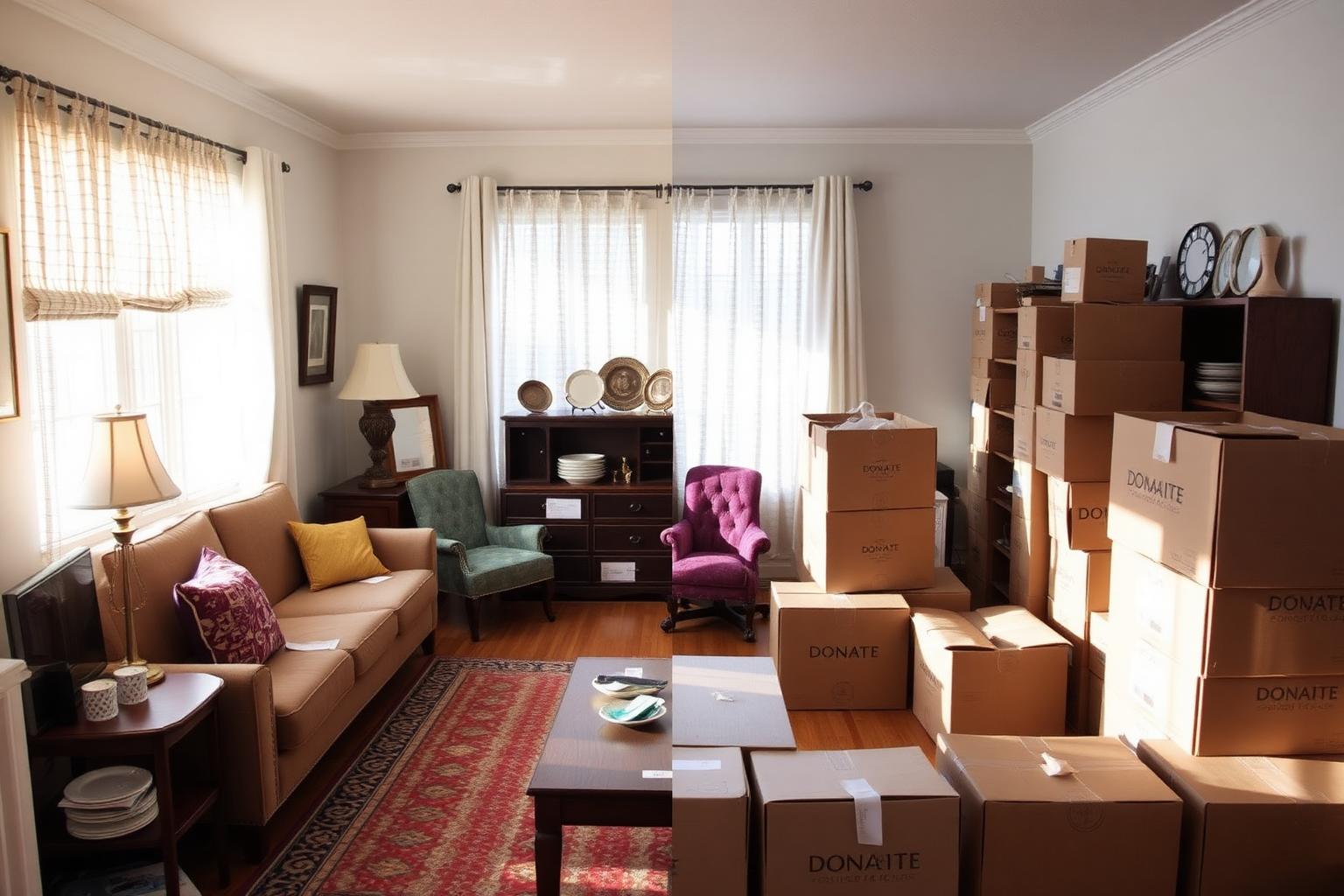
The conversation goes nowhere. Your brother — exhausted, three states away, doing his grieving by trying to make this be over — wants to call a junk hauler and donate everything else. Your sister — practical, local, doing her grieving by getting things right — wants the estate sale company. You're in the middle, and both of them sound right depending on which one is talking.
Both of them are right, partially. The decision isn't a personality test. It's a five-question framework. Let's walk through it.
The Honest Trade-off
Two paths, two honest descriptions:
Estate sale. Four to eight weeks. A professional company handles everything. You receive a check for the gross sale minus their commission (typically 30–50%). A typical 3-bedroom American home grosses $10,000–$40,000 at estate sale, which after commission means the family receives roughly $6,000–$24,000.
Donation. One to three days. Far less emotional labor. A pickup truck takes the contents of the house and you get a tax-deductible receipt with a self-reported value (talk to your accountant about whether and how it actually offsets income — for many families it doesn't help much).
Neither path is wrong. The question is which one your specific situation actually calls for.
The 5 Questions That Make This Decision
Answer these five honestly. The answer becomes obvious.
- Is the estate primarily general household goods, or mostly items with no significant resale value? A typical home with kitchen, furniture, decor, books, tools, garage, and closets — that's estate sale territory. A small studio apartment with mostly IKEA-era basics — donation territory.
- Do you have 4–8 weeks before the house needs to be cleared? Estate sales need that runway. If the listing date is two weeks away and there's no flexibility, options narrow.
- Is a meaningful financial return important to the heirs? Be honest about this with each other. If the estate proceeds will make a real difference to a sibling in financial hardship, $15,000 from an estate sale matters in a way that "the relief of being done" does not match.
- Is anyone physically local who can coordinate with the company? Estate sales work best with a local point of contact. If everyone is out of state, it's still possible — companies can coordinate by phone and video — but it's harder.
- Has anyone with knowledge of antiques, collectibles, or vintage goods walked through the house? This is the silent killer. Families donate without knowing, and lose serious money. Even a 20-minute pass with the Ai photo appraiser on the items in question is enough to flag the obvious value.
If you said yes to questions 1, 2, and 3 — estate sale, almost always. If you said no to 1, 2, and 3 — donation may be the honest answer. If your answers are mixed, the hybrid (below) is the right path.
The Most Common Mistake
Donating things that turn out to be worth real money.
The categories families almost universally underestimate, in rough order of how often I see them given away:
- Vintage Pyrex sets. A complete Spring Blossom or Butterprint set: $200–$400. The Gooseberry promotional pieces can run higher.
- Cast-iron cookware. A vintage Wagner or Griswold pan: $60–$200 each. Multiples add up fast.
- Mid-century furniture. Anything teak, walnut, or stamped Lane / Heywood-Wakefield from the 50s–60s. A single credenza can run $400–$2,000.
- Vintage costume jewelry. Trifari, Coro, Weiss, Eisenberg — even pieces grandma considered "junk" can run $30–$150 each.
- Old tools. Stanley planes, Disston hand saws, vintage Snap-On from the 60s–70s. The garage frequently contains the most undervalued items in the house.
- Vintage linens and quilts. A handmade quilt from before 1970, in good condition: $150–$600.
- Sterling silver. Even single sterling pieces have melt value alone — currently $25–$30 per troy ounce of silver content.
Before you donate anything in these categories, run a free Ai photo appraisal on it first. It takes about 90 seconds per item and pulls real recent comp data.
The Hybrid Answer (Usually the Right One)
Most families should do both, in this order:
- Estate sale first — handle the volume, get the check, process the bulk of the house.
- Donation second — what didn't sell goes to charity, often coordinated by the estate sale company itself as part of haul-away.
The sequence matters. Estate sale → donation works. Donation → estate sale doesn't (because there's nothing left to sell). The estate sale company will tell you straight up: most of what you donate at the end of the process is genuinely low-value items the buyers passed on at $1 each. That's a clean conscience to donate.

The Guilt Factor (Let's Name It)
Many families choose donation because the estate sale feels like selling Mom's stuff to strangers. It feels disrespectful. It feels like a yard sale of someone's life.
That feeling is real and worth honoring. It's also worth examining.
An estate sale isn't a humiliation of someone's belongings. It is, in the actual experience of being there, the opposite. Strangers walk in with reverence — these are people who collect what your mother collected, who recognize the things she chose, who will take her Pyrex bowls home and use them on Sunday mornings the same way she did. The objects continue. They don't end in a landfill or a Goodwill backroom. They go to people who wanted them.
That is not a failure of respect. That is, arguably, the most respectful thing you can do with a life's worth of objects: ensure they go to people who will value them.
When you're ready, find a vetted estate sale company near you.
Keep exploring
Ready to start your own treasure hunt?
Discover estate sales near you and find incredible deals.
Explore Sales Near Me
About the author
Andy
Founder, EstateSaleFinder.net
Hi, I'm Andy — a retired commercial photographer turned developer with a five-year (and counting) obsession with estate sales. I started EstateSaleFinder.net because I knew there had to be an easier, smarter way to find and list estate sales. Now I get to chase treasure and build the tool I always wished existed.