
How to Appraise Estate Sale Items: A Practical 2026 Guide (with Ai Appraiser)
You don't need a certified appraiser to know what something is worth at an estate sale. This is the honest, step-by-step guide to appraising estate sale items in the real world — how to read a maker's mark, where to pull real sold comps, when a pro appraisal is actually worth the money, and how to use the free Ai Appraiser to get an instant, defensible value on almost any item before you buy or sell it.
Appraising an estate sale item is really answering one question: what would a similar item, in similar condition, actually sell for right now? Not what it sold for in 1998. Not what someone is asking on Etsy. What the last real buyer paid a real seller last week. This guide walks you through the exact process appraisers use, then shows you how the free Ai Appraiser does the same work in about ten seconds on your phone — so you can price with confidence whether you're a shopper, a reseller, or a seller running your own sale.
The 5-step appraisal process (what pros actually do)
Every real appraisal — from a certified appraiser to a savvy estate sale runner — follows the same five steps in the same order. Skip one and your value is a guess.
1. Identify the item
Before value comes identity. What is it, who made it, and when? For most estate sale items, identity lives in three places:
- The maker's mark. Flip it over. Pottery, china, silver, and pewter almost always carry a stamp on the underside. A Wedgwood mark, a Sterling stamp, a Roseville signature — each one narrows the field from "old vase" to "1935 Roseville Pinecone." That single detail can swing the value 20x.
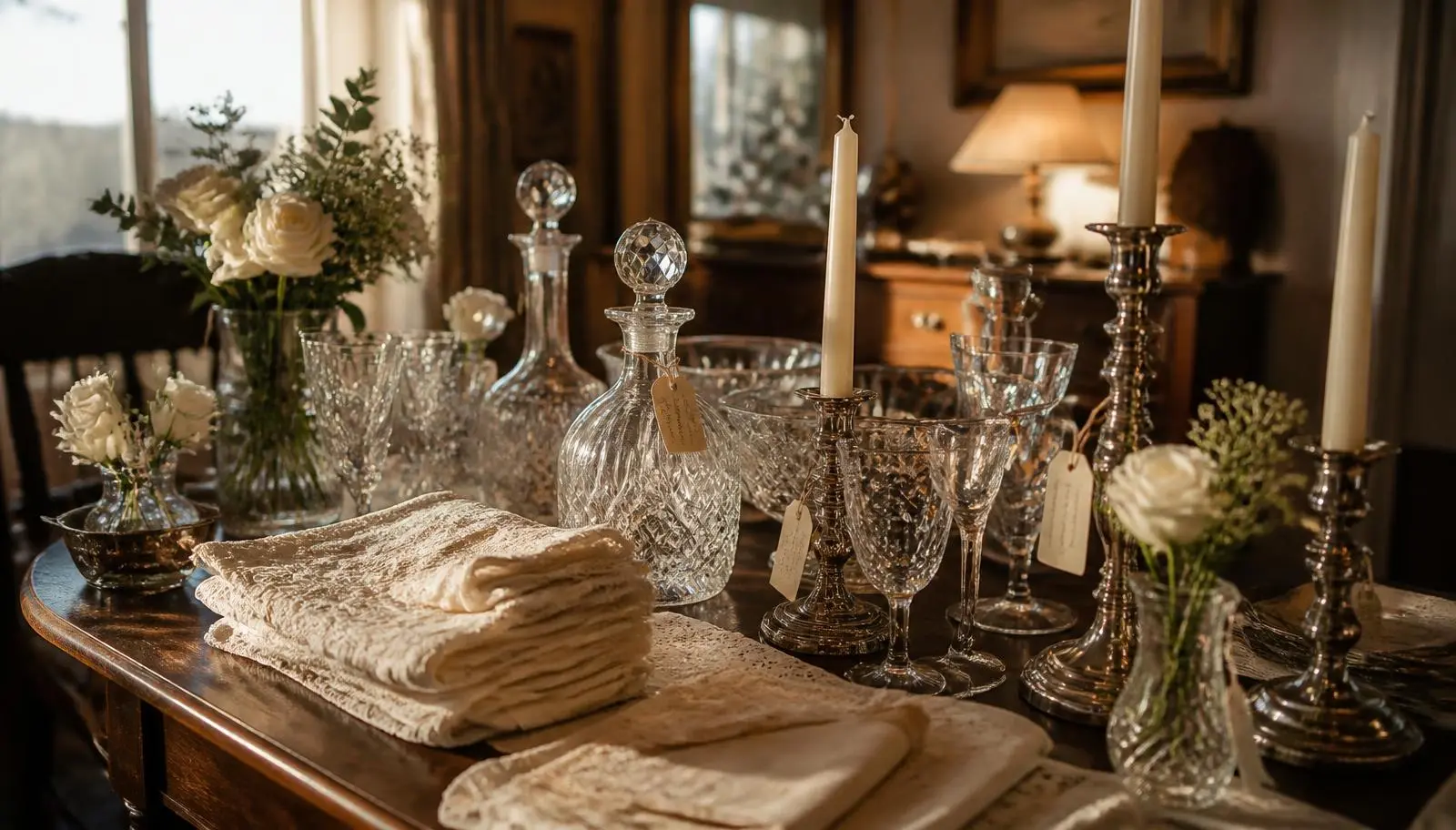
- The style + materials. Solid brass vs plated. Real wood vs veneer. Cut lead crystal vs pressed glass. Learn to feel the difference and you'll skip 90% of low-value items on sight.
- The details. Signatures on paintings. Model numbers on electronics. Patent dates on tools. Hallmarks on jewelry. These are the fingerprints.
2. Assess condition — honestly
Condition is the single biggest value multiplier. A pristine mid-century lamp is worth 5x the same lamp with a hairline crack in the base. Use this scale:
- Mint — looks like it left the factory. Original box a bonus.
- Excellent — minor age, no damage, no repairs.
- Good — light wear, small nicks, still fully usable.
- Fair — visible damage, chips, cracks, missing pieces.
- Poor — parts only.
Be brutal. Every collector will be.
3. Pull sold comps (not asking prices)
This is the step everyone gets wrong. Asking prices tell you what someone hopes to get. Sold prices tell you what someone actually paid. The gap is often 3x.
The pro sources:
- *eBay → search the item → filter Sold Items + Completed.* The most reliable free comp database on earth. Look at the last 90 days, ignore outliers, take the median.
- WorthPoint (paid) — 15+ years of sold comps across eBay, Christie's, and Heritage. Worth it if you appraise weekly.
- LiveAuctioneers / Invaluable — for anything that would sell at a real auction house.
- Etsy Sold (harder to see, but possible via the item URL trick) — good for handmade and Victorian smalls.
Three real comps beat one educated guess every single time.
4. Adjust for your market
A $200 Stiffel lamp on eBay in New York is a $60 Stiffel lamp on a folding table in Tulsa on a Saturday morning. Estate sale prices live in a specific market with specific math:
- Buyers can't return anything.
- Buyers do the loading and hauling.
- Buyers came for a deal, not retail.
- Items need to be gone by Sunday.
The rule of thumb every estate sale pro knows by heart: most items should be priced at 25–35% of their sold-comp value. More on this in our pricing playbook.
5. Decide when to escalate to a certified pro
For 95% of estate sale items, steps 1–4 (or the Ai Appraiser) are more than enough. Call a certified appraiser when:
- The item is likely worth over $2,500.
- You need the number in writing for insurance, IRS, or probate court.
- The item is a signed artwork, rare instrument, fine jewelry, or a designer piece.
A one-hour verbal appraisal typically runs $75–$200. Written formal appraisals run $250–$500+. Worth every penny on a real find. Never worth it on a $40 lamp.
The fast lane: how the Ai Appraiser does all five steps in ten seconds
The five-step process is exactly what our free Ai Appraiser automates. Snap a photo, and it:
- Identifies the item using vision AI trained on antique categories, maker's marks, and patterns.
- Assesses condition from the photo (dents, chips, wear, missing pieces).
- Pulls live sold comps from the eBay Browse API — real completed sales, last 90 days, sorted by relevance.
- Adjusts for market context — retail vs eBay vs estate sale price bands.
- Gives you a defensible price range you can quote to a client, list at, or offer against.
It's free for buyers, and Pro sellers get unlimited appraisals plus a Deep Research mode that pulls maker history, era-specific notes, and reseller strategy. No credit card, no downloads — it runs in the browser.
Try it on the next item that makes you hesitate: estatesalefinder.net/ai-appraiser.
Common appraisal mistakes to skip
- Trusting asking prices. Zero people are being paid the asking price. Filter for Sold every time.
- Averaging one great sale with 100 bad photos. One high sold price often means one incredible photo, not a high market. Take the median.
- Ignoring condition. A hairline crack is 60% off. Missing lid: 80% off. Repro anything: 90% off.
- Assuming old = valuable. Almost none of Grandma's china is worth what she paid. That's fine — some of it still is.
- Skipping the maker's mark. Two minutes with a phone light saves you 200% of the correct value.
Bottom line
Real appraisal is identity → condition → sold comps → market adjustment → escalate if needed. Do it manually until you can do it in your sleep, or run it through the Ai Appraiser and get all five steps in ten seconds. Either way — never buy or price an estate sale item on a hunch again.
Keep exploring
Ready to start your own treasure hunt?
Discover estate sales near you and find incredible deals.
Explore Sales Near Me
About the author
Andy
Founder, EstateSaleFinder
Hi, I'm Andy — a retired commercial photographer turned developer with a five-year (and counting) obsession with estate sales. I started EstateSaleFinder.net because I knew there had to be an easier, smarter way to find and list estate sales. Now I get to chase treasure and build the tool I always wished existed.