
Do You Need an Appraisal Before an Estate Sale? Probate Inventories, Date-of-Death Value, and When the Sale Price Counts
Usually you don't need a formal appraisal before an estate sale. You may need one for probate inventories, valuable items, heir disputes or an estate tax return. Here's appraisal vs. company pricing, how Ohio, Washington and California differ, date-of-death value, and how to document the sale.
Usually, no. Most families don't need a formal appraisal before an estate sale. You may need one if the estate is in probate and the court requires values, if the household includes high-value items like jewelry or art, if heirs disagree, or if a federal estate tax return is required. In those cases, get values before items are sold.
That's the short answer. The details depend on your state, your court and the size of the estate. This guide explains the difference between a formal appraisal and an estate sale company's pricing, how a few states handle it, when the sale price itself can count as the value, and how to keep records that protect you as the executor.
Important: this is not legal or tax advice. This article is general information only. Laws, court rules and forms change, and they vary by state and county. Always verify everything here with your estate's attorney, your probate court or a tax professional before you sell, value or give away anything. Reading this article does not create an attorney-client relationship.
Quick summary for skimmers:
- Most estate sales happen without a formal appraisal. The company's pricing is for selling, not for court.
- Probate can change that. Many states require an inventory with values, often as of the date of death.
- Some states let the sale price count. Washington says that when personal property is sold before appraisal, "the sale price shall be deemed the value for appraisal."
- Valuable items need more care. For federal estate tax returns, the IRS requires an expert appraisal under oath when valuable articles total more than $3,000.
- Document everything: photos before the sale, the company's itemized sales report, and your settlement.
Do you need an appraisal before an estate sale?
For most households, no. An estate sale company prices items to sell, and the final sales report shows what each item brought. If nobody is asking for a court-ready value, that's usually enough.
You should talk to the estate's attorney about an appraisal before the sale if any of these apply:
- The estate is in formal probate and the court requires an inventory with values.
- There are valuable items: fine jewelry, coins, sterling silver, signed art, oriental rugs, antiques, firearms or collections.
- Heirs disagree about value, or one heir wants to buy items from the estate.
- The estate may owe federal or state estate tax, or must file a federal estate tax return.
- An item will be donated and someone plans to claim a large tax deduction.
- Insurance or a lawsuit needs a documented value.
If you're not sure whether the estate is in probate at all, start with can you have an estate sale during probate?
Formal appraisal vs. estate sale company pricing
They sound alike, but they answer different questions.
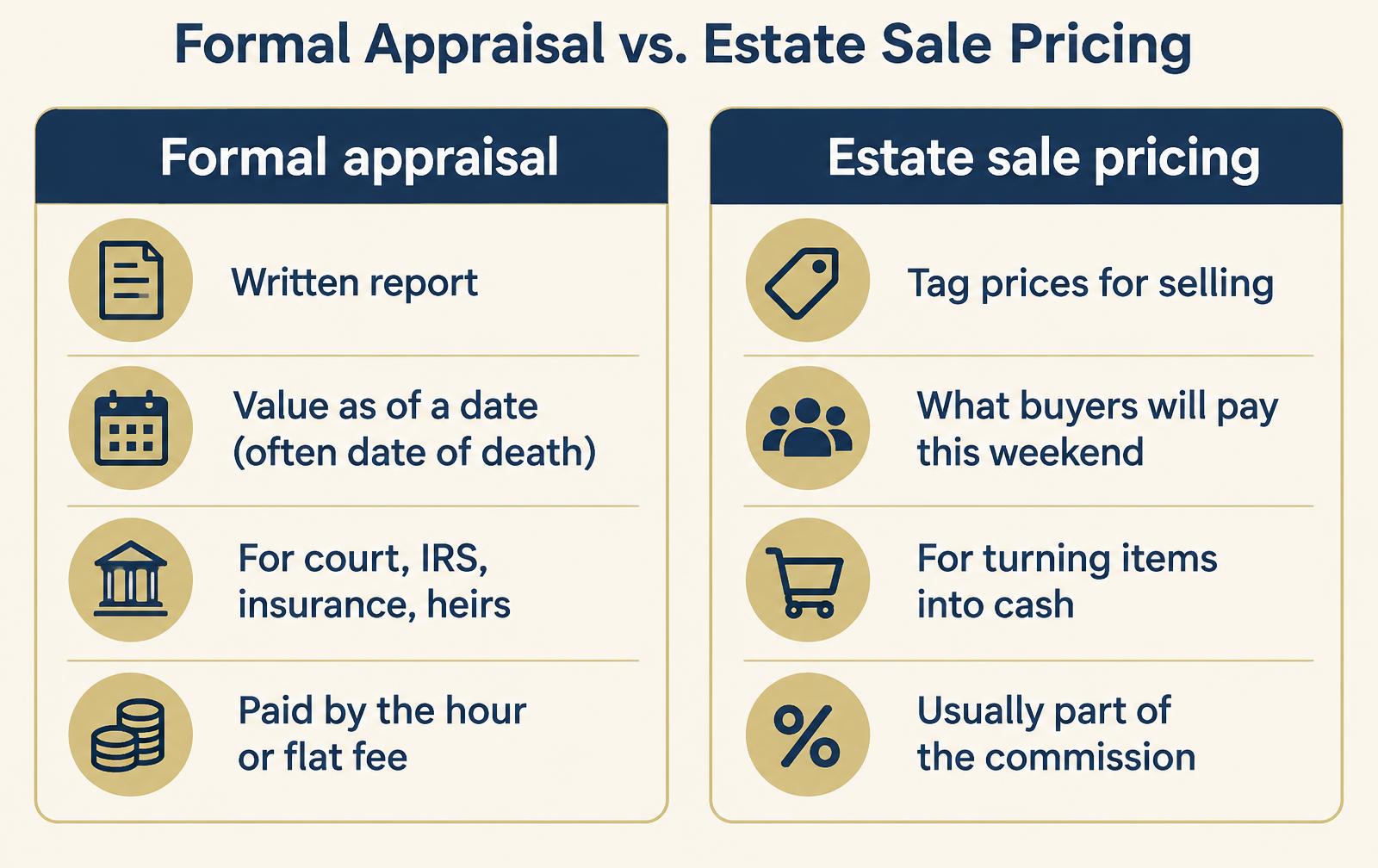
| Formal appraisal | Estate sale company pricing | |
|---|---|---|
| Purpose | Document value for court, tax, insurance or heirs | Sell items quickly at a fair price |
| Output | A written, signed report | Price tags and a sales report |
| Value date | A specific date, often the date of death | This weekend's market |
| Who does it | A qualified appraiser or, in some states, a court-appointed person | The company's staff |
| Cost | Separate fee | Usually included in the commission |
An estate sale company's prices aren't an appraisal, and most companies will say so. But their itemized sales report is a real record of what items sold for in an open market, and in some situations that's exactly what an executor needs. For how companies set tag prices, see how to price items for an estate sale.
What is date-of-death value?
Date-of-death value is what an item was worth on the day the person died. Probate inventories and estate tax returns usually use it.
Federal estate tax rules define it as fair market value: "the price which a willing buyer would pay to a willing seller, neither being under any compulsion to buy or to sell and both having reasonable knowledge of relevant facts" (26 CFR 20.2031-6). An estate sale held a few months later, open to the public and properly advertised, is often good evidence of that value for ordinary household goods. Ask your attorney whether it will be accepted in your case.
How state probate rules differ: three examples
Every state handles this its own way. These three show the range. Always check your own state and county.
Ohio: inventory with date-of-death values; appraisal unless value is readily ascertainable
In Ohio, the executor must file an inventory within three months of appointment, and it "shall set forth values as of the date of death of the decedent." The statute adds: "Any asset, the value of which is readily ascertainable, is not required to be appraised but shall be included in the inventory" (Ohio Revised Code 2115.02). Property that does need appraising is appraised by "one suitable disinterested person" appointed by the executor and approved by the court, unless the court dispenses with it (Ohio Revised Code 2115.06). Ohio's Inventory and Appraisal form includes an appraiser's certificate.
Washington: the sale price can be the value
Washington law is unusually clear for estate sales: "Where personal property is sold prior to appraisement, the sale price shall be deemed the value for appraisal" (RCW 11.56.020). The same section lets a court order personal property sold at public or private sale. For a Washington executor, a well-run estate sale and a detailed sales report can do much of the valuation work.
California: inventory and appraisal, with a probate referee for many assets
In California, the personal representative files an Inventory and Appraisal (form DE-160), which "tells the court what property is owned by the estate and approximately how much it is worth" (California Courts Self-Help). The form has separate totals for items valued by the representative and items valued by a probate referee. The court's self-help site lists fees "to have an appraiser such as a probate referee value property" as a typical probate cost (California Courts: formal probate). Ask the estate's attorney which items the referee must value before you sell.
| State | Inventory values | Formal appraisal | Sale price as value |
|---|---|---|---|
| Ohio | Date of death | Required unless value is readily ascertainable or the court dispenses with it | Not stated in the inventory statute |
| Washington | Appraised value | Can be avoided for items sold first | Yes, if sold before appraisal |
| California | Approximate value on DE-160 | Probate referee values many assets | Ask your attorney |
Sources for the table are the Ohio, Washington and California links above.
When does the IRS require an appraisal?
Most estates don't file a federal estate tax return. The IRS lists the current filing threshold on its estate tax page. When a return is filed, household goods are valued at fair market value, and a room-by-room list is "desirable." Items in the same room worth $100 or less each can be grouped.
The big rule for estate sales: if the household includes "articles having marked artistic or intrinsic value of a total value in excess of $3,000 (e.g., jewelry, furs, silverware, paintings, etchings, engravings, antiques, books, statuary, vases, oriental rugs, coin or stamp collections), the appraisal of an expert or experts, under oath, shall be filed with the return" (26 CFR 20.2031-6).
So if a return is required and the estate includes a coin collection or a few paintings, get those appraised before they're sold.
When the sale price counts as the value
A sale price is strongest as evidence of value when:
- The sale was public and advertised. Lots of buyers, not a quiet sale to a relative.
- It happened reasonably soon after the date of death.
- Items were priced by an independent professional, not by an heir who wanted to buy them.
- You have an itemized record showing each item (or group) and its price.
- State law or the court accepts it, as Washington's statute does.
It's weakest when an heir or the executor bought items cheaply, when the sale was months or years later, or when valuable items were sold in bulk without being identified.
How to document an estate sale for the court and heirs
Whatever your state, these records protect you:
- Photograph every room before anything moves. Wide shots plus close-ups of valuables, marks and signatures.
- Make a simple list of items you think may be valuable. A free tool like our Ai Appraiser can help you identify what something is and give a suggested range. It's a starting point, not an appraisal.
- Get formal appraisals first for anything the attorney flags.
- Use a written contract with the estate sale company that names the estate and the executor.
- Ask for an itemized sales report and the final settlement statement. Companies that use a digital register can usually export one.
- Keep heir purchases separate, at tag price or appraised value, with receipts.
- Keep donation receipts and a list of what was donated or hauled away.
- Share the records with heirs early. Most disputes start with surprise.
For the steps that come first, see estate sale after a death: what to do first.
For estate sale companies: answering "do we need an appraisal?"
Families ask this on almost every probate job. A good answer is honest and short: "We price to sell, and we'll give you an itemized sales report. If your attorney or the court needs appraised values, especially for jewelry, coins or art, get those before the sale. We can set those items aside."
Itemized records are where companies earn trust. On EstateSaleFinder, the sale register records each checkout and payment, and the ledger groups sales by day, so you can hand the executor a clean report. List your company so executors and attorneys can find you.
How EstateSaleFinder helps executors
- Find a company that handles probate sales in our estate sale company directory, or get matched.
- Understand costs with how much estate sale companies charge.
- Check what things are with the Ai Appraiser. Its prices are suggestions, not appraisals.
FAQ
Do you need an appraisal before an estate sale?
Usually not. You may need one if the estate is in probate and the court requires values, if there are valuable items, if heirs disagree, or if an estate tax return is required. Ask the estate's attorney before the sale.
How do you appraise estate sale items?
For selling, companies research sold prices for similar items. For court or tax purposes, hire a qualified appraiser. Our guide on how to appraise estate sale items explains sold-comp research.
What is the date of death value of personal property?
It's the fair market value on the day the person died: what a willing buyer would pay a willing seller, both knowing the relevant facts. Probate inventories and estate tax returns often use it.
Can an estate sale price be used as the appraised value?
Sometimes. In Washington, if personal property is sold before appraisal, the sale price is deemed the value. In other states, a public, well-documented sale is often good evidence. Ask your attorney.
Does the IRS require an appraisal of household items?
Only when a federal estate tax return is filed. Then, if valuable articles like jewelry, silver, art or collections total more than $3,000, an expert appraisal under oath must be filed with the return.
Is an estate sale company's pricing the same as an appraisal?
No. A company prices items to sell. An appraisal is a written report of value as of a specific date, used for court, tax, insurance or heirs.
Related reading
Not legal advice. Laws quoted were checked October 24, 2026, and can change. Always verify with a licensed attorney in your state, your probate court or a tax professional before acting.
Keep exploring
Ready to start your own treasure hunt?
Discover estate sales near you and find incredible deals.
Explore Sales Near Me
About the author
Andy
Founder, EstateSaleFinder.net
Hi, I'm Andy — a retired commercial photographer turned developer with a five-year (and counting) obsession with estate sales. I started EstateSaleFinder.net because I knew there had to be an easier, smarter way to find and list estate sales. Now I get to chase treasure and build the tool I always wished existed.