


Do You Pay Taxes on Estate Sale Proceeds? Stepped-Up Basis, Sales Tax & the 1099-K, Explained (2026)
Heirs usually owe no income tax on estate sale proceeds thanks to stepped-up basis. The three taxes people confuse, a worked example, the 2026 1099-K rule, how states handle sales tax, and an executor's records checklist.
Usually not. Heirs who sell inherited items at an estate sale usually owe no income tax, because the items get a new tax "basis" equal to their value on the date of death, and estate sale prices rarely go above that. The federal estate tax only touches estates over $15 million per person in 2026. Sales tax is different: in many states the estate sale company must collect it from buyers.
That's the short answer. This guide explains the three taxes people mix up, shows a worked stepped-up basis example, covers when a Form 1099-K shows up, explains how states handle sales tax at estate sales, and gives executors a records checklist.
Quick summary for skimmers:
- Income tax: you're taxed only on a gain. Gain = sale price minus the item's value on the date of death. For most household contents, that's zero.
- Estate tax: a tax on the whole estate, not on the sale. The 2026 federal exemption is $15 million per person, so almost no family pays it.
- Sales tax: paid by the buyer. Whether it's collected depends on your state and on who runs the sale.
- Form 1099-K: payment apps and marketplaces file one only above $20,000 and more than 200 payments in a year. It reports payments, not profit.
- Keep records: a date-of-death inventory and the company's settlement report are what prove there was no gain.
This is general information, not tax or legal advice. Tax rules change and vary by state. Talk to a CPA or tax attorney about your situation.
Do you pay taxes on estate sale proceeds?
In most cases, no income tax is due. The reason is a rule called stepped-up basis.
"Basis" is the number the IRS subtracts from your sale price to figure out whether you made money. Normally it's what you paid. For inherited property, federal law resets the basis to the property's fair market value on the date the owner died (26 U.S. Code § 1014, Cornell Law). The IRS explains the same rule for heirs and executors in Publication 551, Basis of Assets (IRS Pub. 551) and Publication 559, Survivors, Executors, and Administrators (IRS Pub. 559).
Used furniture, dishes, clothes, tools and decor are almost always worth less on the resale market than people expect. An estate sale prices things to sell within a few days. So the sale price is usually at or below the date-of-death value, and there's no gain to tax.
The exceptions are items that were worth much more than the estate valued them at, or that rose in value between the death and the sale. Think gold and silver after a price jump, a painting by a known artist, a rare coin collection, or a classic car. Those are the items to have appraised and to discuss with a CPA.
The three taxes people confuse
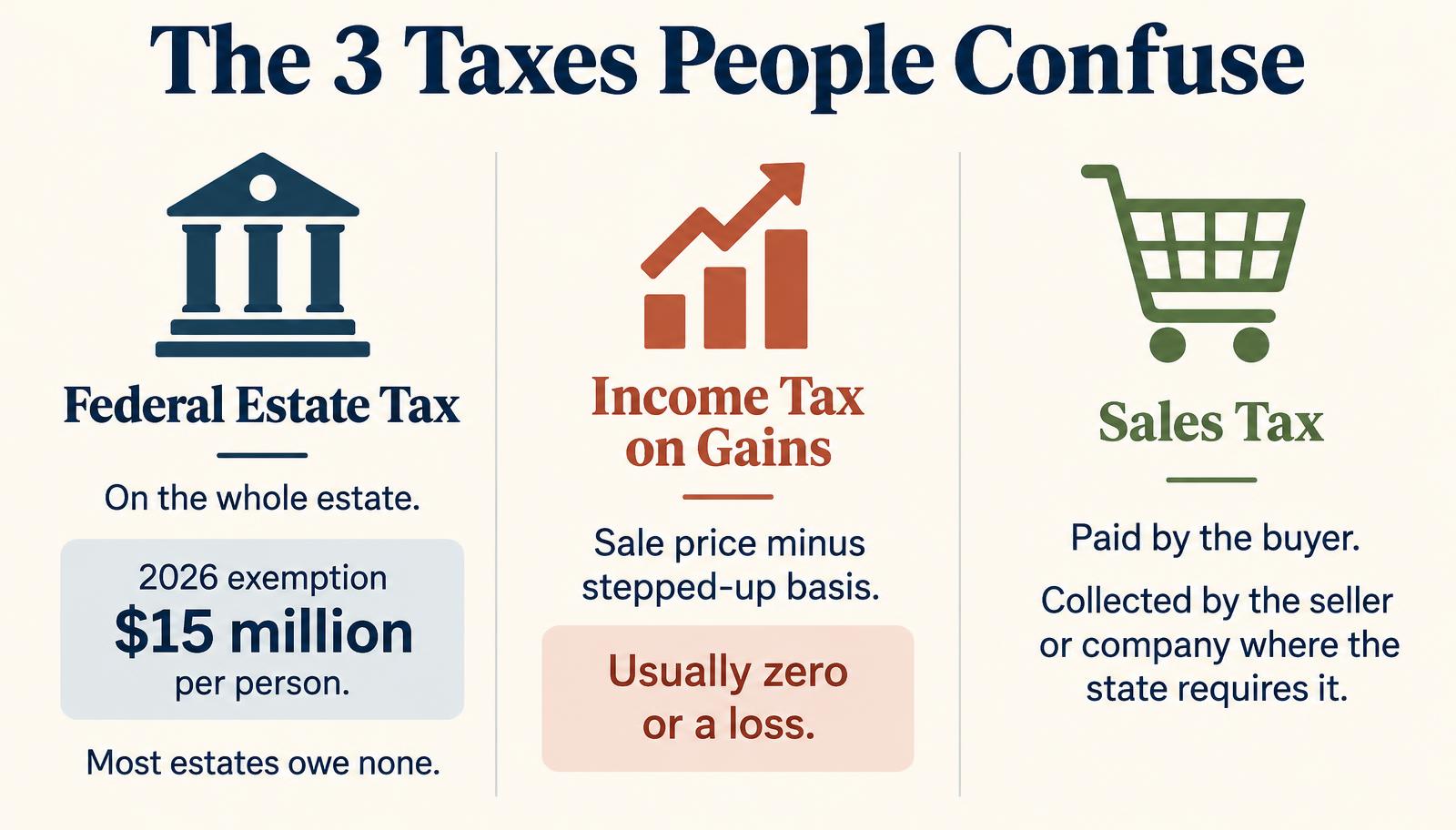
When someone asks "do I pay tax on the estate sale," they usually mean one of three different taxes.
| Tax | Who pays | What it's based on | Does it usually apply to an estate sale? |
|---|---|---|---|
| Federal estate tax | The estate | The total value of everything the person owned at death | Only above $15 million per person in 2026 |
| Income tax on gains | The estate or the heir who sells | Sale price minus date-of-death value | Rarely, because prices are usually lower |
| Sales tax | The buyer | Each purchase | Depends on the state and who runs the sale |
The IRS confirms the federal estate tax basic exclusion amount is $15,000,000 for people who die in 2026, under the One, Big, Beautiful Bill passed in 2025 (IRS: What's new — Estate and gift tax). Some states have their own estate or inheritance taxes with much lower limits, so check your state if the estate is large.
The estate tax is figured on the value of the estate, whether or not anything is sold. Selling the contents doesn't create the tax, and it doesn't avoid it.
How stepped-up basis works: a worked example
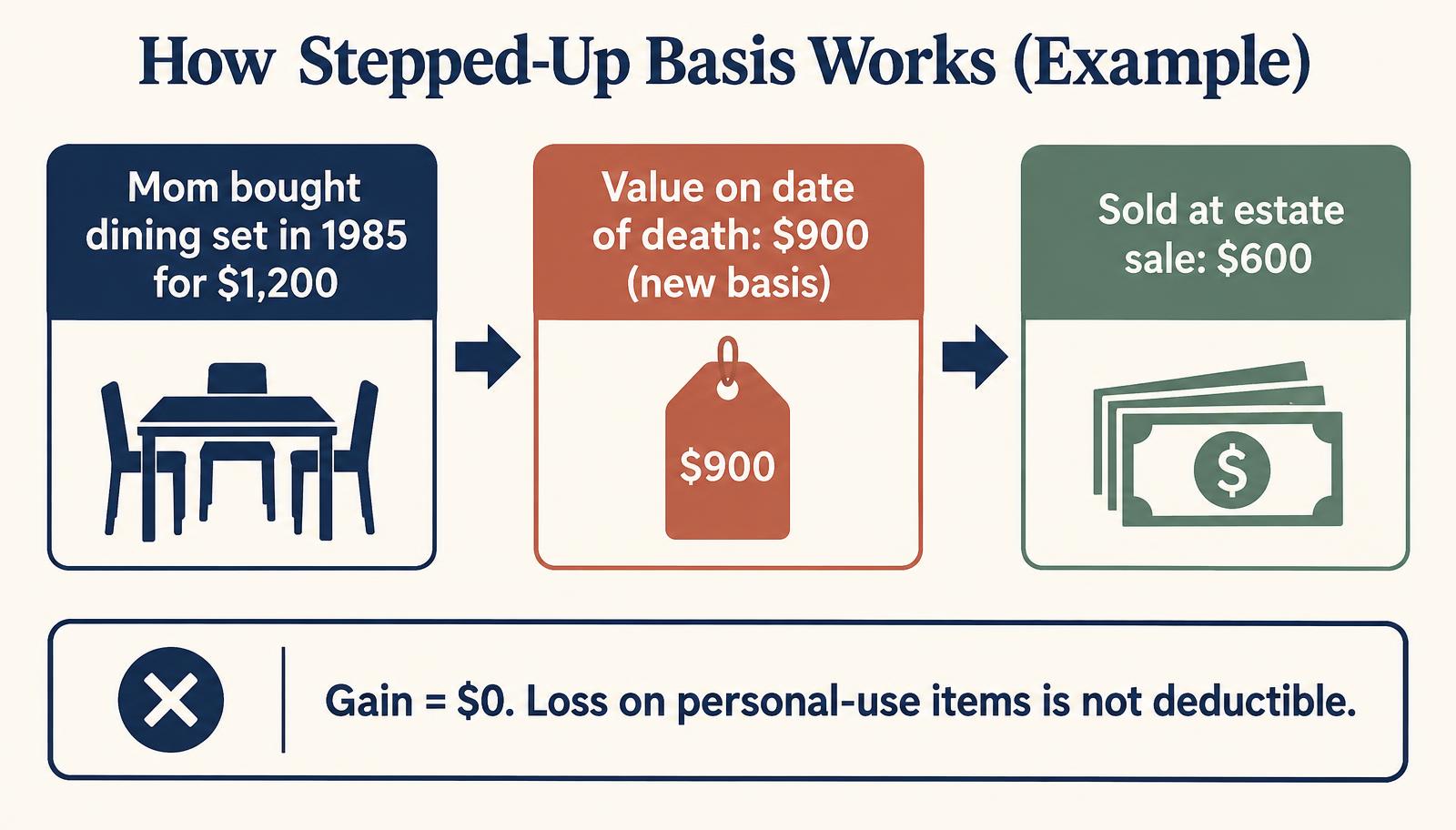
Here's a hypothetical example with round numbers.
- In 1985, Mom bought a dining set for $1,200.
- When she died, a set like it was selling for about $900. That's the new basis.
- At the estate sale, it sold for $600.
Gain: $0. The sale price ($600) is below the basis ($900). There's nothing to tax.
Now a second example, where tax can come up:
- Dad inherited a small collection of silver coins. On the date of his death, they were worth $4,000 at melt.
- Silver prices climbed, and eight months later the coins sold for $5,500.
- Gain: $1,500. That gain is taxable.
Two details help here. First, the IRS treats inherited property as held long-term no matter how quickly it's sold, so gains get long-term capital gains treatment (IRS Pub. 551). Second, collectibles such as coins and precious metals can be taxed at a different long-term rate than stocks (IRS Topic 409). A CPA can tell you which rate applies.
What about a loss? Most estate sale items sell below their date-of-death value. Whether that loss can be deducted depends on facts like whether the heir used the items personally after the death. Losses on personal-use property generally aren't deductible (IRS Topic 409). Ask your CPA before claiming one.
How do you prove the date-of-death value?
You don't need a formal appraisal of every dish. But you do need a reasonable, written basis for what things were worth. Good evidence includes:
- A dated photo inventory of the house taken soon after the death.
- Appraisals for jewelry, art, coins, guns, vehicles and collections.
- The estate sale company's itemized results, which show what similar things actually sold for.
- Printouts of comparable sold listings for big-ticket items.
Our guide to whether you need an appraisal before an estate sale explains when a formal appraisal is worth paying for. If you're still sorting through things, read valuing inherited items before giving away a fortune first. EstateSaleFinder's Ai Appraiser can give a quick suggested value and comparable listings to help you decide which items need a professional. It's a suggestion, not a formal appraisal.
Will you get a 1099-K for estate sale income?
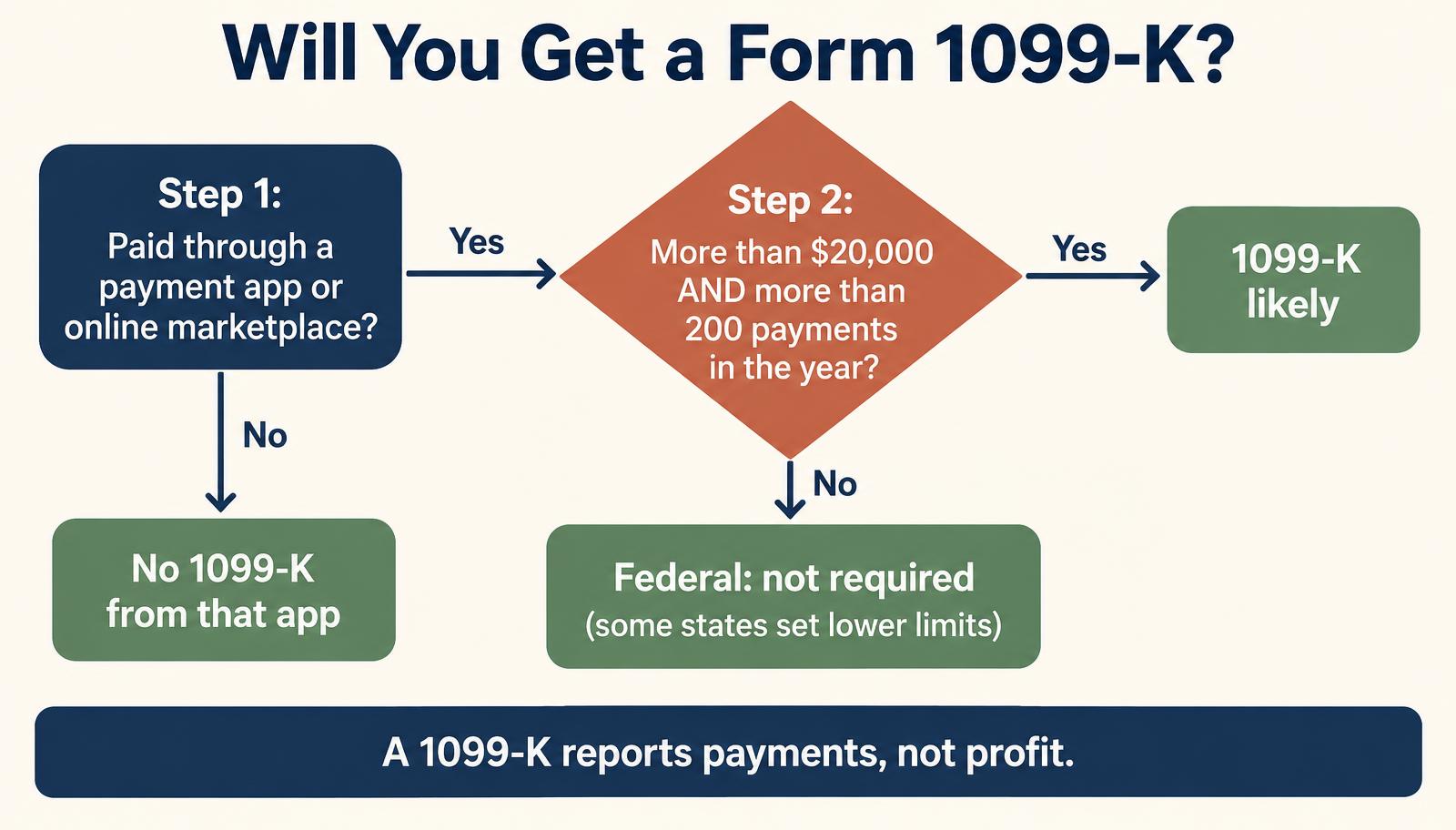
Form 1099-K is a form payment apps and online marketplaces send to the IRS. It reports the gross payments you received for goods.
The rule for 2026: payment apps and online marketplaces, which the IRS calls third-party settlement organizations, must file a 1099-K only when payments to you top $20,000 and more than 200 transactions in the year. The One, Big, Beautiful Bill restored that threshold retroactively, replacing the lower limits that had been phasing in (IRS IR-2025-107). The IRS also publishes updated 1099-K FAQs (IRS Fact Sheet 2025-08).
What this means in practice:
- If an estate sale company runs the sale, card payments are usually made to the company's account, not yours. The company pays the estate from its proceeds under your contract.
- If you sell items yourself on a marketplace or through a payment app, you could get a 1099-K if you cross both limits. A few states set lower state reporting limits, so check yours.
- Payment card processors follow separate rules from payment apps. Ask the processor or a CPA if you take cards directly.
- A 1099-K is not a tax bill. It reports gross payments. You still subtract your basis, so a 1099-K for $25,000 of inherited items sold below their date-of-death value can still mean no gain. The IRS explains how to report that on its page for what to do with Form 1099-K.
Do you charge sales tax at an estate sale?
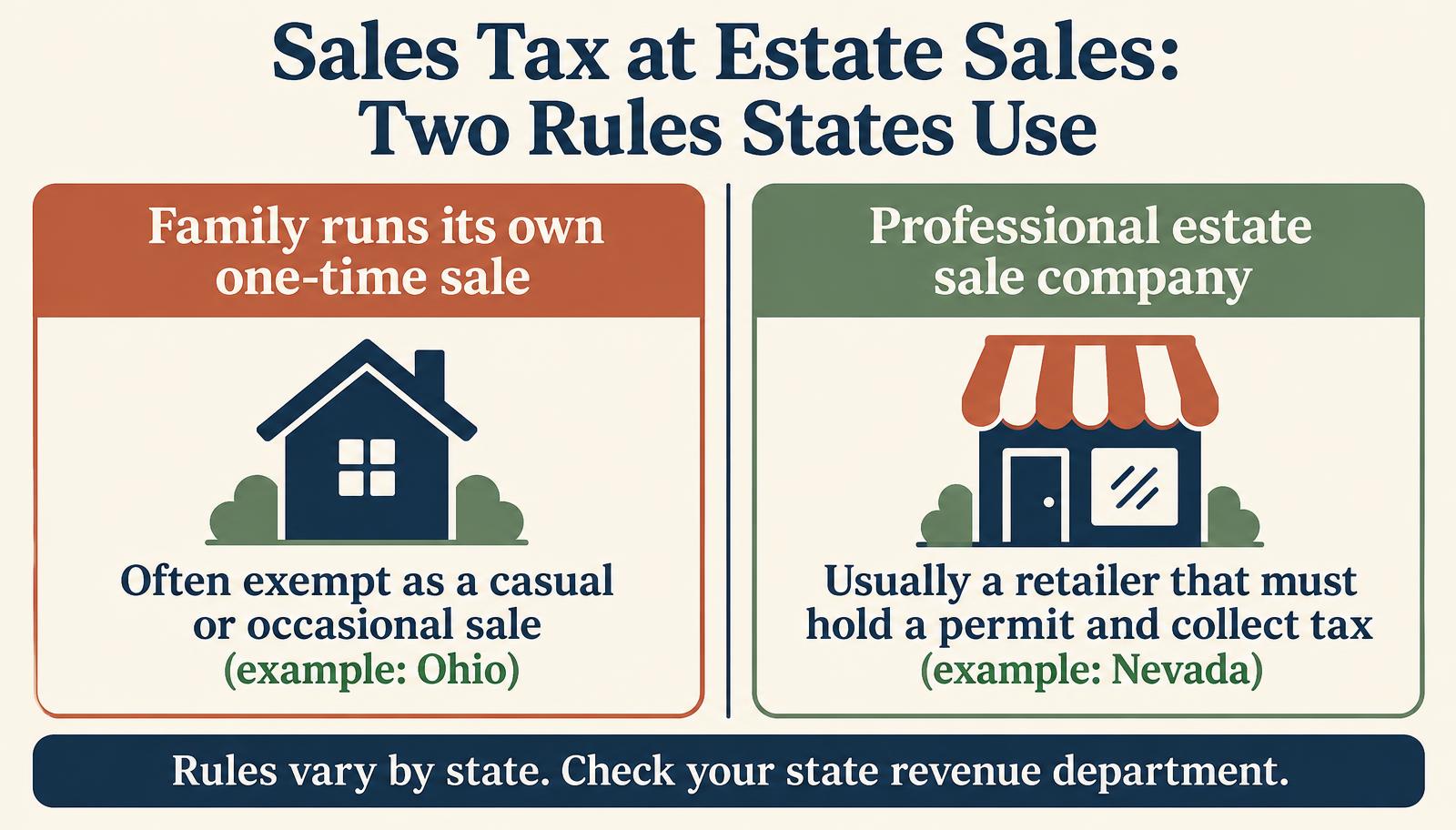
It depends on your state and on who runs the sale. States that have a sales tax usually draw a line between a person making an occasional sale of their own things and a business that sells regularly.
Here's how four state tax agencies describe it:
| State | What the state says | Source |
|---|---|---|
| Ohio | An executor holding an estate sale at the person's home is making a "casual sale" that's exempt. A business regularly selling must collect. | Ohio Dept. of Taxation, ST 2025-01 |
| Nevada | Auction companies and estate sellers are retailers that must register and collect. The occasional-sale exemption does not apply to them. | Nevada Tax Bulletin SUT 13-0001 |
| Idaho | Most sellers need a permit. The occasional-sale exemption is narrow: two or fewer sales in 12 months, and you can't be in the business of selling. | Idaho State Tax Commission |
| Minnesota | Has an "isolated and occasional sale" exemption and a dedicated section on estate sales; the exemption doesn't apply to sales made in the normal course of a business. | Minnesota Revenue Fact Sheet 132 |
Tennessee also publishes a manual for auctioneers and consignees that covers who collects and when occasional sales are exempt (Tennessee Department of Revenue).
Why we don't show a 50-state table
rules depend on details like whether the company acts as your agent, local add-on taxes and how often sales happen. We'd rather point you to your state's revenue department than publish a summary that's wrong for your county. Search "[your state] occasional sale exemption estate sale" on your state's official tax site.
What this means for you
- Hiring a company? Ask: "Do you hold a sales tax permit, and do you collect and file sales tax on my sale?" A professional company in a state that taxes these sales should say yes, and the tax should appear on the settlement report as a separate line, not as part of your proceeds.
- Running it yourself? Check whether your state treats a one-time family sale as exempt. If you run sales often, you may count as a business.
- Sales tax isn't income. Tax collected from buyers belongs to the state. It shouldn't be counted as money the estate earned.

For estate sale companies: report tax and fees separately
If you run sales professionally, your clients and their CPAs need to see four numbers clearly: gross sales, sales tax collected, card processing fees and your commission. Mixing them makes it look like the estate earned more than it did.
EstateSaleFinder's register and sale ledgers show sales tax and card fees as separate lines, so the settlement you hand the family matches what the executor reports. You can also list your sales so buyers find them.
Executor's records checklist
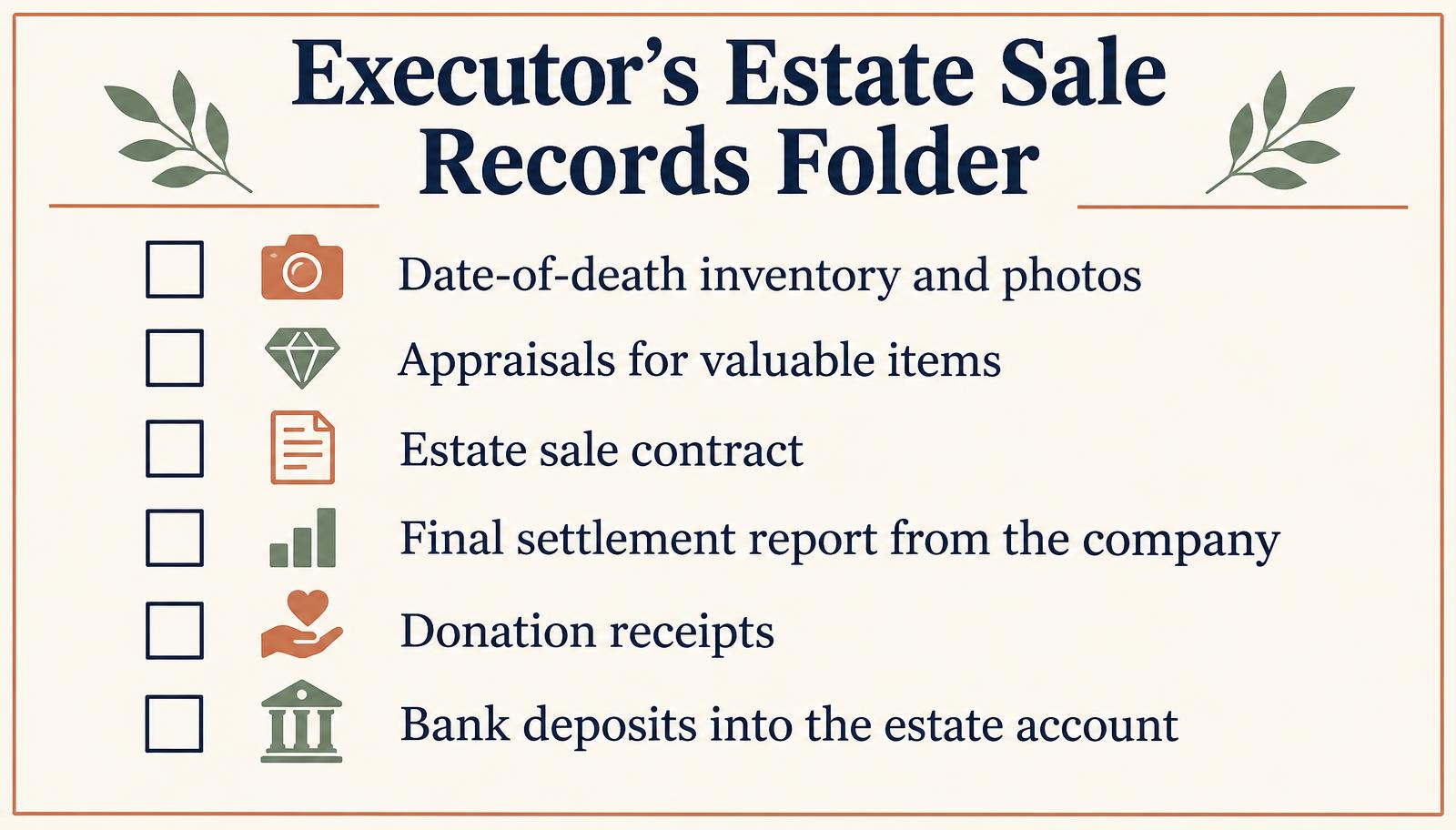
Keep all of this in one folder, paper or digital:
- Date-of-death inventory with photos of every room, closets, garage and attic.
- Appraisals for anything of real value.
- The estate sale contract, showing the commission rate and fees.
- The final settlement report from the company: what sold, for how much, sales tax, card fees, commission and the check amount.
- Donation receipts for anything donated after the sale.
- Bank records showing the payout went into the estate's account, not a personal one.
Probate courts often expect an accounting of what was sold. See our guide to estate sales during probate for the usual questions to ask the estate's attorney.
When to call a CPA
You can handle a typical household sale with good records. Call a CPA or tax attorney when:
- The estate may be near the federal limit or your state has its own estate or inheritance tax.
- There are high-value items: gold, silver, coins, fine art, jewelry, firearms, vehicles or a large collection.
- Items sold for more than their date-of-death value.
- You received a 1099-K and aren't sure how to report it.
- The estate has a business, a rental or inventory the person sold regularly.
- Heirs disagree about values or who gets the proceeds.
Questions & answers
Frequently asked questions
Is estate sale income taxable?
Usually not, for inherited items. Heirs and estates are taxed only on a gain, and the starting value is the item's value on the date of death. Most estate sale prices are at or below that, so there's no gain. Items that rose in value after the death can create a taxable gain.
Do heirs pay taxes on money from an estate sale?
Not usually. Money from selling inherited household goods is typically a return of value the heir already inherited, not new income. Tax applies only to the part of the sale price above the date-of-death value.
Do you have to report estate sale proceeds to the IRS?
If there's a gain, it's reported on the estate's income tax return (Form 1041) or the heir's return, depending on who sold the items. If you get a Form 1099-K, you should report it and show your basis even when there's no gain. A CPA can tell you which return applies.
Do estate sale companies charge sales tax?
In many states, yes. Professional estate sale companies are often treated as retailers who must collect sales tax from buyers. Some states exempt a family's own one-time sale as a casual or occasional sale. Rules vary, so check with your state's revenue department.
Will I get a 1099-K from an estate sale?
Only if payments went to you through a payment app or marketplace and topped $20,000 and 200 transactions in the year. When an estate sale company runs the sale, card payments usually go to the company, which then pays the estate.
What is stepped-up basis for inherited property?
It's the rule that resets an inherited item's tax starting point to its fair market value on the date the owner died, instead of what they originally paid. It's set by 26 U.S. Code § 1014.
Does an estate sale trigger estate tax?
No. The federal estate tax is based on the total value of the estate at death, not on whether anything is sold. In 2026, it applies only to estates above $15 million per person.
Should I keep receipts from the estate sale?
Yes. Keep the company's itemized settlement report, the contract and any appraisals. Together they show what things were worth and what they sold for, which is what a CPA, the IRS or a probate court will ask about.
Next steps
- Photograph and inventory the house before anything is removed.
- Get appraisals for the few items that might be worth real money.
- Ask each estate sale company how they handle sales tax and what their settlement report shows. Our guide to finding an estate sale company lists the other questions to ask, and the estate sale company directory lets you compare companies by city.
- Read how much estate sale companies charge so you can read the settlement report with confidence.
- Hand the folder to your CPA.
Buying and reselling estate sale finds as a business? See do resellers pay taxes for the 2026 1099-K rules, sales tax and write-offs.
Sources:
- 26 U.S. Code § 1014 — Basis of property acquired from a decedent (Cornell Law)
- IRS Publication 551, Basis of Assets
- IRS Publication 559, Survivors, Executors, and Administrators
- IRS Topic 409, Capital gains and losses
- IRS: What's new — Estate and gift tax
- IRS IR-2025-107: Form 1099-K threshold reverts to $20,000
- IRS Fact Sheet 2025-08: Form 1099-K FAQs
- IRS: What to do with Form 1099-K
- Ohio Department of Taxation, ST 2025-01 (Auctioneers; casual sales)
- Nevada Department of Taxation, Bulletin SUT 13-0001 (Auction Companies and Estate Sellers)
- Idaho State Tax Commission, Occasional Sellers
- Minnesota Revenue, Fact Sheet 132: Isolated and Occasional Sales
- Tennessee Department of Revenue, Tax Manual: Auctioneers and Consignees
Related reading:
Sources checked October 28, 2026. General information, not legal or tax advice.
Keep exploring
Ready to start your own treasure hunt?
Discover estate sales near you and find incredible deals.
Explore Sales Near Me
About the author
Andy
Founder, EstateSaleFinder.net
Hi, I'm Andy — a retired commercial photographer turned developer with a five-year (and counting) obsession with estate sales. I started EstateSaleFinder.net because I knew there had to be an easier, smarter way to find and list estate sales. Now I get to chase treasure and build the tool I always wished existed.