


What Is a Downsizing Sale? How It Differs From an Estate Sale, and How to Hold One While You Still Live There
A downsizing sale is an estate-style sale held while the owner still lives in the home, selling what won't fit in a smaller place. Here's how it compares to partial, moving and full estate sales, why some companies say no to occupied homes, what gets a yes, and a step-by-step plan.
A downsizing sale is an estate-style sale held while the owner still lives in the home, to sell the things that won't fit in a smaller place. Unlike a full estate sale, only part of the house is sold, and the rooms and items being kept are closed off. Many companies will run one, but some won't while anyone still lives there.
That's the short definition. The catch most guides skip is the last part. Lots of people downsizing call an estate sale company, ask for a sale before they move, and hear "we can't do it while you're living there." This guide explains what a downsizing sale is, how it compares to partial, moving and full estate sales, why some companies say no, what gets them to say yes, and a step-by-step plan to hold one.
Quick summary for skimmers:
- Downsizing sale = selling part of a home's contents while the owner still lives there, usually before a move to a smaller home or senior living.
- Many companies offer them. Some list "downsizing sales" right next to estate and moving sales; others won't sell in an occupied home.
- What gets a yes: a locked keep-room (or several), staying somewhere else on sale days, and enough items to make the sale worth it.
- Get rid of the big stuff first: furniture that won't fit, duplicates, and collections nobody's taking.
- Not enough for a sale? An online-only sale or online auction can work without opening the house to the public.
What is a downsizing sale?
A downsizing sale is a sale of household contents that happens before a move, while the owner still lives in the home. It's run like an estate sale: the items are sorted, priced and staged, the sale is advertised, and the public shops for a day or two. The difference is that the owner is keeping some of what's there, so those rooms or items are off-limits.
One estate sale company's comparison guide sums it up: a downsizing estate sale "occurs when the homeowner is still living in the home and reducing belongings before a move" (Donna Davis Estate Sales). Another describes it as "perfect for an individual or family needing to sell a small portion of the items in order to move into a smaller home" (Argonne Hall Estate Sales).
Common reasons for a downsizing sale:
- Moving from a family home into a smaller house, condo or apartment
- Moving into independent living, assisted living or a retirement community
- Moving in with an adult child
- Retiring and relocating out of state or overseas
- Preparing a house to go on the market
Downsizing sale vs. estate sale (and partial and moving sales)
The terms overlap, and companies use them a little differently. Here's how they usually compare:
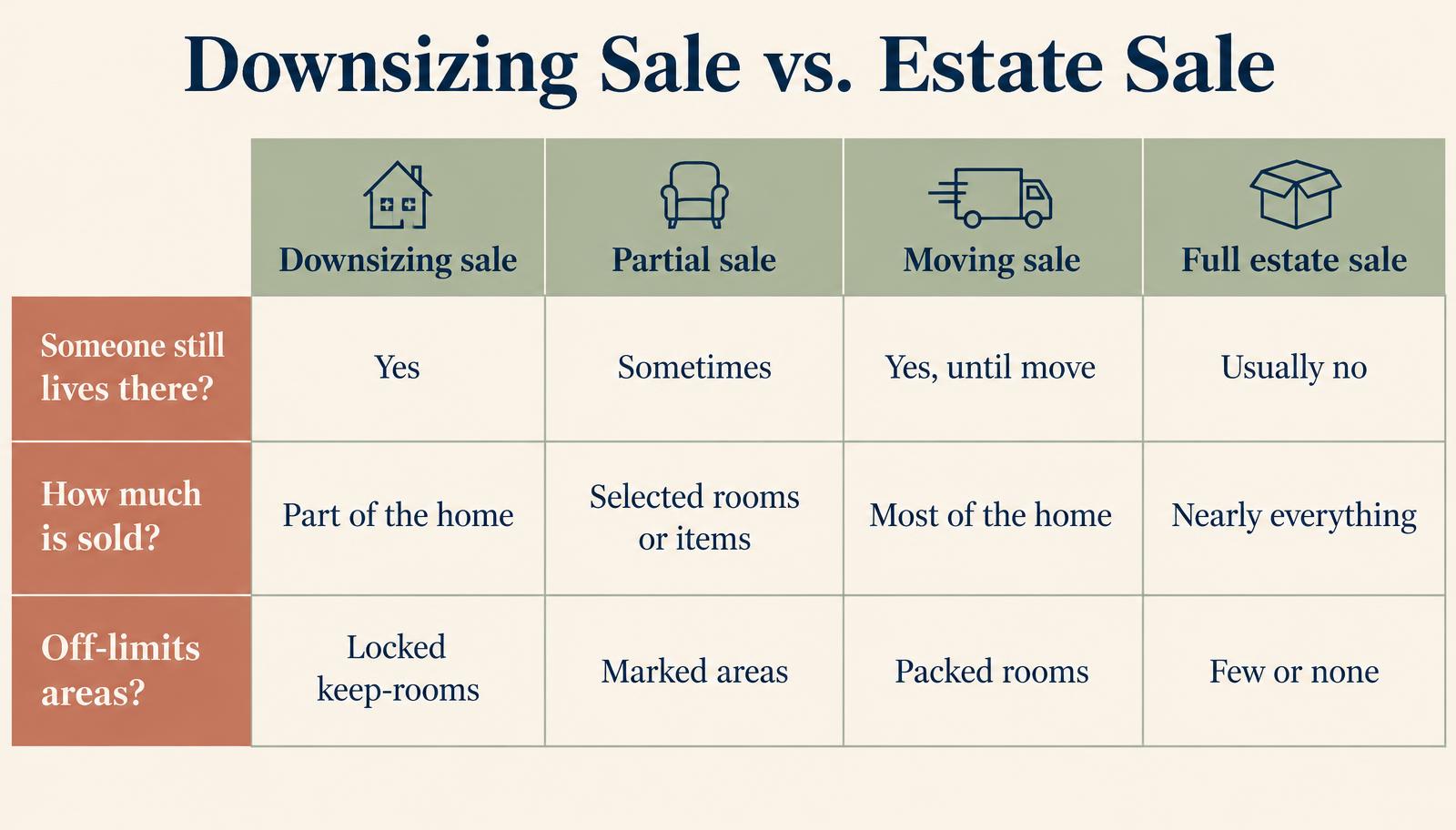
| Downsizing sale | Partial sale | Moving sale | Full estate sale | |
|---|---|---|---|---|
| Someone still lives there? | Yes | Sometimes | Yes, until the move | Usually no |
| How much is sold | The part that won't fit in the new home | Selected rooms or items | Most of the home | Nearly everything |
| Off-limits areas | Locked keep-rooms | Marked areas | Packed rooms | Few or none |
| Typical reason | Smaller home or senior living | Family keeps most things | Relocation | After a death or a full move |
| Will every company do it? | No | No | No | Most will |
The definitions above follow how companies themselves describe these sales: a partial estate sale is one where "only selected items are sold," and a moving or transition sale "involves selling many belongings during a relocation, but not necessarily the entire household" (Donna Davis Estate Sales). Many companies offer all of these under one roof; for example, one North Texas company advertises "Estate Sales, Downsizing Sales, or Moving sales," from "partial to complete" liquidation (J & S Estate Sales).
If you're still deciding between a sale and other options, our guide to estate sale vs. auction vs. cleanout walks through each one.
Can you have an estate sale while you still live in your home?
Sometimes. It depends entirely on the company.
A Reddit post asking exactly this question came from a couple in their 60s planning to retire abroad. They wanted to sell everything but a bed, a couch and some kitchen items before their house went on the market, and "the main ES agent in this area told me under no circumstances could she do a sale until we had permanently vacated the premises" (r/estatesales). The top reply: "Depends on the company. Some will do it, some won't."
In a separate thread, a self-described operator wrote, "It's possible, you'll just have to quarantine your stuff in some bedrooms/back rooms" (r/estatesales). Those are individual experiences, but they line up with what many companies say.
Why estate sale companies say no to occupied homes
It's rarely personal. Here's what companies worry about:
- The owners get in the way. One liquidator listed reasons "virtually NO liquidator wants the family in the house," including that shoppers "will literally come up to you and ask you if you'd take $10 for an item marked $25," and that family members take up space and distract staff (r/estatesales).
- Second thoughts. Seeing your things tagged, and sold for less than you hoped, is hard. Companies have had owners pull items mid-sale or argue with buyers. A Reddit commenter called this "a common complaint" (r/estatesales).
- Mixed-up items. When daily-use things sit next to sale items, it's easy for a shopper to buy, or walk off with, something you meant to keep.
- Not enough to sell. Companies work on commission. If most of the valuable things are moving with you, the sale may not cover the company's costs. One Dallas company lists "not enough items of value" as the first reason a company might decline a sale (Afternoon Estate Sales).
- Setup is harder. Staff need days in the house to sort, clean, price and stage. That's tough around people who are still cooking, sleeping and packing there.
What gets a company to say yes
If you want a downsizing sale, make it easy for a company to agree:
- Lock off your keep-rooms. Put everything you're keeping (and everything you need day to day) into one or two rooms with a lock or a clear "Private" sign. Many companies will only work this way.
- Stay somewhere else on sale days. Book a night or two with family, at a friend's or at a hotel. Be gone during setup hours too, if the company asks.
- Decide before they arrive. Mark every keep item before setup. Don't change your mind once things are priced.
- Agree not to set prices yourself. Let the company price. It's what you're paying them for.
- Have enough to sell. A house full of furniture, kitchenware, decor, tools and collectibles is a much easier yes than a few rooms of basics.
- Lock up valuables and papers. Jewelry, medications, documents, keys and electronics go in the keep-room or a safe-deposit box.
- Be flexible on dates. Companies book weeks out. Give yourself time before the move.
If the first company says no, ask a second and third. Some companies list downsizing sales as a standard service.
How to have a downsizing sale: step by step
8–12 weeks before your move
- Get the floor plan of your new home and measure the rooms.
- Decide which furniture fits. Everything else is a sale candidate.
- Let family pick sentimental items now, and set a deadline for picking them up.
- Call two or three estate sale companies for a walkthrough. Ask directly: "Will you do a sale while we're still living here?" Our guide on how to find an estate sale company has questions to ask.
4–6 weeks before
- Sign a contract. Read how leftovers are handled and when you'll be paid. Our guide to how estate sale companies make money explains commissions and the leftovers clause.
- Pack what's moving with you, or move it into the keep-room.
- Don't throw things away yet. Companies regularly sell items owners thought were trash.
1–2 weeks before
- Finish clearing the keep-room and lock it.
- Remove medications, papers, photos and valuables.
- Plan where you'll stay on sale days.
Sale week
- Let the company set up without you in the way.
- Stay away during the sale. Check in by phone if you need to.
After the sale
- Leftovers go to donation, a buyout, a cleanout or an online auction, depending on your contract.
- Expect your payment and a sales report on the schedule in your contract.
For a full room-by-room list, see our downsizing checklist for seniors.
What to get rid of first when downsizing
Start with the things that free up the most space and cause the fewest arguments:
- Furniture that won't fit the new floor plan. This is the biggest win and the easiest decision.
- Duplicates. Extra sets of dishes, linens, small appliances and tools.
- Formal items you no longer use. Formal dining sets, china and crystal, guest-room furniture.
- Garage, shed and attic contents. Lawn equipment, ladders, workshop tools and holiday decorations you won't have room for.
- Collections no one in the family wants. Ask the family first, then sell.
- Books, records and media you won't reread or replay.
Save photos, papers, and anything sentimental for last. Those take the longest and are easiest to regret.
When an online auction or partial sale fits better
A full public sale isn't always the right fit for a home someone still lives in. Other options:
- Online-only sale or auction. Buyers shop on a website and come for scheduled pickups, so the public never walks through your home. One New York company calls online sales "highly recommended in cases where the home is still occupied" (ReclaimingMia). Our guide on whether to have an estate sale or an online auction compares the two.
- Appointment-only sale. Small groups of shoppers come in at scheduled times. Good for tight streets, HOAs and homes with people living in them.
- Consignment or facility sales. Some companies move items to their own space and sell them there.
- Buyout. One buyer purchases most or all of the contents at once. Faster, but usually less money.
- Partial sale later. Hold the sale after you've moved out, and keep only what you need in the old house until then.
A note for realtors and senior move managers
Timing is the most common problem. A listing photo shoot, open house and estate sale all need the house at the same time. A few tips:
- Bring the estate sale company in early, before the listing date. Ask whether they run sales in occupied homes.
- Plan the order: sort and move first, sale second, cleanout third, photos and listing last.
- Keep a short list of local companies that do downsizing sales. Not all of them do. Our estate sale company directory shows companies by state and city.
- Senior move managers can coordinate the keep-room, the move, and the sale. The National Association of Senior and Specialty Move Managers has a member directory.
For more, see our realtor's guide to estate sales. Estate sale companies can list their company on EstateSaleFinder and note downsizing sales as a service.
Questions & answers
Frequently asked questions
What is a downsizing sale?
A downsizing sale is an estate-style sale held while the owner still lives in the home, to sell items that won't fit in a smaller home. Only part of the house is sold, and keep areas are closed off.
What's the difference between a downsizing sale and an estate sale?
A full estate sale usually sells nearly everything in a home, often after the owner has passed away or moved out. A downsizing sale sells only part of the contents while the owner is still living there.
Can you have an estate sale while still living in the house?
Sometimes. Some companies will, usually with locked keep-rooms and the owners staying elsewhere on sale days. Others won't run a sale until the home is vacant. Ask each company directly.
What is a partial estate sale?
A sale where only selected items or rooms are sold and the rest stays with the family. It can happen in an occupied or empty home.
What should I get rid of first when downsizing?
Furniture that won't fit your new home, duplicates, formal items you don't use, garage and attic contents, and collections no one in the family wants. Save sentimental items for last.
Is a downsizing sale worth it?
It can be if you have enough to sell, especially furniture, decor, kitchenware, tools and collectibles. If only a few items are going, an online sale, consignment or donation may be simpler.
How long does a downsizing sale take?
Plan on several weeks from first call to sale day, because companies book ahead and need days to set up. The sale itself usually runs one to three days.
Do I have to leave my house during a downsizing sale?
Most companies prefer you do. Being away during setup and sale hours keeps shoppers from asking you for discounts and lets staff work.
Keep reading
Sources checked October 23, 2026: service and FAQ pages from estate sale companies (Donna Davis Estate Sales, Argonne Hall Estate Sales, J & S Estate Sales, Afternoon Estate Sales, ReclaimingMia), the National Association of Senior and Specialty Move Managers, and r/estatesales threads quoted as individual experiences. Each company sets its own policies on occupied homes.
Keep exploring
Ready to start your own treasure hunt?
Discover estate sales near you and find incredible deals.
Explore Sales Near Me
About the author
Andy
Founder, EstateSaleFinder.net
Hi, I'm Andy — a retired commercial photographer turned developer with a five-year (and counting) obsession with estate sales. I started EstateSaleFinder.net because I knew there had to be an easier, smarter way to find and list estate sales. Now I get to chase treasure and build the tool I always wished existed.