


Senior Move Manager or Estate Sale Company? Who Does What When Parents Downsize (and When You Need Both)
The move manager moves the person; the estate sale company sells what stays behind. A side-by-side comparison, NASMM's services list, sourced cost ranges, the right order to hire them, and a partnering section for companies.
A senior move manager moves the person; an estate sale company sells what stays behind. The move manager plans the new space, sorts what's coming along and runs move day. The estate sale company prices, advertises and sells the rest of the household, usually for a commission. For a big family home, most families need both, in that order.
That's the short answer. The longer one matters, because hiring them in the wrong order is one of the most common and costly downsizing mistakes. Families donate things that should have sold, or hold a sale while Mom's favorite chair is still in the living room with a price tag on it. This guide explains what each professional actually does, how each gets paid, when you need one, the other, or both, and the right order to bring them in.
Quick summary for skimmers:
- Senior move manager: plans and manages the move itself, including floor plans, sorting, packing oversight, movers and unpacking. Usually paid by the hour or by the project.
- Estate sale company: sells the contents that aren't moving. Usually paid a percentage of what the sale brings in.
- The order: plan the new space, move the keepers out, hold the estate sale, then donate or clear what's left.
- Cost: published ranges for move managers run about $40–$125 an hour, or roughly $1,500–$5,000 for a full project. Always get a written estimate.
- "Senior Move Manager®" is a service mark. Only members of the National Association of Senior & Specialty Move Managers (NASMM) can use it.
Senior move manager vs. estate sale company at a glance
| Senior move manager | Estate sale company | |
|---|---|---|
| Main job | Moves the person and the things they're keeping | Sells the household contents that aren't moving |
| Who they work for | The older adult and family | The family or estate (the seller) |
| How they're paid | Usually hourly or a project fee | Usually a commission on sale proceeds, sometimes with minimums or fees |
| When to bring them in | First, as soon as a move is likely | After the keepers are chosen and ideally moved out |
| What they usually don't do | Run a public sale themselves (many coordinate one) | Pack and set up the new home |
| Trade group | NASMM | Varies; many are independent or regional |
The table is a general pattern. Individual companies vary, and some offer a bit of both. Ask each one directly what's included.
What does a senior move manager do?
According to NASMM, senior move management "is the profession that assists older adults, individuals, and families with downsizing, relocation or simplifying their homes" (NASMM FAQs). NASMM lists services most move managers offer some or all of:
- Developing an overall move or "age in place" plan
- Organizing, sorting and downsizing
- Customized floor plans for the new home
- Arranging for "the profitable disposal of unwanted items through auction, estate sale, buy-out, consignment, donation, or a combination"
- Interviewing, scheduling and overseeing movers
- Arranging shipments and storage
- Supervising professional packing
- Unpacking and setting up the new home
- Related help such as cleaning, waste removal and preparing the house to be sold
Notice the fourth bullet. Move managers often arrange the estate sale, but most don't run it. That's where an estate sale company comes in.
NASMM also notes that some members do the hands-on work themselves, while others act more as project managers who coordinate other services (NASMM FAQs). Ask which kind you're hiring.
Is "Senior Move Manager" a certification?
The title is a registered service mark. NASMM states: "The term Senior Move Manager® is a service mark owned by NASMM. Only NASMM members are Senior Move Managers®," and its members have completed required courses in safety and ethics and are screened for insurance (NASMM: Find a Move Manager). Plenty of capable professionals aren't NASMM members, so the title alone isn't the only test. Still ask for proof of insurance and references.
What does an estate sale company do?
An estate sale company turns the contents of a home into money. A typical full-service sale includes:
- A walkthrough and contract
- Sorting, cleaning and staging rooms
- Researching and pricing items
- Photographing and advertising the sale
- Staffing the sale days and handling payments and security
- A final accounting and payout to the family
Many also offer buyouts or cleanout services for what doesn't sell. If you're new to how sales work, our guide What Is an Estate Sale, and How Do They Work? covers the basics, and How to Sell Everything in Your House shows what goes to a sale versus Marketplace, eBay, consignment or donation.
When do you need one, the other, or both?
You probably need only a move manager when:
- The house is small or mostly ordinary furniture and household goods.
- Family is taking most of the contents.
- The leftovers can be donated or handled with a small cleanout.
You probably need only an estate sale company when:
- The person has already moved, or has passed away.
- Family can handle the move or there is no move.
- The house is full of sellable contents.
You probably need both when:
- A parent is moving from a large, long-time family home into a smaller apartment or senior living.
- There's a lot of furniture, collections, tools or kitchenware worth selling.
- Family lives out of town and can't run the logistics.
In short: start with the move manager, bring in the estate sale company for what is left, and use both for a large downsize.
The right order: plan, move, sell, clear
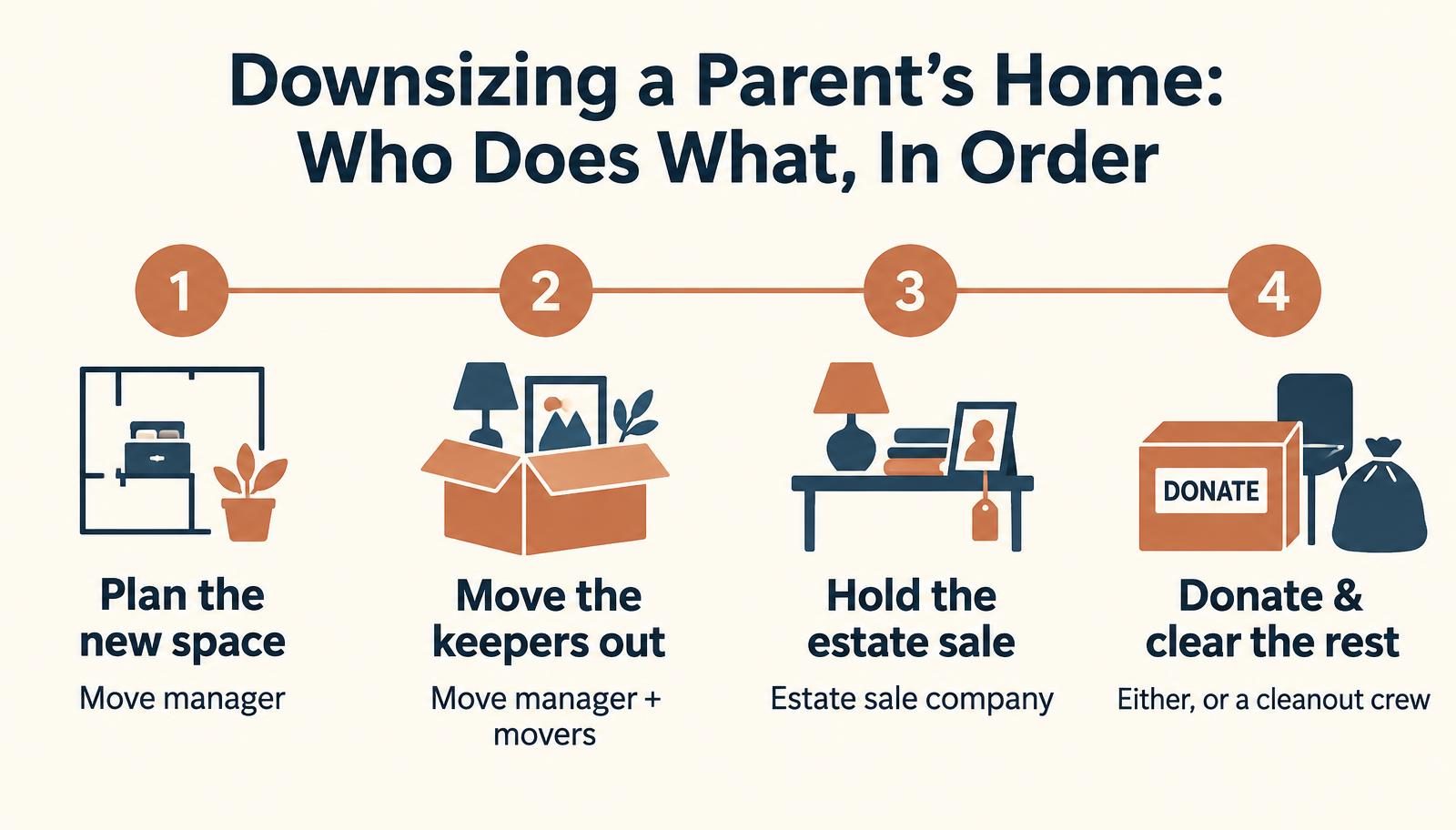
Step 1: Plan the new space
The move manager measures the new apartment or room and makes a floor plan. This answers the hardest question in downsizing: what fits? Once you know which bed, chair and dresser are going, everything else becomes a decision instead of a fight.
Step 2: Move the keepers out
Family members take their items, and the senior's belongings move to the new home. Getting keepers out before the sale protects them from being sold by accident and makes the house easier to stage. If some items must stay until the sale, lock them in one room and mark it clearly.
Step 3: Hold the estate sale
Call estate sale companies early, during Step 1, not after the move. Good companies book weeks or months ahead. Tell them your move date and ask when they could run the sale. Then:
- Don't throw away or donate anything yet. Everyday kitchenware, tools, linens and craft supplies often sell. Let the company decide what's sellable.
- Don't clean out drawers. Companies often find value in "junk" drawers, closets and the garage.
- Ask about timelines and payout. When will you be paid, and how is the accounting shown?
Step 4: Donate or clear what's left
After the sale, what's left gets donated, bought out, or cleared by a crew. Some estate sale companies handle this; some move managers coordinate it. Our guide Estate Cleanout or Estate Sale: How to Decide explains the trade-offs.
For a full room-by-room plan, see our downsizing checklist for seniors. If the sale will happen while your parent still lives there, read What Is a Downsizing Sale? first. Some companies won't sell in an occupied home, and that guide covers what gets a yes.
How much do senior move managers charge per hour?
NASMM doesn't publish a national rate. The figures below come from industry sources and vary a lot by region, home size and how much hands-on work is included:
| Source | Hourly | Full project |
|---|---|---|
| MovingExpert.org | $40–$125 | $1,500–$5,000, before transport |
| Placement Helpers (2025) | $40–$60 basic; $60–$80 full service | $1,000–$2,000 basic; $1,500–$5,000 full service |
Treat these as ballparks only. Always get a written estimate that spells out the hourly rate or project fee, what's included, what costs extra (movers, packing materials, storage) and how hours are tracked.
What is generally the cost of senior moving?
The total cost of a senior move usually has three separate parts:
- Move management (the ranges above).
- Movers, billed separately for truck, crew and distance.
- Selling and clearing the leftovers, which may bring money in rather than cost money.
That third part is where an estate sale changes the budget. Instead of paying to haul away a houseful of furniture, a sale can turn it into proceeds that help pay for the move. Companies are usually paid a commission on the sale, and terms vary, so compare a few written proposals.
Are senior move managers worth it?
They're often worth it when family lives far away, the move is on a deadline, or the decisions are emotional and keep stalling. NASMM points out that families "avoid the costly mistakes and remorse that often accompany such major lifestyle transitions" when someone guides the process (NASMM consumer brochure). That's the association's own claim, but it reflects the real value: a neutral person who keeps things moving.
They may not be worth it if family is local, has time, and the new space is easy to plan.
Is hiring an estate sale company worth it?
Usually, if there's enough to sell. A professional company knows what things are worth, has a buyer list and can sell a whole house in a weekend. Many won't take a small sale, so ask about minimums. If the contents are mostly low-value, a donation pickup or cleanout may make more sense. Our guide Do You Need an Appraisal Before an Estate Sale? explains when a formal appraisal is needed versus company pricing.
Find a company near your parent's home
EstateSaleFinder's Hire an Estate Sale Company tool lets you describe the job once and hear from local companies, and our estate sale company directory lets you browse companies by state with their past sales and reviews. Our downsizing page explains how sales work when someone is moving, not settling an estate.
For estate sale companies: partnering with move managers
Move managers meet families weeks or months before an estate sale company would. That makes them one of the best referral partners you can have, and the relationship goes both ways: you see families who need move help after a sale call.
Ways companies build these partnerships:
- Share a clear timeline. Tell move managers how far ahead you book and how long you need in the house.
- Make the handoff easy. A simple form with move date, home size, and what's staying.
- Communicate during the job. Move managers are protecting their client relationship.
- Consider a referral program. Some companies pay one. For example, Nashville-based Estate Greats advertises $200 for every referred client who signs a contract, open to senior move professionals, realtors and others (Estate Greats).
On EstateSaleFinder, companies can manage referral partners and track every job and booking in one place, and families find you through the directory and the Hire a Company tool. You can list your company to start.
A note for realtors
If you're a real estate agent, check the rules before accepting referral fees. The federal Real Estate Settlement Procedures Act (RESPA) prohibits fees or kickbacks for referring settlement-service business connected to a federally related mortgage loan (CFPB, 12 CFR 1024.14). Whether that reaches a given estate sale referral depends on the facts and your state's rules, so ask your broker or an attorney. This is general information, not legal advice. Always verify.
Questions & answers
Frequently asked questions
What's the difference between a senior move manager and an estate sale company?
A senior move manager plans and manages the move of the person and their keepers. An estate sale company sells what's left behind. One is usually paid by the hour or project; the other usually by a commission on the sale.
Should I hire a move manager or an estate sale company first?
The move manager, usually. The floor plan decides what stays and what goes. But call estate sale companies early too, because good ones book well in advance.
Can a senior move manager run an estate sale?
Some coordinate one, and NASMM lists arranging estate sales among common services. Most partner with an estate sale company to actually run the public sale.
How much does a senior move manager cost?
Published ranges run about $40–$125 an hour, or roughly $1,500–$5,000 for a full project before movers. Costs vary widely by region, so get a written estimate.
Does an estate sale cover the cost of a move manager?
Sometimes. Sale proceeds after the company's commission can offset move costs, especially in a well-furnished home. It depends on what sells.
Sources
- NASMM: Frequently Asked Questions (services list)
- NASMM: Find a Move Manager (service-mark statement)
- NASMM consumer brochure (PDF)
- MovingExpert.org: Senior Move Manager costs
- Placement Helpers: Relocation services and typical costs
- Estate Greats referral partner program
- CFPB: 12 CFR 1024.14, prohibition against kickbacks and unearned fees
Related reading:
Sources checked October 25, 2026. Cost ranges are published estimates, not quotes; services and pricing vary by company and region.
Keep exploring
Ready to start your own treasure hunt?
Discover estate sales near you and find incredible deals.
Explore Sales Near Me
About the author
Andy
Founder, EstateSaleFinder.net
Hi, I'm Andy — a retired commercial photographer turned developer with a five-year (and counting) obsession with estate sales. I started EstateSaleFinder.net because I knew there had to be an easier, smarter way to find and list estate sales. Now I get to chase treasure and build the tool I always wished existed.