

How Do Estate Sale Companies Make Money? Commission, Extra Fees, Buyouts and the Leftovers Clause
Most estate sale companies make money from a commission on what sells, about 35% on average nationally, plus extra fees for things like cleanout and card processing. Some also earn from buyouts, consignment and leftover items. Here's where the money goes, a worked example, and what makes the business profitable.
Estate sale companies make most of their money from a commission on what sells, usually a percentage of the gross sales. EstateSales.NET's survey found the national average commission is 35%, and about 80% of companies also charge extra fees for things like advertising, trash hauling, cleanup or card processing. Some companies add income from buying items outright (buyouts), selling leftovers, online auctions or cleanout services.
That's the short answer, and it's the one most guides stop at. But if you're a family deciding whether 35% is fair, a realtor explaining fees to a client, or someone thinking about starting a company, the more useful question is: where does that commission actually go? This guide breaks down each way companies earn money, walks through a full worked example, explains the "we keep the leftovers" clause, and answers whether running an estate sale company is profitable.
Quick summary for skimmers:
- Commission is the main income. About 35% on average nationally (EstateSales.NET); companies on Reddit report anywhere from about 25% to 50% depending on city and sale size.
- Extra fees are common. Around 80% of companies charge some (same source).
- Buyouts, leftovers and auctions are secondary income streams, and the source of most surprises in contracts.
- The commission isn't all profit. Staff wages, advertising, insurance and supplies come out of it first.
- Want the fee details? Our guide to estate sale company fees covers every fee line by line.
What percentage do estate sales usually take?
The most-cited national figure comes from EstateSales.NET, which reported from its industry survey that "the average commission rate, nationwide, is 35%" (EstateSales.NET).
In practice you'll see a range. People discussing real quotes on Reddit's r/estatesales mention numbers from around 25% at the low end to 50% for small or difficult sales. Two real examples from that forum (individual quotes, not averages):
- A family described a quote where the "estate sale service gets 40%" for cleaning, organizing and pricing (Reddit thread).
- A family planning an online auction was offered "60% to my parents and 40% to the estate company," plus separate charges for prep days, card fees, pickup staff, marketing and cleanout (Reddit thread).
Why the range? Commission usually moves with:
- Sale size. Higher-value estates often get a lower percentage, because the company still earns well. Small estates often pay more, or hit a minimum fee.
- Labor. A packed house that needs weeks of sorting costs the company far more than a tidy one.
- Local market. Wages, rents and competition differ a lot between cities.
- What's included. Some quotes bundle cleanout and advertising; others charge them separately. Compare the total cost, not just the percentage.
For a deeper look at total cost, see how much an estate sale company costs, or check the estate sale company pricing guide.
The three main pricing models
| Model | How the company gets paid | Best for | Watch out for |
|---|---|---|---|
| Commission | A percentage of gross sales (often 30–40%) | Most full-service estate sales | Extra fees on top; a minimum fee if sales are low |
| Commission plus fees | A percentage plus set charges (cleanout, advertising, card fees, prep days) | Big or complicated jobs | Fees that add up to more than the commission |
| Buyout | The company pays you a lump sum and keeps everything | Fast closings, small estates, out-of-state families | You get less than a sale would bring, in exchange for speed |
Most companies use the first or second model, and many offer a buyout as an option when a full sale doesn't make sense. Some also run online auctions, which often have their own fee structure (and, on many platforms, a buyer's premium paid by the bidder).
Every way an estate sale company makes money
1. Commission on what sells
This is the core business. The company prices, stages, advertises and runs the sale, and earns a percentage of what buyers pay. Because the company is paid only when items sell, its interests line up with yours: higher sales mean more for both of you. EstateSales.NET puts it simply: it's "a commission-based field, so the majority of the money estate sale companies make comes from the sale of the items" (source).
2. Extra fees
Around 80% of companies charge fees on top of commission (EstateSales.NET). Common ones include:
- Cleanout or haul-away of unsold items and trash
- Advertising (paid listings, signs, print ads)
- Credit card processing, often a few percent of card sales
- Prep or setup days, especially for packed homes
- Minimum fee, if commission on a small sale wouldn't cover the company's costs
- Travel, for homes far outside the company's area
- Online auction or shipping fees if part of the estate is sold online
Fees aren't a red flag by themselves; they're how companies charge fairly for different amounts of work. The red flag is fees you didn't know about. Our fees explained guide lists the questions to ask about each one.
3. Buyouts
In a buyout, the company makes you an offer for everything (or a group of items) and pays you directly. It then resells those items at its own sales, in a shop, or online. The company earns the difference between what it paid and what the items eventually sell for.
Buyouts are genuinely useful when speed matters more than top dollar: a closing in two weeks, an estate with few valuable items, or a family that lives far away. But a buyout price will always be lower than a well-run sale, because the company takes on the risk and the labor.
4. Leftovers, consignment and online sales
After a sale, some items always remain. What happens to them is one of the most important parts of the contract (more on that below). Companies may donate them, haul them away for a fee, consign the better pieces in a shop or online auction and share the proceeds, or, in some contracts, keep them. See what happens to unsold items after an estate sale for the usual options.
5. Related services
Many companies earn additional income from cleanouts, move management, appraisals, or online auctions. EstateSales.NET's 2024 industry survey found that 22% of businesses supplement estate sales with auctions (2024 survey).
A worked example: where a $20,000 estate sale goes
Here's an illustration (not a quote) of a mid-size, three-day sale with $20,000 in gross sales and a 35% commission. Your numbers will be different, but the shape is typical.
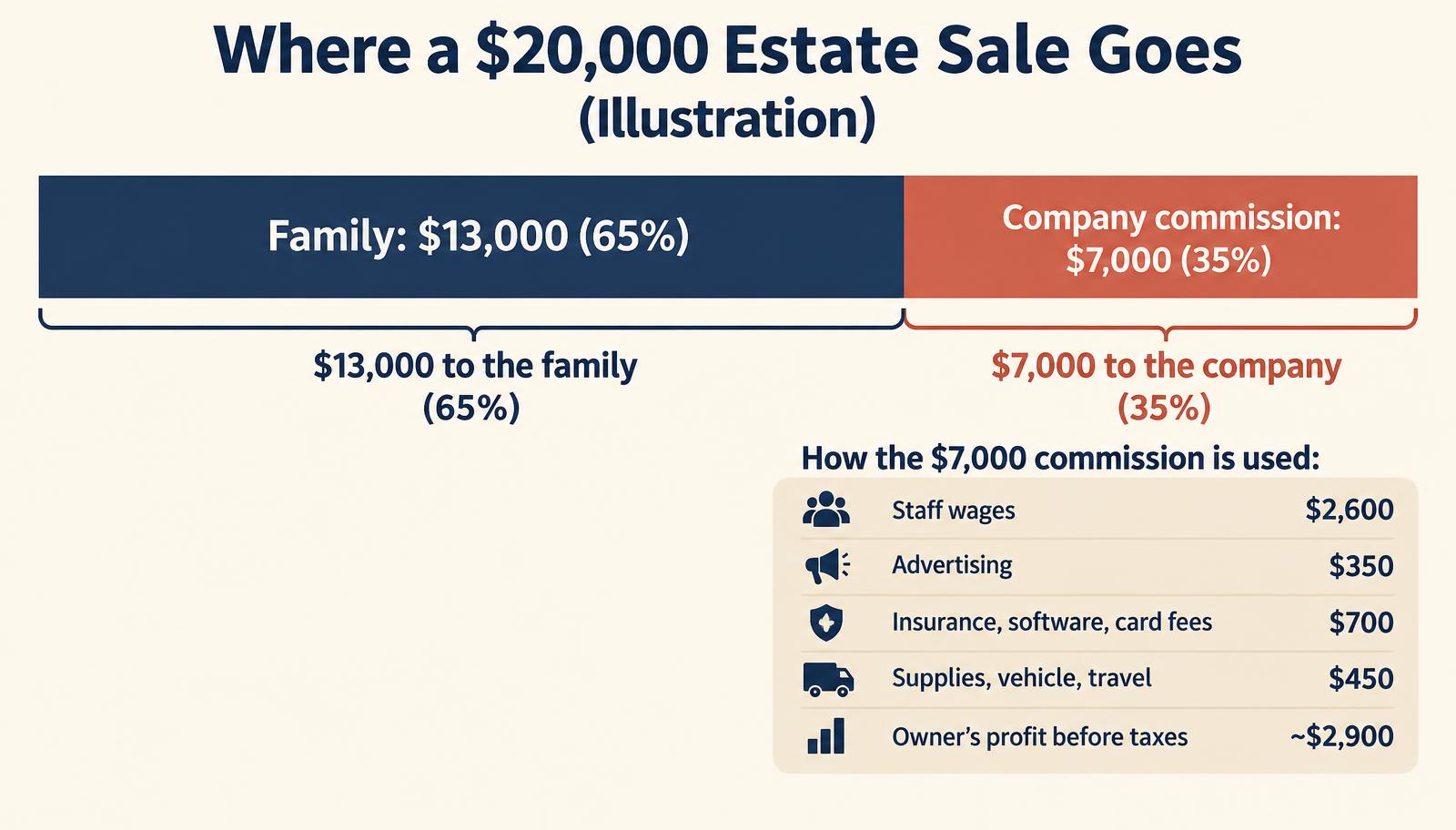
| Line | Amount | Notes |
|---|---|---|
| Gross sales | $20,000 | What buyers paid over three days |
| Family receives | $13,000 | 65% of gross, before any separate fees |
| Company commission | $7,000 | 35% of gross |
| Staff wages | about $2,600 | Example: 4 helpers for setup, three sale days and pickup |
| Advertising | about $350 | Listing upgrades, signs, social ads |
| Insurance, software, card processing | about $700 | Liability insurance, point-of-sale, card fees |
| Supplies, vehicle, travel | about $450 | Tags, tables, bags, gas, truck |
| Owner's profit before taxes | about $2,900 | Pays for the owner's own week or more of work |
Two things stand out:
- The company keeps much less than 35%. In this illustration, the owner clears roughly 15% of gross sales, and that has to pay for their own time: walkthroughs, pricing research, staging, running the sale and settling up.
- Small sales hurt. If that same house only brought in $6,000, the commission would be $2,100, but many costs (staffing a weekend, insurance, advertising) barely shrink. That's why companies set minimums or charge higher percentages on small sales.
The "we keep the leftovers" clause
Some contracts say that anything left after the sale becomes the company's property. That can be fine, or it can cost a family real money. It depends on what's left and whether it was priced fairly.
Why some sellers see it as a red flag
if the company keeps what doesn't sell, it has less reason to price everything to sell during the sale. A valuable piece priced high on day one, never marked down, could end up the company's on day four. In r/estatesales discussions, families and other professionals often call this kind of clause something to question before signing.
Why some companies use it
cleanout costs money. Hauling, donation runs and dump fees add up, and some companies offset that by keeping and reselling leftovers instead of charging a cleanout fee.
What to ask before you sign:
- What exactly happens to unsold items, and when?
- Will you mark items down on the last day?
- If you keep the leftovers, does that replace the cleanout fee? What would cleanout cost otherwise?
- Can I pull specific items out (or set a minimum price) if they don't sell?
- Do I get a donation receipt for anything that's donated?

A clear contract answers every one of these in writing. For more contract and vetting advice, see how to find an estate sale company you can trust and the top complaints about estate sale companies.
How much do estate sale companies make?
There's no reliable national figure for owner income, and anyone quoting one exactly is guessing. What we do know from the industry's largest survey:
- For most owners, it's a real job. In EstateSales.NET's 2024 survey of 774 businesses, 55% said estate sales are their primary source of income (2024 survey).
- Many are long-running. 25% of businesses had been operating 11–20 years (same survey).
- Online sales help. Businesses combining online and in-person sales reported a 15% boost in revenue per sale (ATG summary of the survey).
Income depends mainly on how many sales a company runs each month, the average size of those sales, and how well it controls labor costs.
Is an estate sale business profitable?
It can be, but it's a labor business, not passive income. The companies that do well usually share a few habits:
- They choose jobs carefully. Not every house is worth a full sale. Good companies offer buyouts, consignment or a referral for houses that won't cover costs.
- They set minimums. A minimum fee protects the company on small or low-value estates.
- They price to sell. Commission only pays if items leave the house. Over-pricing kills both the client's results and the company's income.
- They build a buyer list. A strong email list and steady social media bring the crowds that make sales successful. See where estate sales are advertised for how buyers find sales.
- They use the right tools. Pricing research, item photos, offers and fast checkout let a small team handle more sales.
- They get trained. Professional programs like the Institute for Estate Sale Professionals (IESP) teach pricing, contracts and business operations.
Startup costs are lower than many small businesses (no storefront is required), but owners need liability insurance, a business license where required (see do you need a license to run an estate sale), tables and supplies, a point-of-sale system, a vehicle, and a reliable crew. Our full guide on how to start an estate sale company walks through every step.
For companies
EstateSaleFinder gives estate sale companies sale listings with item photos, Ai-assisted pricing suggestions, buyer offers, label printing, team tools and a client pipeline in one place. See what we offer estate sale companies.
For realtors and attorneys: explaining fees to clients
Realtors, estate attorneys and senior move managers are often the first people a family asks, "Is 35% normal?" A few plain-language points help:
- Yes, a commission in the 30–40% range is common, and the company only earns when items sell.
- Ask for the total cost, commission plus every fee, in writing.
- Ask what happens to leftovers and whether cleanout is included. That's where most disagreements come from.
- Ask when the family gets paid, usually within a set number of days after the sale, with an itemized statement.
- Consider the timeline. If the house must be empty by a closing date, a buyout or a sale-plus-cleanout package may be worth more than a few extra percentage points.
Families can compare estate sale companies near them on EstateSaleFinder, or browse the company directory.
Questions & answers
Frequently asked questions
How do estate sale companies make money?
Mainly from a commission on what sells at the sale, about 35% on average nationally, plus extra fees for services like cleanout, advertising and card processing. Some also earn from buyouts, consignment, online auctions and leftover items.
What percentage do estate sales usually take?
EstateSales.NET reports a national average of 35%. Real quotes commonly range from about 25% to 50%, depending on the size and value of the estate, the work involved and the local market.
What is the average fee for an estate sale?
Beyond commission, about 80% of companies charge some extra fees. Common ones are cleanout, advertising, credit card processing, prep days and a minimum fee for small sales. Always ask for a written total.
Is 50% too much for an estate sale company?
Not always. For small estates, packed homes or online auctions with a lot of labor, 40–50% can be fair. For a large, valuable, well-organized estate, it's high. Compare total cost across two or three written quotes.
What happens to stuff not sold at estate sales?
It depends on the contract. Common options are donation, haul-away for a fee, consignment or online auction, the family keeping it, or the company keeping it. Make sure your contract says which.
Is it a red flag if the company keeps the leftovers?
Not automatically, but ask questions. Find out whether it replaces a cleanout fee, whether items get marked down, and whether you can set a minimum price on valuable pieces.
Do estate sale companies buy items themselves?
Some offer buyouts, paying a lump sum for everything or selected items. It's faster but brings in less money than a full sale.
How much do estate sale company owners make?
There's no reliable national figure. Industry survey data shows estate sales are the primary income for 55% of owners. Profit depends on the number and size of sales and how well the company controls labor costs.
Is an estate sale business profitable?
It can be, for owners who choose jobs carefully, set minimums, price to sell and build a strong buyer list. It's hands-on work with real costs, not passive income.
Do estate sale companies get paid before or after the sale?
Usually after. Most deduct their commission and fees from the sale proceeds and pay the family the rest, typically within a set number of days with an itemized statement. Some charge upfront prep or auction fees.
Keep reading
Sources checked October 22, 2026: EstateSales.NET's help center and 2024 Estate Sale Industry Survey, Auction Technology Group's survey summary, and r/estatesales discussions (quoted as individual examples, not averages). The $20,000 example is an illustration, not a quote or an industry average.
Keep exploring
Ready to start your own treasure hunt?
Discover estate sales near you and find incredible deals.
Explore Sales Near Me
About the author
Andy
Founder, EstateSaleFinder.net
Hi, I'm Andy — a retired commercial photographer turned developer with a five-year (and counting) obsession with estate sales. I started EstateSaleFinder.net because I knew there had to be an easier, smarter way to find and list estate sales. Now I get to chase treasure and build the tool I always wished existed.