
What Happens to Unsold Items After an Estate Sale? (And How Smart Shoppers Grab Them First)
Estate sales rarely sell everything — 60–80% is a normal sell-through. So where do the leftovers actually go? A field guide to donations, buyouts, cleanouts, second sales, and the smart-shopper trick for scooping the good stuff before the truck shows up.
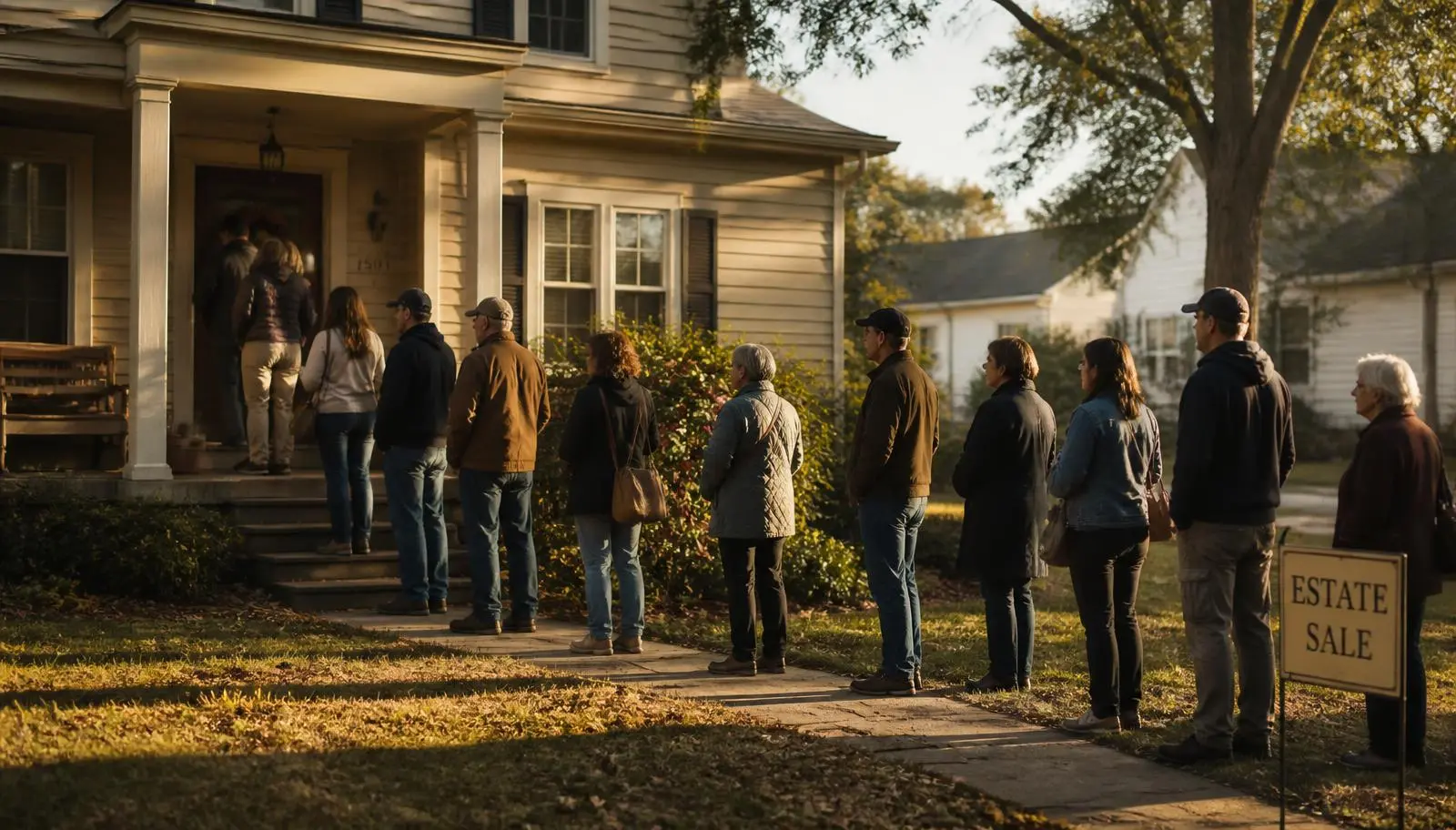
It's 3:47 p.m. on the last Sunday of an estate sale. The chalkboard sign out front now reads "50% OFF EVERYTHING." A blue armchair is still sitting where it was Friday morning. The china cabinet has three lonely gravy boats and a full set of highball glasses. Someone's rocking a $10 lamp under one arm while their kid asks if they can go home.
At 4:00 p.m., the doors close. And then… what?
That's actually one of the most-Googled estate sale questions in America, and if you've ever wondered whether the good stuff just gets thrown away, or whether you can swoop in and buy the leftovers cheap, or whether the family gets stuck with a garage full of tchotchkes — this is your field guide.
Short answer
most estate sales move 60–80% of inventory, and what happens to the other 20–40% depends almost entirely on what the family and the estate sale company agreed to before the sale ever opened. There are six real paths the leftovers take. We'll go through all of them.
Then we'll talk about the part nobody writes about: how a savvy shopper actually catches those leftover pieces before they disappear into a truck — because a lot of them are quietly the best deals of the entire weekend.
First, why doesn't everything sell?
Even a well-run, well-priced, well-advertised sale rarely clears 100% of a house. Industry sources put the typical sell-through around 60–80%, with 20% or so of inventory needing another destination (Shopgoodwill blog, Senior Move Guide).
The reasons are boring and predictable:
- Furniture is heavy. Big case pieces — armoires, hutches, sleeper sofas, formal dining sets — don't fit modern homes, modern taste, or modern back muscles. Beautiful mahogany secretary desks routinely go unsold at $150 in 2026 that would have brought $900 in 2005.
- Volume outruns demand. A house with 40 years of accumulation has more silverware, more books, more coffee mugs, and more Christmas décor than any one weekend of shoppers can absorb.
- Category saturation. If the deceased collected Hummels, and the pricing reflects Hummel prices from 1998, and the buyers of Hummels are mostly also deceased… it sits.
- Timing. Rain, a holiday weekend, a competing multi-day mega sale two blocks over, the Super Bowl — every one of these knocks 10–30% off a sale's foot traffic.
None of that is the family's fault, and none of it is the company's fault. It just is. The professional question isn't "how do we sell everything?" — it's "what's the plan for what doesn't?"
The six paths a leftover item can take
Every unsold item at the end of a sale ends up on one of these six roads. In most well-run sales, the split is written into the contract before day one.
1. Deep-discount final day (the "half-price" push)
This is the one you already know if you shop estate sales. Saturday is full price. Sunday morning is often 25% off. Sunday afternoon is 50% off. Some companies do a "bag sale" in the last two hours: fill a grocery bag for $10.
The purpose isn't to squeeze full value out of the inventory — it's to move volume so less physically remains at close. A good half-off push can convert another 10–20% of inventory into cash, and it turns your Sunday afternoon into the single best price-to-quality ratio of the whole weekend if you have eyes.
Two hard truths shoppers should know:
- The company usually still takes their normal commission on discounted items, so they want you to buy the deep-discount stuff — the alternative is packing it out or paying to haul it.
- Not every item is on the table. Sellers can pull specific pieces (antiques, jewelry, collectibles) from the discount schedule, or set floor prices below which they'd rather keep the item than sell it.
2. Buyout: one dealer takes it all
This is the option that shocks most families, in a good way and a bad way.
A "buyout" is when a single dealer, reseller, or another estate liquidator walks the remaining inventory on Sunday evening (or Monday morning) and offers a lump-sum price — sometimes a few hundred dollars, sometimes a few thousand — to take everything left in the house off the family's hands in one truckload.
The bad: the per-item price is a fraction of retail. A dealer paying $800 for a house's leftover contents is buying $2,000–$5,000 of merchandise at wholesale. They have to; they're absorbing the sorting, hauling, storage, restaging, and reselling risk.
The good: the family walks away with cash and an empty house. No dumpster, no donation runs, no scheduling three more logistics calls during the worst week of their life. For someone selling a parent's home, that combination is often worth more than the extra dollars a slower cleanout would produce.
Reputable estate sale companies usually have two or three trusted buyout dealers they call on Sunday nights. If they don't, that's a fair question to ask before you sign a contract.
3. Donation to a charity that picks up

The single most common destination for the "true leftovers" — the stuff that had no buyout appetite and no shopper appetite — is donation.
Good estate sale companies coordinate donation pickup so the family never has to think about it. They also get you the receipt, which is not a minor detail: donated household goods in reasonable condition are tax-deductible at fair market value, and a paper trail from a 501(c)(3) is what makes that stick with the IRS.
The charity list varies by region, but the workhorses are:
- Habitat for Humanity ReStore — furniture, appliances, building materials, tools. They'll usually schedule a truck. Doesn't take clothing or small housewares.
- Salvation Army and Goodwill — clothing, housewares, books, small furniture. Salvation Army does pickup; Goodwill usually asks you to bring it in.
- Vietnam Veterans of America, AMVETS, and other veterans groups — pickup service in most metros, take a wider range of items than most.
- Local shelters, women's shelters, animal rescues, and religious charities — often the best home for linens, blankets, kitchenware, and children's items that big charities are picky about.
The community angle is real. Rawhide Youth Services, for example, is one of many charities that resells donated estate goods to fund youth programs (Rawhide). Your grandmother's crystal pitcher, in that world, doesn't get thrown away — it funds counseling for a teenager who needs it.
4. Cleanout / broom-swept

Sometimes the family needs the house empty — for a closing date, a landlord, a probate deadline, or a rehab. In that case the leftover inventory goes to a cleanout service: a crew that hauls out everything remaining, sorts it into donation / recycle / trash on their end, and leaves the house broom-swept.
This is usually a flat fee or a per-truck fee. A single-truck cleanout might be $400–$800. A full house — attic, basement, garage, shed — can run $1,500–$4,000+ depending on volume and stairs.
Full-service estate sale companies often offer this as part of their package. A cleanout-focused liquidator does it as its own service. Either way, if you're the family, get the number in writing before the sale, because "we'll figure out the cleanout at the end" is where a lot of ugly financial surprises come from (Estate Greats, SaveOr).
5. Consignment or a "second bite" sale
Higher-value pieces that didn't sell — a signed lithograph, a vintage Rolex without a buyer that weekend, a Persian rug, mid-century furniture — often get pulled from the estate sale and moved to:
- A consignment shop or antique mall booth where they can sit in front of buyers for 30–90 days at a more patient price.
- An online auction through a platform like LiveAuctioneers, EBTH, or Everything But The House-style regional auctioneers.
- A second on-site sale two or three weekends later, sometimes at a different property where the leftover inventory can be combined with a new estate.
The tradeoff: consignment and auction pay slower and take a cut (usually 30–50%), but for pieces where the right buyer wasn't at the sale that weekend, they can still recover meaningful money.
6. The family keeps it
Underrated option. Not every unsold item needs to go anywhere. Sometimes a piece just gets rescued back into the family's own home, or a niece finally speaks up for the china hutch on Sunday afternoon.
Good estate sale companies bake a "keep-back" round into the workflow — one last walk-through with the family before the truck comes — because grief is weird and a leftover teacup can suddenly mean a lot on the last day.
What the family is actually paying for
Cleanout, donation coordination, and hauling aren't free. Depending on the contract, they'll show up in one of three ways:
- Bundled into commission. The company keeps 35–50% of sale proceeds and handles disposition end-to-end. Simpler for the family, but the disposition happens whether or not there's money left after commissions.
- Line-itemed. Standard commission (say 35%) plus a separate cleanout fee (say $600). Cleaner accounting, but the family sees the fee.
- Net-of-proceeds guarantee. Rarer. The company guarantees the family a minimum dollar amount after all fees. The company takes the cleanout risk — and prices the whole deal accordingly.
For deeper breakdowns of what estate sale companies actually charge and what those fees cover, see our guides on estate sale company costs and estate sale company fees explained. The short version: the cheapest commission almost never produces the best net check, because a company that undercuts on rate usually cuts corners on marketing, staging, or (surprise) cleanout.
Now for the fun part — how shoppers grab the leftovers
Here's the piece that no other article on this topic will tell you, and it's the whole reason we built the feature we're about to describe.
Sunday afternoon at an estate sale is, item-for-item, often the best value of the entire weekend. Prices are half off. The competition has already gone home with their Friday-morning trophies. The company would rather move it than pack it. And a real percentage of what's still sitting there is legitimately good — it just didn't match Friday's crowd.
The problem is that most shoppers have no idea which sales still have leftover inventory of the specific thing they want. You can't drive to twelve half-price sales on a Sunday afternoon. You need the sale to tell you.
That's what a wishlist does.

On EstateSaleFinder, you can save the specific items you're hunting — a Pyrex pattern, a mid-century credenza, cast-iron skillets, vintage cameras, a particular china pattern by name — and the site watches every new sale posted anywhere in your area. When a listing photo or description matches your keywords, you get a ping.
- Set a wishlist with the exact items and keywords you care about.
- Save sales you're interested in so you get reminders when they go into half-off mode on Sunday.
- Turn on proximity notifications so you get alerted when a matching sale is within driving distance right now, including on Sundays when the discounts hit.
This is what we mean when we say we're building the site for buyers who are used to convenience. You don't win at estate sales anymore by driving eight blind loops around your city. You win by letting a computer watch 1,000 sales for you and only nudging you when one of them has your thing.
The Sunday leftover playbook, in one paragraph
save the specific items you want to your wishlist → let alerts fire on any new sale that matches → on Sunday afternoon, sort your saved sales by "final day" and pick the two or three closest to you → walk in with cash and low expectations, and expect to walk out with the one or two things you actually needed at half price. That's it. That's the trick nobody writes about.
A few questions we get all the time
Do estate sale companies really throw good stuff away? Very rarely, and never on purpose. A reputable company's whole business model is turning inventory into money — throwing away sellable inventory would be self-inflicted. What does happen is that low-dollar, high-volume items (paperbacks, mismatched glassware, half-used cleaning supplies) sometimes end up in the "donate or dispose" pile because sorting them is more expensive than the money they'd bring. That's not the same as tossing your grandma's brooch.
Can I show up right before close and lowball everything? You can ask. Companies vary. Some will do a "make an offer on the whole table" deal on Sunday at 3:45 p.m. Others hold firm because they have a buyout dealer coming. Being polite, having cash, and being willing to take multiple items at once tips the odds heavily in your favor.
Can I contact the family after the sale to buy leftovers direct? No. Every reputable estate sale company will (rightly) refuse this and most contracts explicitly prohibit it. The company controls the contents until final disposition; going around them isn't just rude, it's usually a breach of contract. If you want the leftovers, ask the company.
What about the buyout dealer — can I be one? Yes, and this is actually a real career path we've written about — see How to actually make money reselling from estate sales and Antique booth side hustle guide. Buyout dealers usually build the relationship with local estate sale companies over months of showing up on Sundays, paying fairly, and hauling on time. It's a real business, not a hobby.
If I'm the family — what should I ask before signing? Four questions:
- What's your expected sell-through, and what's your written plan for the remaining 20–40%?
- Is cleanout bundled into commission, line-itemed, or an add-on I sign for later?
- Do you have buyout dealers you work with, and can I approve the buyout price?
- Which charities do you donate to, and do I get the tax receipts?
If a company can't answer those cleanly, keep interviewing. And when you're ready to compare, our Find a Vetted Company directory is a good starting point.
The bottom line
Unsold estate sale items don't disappear. They travel one of six well-worn roads: half-price push, buyout, donation, cleanout, consignment, or family keep-back. A good estate sale company plans all six before the doors open, not after they close.
And for shoppers — the leftovers are quietly some of the best deals of the entire weekend. You just need a way to know which sales still have your stuff on the table Sunday afternoon.
Set your wishlist. Let the site do the driving.
Keep exploring
Ready to start your own treasure hunt?
Discover estate sales near you and find incredible deals.
Explore Sales Near Me
About the author
Andy
Founder, EstateSaleFinder.net
Hi, I'm Andy — a retired commercial photographer turned developer with a five-year (and counting) obsession with estate sales. I started EstateSaleFinder.net because I knew there had to be an easier, smarter way to find and list estate sales. Now I get to chase treasure and build the tool I always wished existed.