

Estate Sale Tips for First-Time Buyers: How They Work & How to Score the Best Deals
Nervous about your first estate sale? Don't be. Here's exactly how estate sales work, what to expect when you walk in, the beginner tips that help you spot real value, and the rookie mistakes to skip — so you leave with treasures instead of regrets.
An estate sale is a supervised sale — usually held right inside a private home — where almost everything a household owns is individually priced and sold to the public over one to three days. If you've been thumb-typing "estate sales near me" into your phone and wondering whether it's weird to walk through a stranger's house picking up their teacups, here's the good news: it's completely normal, it's completely legal, and it's one of the last places in America where you can still buy a solid-wood dresser for less than a pizza. This guide walks you through exactly how estate sales work, what to expect at your very first one, and the handful of tips that turn a nervous rookie into a confident hunter. By the end, you'll walk in like you've done it a hundred times.
What is an estate sale?
An estate sale is a way for a family to sell most of the contents of a home at once. Unlike a garage sale — a few folding tables of odds and ends — an estate sale opens the whole house. You'll walk through real rooms: the kitchen with its cabinets full of Pyrex, the garage stacked with tools, the bedroom closet of vintage coats, the china cabinet nobody's opened in twenty years.
Most estate sales happen for one of a few reasons: someone passed away and the family is settling the estate, an older couple is downsizing, or a household is moving and clearing out. That's why the mix is so good — you're not shopping picked-over retail leftovers. You're shopping a lifetime of one household's stuff, priced to sell fast.
The magic of an estate sale is simple: the seller's goal is an empty house by Sunday night, not maximum profit on every teapot. That gap between "must go" and "actually valuable" is exactly where first-time buyers find their best deals.
How do estate sales work?
Here's the whole rhythm, start to finish, so nothing catches you off guard:
- A company (or family) prices everything. Every item gets a tag. Furniture, glassware, books, jewelry — it's all individually marked.
- The sale is advertised with dates and times. Most run Friday–Sunday. Opening morning is the busiest by a mile.
- On a busy morning, there may be a numbered list. People sign a sheet or grab a ticket, and staff let shoppers in a few at a time so the house doesn't get mobbed.
- You browse room by room and carry a basket or bag. See something you want? Hold it — at estate sales, possession is the rule. If it's in your hands or your box, it's yours to buy.
- Prices drop as the sale goes on. Day one is full price. By the last day (the "half-off day"), remaining items are often 50% off.
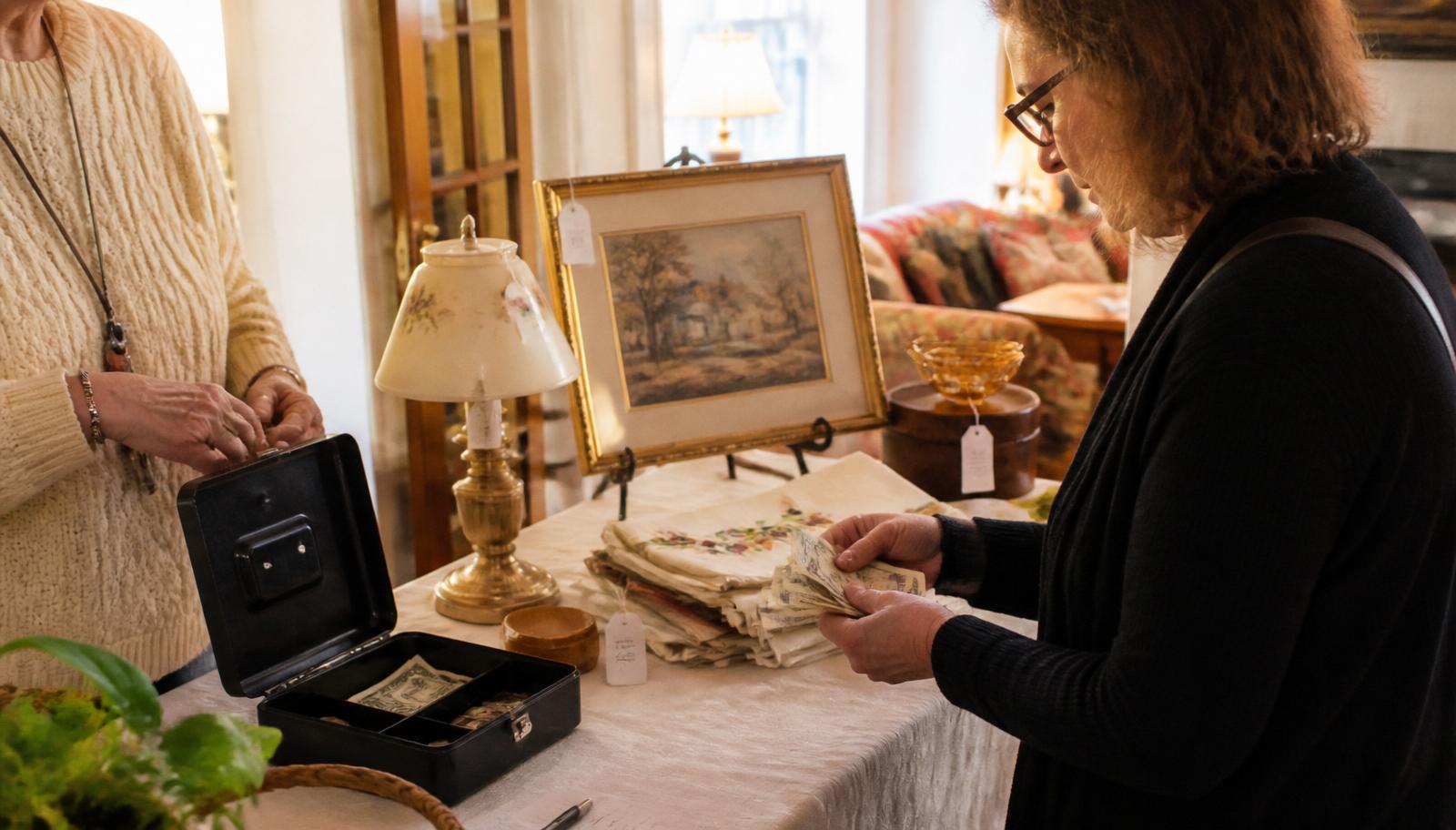
- You pay on the way out. Cash is king; many sales now take cards too, but bring cash to be safe.

That's it. No auction paddles, no bidding wars, no pressure. You look, you grab, you pay. The only real skill is knowing when to show up and what to look for — which is exactly what the next section is about.
9 estate sale tips for first-time buyers
1. Decide what you're after: deals or selection
This is the single most important choice you'll make. Go on opening morning for the best selection. Go on the last day for the best prices. You usually can't have both. Big-ticket furniture and rare collectibles vanish in the first hour; everyday treasures pile up cheap by the end.
2. Bring cash, a tote, and a tape measure
Small bills make checkout painless and help you haggle ("I've got $15 cash — deal?"). A sturdy tote or box keeps your finds together. And a tape measure (or the measuring app on your phone) saves you from the heartbreak of a gorgeous sideboard that won't fit through your door.
3. Arrive early — or embrace the list
If a sale is advertised as busy or "numbered," get there before opening. Sign the list, be friendly, and wait your turn. It feels formal the first time; it's really just a fair way to keep 40 people from stampeding a living room.
4. Check the bottom, the seams, and the marks
Turn things over. Flip the bowl, check the lamp base, look inside the drawer. Maker's marks, stamps, and signatures are where hidden value hides — and where damage does too. Ten seconds of inspection is the difference between a steal and a dud.

5. Not sure what it's worth? Look it up on the spot
You don't need to be an antiques expert anymore. If you find something intriguing and can't tell if it's a $4 trinket or a $400 find, snap a photo and run it through our Ai Appraiser right there in the driveway. It reads the item and gives you a real-world value range in seconds — so you buy with confidence instead of guessing.
6. It's okay to make an offer (politely)
Estate sale prices aren't always final, especially later in the sale. A friendly "Would you take $20 for these two?" is completely normal. Just read the room — lowballing a five-star piece on opening morning won't fly, but bundling odds and ends on day three usually will. New to the social rules? Our estate sale etiquette guide covers exactly what's polite and what's not.
7. Buy what you love, not just what's "valuable"
The best rule in the room: if it makes you happy at that price, buy it. Resale value is a bonus. A $6 lamp that lights up your hallway for the next decade is a win whether or not it's collectible.
8. Look where everyone else won't
The jewelry case gets swarmed. Meanwhile the "$2 each" box on the folding table, the garage shelves, and the linen closet sit untouched — and that's where sharp first-timers clean up. Slow down and dig.
9. Be kind to the staff and the home
You're a guest in someone's house on an emotional weekend. Wipe your feet, handle things gently, and say thank you. Friendly shoppers get the better deals and the "psst, we've got more in the back" tips. Every time.
Estate sale mistakes to avoid
A few rookie missteps we see over and over — dodge these and you're ahead of most:
- Showing up with no cash. Even card-friendly sales move faster on cash, and some still don't take plastic.
- Skipping the measurements. The number one reason great furniture gets returned to the curb: it didn't fit.
- Grabbing everything "just in case." Holding an item means you intend to buy it. Be considerate — don't hoard a cart you'll abandon at checkout.
- Assuming the price is the value. Sometimes it's marked high, sometimes it's a gift. That's why a quick value check pays for itself.
- Only going on opening day, forever. If deals matter more than selection, the last day is your best friend.
Do you tip estate sale workers?
No — tipping isn't expected at estate sales. The staff are paid by the company running the sale. The kindest thing you can do is be respectful, handle items with care, and pay promptly. A genuine "thank you, this was a great sale" means more than a tip ever would.
What should you wear to an estate sale?
Comfortable clothes and closed-toe shoes you don't mind getting a little dusty. You'll be on your feet, reaching into garages, and navigating tight, crowded rooms. Layers help — homes can be warm with a crowd inside. Skip the big handbag; a crossbody or tote leaves your hands free to hunt.
How early should you arrive at an estate sale?
For a normal sale, 15–20 minutes before opening is plenty. For a sale advertised as popular, high-value, or "numbered," arrive 45–60 minutes early to get a good spot on the list. If you only care about bargains, ignore the morning entirely and show up for the final half-off day.
How to find estate sales near you
Here's the part that turns all this into an actual weekend plan. You can:
- Browse every published sale around you on our estate sales near me map — sortable by distance, date, and what's inside.
- See what's happening in the next few days on the estate sales this weekend page.
- Explore the full estate sale directory to scan photos and highlighted items before you ever leave the house.
- Set up wishlist alerts so we email you the moment a sale near you lists that mid-century credenza, Pyrex set, or vinyl collection you've been hunting.
Want the deeper dive on shopping like a pro? Our full buyer's guide picks up right where this leaves off.
You've got this. Grab your tote, bring some cash, and go find something wonderful — your first estate sale treasure is waiting in a stranger's living room right now.
Keep exploring
Ready to start your own treasure hunt?
Discover estate sales near you and find incredible deals.
Explore Sales Near Me
About the author
The EstateSaleFinder Team
Estate sale pros & lifelong treasure hunters
Hi, I'm Andy — a retired commercial photographer turned developer with a five-year (and counting) obsession with estate sales. I started EstateSaleFinder.net because I knew there had to be an easier, smarter way to find and list estate sales. Now I get to chase treasure and build the tool I always wished existed.