
Do Estate Sales Take Credit Cards? Cash, Venmo, Apple Pay, Card Fees and What to Bring (2026)
Most estate sales take cards now, but cash is still king. What 561 companies accept, when a 3% card fee is legal, Venmo and Zelle risks, and what to bring.
Most estate sales take credit and debit cards now, but cash is still the safest thing to bring. Of 561 estate sale companies on EstateSaleFinder that list how they get paid, 72% take credit cards and 99.8% take cash. About one in four take Venmo or Zelle. Some add a fee of up to 3% for credit cards, which isn't allowed in Connecticut, Maine or Massachusetts. Check the listing first and bring some small bills.
Our numbers, checked November 3, 2026: 561 estate sale company profiles on EstateSaleFinder that list accepted payments, plus the written terms on 187 live sale listings. Details in our count further down.
Quick summary
- Cards: Most professional estate sale companies take credit and debit cards. Small family-run sales and garage-style sales are more likely to be cash only.
- Cash: Accepted at virtually every sale. Small bills make haggling and checkout faster.
- Apps: Venmo, Zelle and Cash App show up at about one in four sales. They're fast, but most app payments come with little or no buyer protection.
- Card fees: Some sales add a fee of up to 3% on credit cards. Fees on debit cards aren't allowed under card network rules.
- Checks: Rare. Only about 1 in 7 companies list them.
- Big furniture: Ask about holds, deposits and pickup times before you pay.
Do estate sales take credit cards?
Yes, most of them do. EstateSales.NET surveyed 774 estate sale businesses for its 2024 industry report and found that 82% take card payments (EstateSales.NET 2024 survey). Our own count is close: of the 561 estate sale companies on EstateSaleFinder that list their payment methods, 402 (72%) take credit cards and 405 (72%) take debit cards.
That still leaves roughly one sale in four or five that won't take your card. The ones most likely to be cash only:
- Sales run by the family themselves, without a company.
- Very small sales, or sales in a garage or carport.
- Rural sales where phone signal is weak and a card reader can't connect.
- The first rush of the first morning at some sales, when the line is long and the reader is slow (a few companies switch to cash only during busy stretches).
Are estate sales cash only?
Not usually anymore. In our check of 187 live sale listings on EstateSaleFinder, only 8 (about 4%) said "cash only" in their written terms. But cash still matters for three reasons:
- It works everywhere. 560 of the 561 companies in our count take cash.
- It's easier to haggle with. "Would you take $40 cash?" is a stronger offer when the money is already in your hand. See our guide on how to negotiate estate sale prices.
- It avoids card fees. Some sales add a credit card fee. Cash and debit never have one.
Bring a mix of $1s, $5s, $10s and $20s. Many checkouts run low on change early in the day, and a $100 bill for a $6 item can hold up the line.
What payment methods do estate sales take?
Here's what the 561 estate sale companies on EstateSaleFinder that list payment methods say they accept, as of November 3, 2026. The same table appears in the chart below.
| Payment method | Companies that take it | Share |
|---|---|---|
| Cash | 560 | 99.8% |
| Debit card | 405 | 72% |
| Credit card | 402 | 72% |
| Venmo | 155 | 28% |
| Zelle | 126 | 22% |
| Check | 80 | 14% |
| Cash App | 71 | 13% |
| Apple Pay | 52 | 9% |
| PayPal | 34 | 6% |
| Google Pay | 17 | 3% |
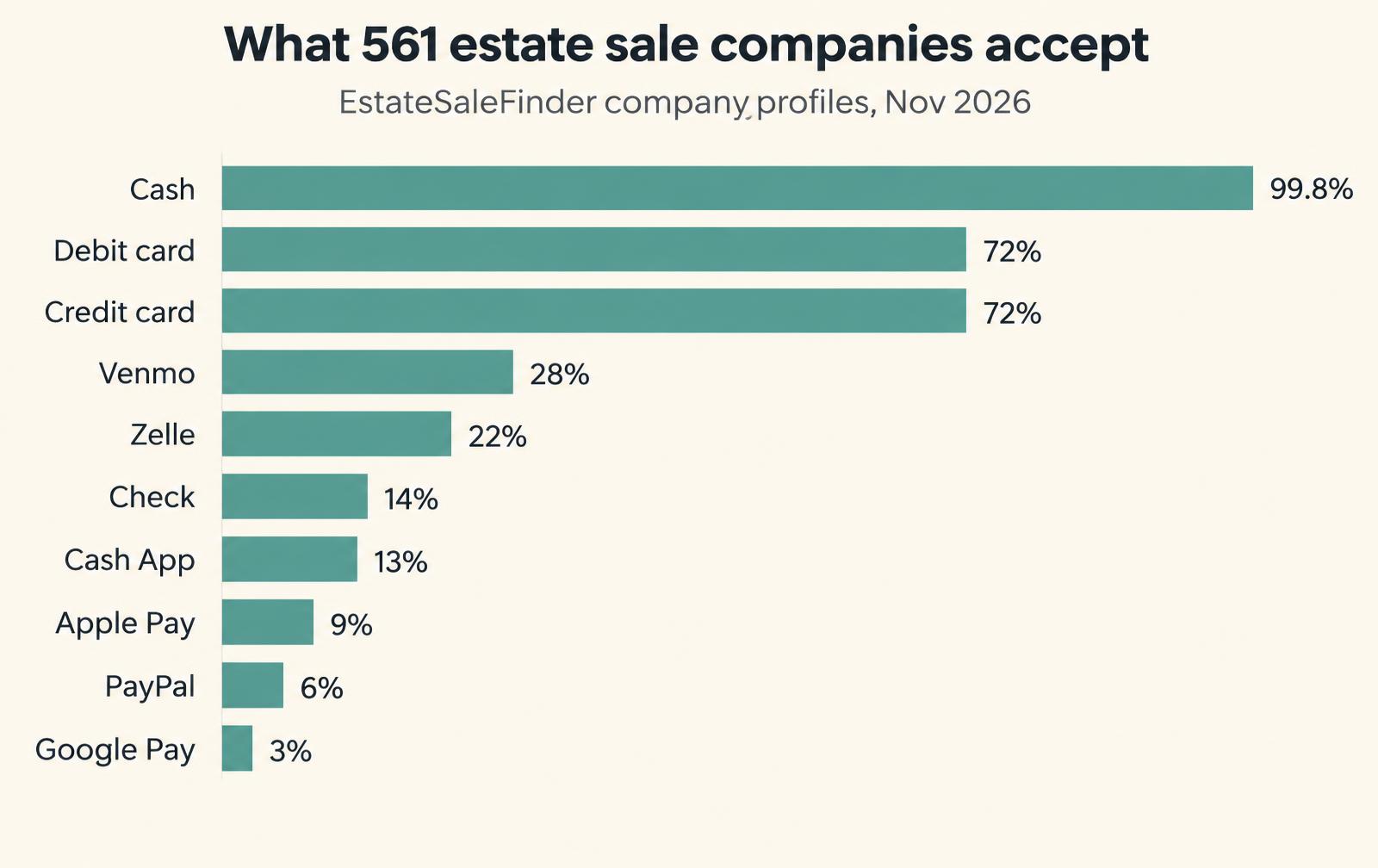
These are what companies list on their profiles. Apple Pay and Google Pay are probably undercounted, because any reader that takes tap-to-pay cards usually takes phone wallets too, even if the company only ticked "credit card." The EstateSales.NET survey, which asked companies directly, found 44% accept digital wallets like Apple Pay and Google Pay, 51% take Venmo, 44% PayPal and 37% Zelle (EstateSales.NET). Their numbers run higher than ours for apps, so treat both as a range.
Do estate sales take Venmo, Zelle or Cash App?
Some do. About 28% of companies in our count take Venmo and 22% take Zelle. Before you pay with an app, know what protection you do and don't get:
- Zelle has no purchase protection. Zelle's own help page says it "does not offer purchase protection" and recommends using it only with people you know and trust (Zelle). Once you send money, you usually can't get it back.
- Venmo protection depends on how you pay. Venmo's Purchase Protection covers payments to business profiles and payments you tag as a purchase. Ordinary personal payments aren't covered (Venmo).
- Cash App works much like Zelle at a checkout table. Treat it like cash.
At a checkout table you're usually walking out with the item, so the risk is small. It matters more for deposits and holds on furniture you'll pick up later. For those, a credit card gives you the most protection (see the furniture section below).
Always double-check the name on the screen before you send. Pay the company's account shown on the checkout sign, never a personal account someone texts you. Our guide to common estate sale scams covers fake "deposit" requests.
Do estate sales take checks?
Rarely. Only 80 of 561 companies (14%) list checks, and some listings say "no checks" outright. When checks are accepted, it's often only from local buyers with ID, or only for larger purchases. Don't plan on it unless the listing says so.
Why do some estate sales charge a card fee?
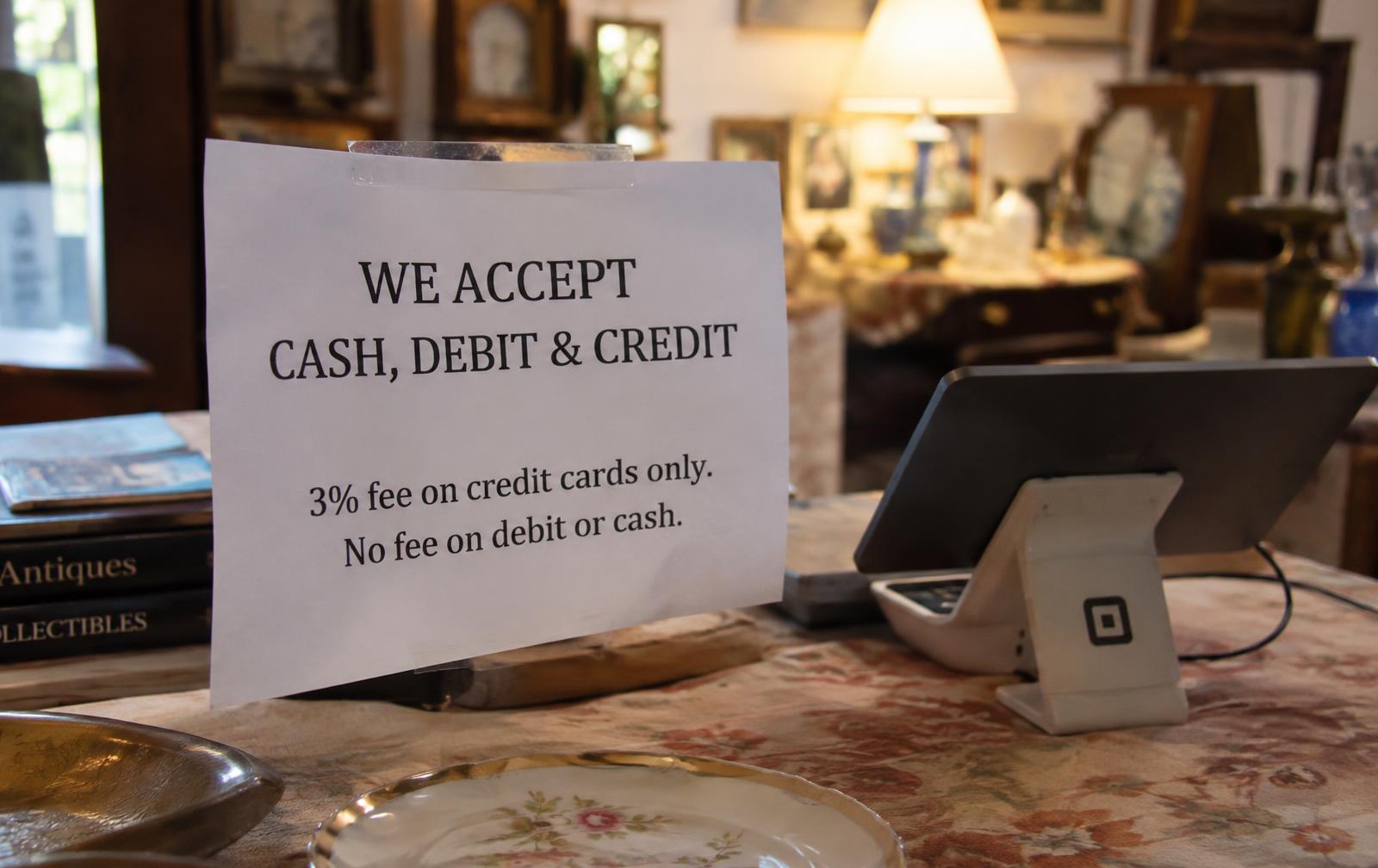
Card processors charge the seller a fee on every swipe or tap. For a company working on commission, that fee comes out of the family's share or the company's. Some companies absorb it. Others pass it on to the buyer as a surcharge, usually 3%.
In our check of live listings, 27 of 187 (about 14%) mentioned a card fee, surcharge or processing fee in their written terms. The most common wording was a flat percentage on credit cards only.
Is a credit card fee at an estate sale legal?
In most states, yes, within limits. The rules come from two places: the card networks and state law.
Card network rules (everywhere in the U.S.):
- Visa caps a surcharge at the seller's actual cost of taking the card or 3%, whichever is lower. Sellers must post the fee where you enter and at checkout, and show it on the receipt (Visa).
- Mastercard's cap is 4%, still limited to the seller's cost (Michigan Department of Attorney General).
- Debit and prepaid cards can't be surcharged, even if they're run as credit (Visa).
State law (stricter in some places):
- Connecticut, Maine and Massachusetts ban credit card surcharges for businesses selling to the public. Discounts for paying cash are still allowed in all three (Nickel, citing Conn. Gen. Stat. § 42-133ff, Me. Rev. Stat. tit. 9-A § 8-509 and Mass. Gen. Laws ch. 140D § 28A).
- Colorado and Oklahoma cap surcharges at 2% or the seller's actual cost (IntelliPay).
- Several other states, including New York and California, have their own rules about how prices and fees must be shown (IntelliPay).
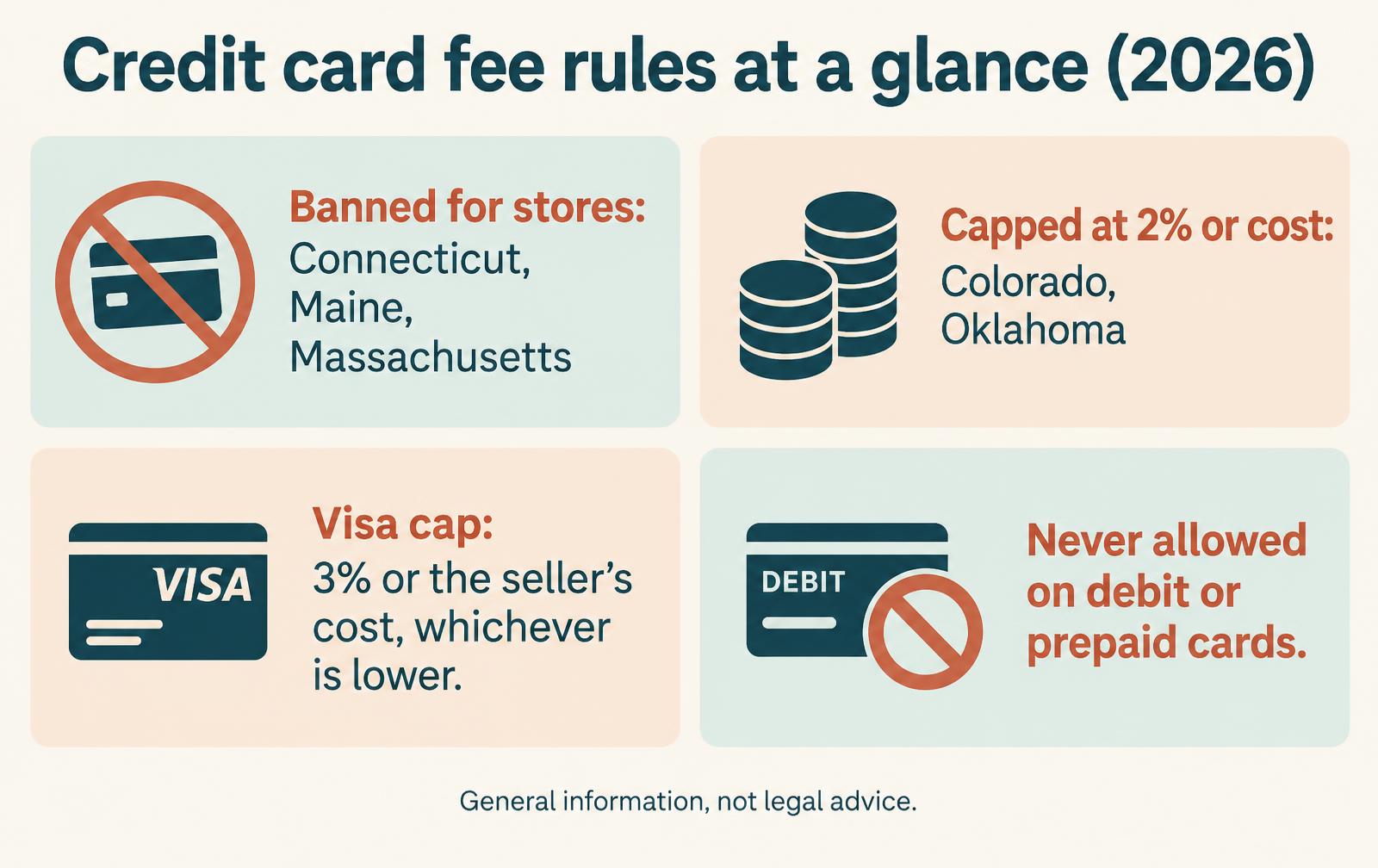
Laws change often, so check your own state before relying on this. This is general information, not legal advice.
Cash discount vs. card surcharge
They can look alike but work differently. A surcharge adds money to the tagged price when you pay by credit card. A cash discount takes money off the tagged price when you pay cash. Cash discounts are legal even in the three states that ban surcharges.
Debit or credit at an estate sale?
If a sale charges a credit card fee, use debit (run it with your PIN if asked) and you won't pay the fee. If there's no fee, credit is usually the better choice, especially for bigger purchases:
How to check a sale's payment methods before you go
- Open the listing and read the terms. On EstateSaleFinder, many sale pages show the company's accepted payments and its written terms. Look for words like "cash only," "cards accepted," "3% fee" or "no checks."
- Look at the company's profile. The company page often lists every payment method it takes.
- Check the photos. Some listings photograph the checkout sign.
- Message the company if it's not clear, especially before a big purchase.
- Plan for a weak signal. In rural areas or basements, card readers sometimes can't connect. Cash is the backup.
Find estate sales near you and read the terms on each listing before you head out.
Paying for big furniture: holds, deposits and pickup
Furniture and large items are where payment questions really matter.
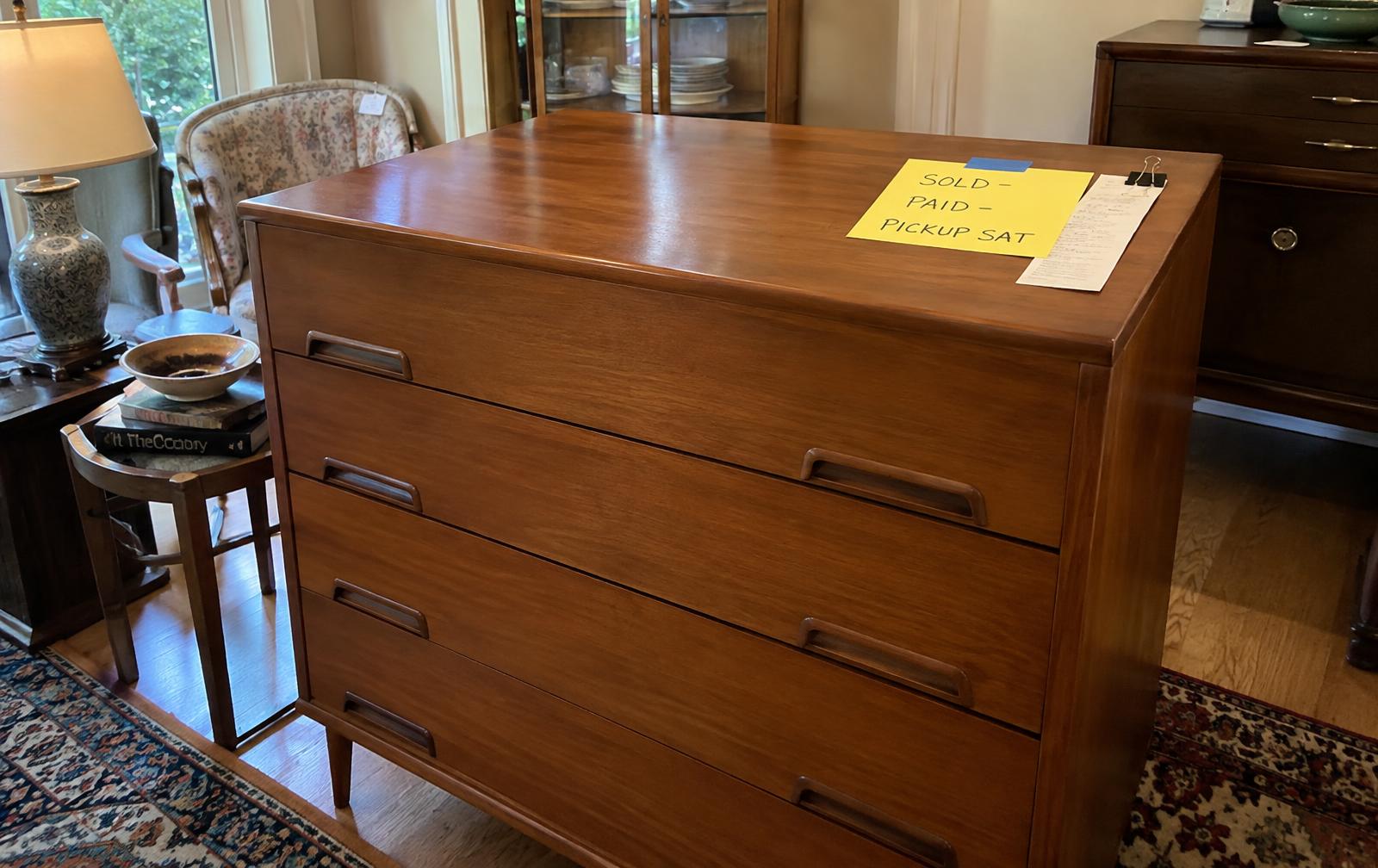
- Most sales want full payment before they'll hold an item. "Hold it for me while I get my truck" usually only works if you've paid.
- Ask about the pickup window. Many companies give you until the end of the sale or a set pickup time. Miss it and you may lose the item and the money, depending on the terms.
- Get a receipt with the item, the price, the date and the pickup time. Take a photo of the sold tag.
- Use a credit card for big deposits when you can. If the item disappears or the pickup falls through, you have dispute rights. Apps like Zelle don't offer that.
- Bring help and supplies. Most companies won't load or deliver. See our guide to the furniture buyers at estate sales.
Some EstateSaleFinder sales let you make offers on items before the sale opens. If the seller accepts, they send an invoice you pay by card and you pick a pickup time, so you don't need cash on the day.
What to bring to an estate sale

- Cash in small bills, about $40–$100 depending on your plans.
- A debit card and a credit card. Debit avoids any card fee; credit protects bigger buys.
- Your phone, charged, for apps, photos and price checks.
- A tape measure and your room or vehicle measurements.
- Bags, boxes and wrapping for fragile pieces.
- Gloves and a small flashlight for basements, garages and attics.
New to estate sales? Read what to expect at your first estate sale and the unwritten rules of estate sale etiquette.
What we found when we checked real listings
On November 3, 2026 we checked two sets of data on EstateSaleFinder:
1. Company profiles. 561 estate sale companies list the payment methods they accept. The results are in the table above.
2. Live sale listings. We read the written payment terms, sale terms and descriptions of 187 sales that were live that day. 163 of them mentioned payment somewhere. Of all 187:
| Mentioned in the listing | Listings | Share of 187 |
|---|---|---|
| Cash | 152 | 81% |
| Credit or debit cards | 129 | 69% |
| Zelle | 49 | 26% |
| Venmo | 44 | 24% |
| A card fee or surcharge | 27 | 14% |
| Apple Pay | 26 | 14% |
| Cash App | 18 | 10% |
| "Cash only" | 8 | 4% |
How we counted
we searched each listing's text for each payment word. A listing that doesn't mention a method may still accept it, so these are minimums. This is a snapshot of one day on one site, not a national survey.
For estate sale companies: setting your payment policy
If you run sales, a clear payment policy speeds up your line and prevents arguments at the table.
- Post your methods everywhere: on the listing, on your company profile and on a sign at the door and checkout.
- If you add a credit card fee, keep it within your actual cost and your card network's cap, don't apply it to debit, post it at the entrance and at checkout, and show it on receipts (Visa). Don't add one at all in Connecticut, Maine or Massachusetts. Your processor will usually need advance notice.
- Consider a cash discount instead if surcharging is restricted where you work.
- Have a backup for when the reader loses signal, such as a second device, a mobile hotspot or cash only for small items.
- Write a hold and pickup policy and print it on receipts.
- Watch for chargebacks on large card sales. Get a signature and keep the receipt and a photo of the item.
On EstateSaleFinder, companies can list accepted payments on their profile and sale pages, take card payments for accepted early offers through Square invoices, and set an optional card fee for those invoices. Our guide to estate sale company fees covers the other side of the money question.
FAQ
Do estate sales take credit cards?
Most do. 82% of estate sale businesses in EstateSales.NET's 2024 survey take cards, and 72% of the 561 companies on EstateSaleFinder that list payment methods take credit cards. Family-run and very small sales are more likely to be cash only.
Do I need cash for an estate sale?
It's smart to bring some. Nearly every sale takes cash, it makes haggling easier, and it's your backup if the card reader loses signal.
How much cash should I bring to an estate sale?
About $40–$100 in small bills covers most small finds. Use a card for anything bigger.
Do estate sales take Venmo?
Some do. About 28% of companies in our count list Venmo. Personal Venmo payments aren't covered by Venmo's Purchase Protection unless you tag them as a purchase or pay a business profile.
Do estate sales take Apple Pay?
Many do without saying so. A card reader that takes tap-to-pay cards usually takes Apple Pay and Google Pay too. Only 9% of companies in our count list Apple Pay by name.
Do estate sales take checks?
Rarely. Only 14% of companies in our count list checks. Don't count on it unless the listing says so.
Can an estate sale charge a credit card fee?
In most states, yes, up to the seller's cost and the card network's cap (3% for Visa). It's banned in Connecticut, Maine and Massachusetts, capped at 2% in Colorado and Oklahoma, and never allowed on debit cards.
Is it better to pay with debit or credit at an estate sale?
Use debit if there's a credit card fee. Otherwise credit gives you more protection, especially for large items you'll pick up later.
Can I pay a deposit to hold furniture?
Ask the company. Many require full payment to hold an item, with a set pickup window. Pay big deposits by credit card when you can, and get a receipt.
Sources
- EstateSales.NET: 2024 Estate Sale Industry Insights Report
- Visa: U.S. Merchant Surcharge Q&A (PDF)
- Michigan Department of Attorney General: Credit and Debit Card Surcharges
- Nickel: 2026 credit card surcharge laws by state
- IntelliPay: 2026 Surcharge and Interchange Fee Laws by State
- Zelle: Paying someone you don't know
- Venmo: Purchase Protection
- FTC: Using Credit Cards and Disputing Charges
- FTC: Billed for things you never got
- EstateSaleFinder company profiles and live sale listings, checked November 3, 2026
Sources checked November 3, 2026. General information, not legal or financial advice.
Keep exploring
Ready to start your own treasure hunt?
Discover estate sales near you and find incredible deals.
Explore Sales Near Me
About the author
Andy
Founder, EstateSaleFinder.net
Hi, I'm Andy — a retired commercial photographer turned developer with a five-year (and counting) obsession with estate sales. I started EstateSaleFinder.net because I knew there had to be an easier, smarter way to find and list estate sales. Now I get to chase treasure and build the tool I always wished existed.