

Estate Sale Discount Days Explained: Day-1 Prices, Half-Off Day, and the "Tomorrow's Price" Rule for Making Offers
Yes, you can usually negotiate at estate sales, but timing decides it. Most companies hold firm on day one, then discount on a schedule like 25% off and 50% off. Here's the tomorrow's price rule, when offers work, last-hour bundle deals, and why some sales take no offers.
Yes, you can usually negotiate at estate sales, but timing decides it. Most companies hold firm on day one, then drop prices on a set schedule, often 25% off on day two and 50% off on the last day. Offers work best on higher-priced items after day one, and on bundles in the last hours of the sale.
That's the short answer. The longer answer is why. Shoppers who get turned down on Friday morning often think the staff are being rude. They're not. They're working for a family, on a schedule that's already promised a discount tomorrow. Once you understand that schedule, you'll know when an offer has a real chance, when to wait, and when to just pay the tag.
This guide is about timing: discount days, the "tomorrow's price" rule, last-hour bundle deals, and why a few sales take no offers at all. For word-for-word scripts and how much to offer, see our companion guide, How to Negotiate Estate Sale Prices.
Quick summary for skimmers:
- Day 1 is usually full price. Many companies don't take offers on the first day, or only take them on big-ticket items.
- Discount days are common. A typical schedule is full price, then 25% off, then 50% off. EstateSales.NET calls the declining price format "a tradition among many estate sale companies" (EstateSales.NET).
- The "tomorrow's price" rule: a company can rarely accept less today than the price it will advertise tomorrow.
- Bundles win at the end. "Fill a box for $X" offers in the last hours are the easiest yes.
- Some sales take no offers. That's the company's and family's call. Read the listing first.
- Plan ahead: save sales on EstateSaleFinder and check each listing's terms for its discount schedule.
Can you negotiate at estate sales?
Usually yes, with three conditions:
- The company allows it. Most do at some point, but policies vary. Some post "prices firm" in the listing.
- It's the right day. Offers on day one are often declined. Offers on discount days, especially on higher-priced items, get much more traction.
- The offer is reasonable. A polite offer on a $400 dresser is very different from asking for half off a $6 mug at 9:01 AM.
That's not just our opinion. In a Reddit thread asking whether it's acceptable to negotiate, one estate sale worker answered: "Generally, yes. I can't speak for everyone, but the companies I've worked for don't typically negotiate on the first day" (r/estatesales). That's one person's experience, but it's the pattern you'll hear over and over.
Do you haggle at an estate sale?
You ask. You don't haggle like a flea market. The difference matters: at a flea market the seller owns the item and can take any price they like. At an estate sale, the staff are selling on behalf of a client, often a grieving family or someone moving into assisted living, and they've agreed on prices and a discount plan in advance. Haggling with insults ("this is junk," "I can get it cheaper on Amazon") doesn't work, and it annoys the people who decide whether you get a yes.
One estate sale worker posted a list of what hagglers say to them, including "It's just trash" and "I'll give you 5 bucks" on a $20 item, "it's the first day, and we just opened" (r/estatesales). If that's your opening line, expect a no.
Estate sale discount days, explained
Most estate sale companies lower prices over the course of a sale. EstateSales.NET describes it this way: "On the second day, for example, all prices might be reduced by 25 percent, and by day three it's a 50 percent discount" (EstateSales.NET). The same page notes the policies vary and that some companies prefer not to discount at all.
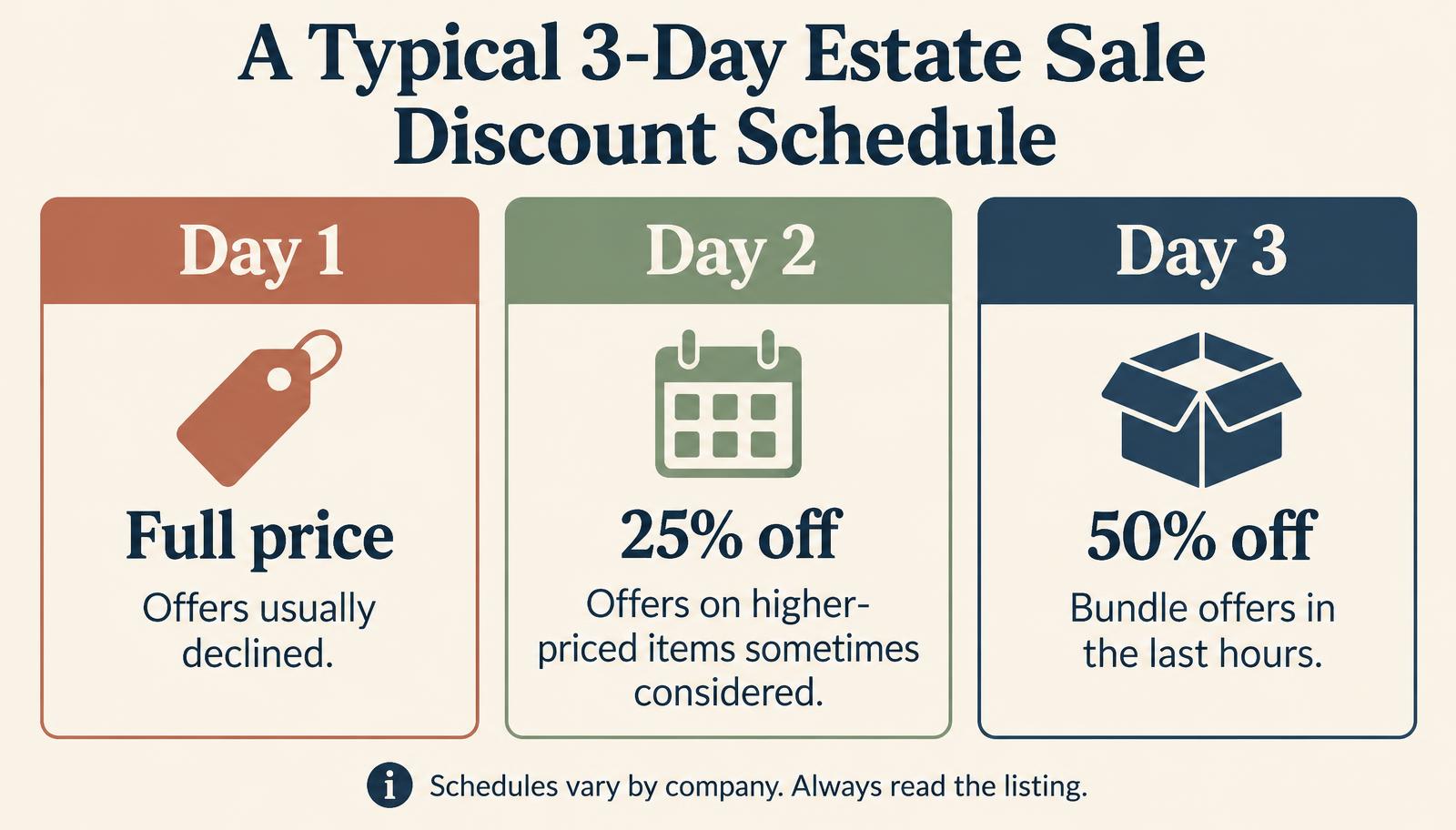
Here's how real companies describe their schedules:
| Sale length | Example schedule | Source |
|---|---|---|
| 3 days | Day 1 full price, day 2 25% off, day 3 50% off | CS Estate Sales FAQ |
| 2 days | Friday full price; Saturday 25% off until 1 PM, then 50% off | The Jewel Box, Dallas |
| Varies | Tags show the full day-one price; discounts are taken at the register | Vintage Estate Company |
Notice the last row. Many companies don't re-tag anything. The tag stays at the day-one price and the discount is applied at checkout. So a $40 tag on a 50%-off day means you'll pay $20 at the register before you've said a word.
What to look for in the listing
Before you go, read the terms on the listing for:
- The discount schedule. "25% off Saturday," "50% off Sunday," "half price after noon."
- Whether discounts apply to everything. Jewelry, art, firearms and big furniture are sometimes excluded or discounted less.
- An offers policy. Some companies say "offers accepted on day 2," "bids taken on large items," or "no offers."
- Online or early offers. Some companies take offers on specific items before or during the sale.
On EstateSaleFinder, each sale's details and terms are on its listing, and you can save sales you're considering so you can compare schedules the night before. Some companies on EstateSaleFinder also let shoppers make offers on individual items right from the listing.
The "tomorrow's price" rule
Here's the idea that explains most first-day turn-downs: a company usually can't take less today than the price it has already promised everyone tomorrow.
Think about it from the company's side. If the sale is 25% off tomorrow, the company expects some items to sell at 25% off tomorrow. An item that sells today at full price is a win for the family. An offer of 30% off today is lower than tomorrow's price, on the busiest day, when other shoppers are still likely to pay the tag. Saying yes would cost the family money for no reason.
So the math is simple:
- Offer at or above tomorrow's price and you might get a yes, especially on a big item that's been sitting.
- Offer below tomorrow's price on day one and you'll almost always get a no.
Worked example. A walnut sideboard is tagged $600 on Friday. The sale is 25% off Saturday and 50% off Sunday.
| When | Tag price after discount | A reasonable offer | Likely answer |
|---|---|---|---|
| Friday morning | $600 | $300 | No: below even Sunday's price |
| Friday afternoon | $600 | $450 | Maybe: that's Saturday's price, guaranteed today |
| Saturday | $450 | $350 | Maybe, if it's large and hasn't drawn interest |
| Sunday | $300 | $250 with same-day pickup | Good chance, especially near closing |
The Friday $450 offer works because you're asking the company to lock in tomorrow's price today, not to beat it. Some companies even advertise the idea: one California company ran short "Flash Estate Sale" previews billed as "Tomorrow's prices today" (EstateSales.NET listing).
Should you wait for half-off day?
It depends on how badly you want the item. Discount days are a gamble:
- Wait for common items (glassware, linens, books, everyday furniture). There's usually plenty left.
- Pay full price for anything rare, underpriced or on your must-have list. The best items are often gone in the first hour.
- Leave a bid if the company takes them. Some companies keep a bid sheet for big items and call the highest bidder near the end.
A newer shopper on Reddit asked whether percent-off days are picked over, noting the sale "seemed like it had been gutted" by the end of day one (r/estatesales). That's the tradeoff. Day one has the selection; the last day has the prices. Our guide on the Saturday morning checklist and finding sales before they're picked over covers first-day strategy.
Last-hour bundle deals
The last couple of hours of the last day are when offers are most welcome. The company's goal has changed: instead of getting the best price per item, it now wants to sell as much as possible, because whatever's left becomes a donation, a buyout or a cleanout job.
That's why bundle offers work so well at the end:
- "Can I fill this box for $20?" Great for books, kitchenware, linens, tools and craft supplies.
- "I'll take all six of these chairs for $X." Selling a set clears floor space.
- "Everything on this shelf for $X, and I'll carry it out now." Same-day pickup is a real benefit to the company.
One Reddit shopper said they can "usually" get sales "to let me fill an entire box of books for a certain price on the last day" (r/estatesales). That matches what many regulars report, but it's not a guarantee, as that same thread shows.
Bundle offer tips:
- Group items first, then ask. Don't ask about each item separately.
- Offer a round number and be ready to pay right away.
- Offer to take the heavy or awkward stuff too. It helps the company.
- Accept a counteroffer gracefully. "Okay, how about $25?" is a yes in disguise.
Why some estate sales refuse all offers
The Reddit thread above is titled "Estate sale would not entertain offers whatsoever," and it drew 72 comments (r/estatesales). The poster had offered a deal on hundreds of leftover books with 15 minutes left, at a sale already at 50% off, and was turned down.
It's frustrating, but there are real reasons a sale might say no to every offer:
- The family set the rule. The client may have asked for no negotiating at all, especially on items with sentimental value.
- The leftovers already have a plan. Unsold items may be going to a buyout, an online auction, consignment or a charity pickup. Selling them cheaply to you may not help the family.
- *The discount already is the negotiation.* Some companies see their schedule as fair to everyone and don't want staff making one-off deals.
- Short staffing. Evaluating offers takes time. A small crew at a busy register may simply say no to everything.
- Fairness. If the company gives one person 70% off, the next shopper who paid 50% feels cheated.
What to do
don't argue. Say thanks, and if you really want the item, ask whether they keep a bid sheet or whether the item might go to auction later. Then check the company's other sales; policies are usually consistent from sale to sale.
Estate sale negotiation etiquette
The shoppers who get the most yeses are the ones staff like seeing. A quick checklist:
- Read the listing terms first. If it says "no offers on day 1," don't make them say it.
- Ask, don't insult. "Would you take $40?" works. "This is overpriced junk" doesn't.
- Offer on items that make sense. A higher-priced item that hasn't sold is a better candidate than a $3 trinket.
- Talk to the person who can decide. That's usually at the checkout table, not the staffer restocking the kitchen.
- Don't ask the family. If you find out someone is a relative, don't make offers to them.
- Keep it quiet. Don't announce your deal to the room.
- Have payment ready. Cash or card in hand makes your offer more real.
- Take no for an answer. You can always come back on discount day.
- Don't hide items to buy them later at a discount. It's the fastest way to get banned.
For more, see the unwritten rules of estate sale etiquette.
For estate sale companies: making offers work for you
If you run sales, a clear offers policy saves your staff a lot of awkward conversations. A few ideas from how companies describe their approach:
- Post your discount schedule and offers policy in every listing, and on a sign by the register. Shoppers plan around it.
- Keep tags at the day-one price and discount at checkout, so you don't have to re-tag overnight.
- Use a bid sheet for big items. Collect bids on day one or two, then call the top bidder near the end. It turns "no" into "maybe later."
- Decide your last-hour bundle prices ahead of time ("fill a bag, $10") so any staffer can say yes quickly.
- Explain the "tomorrow's price" rule when you turn someone down. "We'll be 25% off tomorrow, so I can do $450 today" keeps the shopper friendly.
EstateSaleFinder lets companies take early offers on specific items and respond to them on their own schedule, with item photos shoppers can browse before the sale. See what's included on our page for estate sale companies.
How to plan a discount-day route with EstateSaleFinder
- Find sales near you on the estate sales near me map, sorted by distance and day.
- Check each listing's terms for discount days and offers policies.
- Save the sales you're considering on Saved sales, and split them into "go Friday" and "wait for half off."
- Set wishlist alerts for what you collect, so you know which sales have it before you choose a day.
- Make offers on items where the company allows it, right from the listing.
It's free for shoppers.
Questions & answers
Frequently asked questions
Can you negotiate at estate sales?
Usually yes, but timing matters. Many companies don't take offers on day one. Offers on higher-priced items work better on discount days, and bundle offers work best in the last hours of the final day.
Can you haggle or barter at an estate sale?
You can ask politely, but estate sales aren't flea markets. Staff sell for a client on a set discount schedule. Bartering (trading items) is very rare. A reasonable, polite offer at the right time is the way to go.
Do estate sales go down in price each day?
Most do. A common pattern is full price on day one, 25% off on day two and 50% off on day three (EstateSales.NET). Some companies discount by the hour on the last day, and some don't discount at all.
Is the last day of an estate sale half off?
Often, but not always. Many companies run 50% off on the final day, or after a certain time. Check the listing's terms for that sale's schedule.
Why won't estate sales take offers on the first day?
Because the company has already promised a discount tomorrow. An offer below tomorrow's price on the busiest day usually costs the family money. Offers at or above tomorrow's price have a better chance.
What is the etiquette at an estate sale?
Read the terms, ask politely, make offers to the person at checkout, don't make offers to family members, have payment ready, and take no for an answer. Don't hide items to buy later at a discount.
How much should I offer at an estate sale?
On discount days, a fair offer is usually a bit below the discounted price on higher-priced items. For exact percentages and scripts, see How to Negotiate Estate Sale Prices.
Are bundle deals better at the end of an estate sale?
Yes. Near closing on the last day, companies want to clear the house, so "fill a box" and "take the whole set" offers get the most yeses.
Do estate sales take bids?
Some do. Bid sheets are common for furniture, art and other big items. Ask at checkout whether they're taking bids and when they'll call the winner.
Keep reading
Sources checked October 23, 2026: EstateSales.NET's guide to estate sale pricing and a sample listing, three estate sale company FAQs (CS Estate Sales, The Jewel Box, Vintage Estate Company), and r/estatesales threads, quoted as individual experiences. Discount schedules and offer policies vary by company.
Keep exploring
Ready to start your own treasure hunt?
Discover estate sales near you and find incredible deals.
Explore Sales Near Me
About the author
Andy
Founder, EstateSaleFinder.net
Hi, I'm Andy — a retired commercial photographer turned developer with a five-year (and counting) obsession with estate sales. I started EstateSaleFinder.net because I knew there had to be an easier, smarter way to find and list estate sales. Now I get to chase treasure and build the tool I always wished existed.