How to Spot a Fake Hummel: The 60-Second Base Check (and the Erich Stauffer Trap)
Flip it over. A real M.I. Hummel has the incised M.I. Hummel signature, a Goebel trademark, an incised mold number and soft matte paint. Look-alikes from Arnart (Erich Stauffer), NAPCO and unmarked Japanese makers miss one or more. Here's the full checklist, the Hummel vs Goebel difference, and what today's market really pays.
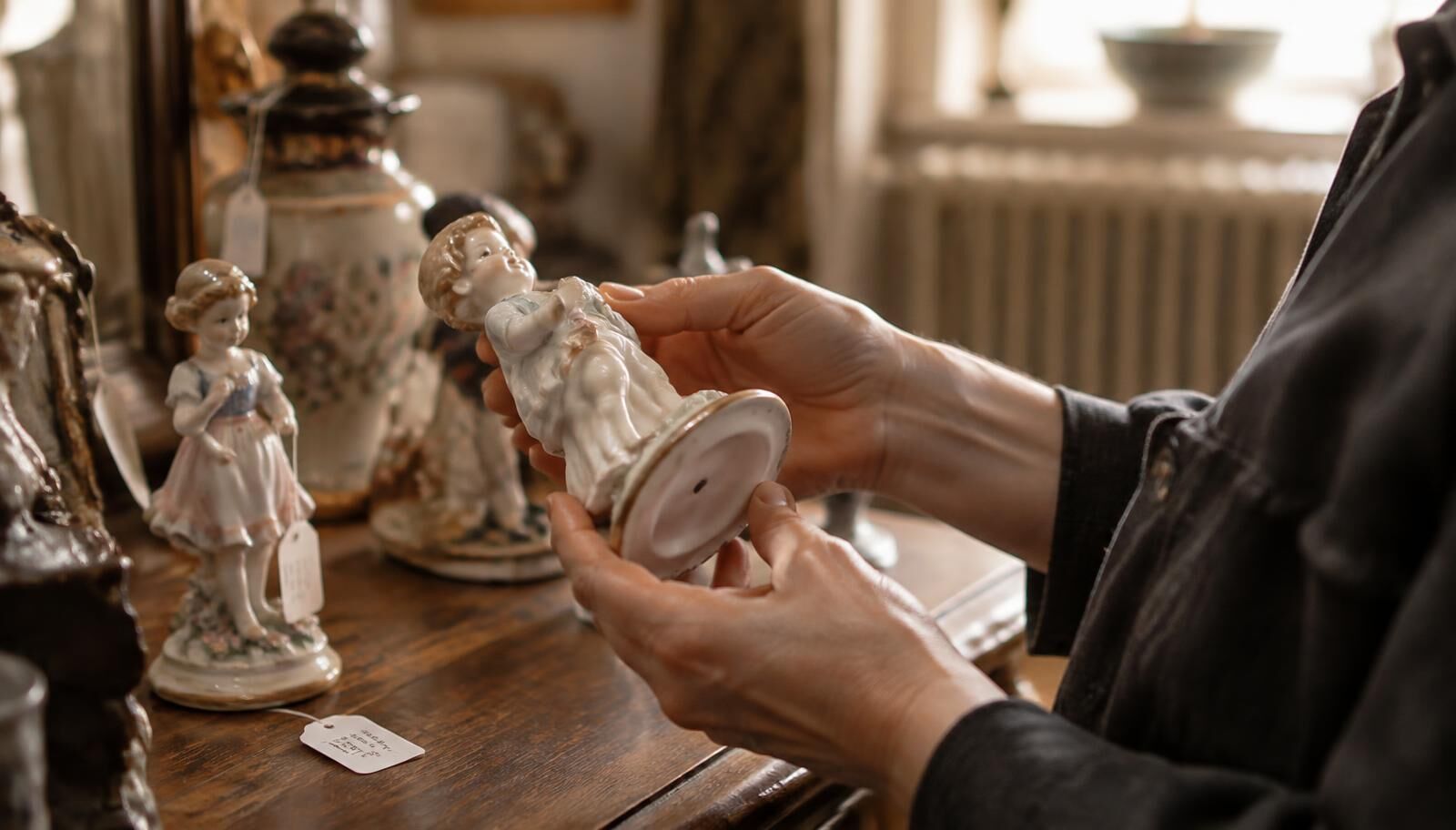
To spot a fake Hummel, turn the figurine over. A genuine M.I. Hummel figurine almost always has the "M.I. Hummel" signature incised (pressed into the clay) on the base or the back of the base, a Goebel trademark that dates it, an incised mold number, and soft, matte, hand-painted color. Look-alikes from Arnart (sold under the Erich Stauffer name), NAPCO and unmarked "Made in Japan" makers usually have a shiny glaze, a paper sticker or ink stamp instead of an incised signature, and no mold number.
That's the whole idea in one breath. The rest of this guide shows you exactly what each mark looks like, the look-alikes that fool people most often, how to tell a real piece that's been damaged from a fake, and an honest picture of what Hummels sell for today, so you can decide in under a minute whether a piece at an estate sale deserves a closer look.
Quick summary for skimmers:
- Real: incised M.I. Hummel signature + Goebel trademark + incised mold number + matte paint.
- Fake or look-alike: high-gloss glaze, paper "Hummel style" sticker, "Erich Stauffer" or "Arnart" stamp, NAPCO, "Made in Japan" or "Taiwan", no incised signature.
- Hummel vs Goebel: Goebel is the German factory that made M.I. Hummel figurines from 1935 to 2008. "Goebel" alone does not mean Hummel; Goebel made many other figurines too.
- Value: most common Hummels sell for modest prices today. Early marks, big sizes, rare molds and perfect condition are what move the needle. See our Hummel marks and values guide for the full dating chart.
How do you tell a real Hummel from a fake?
You check five things on the base, in order: the incised signature, the trademark, the mold number, the country of origin, and the paint and glaze quality. If two or more of those are missing or wrong, you're almost certainly looking at a look-alike.
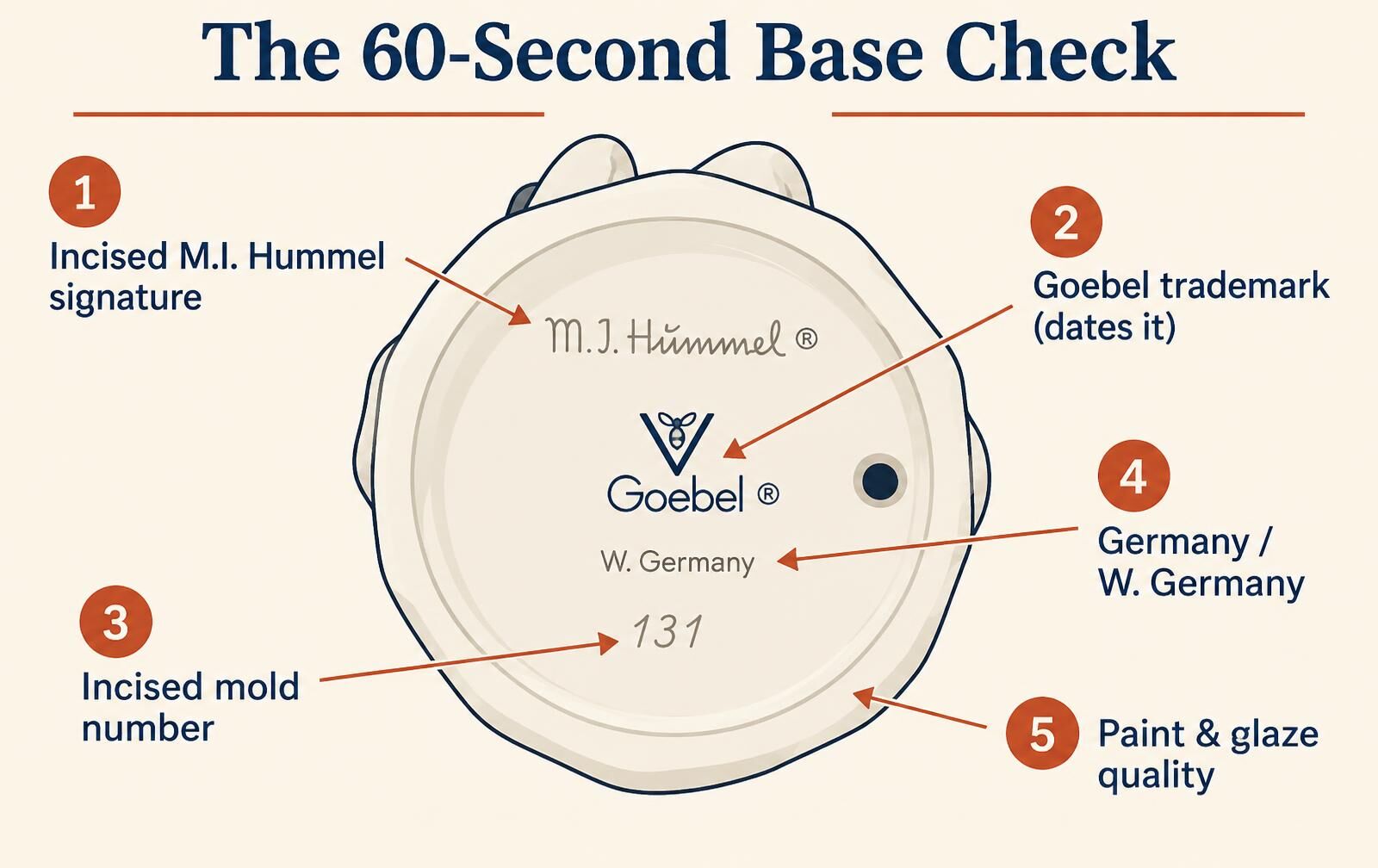
The 60-second base check
Do this every time, in this order. It takes about a minute once you've done it a few times.
- Find the incised M.I. Hummel signature. Look on the base, and on the back edge of the base near the bottom. On genuine pieces the signature is pressed into the clay, not printed on top. Run your fingernail over it; you should feel a groove. The M.I. Hummel Club's guide to fakes lists the incised name as the first thing to check, and notes that almost all genuine figurines carry it. On very small pieces it can be on the back of the figure itself instead.
- Find the Goebel trademark. It's usually printed or stamped underneath. It changed many times over the decades: a crown, a full bee in a V, a stylized bee, a "three line" mark, the "last bee" and later the word "Goebel" with or without a bee. That mark is what dates the piece (our marks and values guide walks through each one). A real figurine has a trademark that fits its era. No trademark at all is a warning sign.
- Find the incised mold number. Genuine Hummels have a number pressed into the base, often called the "Hum number" (for example 1, 15 or 71), sometimes followed by a size code like /0 or /I. Look-alikes usually skip this or use a printed number from a different system.
- Check the country of origin. Genuine pieces say "Germany", "W. Germany" or "Western Germany" depending on the period. A stamp or sticker reading "Japan", "Made in Japan", "Taiwan" or "China" tells you it's not a Goebel-made M.I. Hummel.
- Look at the paint and glaze. Real Hummels have soft, muted, hand-painted color with a satin or matte finish, gentle shading on cheeks and clothing, and crisp detail. Most look-alikes have a high-gloss glaze, flat bright colors, and blurry detail in the faces and hands.
One more feel test
genuine Goebel figurines are made of fine earthenware with a fairly solid, even weight. Look-alikes are often lighter, with thin walls and a rough unglazed bottom. Weight alone doesn't prove anything, but it's a good tie-breaker.
What a "strike" looks like
Here's a simple way to score a piece at a sale:
| What you see | What it usually means |
|---|---|
| Incised signature, Goebel trademark, incised mold number, matte paint | Very likely genuine. Now check condition and era. |
| Incised signature and mold number, but no trademark | Possibly genuine (marks sometimes wore off or were missed), but research it before paying more than a few dollars. |
| Paper sticker saying "Hummel" or "Original Hummel reproduction" | A licensed or unlicensed copy, not a Goebel figurine. Check the sticker maker. |
| "Erich Stauffer", "Arnart", "5th Ave", crown with crossed arrows | Arnart look-alike. Usually $10 to $35. |
| "NAPCO", "Japan", "Taiwan", or a glossy finish with no marks | Look-alike. Price it as decor, not as a collectible. |
What is the Erich Stauffer trap?
"Erich Stauffer" figurines are the single most common Hummel look-alike at estate sales, and the name fools people because it sounds like a German porcelain artist. They were imported by Arnart, a New York company, and most were made in Japan, not Germany.
According to Porcelain Marks and More, Arnart Creations (later Arnart Imports) was an importer, not a factory, operating from 1953 until 2001 out of an office at 212 Fifth Avenue in New York. In the mid-1950s Arnart started its own figurine series inspired by the popularity of Goebel's Hummels and put the designer name "Erich Stauffer" on them. Most were made in Japan, and later production shifted mostly to Taiwan.
The story you'll hear at sales is that Stauffer "worked for Goebel" or "designed the original Hummels." Both specialist sources we checked say that's a legend. Porcelain Marks and More calls the Goebel connection "total nonsense," and the Erich Stauffer reference site says it's most likely Stauffer only ever worked for Arnart.
How to recognize an Erich Stauffer piece:
- A blue or black crown mark, sometimes with crossed arrows, and a series number, often on a sticker. WorthPoint explains that Arnart also borrowed crossed-arrow marks that look like the German Kalk factory's, which adds to the confusion.
- "Erich Stauffer" printed in script on the base, or on a paper label or hang tag on the front.
- Glossy finish, bright color, and soft detail compared with a Goebel piece.
- No incised M.I. Hummel signature and no Hummel mold number.
What they're worth
The Erich Stauffer reference site puts most figurines at about $10 to $35 each, more if they still have their original paper labels or come as a set. That's a fair, honest price for a pretty piece of 1950s to 1960s decor. It's not a Hummel price.
The famous Reddit example
If you search "is this a real Hummel," you'll see the same story play out on Reddit and Facebook over and over: someone finds a sweet figurine of a child in lederhosen with a crown on the base, gets excited, and the replies point out the Erich Stauffer stamp. It's the most common false alarm in the hobby. Knowing the name saves you the drive to an appraiser.
What other Hummel look-alikes should you know?
Besides Arnart, the look-alikes you'll see most are NAPCO, unmarked Japanese "occupied Japan" style figurines, Wagner and Apel pieces from Germany, Beswick and Dubler wartime pieces, and modern "Berta Hummel" bisque figurines. Some are worthless copies; a couple are collectible in their own right.
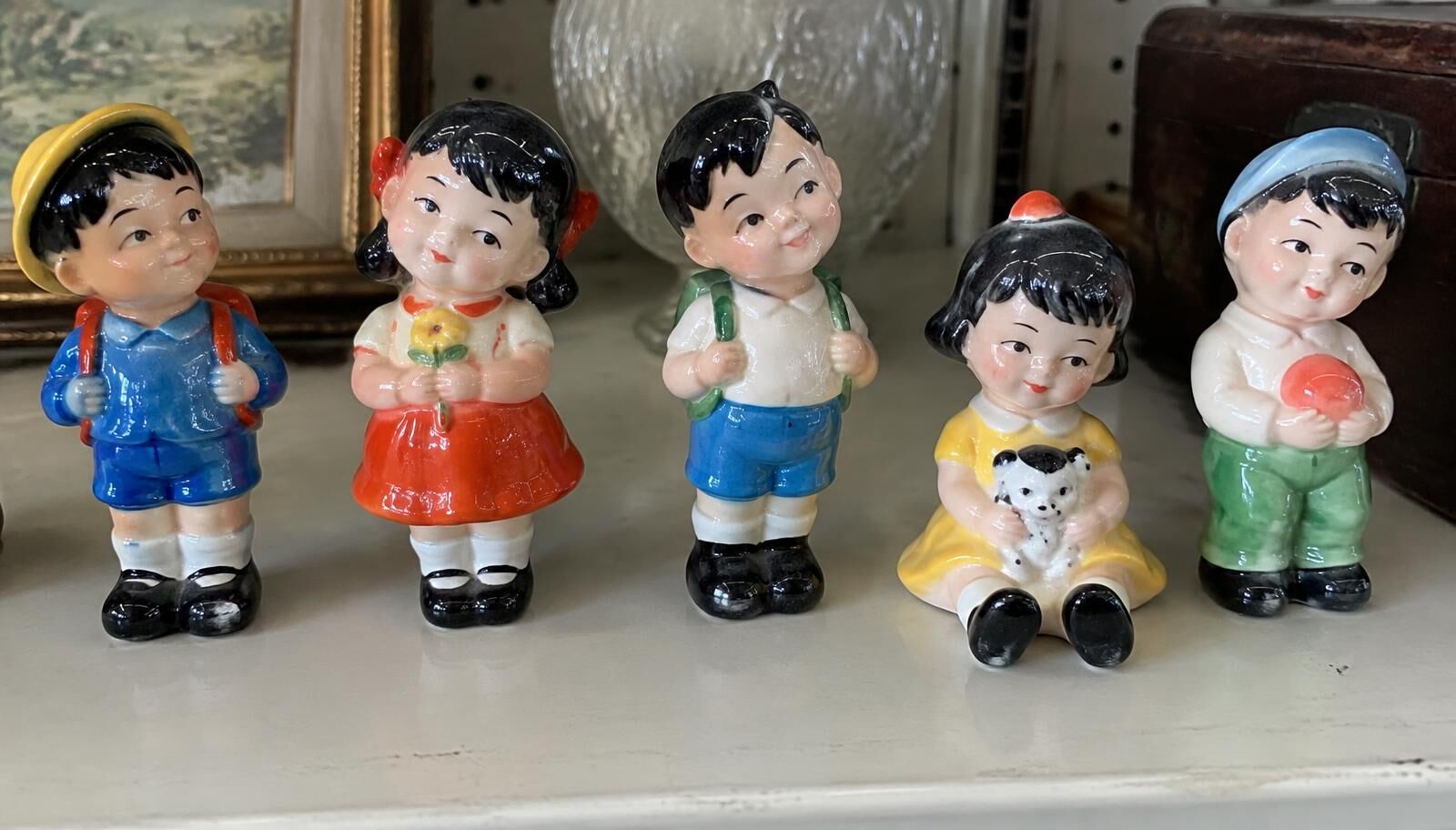
- NAPCO (National Potteries Corporation). An American importer of Japanese-made ceramics best known for planters and holiday pieces. Its child figurines are clearly marked NAPCO or carry a NAPCO sticker. Pretty, inexpensive, not Hummel.
- Unmarked "Made in Japan" pieces. Hundreds of small makers copied the Hummel look after the war. Many have only a paper sticker, which often fell off. If there's no incised signature, no Goebel mark and a glossy glaze, price it as decor.
- Wagner and Apel (W and A). A German porcelain maker from Lippelsdorf in Thuringia. Figurines and Sculpture documents a reader who thought her crown-marked look-alike was Arnart, then traced it to Wagner and Apel. Lesson: a crown mark alone doesn't tell you the maker. Read every letter on the base.
- Dubler and Beswick wartime pieces. The M.I. Hummel Club notes that during World War II, when the Goebel factory was shut down, licensed versions were made by Dubler in New York and Beswick in England. These are a special case: they are licensed, they're not Goebel, and serious collectors research them separately. Don't price them like ordinary look-alikes or like Goebel pieces until you've looked them up.
- "Berta Hummel" figurines. Berta was Sister Maria Innocentia Hummel's birth name. The M.I. Hummel Club describes newer bisque figurines sold under that name and made in East Asian countries including China and Taiwan, based on sketches she made before entering the convent. They're a legitimate product, but they're not M.I. Hummel figurines by Goebel and they sell for much less.
What is the difference between Hummel and Goebel?
Goebel is the German porcelain company; M.I. Hummel is the line of figurines it made under license, based on drawings by Sister Maria Innocentia Hummel. Every genuine M.I. Hummel made between 1935 and 2008 came from Goebel, but not every Goebel figurine is a Hummel.
Here's the short history, from sources we checked:
- 1871: Franz Detleff and William Goebel found the company, and its first porcelain factory opens in 1878 in Oeslau-Rödental, near Coburg in Bavaria (Goebel company history).
- 1935: Goebel begins producing M.I. Hummel figurines based on Sister Maria Innocentia Hummel's drawings (The Local).
- 2006 to 2008: After Hummel sales collapsed, Goebel filed for insolvency in 2006 and stopped making the figurines in October 2008 (Die Welt).
- 2009: A new company, Manufaktur Rödental, took over the equipment and rights and restarted production in the same town with a much smaller staff (The New York Times).
What this means at a sale:
- "Goebel" + incised M.I. Hummel signature = a Goebel-era Hummel. Use the trademark to date it.
- "Goebel" alone, no Hummel signature = another Goebel figurine (Goebel made birds, animals, Friar Tuck monks, Disney and Norman Rockwell lines, and more). Some are collectible; they're just not Hummels.
- Manufaktur Rödental marks = a genuine, post-2009 Hummel. Newer pieces usually sell below early Goebel pieces on the secondary market.
How are Hummels marked?
Hummels carry up to five marks: the incised M.I. Hummel signature, a Goebel (or later Rödental) trademark, an incised mold number with a size code, a country of origin, and sometimes a painted or incised date and artist's initials. The trademark is the one that dates the piece.
Collectors group the trademarks into "TMK" numbers, from TMK-1 (the Crown mark used from 1935) up through the later bee and "Goebel" marks. Our Hummel marks and values guide has the full TMK chart with pictures and dates, so we won't repeat it here.
A few marks that confuse people:
- The incised crown (TMK-1) is the earliest mark, and that's exactly why look-alike makers used crowns too. A crown is only exciting when it sits next to an incised M.I. Hummel signature and mold number.
- "Western Germany" or "W. Germany" dates a piece to the postwar decades when Germany was divided. It's not a fake sign; it's a date clue.
- A painted date on the base (for example the year the figure was painted) sometimes appears on later pieces. It's normal.
- Special event backstamps (like club exclusive or anniversary marks) are real and can add a little to collector interest.
What do newer forged or altered marks look like?
The look-alikes above are mostly honest copies sold as decor. Real forgery, where someone tries to make a newer or damaged piece look older or more valuable, is less common but worth knowing. Watch for these signs:
- A trademark that doesn't match the signature style. An early Crown mark next to a modern-looking printed signature is suspicious.
- Ground-off or painted-over marks. Someone may grind off a later trademark so a piece looks earlier or "unmarked rare." A rough, flat, freshly ground spot on an otherwise smooth base is a red flag.
- Marks that sit on top of the glaze. Genuine trademarks were applied as part of the firing process. A mark that scratches off easily or looks like a decal applied later deserves suspicion.
- Repairs sold as perfect. This is far more common than forgery. Tilt the figure under a light. Glued-on hands, re-glued hats and touched-up paint show up as dull patches, a slightly different color, or a line. Under a blacklight (an inexpensive UV flashlight), many repairs glow differently than original glaze.
- Sizes that don't exist. Every genuine mold number has known sizes. If a seller says a piece is "an unusual giant version," look up the mold number before you believe it.
If a piece is expensive and anything feels off, ask the seller for a return option or get a second opinion. The M.I. Hummel Club is the collector organization most people start with.
How do I know if my Hummel is valuable?
A Hummel's value comes from five things: how early its trademark is, how rare the mold is, its size, its condition, and whether people still want that design. A common figurine in perfect condition with a later mark usually sells for modest money; an early-mark, large or rare piece in perfect condition can sell for much more.
Quick value checklist:
- Early trademark? Crown and Full Bee pieces get the most interest.
- Large size? Size codes like /II or /III and the very large display pieces bring more.
- Rare mold or variation? Some molds were made briefly or have known color or design variations.
- Perfect condition? Chips, cracks, repairs and crazing cut value sharply. Check fingers, hat brims and the tips of anything sticking out.
- Original box and papers? Helpful for later pieces, especially limited editions.
For documented sold prices and examples, read the Hummel marks and values guide. Always use sold prices, not asking prices; a listing that says $500 means nothing until it sells.
Want a fast first opinion? Snap a photo of the figurine and its base with the EstateSaleFinder Ai Appraiser. It suggests an identification and a value range from what it sees and from comparable sales, so you can decide whether a piece is worth more research. It's a suggestion to start from, not a final appraisal.
Does anybody buy Hummels anymore?
Yes, but far fewer people than in the 1980s and 1990s, and prices for common pieces are much lower than many families expect. The buyers today are a smaller group of collectors, people buying a piece that reminds them of a grandparent, and decorators who want one or two.
The numbers back that up. When Goebel stopped production in 2008, The Local reported that demand had dropped to one third of what the company expected, and Die Welt reported the company had filed for insolvency in 2006 after Hummel sales collapsed.
If you're sorting a family collection, here's a simple plan:
- Make three piles: genuine Hummels (incised signature + Goebel mark), look-alikes, and damaged pieces.
- Pull out anything special: early marks, large sizes, unusual molds, or pieces in original boxes. Research those individually.
- Sell common genuine Hummels as a group. A collection often sells better as one lot than one figurine at a time.
- Price look-alikes as decor. A few dollars each, or grouped in a box lot.
- Keep the ones that mean something. If a figurine was Grandma's favorite, its value to your family may be higher than any market price.
If you're clearing a whole house, our guide to valuing inherited items before you give away a fortune helps you find the pieces that are worth more than they look, and estate sale vs auction vs cleanout helps you decide how to sell the rest.
Tips for shoppers at estate sales
- Turn every figurine over, even if it's priced cheap. Underpriced real Hummels still turn up, especially in mixed box lots.
- Carry a small flashlight (or use your phone light) to read faint incised marks.
- Check for damage before you check the mark. A perfect common piece is often worth more than a damaged early one.
- Save searches for the things you collect. Add "Hummel" to your wishlist and EstateSaleFinder alerts you when a sale near you lists matching items.
- Shop early. Figurines are one of the first categories to go. Our guide to finding estate sales before they're picked over shows how.
Ready to look? Find estate sales near you and start turning things over.
Questions & answers
Frequently asked questions
How can you tell if a Hummel is real?
Turn it over. A real M.I. Hummel has the "M.I. Hummel" signature pressed into the base, a Goebel (or later Rödental) trademark, an incised mold number, a German country of origin, and matte hand-painted color. If it has a paper sticker, a glossy glaze, or says Japan, Taiwan, NAPCO, Arnart or Erich Stauffer, it's a look-alike.
Are Erich Stauffer figurines real Hummels?
No. Erich Stauffer figurines were sold by Arnart, a New York importer, starting in the 1950s, and were mostly made in Japan. They were designed to look like Hummels. Most sell for about $10 to $35 each.
What is the difference between Hummel and Goebel?
Goebel is the German porcelain company founded in 1871. M.I. Hummel is the line of figurines Goebel made from 1935 to 2008, based on drawings by Sister Maria Innocentia Hummel. Goebel also made many figurines that are not Hummels. Since 2009, Hummels have been made by Manufaktur Rödental.
Does a crown mark mean my Hummel is old and valuable?
Only if it also has the incised M.I. Hummel signature and mold number. Goebel's crown mark is the earliest Hummel trademark, but look-alike makers, including Arnart, used crowns too.
Is a Hummel without a signature always fake?
Not always. On a few very small pieces the signature is on the back of the figure, and marks can be faint. But a figurine with no signature, no Goebel mark and no mold number is almost certainly a look-alike.
Are Hummels worth anything today?
Most common Hummels sell for modest prices today. Early trademarks, large sizes, rare molds and perfect condition bring the most. Check sold listings, not asking prices, and see our Hummel marks and values guide for examples.
Where can I sell Hummel figurines?
Common pieces sell best as a group at an estate sale, through a local consignment or antique shop, or online. Rare and early pieces deserve individual research and may do better with a specialist or collector group. If you're clearing a whole house, an estate sale company can price and sell a collection with everything else.
Keep reading
Sources checked October 21, 2026: the M.I. Hummel Club, Porcelain Marks and More, the Erich Stauffer reference site, WorthPoint, Figurines and Sculpture, Goebel Porzellan, The Local, Die Welt and The New York Times. Prices are general ranges from those sources, not appraisals.
Keep exploring
Ready to start your own treasure hunt?
Discover estate sales near you and find incredible deals.
Explore Sales Near Me
About the author
Andy
Founder, EstateSaleFinder.net
Hi, I'm Andy — a retired commercial photographer turned developer with a five-year (and counting) obsession with estate sales. I started EstateSaleFinder.net because I knew there had to be an easier, smarter way to find and list estate sales. Now I get to chase treasure and build the tool I always wished existed.