Hummel Figurines: How to Read the Marks & What They're Worth
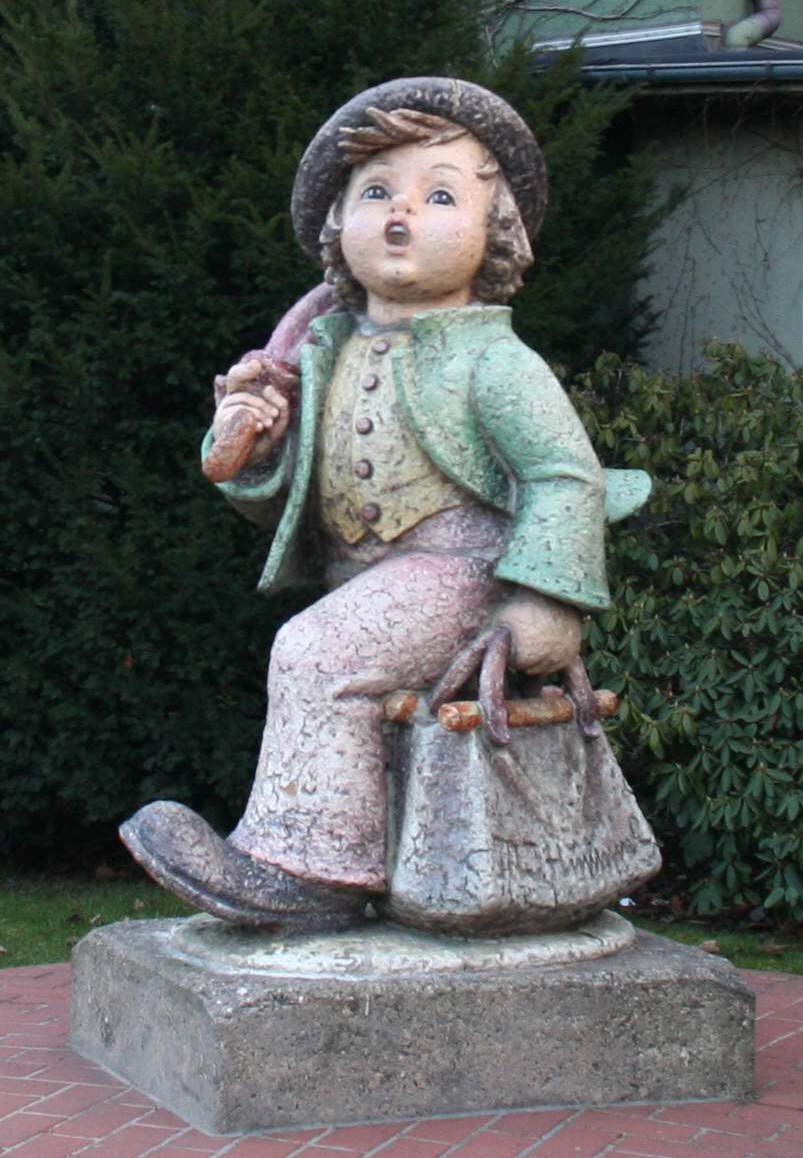
Flip it over and the base tells you everything: the M.I. Hummel signature, the Goebel trademark that dates it, the mold number and the size suffix that decides the price. A picker's field guide to every mark from the 1935 Crown to the Millennium Bee, with documented sold prices — including the 31-inch Merry Wanderer that brought $5,499 and the wartime Internationals at $3,750.
Quick answer
Turn the figurine over. A genuine M.I. Hummel has three things on its base: the incised "M.I. Hummel" signature, a Goebel trademark stamp, and an incised mold number (often with a size suffix like /0, /I or 7/III). The trademark dates it — Crown Mark (1935–1949), Full Bee (1950–1959), Stylized Bee (1960–1972), Three Line (1964–1972), Last Bee (1972–1979), Missing Bee (1979–1990), Hummel Mark (1991–1999), Millennium Bee (2000–2008). Older mark plus bigger size equals the money. Most common Hummels sell today for $20–$60, while early large examples and the wartime "Internationals" have brought $2,000–$5,500 at auction.
I buy at estate sales for a living, and Hummels are the single most misunderstood shelf in the house. Sellers think they're sitting on a retirement fund because a 1978 price guide said so. Buyers walk past the whole shelf because "Hummels are worthless now." Both are wrong, and the difference is on the bottom of the figurine, in a stamp the size of your thumbnail.
This is the field guide I wish someone had handed me: how to read the mark in thirty seconds, what the numbers next to it mean, and what these things actually sell for right now — with the sold prices and sources so you can check my work.
Turn it over: the four things on every base
Before you worry about value, learn the base. Every real one tells you four things.
1. The "M.I. Hummel" signature. Incised into the clay — usually on the back edge of the base or up the side — not printed. Every authentic figurine carries it in addition to the Goebel trademark. No signature is the single fastest fake tell.
2. The Goebel trademark. The dating stamp. Sometimes incised, sometimes stamped in blue, black or (later) a decal. This is the mark everything below is about.
3. The mold number (HUM number). An incised number identifying the design, fixed for the life of the model: Hum 1 is Puppy Love, Hum 7 is Merry Wanderer, Hum 141 and 142 are Apple Tree Girl and Boy, Hum 347 is Adventure Bound. The number never changes, no matter which era the piece was made in.
4. The size suffix. The part almost everyone ignores, and the part that actually moves money. A slash number or Roman numeral after the mold number encodes the casting size: 7/0 is small, 7/III is a 12-inch Merry Wanderer, 7/X is a 31-inch monster. Same design, wildly different prices. Always write down the full number and measure the height.
You may also see incised artist initials from the master painter, a copyright year (the design year, not the production year — a huge source of confusion), a paint date on pieces from 1979 onward, and country-of-origin wording that helps you date the piece at a glance.
The mark chronology: TMK-1 through TMK-8
Collectors and price guides shorthand the trademarks as TMK-1 through TMK-8. Here's the whole sequence, what each looks like, and what it means for value.
| Mark (TMK) | Years | What you see on the base | What it means for value |
|---|---|---|---|
| TMK-1 Crown Mark ("Crown-WG") | 1935–1949 | A stylized crown over the initials WG (Wilhelm Goebel), incised and/or stamped in black or blue. Transitional pieces show a "Double Crown." | The oldest and most sought-after. Any Crown Mark piece deserves a second look, especially in larger sizes. |
| U.S. Zone wording | 1946–1949 | "U.S. Zone Germany" or "Made in U.S. Zone Germany" added alongside the crown during Allied occupation | A tight four-year window — an instant, reliable date stamp collectors pay a premium for. |
| TMK-2 Full Bee | 1950–1959 | A naturalistic bumblebee inside a large V (V for Verein, bee for Hummel). Twelve documented sub-variants — High Bee, Small Bee, Baby Bee, Vee Bee — as the bee shrank and slid down the V through the decade. | The collector sweet spot. Early Full Bee examples of rare models are where the four-figure prices live. |
| TMK-3 Stylized Bee | 1960–1972 | The bee flattened into a geometric shape inside the V. Large stylized bee (~1960–63) has "W. Germany" to the right; the small/one-line version centers it below. | Mid-tier. Common models here are the shelf-filler Hummels most sales are full of. |
| TMK-4 Three Line Mark | 1964–1972 (overlaps TMK-3) | The stylized bee/V plus three lines of text beside it, printed in blue | Mid-tier, same as TMK-3. Overlapping dates are normal — Goebel used both at once. |
| TMK-5 Last Bee ("Goebel Bee") | 1972–1979 | A shrunken bee/V with Goebel added. Underglaze 1972–76, overglaze 1976–79. | The peak-production era. Enormous supply, so only big sizes and rare models carry value. |
| TMK-6 Missing Bee | 1979–1990 | The bee disappears entirely: "Goebel W. Germany." Painter's date added to the base. | The bulk of what you'll find at estate sales. Usually $20–$60 unless it's oversized. |
| TMK-7 Hummel Mark | 1991–1999 | Post-reunification, "W. Germany" becomes just "Germany." The first mark used exclusively on M.I. Hummel pieces rather than across all Goebel lines. | Late, common, and often bought new at retail for far more than it resells for. |
| TMK-8 Millennium Bee | 2000–2008 | The bee and V return above "Goebel"/"Germany" for the company's centennial. The last Goebel-era mark. | Newest Goebel production. Value tracks the retail secondary market, not antiquity. |
| Manufaktur Rödental | 2009–present | Goebel-era production ended; marks reference M.I. Hummel / Manufaktur Rödental, no Goebel name | Current production. Buy because you like it, not as an investment. |
One honest caveat
these boundary years are approximate. Goebel phased marks in gradually and used overlapping stamps for years at a time — Antique Trader's trademark guide flatly says the dates are "accurate to within five years or so." Sources also disagree on whether TMK-1 ends in 1949 or 1950 and whether TMK-6 ends in 1990 or 1991. Use the mark to place a piece in an era, not to pin an exact year.
Want to see each mark photographed? The stamps are small — thumbnail-sized on the base — so rather than blow up low-resolution copies of someone else's photos here, use the two best free reference galleries and compare side by side with the piece in your hand: mihummel.org's TMK gallery shows every mark from the Crown through the Millennium Bee with close-ups, and Wolfgang's Hummel Haus trademark history photographs the sub-variants of each bee. Both open in a new tab.
The fastest date check: read the country
If the light is bad and you can't make out the bee, read the words instead. The country wording alone brackets the piece:
- "U.S. Zone Germany" → 1946–1949. Stop and look closely.
- "Germany" alone with a crown → 1948–1949.
- "W. Germany" / "West Germany" / "Western Germany" → sometime between 1960 and 1990.
- "Germany" with a modern-looking mark → 1991 or later.
A word of warning that saves people real money: "W. Germany" does not mean valuable. It just means pre-1991. There are millions of West German Hummels, and most of them are the $25 kind.
What Hummels are actually worth
Here's the part price guides get wrong. These are realized prices — what someone actually paid at auction or on eBay — not book values. Each row links to the source.
| Figurine | Mark / size | Sold price | Where and when |
|---|---|---|---|
| Common small figurines (4"–6", TMK-5 to TMK-7) | Late marks | $20–$60 | Typical estate sale and resale reality today |
| Harmony In Four Parts (Hum 471) | Standard | $150 | Hill Auction Gallery, 2020 (Invaluable) |
| Apple Tree Boy & Girl pair (141/142) | Small, 3.5"–6" | ~$80 the pair | Smith Auction Co., 2021 (Invaluable) |
| Apple Tree Boy, jumbo | 30" | $2,500 | Blackwell Auctions, 2021 (Invaluable) |
| Apple Tree Girl, jumbo | 30" | $2,200 | Blackwell Auctions, 2021 (Invaluable) |
| Merry Wanderer (Hum 7/III) | TMK-1 Double Crown, 12" | $899 | eBay, Sept 2021 (Hummel price reference) |
| Merry Wanderer (Hum 7/X) | Jumbo, 31" | $5,499 | eBay, Mar 2020 (Hummel price reference) |
| Umbrella Boy & Girl (152/II) | Mixed marks, large pair | $1,800 | eBay, Jul 2019 (Hummel price reference) |
| Adventure Bound (Hum 347) | TMK-5, large group | $1,200–$2,000 | eBay, 2024 (Hummel price reference) |
| Hungarian Girl (Hum 854) | TMK-1 | $3,499 | eBay, Jan 2023 (Hummel price reference) |
| Internationals series (Serbian, Bulgarian, Swedish, Slovak, Czech) | TMK-1 wartime | $1,600–$3,750 | Blackwell Auctions, 2020–21 (Invaluable) |
Two things I want to be straight about. First, these are the most recent results I can actually verify with a link — they run 2019 through 2024, because 2025–26 sold archives on WorthPoint and LiveAuctioneers sit behind paid walls. Anyone quoting you precise 2026 "current values" for free is quoting a guide, not a sale. Second, condition assumptions matter: those numbers are for clean, undamaged, unrestored pieces.
The pattern underneath all of it:
- Size beats everything. A jumbo Merry Wanderer brought $5,499; the small one is $40. Measure the height before anything else.
- Early marks beat late marks. Crown and Full Bee pieces of the same model routinely outrun TMK-6 versions by multiples. Experts have quoted early Full Bee Adventure Bound examples at $6,000–$9,000.
- Rarity beats both. The wartime "Internationals" — Hungarian, Serbian, Bulgarian, Swedish, Slovak and Czech children, Hum 813 through 854 — were made in tiny numbers in the early 1940s and many never went into full production. Those are the lottery tickets.
Why the market crashed, and why that's good news for buyers
Hummels were the 1970s and 80s collectible. People bought them as investments, on layaway, through a collectors' club, and they were told the values only went up. Then they didn't.
By 1993 newspaper advice columns were already telling readers there was "not much value in Hummel pieces" (The Morning Call). In 2009 the New York Times covered Goebel's Hummel operation going through insolvency and restructuring as demand collapsed and the workforce shrank (NYT). By 2015 the Arizona Republic was writing about the "dramatic drop in value" as tastes shifted away from mid-century collectibles (AZCentral). One dealer guide puts it plainly: it is a buyer's market for Hummels right now (House of Hummels).
Here's why I love that. A collapsed market means the whole shelf gets priced at $10 apiece by someone who's tired of hearing that Hummels are worthless — and the 12-inch Crown Mark piece is standing right there in the middle of it. The crash didn't kill the value at the top. It killed the sorting.
The 30-second field checklist
This is what I run on every figurine, in this order, standing at the table:
- Flip it. Is the incised "M.I. Hummel" signature there? No signature, put it down.
- Read the mark. Crown or Full Bee → slow down. Stylized/Three Line → maybe. Missing Bee or later → only if it's big.
- Write down the full mold number, suffix included (7/III, not "7").
- Measure the height. Anything over 9 inches is worth researching on the spot.
- Run a fingertip over the glaze for crazing — fine cracks in the surface.
- Phone flashlight, held behind and beside the piece, looking for repair lines, color mismatch, and glue seams at fingers, hats, umbrellas and animal ears.
- Check for the original box. It's real money on desirable pieces.
- Ask about the rest. Collections are never all on one shelf. Ask what's in the closet.
Fakes, whitewares and reproduction tells
Genuine Hummels are earthenware, not translucent porcelain. Hold one to a bright light: it shouldn't glow through the way fine china does. The most common tells:
- No "M.I. Hummel" signature. Look-alike figurines copy the style and the Goebel-ish stamp but can't legally carry the signature.
- Wrong weight and feel. Fakes often ring lighter or feel chalky.
- Sloppy painting. Real ones have crisp eyes, lashes and shoe detail; reproductions get muddy faces.
- After-decorated whitewares. Genuine undecorated factory blanks painted by outsiders and sold as finished pieces. The mark can be real while the paint isn't.
- Factory seconds. Look for a scratch or grinding line through the trademark — that's Goebel marking a piece it didn't fully approve.
Two useful references for cross-checking a suspect piece: mihummel.org's fakes page and Antique HQ's forgery checklist.
Condition: what actually kills the price
In a buyer's market, buyers get picky, and picky means condition.
- Chips and hairlines — even hidden ones on the base — cut value sharply.
- Crazing (fine cracking through the glaze) drops a piece from collector-grade to decorative.
- Restoration and repaint hurt more than honest damage on common pieces; on genuinely rare pieces a professional restoration is tolerated but still discounts the result.
- Missing paint on faces and hands is close to fatal.
- The original box adds real money on the pieces collectors chase.
What to buy, what to walk past
Buy:
- Anything with a Crown Mark or Full Bee, in any size.
- Anything over 9 inches, regardless of mark.
- The Internationals (Hungarian, Serbian, Bulgarian, Swedish, Slovak, Czech children) — know these by sight; they're the score.
- Complete boxed sets and matched pairs like Umbrella Boy and Girl.
- Anything you can buy for a few dollars in a "whole shelf" lot, because sorting is the whole job.
Walk past (at anything above a few dollars):
- Single small TMK-6 and TMK-7 figurines — the shelf-filler tier.
- Anything crazed, chipped or repaired that isn't rare.
- Collector plates, bells and annual ornaments. These sold in enormous numbers and have essentially no secondary market.
- Anything a seller has priced from a 1990 price guide. Explain kindly, or come back on half-price day.
If you inherited a collection
Grandma's Hummels are usually worth less than the family hopes and more than a quick internet search suggests, and both halves of that sentence matter.
- Don't dump the whole thing on eBay one piece at a time. After fees and shipping, a $30 figurine that arrives broken loses you money.
- Sort by mark and size first. Pull out Crown, Full Bee, and everything over nine inches. That's the group worth listing individually or taking to a specialist auction like Blackwell, which runs dedicated rare-Hummel sales.
- The rest belongs in an estate sale, priced to move as a group. Buyers who want a shelf of Hummels for decorating exist, and they'll take twenty at once.
- Don't clean anything aggressively. Warm water and a soft brush. No dishwasher, ever, and no abrasives on the paint.
- Photograph the bases. When you sell — publicly or to a dealer — a clear photo of the mark and mold number is what turns an offer into a good offer.
Running the sale yourself, or hiring a company to do it? List an estate sale on EstateSaleFinder and buyers searching for Hummels in your area get notified directly.
Questions & answers
Frequently asked questions
How do I know how old my Hummel is?
Read the Goebel trademark on the base and match it to the mark chronology above: Crown (1935–1949), Full Bee (1950–1959), Stylized Bee (1960–1972), Three Line (1964–1972), Last Bee (1972–1979), Missing Bee (1979–1990), Hummel Mark (1991–1999), Millennium Bee (2000–2008). The copyright year incised on the base is the year the design was created, not the year your piece was made — that trips up almost everyone.
What does TMK mean on a Hummel?
TMK stands for trademark, and collectors number them TMK-1 through TMK-8 in chronological order. It's shorthand for the era: "TMK-2" means a Full Bee piece made in the 1950s.
Are Hummel figurines worth anything in 2026?
Most are worth $20–$60. The exceptions are real: early Crown and Full Bee pieces, oversized castings, and the wartime Internationals have sold from roughly $900 to $5,499 in documented auction and eBay results. The market crashed for common figurines; it never crashed for rare ones.
What is the rarest Hummel figurine?
The wartime "Internationals" series (roughly Hum 813 through 854 — Hungarian, Serbian, Bulgarian, Swedish, Slovak and Czech children) is the most commonly cited rarity, made in very small numbers in the early 1940s with many models never reaching full production. Individual examples have sold in the $1,600–$3,750 range.
Does "W. Germany" on the base mean it's valuable?
No. It only tells you the piece was made before German reunification in 1990. Millions of ordinary Hummels carry it. Pair the country wording with the mark and the size before you get excited.
Do chips and crazing really matter?
Yes, a lot. In a buyer's market collectors buy the clean example and skip the damaged one. Crazing, chips, hairlines and repaint all move a piece from collector-grade to decorative, which usually means a fraction of the price.
Sources
- Antique Trader — How to Identify Hummel Trademarks (Heidi Ann Von Recklinghausen)
- Wolfgang's Hummel Haus — Trademark History
- mihummel.org — Hummel Figurine Trademarks, Rare Hummels: The Internationals, Hummel Fakes
- Invaluable — Inside the Archives: Hummel Figurine Prices
- Hummel Price Reference (realized eBay sales)
- New York Times — Hummels Regain Fragile Foothold on Life (2009)
- AZCentral — Sweet Hummel figurines aren't what they used to be (2015)
- The Morning Call — Not Much Value in Hummel Pieces (1993)
- House of Hummels — Guide to Evaluating the Condition of Hummels
- Antique HQ — Hummel Numbering System and fake/forgery checklist
Related reading:
Photo credits appear beneath each image — every photo here is a real Hummel used under its Creative Commons license, with the photographer credited and linked. Prices cited are documented realized sales, not appraisals — condition, market and venue change what any individual piece brings.
Keep exploring
Ready to start your own treasure hunt?
Discover estate sales near you and find incredible deals.
Explore Sales Near Me
About the author
Andy
Founder, EstateSaleFinder.net
Hi, I'm Andy — a retired commercial photographer turned developer with a five-year (and counting) obsession with estate sales. I started EstateSaleFinder.net because I knew there had to be an easier, smarter way to find and list estate sales. Now I get to chase treasure and build the tool I always wished existed.