
First Edition Books at Estate Sales: How to Spot One and What It's Worth
Estate sales are one of the last places a $1 book can turn out to be worth five figures. Here's exactly how to read a copyright page, decode publisher number lines, judge condition like a dealer, and know what the books are actually worth — with real auction results, not internet folklore.
A first edition is the first batch of copies printed and released when a book is first published — and at estate sales, the person writing the price tags almost never knows which books on the shelf are firsts. That gap is the entire opportunity. You can learn to close it in about ten minutes of reading, and it's the rare skill that pays for itself the first time it works.
This guide is the field version: how to read a copyright page in fifteen seconds, the publisher rules that actually matter, what makes a first edition valuable versus merely old, real auction results from the last few years, and exactly what to do when you think you're holding something.
What a "first edition" actually means
In publishing, an edition is a version of the text. A printing (or impression) is one production run of that edition. A book can go through fifty printings and every one of them is technically still "the first edition" — same typesetting, same text.
Collectors don't mean that. When a dealer says "a first," they mean the first edition, first printing — the copies that came off the press before anyone knew whether the book would matter.
That's why the copyright page is the whole game. It's where publishers record printing history, and it's the difference between a $6 shelf-filler and a book worth a car payment.
The one-sentence rule: first edition = the original version of the text; first printing = the first physical run of it. Value lives almost entirely in the second one.
Why estate sales beat thrift stores for rare books
Thrift stores and library sales are fed by anonymous donations and priced by volume. Estate sales are the opposite: you are walking through one household's actual library, usually assembled over forty to seventy years by a person with taste, and frequently bought new at the time of publication.
That matters for three reasons:
- Age of acquisition. A 1974 novel bought in 1974 is far more likely to be a first printing than the same title bought used in 2005.
- Coherence. Real collectors buy deep in one lane. If you find one Cormac McCarthy first, check the whole shelf.
- Pricing by the box. Estate sale staff have to price an entire house in two days. Books get bulk-priced because inspecting them individually is impossible.
If you're building the broader skill set, our guides on spotting valuable items without being an expert and things secretly worth $500 or more pair directly with this one — books show up on both lists constantly.
How to identify a first edition, step by step
Step 1 — Open to the copyright page
It's the reverse side of the title page, almost always. Everything you need is printed there in six-point type: copyright year, printing history, publisher imprint, and (for modern books) the number line.
Step 2 — Read the number line
A number line — printers call it a printer's key — looks like this:
10 9 8 7 6 5 4 3 2 1The lowest number present is the printing. Publishers delete the lowest digit at each new run, so a second printing reads `10 9 8 7 6 5 4 3 2`. Order doesn't matter — only whether the 1 is still there.
All three of these are first printings:
1 2 3 4 5 6 7 8 9 10
10 9 8 7 6 5 4 3 2 1
1 3 5 7 9 10 8 6 4 2
Number lines became widespread among major trade publishers in the mid-20th century. Before that, you're relying on printed statements and dated title pages — see Biblio's first edition identification guide and Raptis Rare Books' identification reference.
Step 3 — Read the printing history statement
Older and mid-century books often spell it out in words instead of digits. This is the single most useful thing to learn, because the statement can also disqualify a copy instantly:
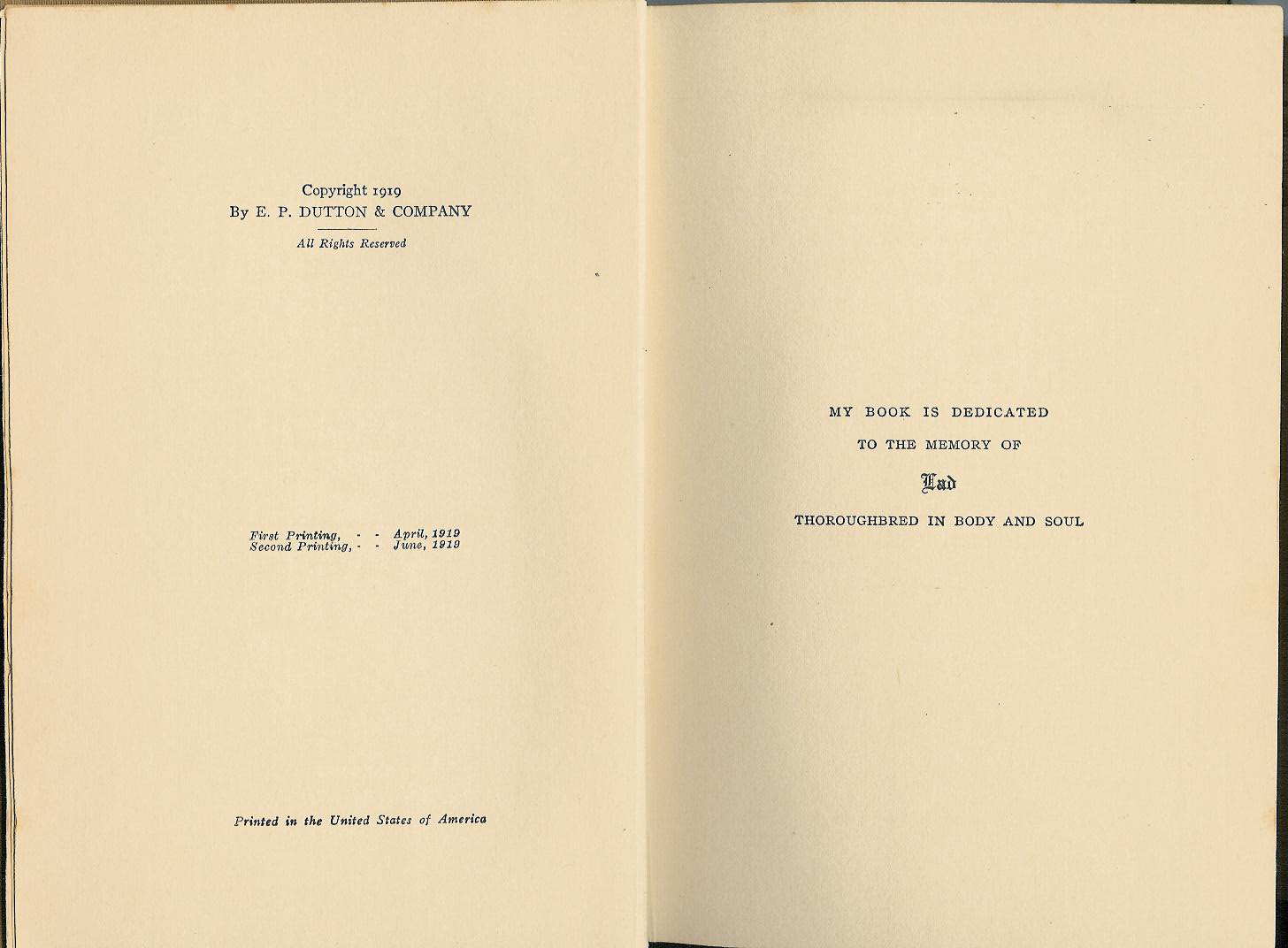
Real example — the copyright page of Albert Payson Terhune's Lad: A Dog (E.P. Dutton, 1919). It reads "First Printing, April 1919 / Second Printing, June 1919." That second line is the tell: this is the first edition, but the second printing — not a collectible first. Photo: Copyright Page First Edition Lad, E.P. Dutton & Company, via Wikimedia Commons (public domain).
Statements like "First Edition," "First Printing," "First Published," or "First Impression" are a positive signal — but never rely on them alone. Some publishers left the words in place across multiple runs. Cross-check against the number line whenever one exists.
Step 4 — Compare the dates
If the copyright date matches the title-page publication date and no later printings or "Reprinted" lines appear, that's a strong positive. Any mention of a subsequent printing, a book club edition, or a different publisher's imprint (Grosset & Dunlap reprints, Book Club Editions with a blind-stamped dot on the rear board) rules it out.
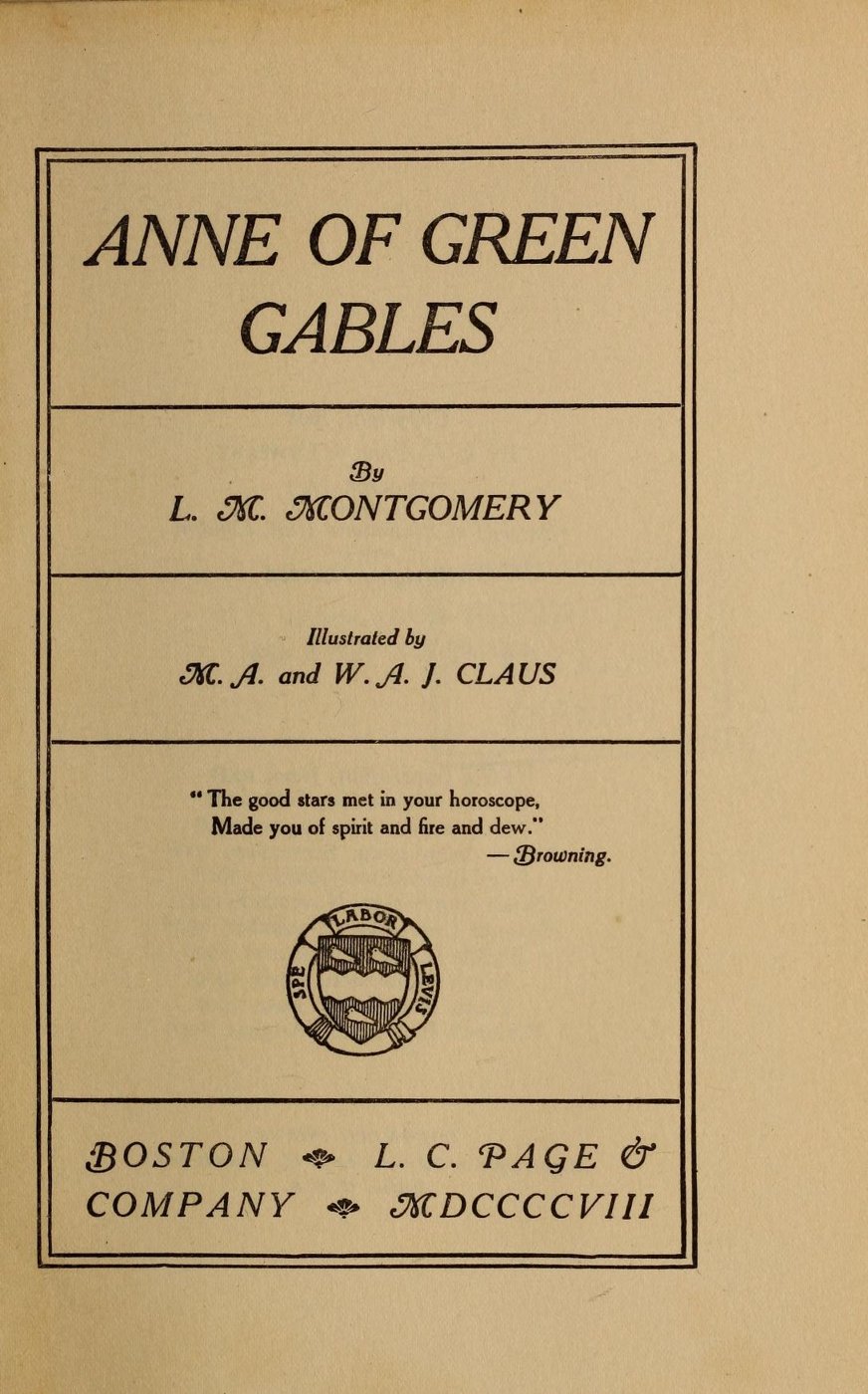
Pre-number-line era: the title page of the 1908 first edition of Anne of Green Gables carries the publisher and date on the title page itself — the primary identification method before printer's keys. Photo via Wikimedia Commons (public domain).
Step 5 — Check the jacket, not just the book
On a modern collectible, the dust jacket must also be first-issue. Look at the printed price on the front flap — a clipped price corner, or a price that doesn't match what the book sold for on publication, is a red flag. Book club editions typically have no price at all.
Publisher rules worth memorizing
Every house did it differently. These are the ones you'll actually encounter in an American estate sale library. The International League of Antiquarian Booksellers and AbeBooks' first edition guide maintain deeper publisher-by-publisher references.
| Publisher | What identifies a first printing |
|---|---|
| Random House | Historically requires the words "First Edition" and a number line — on many titles the line begins at 2 when the statement is present. If the statement is gone, it's a later printing. |
| Alfred A. Knopf | "First Edition" statement plus a number line containing 1 (Knopf also uses a "FIRST EDITION" colophon on many titles). |
| Charles Scribner's Sons | Pre-1973: a capital "A" on the copyright page. Post-1973: standard number line. |
| Doubleday | Often no number line on older titles — look for "First Edition" and, on some titles, a printing code. Stephen King's Carrie (1974) is identified by the code "P6" on the copyright page. |
| Farrar, Straus & Giroux | Number line alone is sufficient; a "First Edition" statement is a bonus. |
| Viking Press | Number line; earlier titles use a "First published in [year] by The Viking Press" statement. |
| Houghton Mifflin | Pre-1950s: publication date on the title page (removed on reprints). Later: number line. |
| Harper & Brothers | 1912–1922: a two-letter code on the copyright page encoding the month and year of printing. |
| Bloomsbury (UK) | Full descending number line to 1 — the identification point on the 1997 Harry Potter and the Philosopher's Stone hardback. |
When a title is worth real money, don't stop at the publisher rule. Check the title-specific points of issue — the typos and binding quirks bibliographers use to separate first-state copies from everything else.
What actually drives value
Being a first edition guarantees nothing. Five factors decide the number:
1. Demand for the author. Collector demand is concentrated: King, Rowling, Hemingway, Steinbeck, Tolkien, McCarthy, Lee, Vonnegut, Orwell. An obscure 1962 first edition with no collector base is worth what any used book is worth.
2. Print run size. The Hobbit had roughly 1,500 copies in its 1937 first printing. Harry Potter and the Philosopher's Stone had about 500 hardbacks, most sent to libraries. Small runs of books that later became famous are the entire high end of the market.
3. Condition — the loudest variable. Dealers grade Fine / Near Fine / Very Good / Good, and the gap between grades is measured in multiples, not percentages. Foxing, sunned spines, water staining, cracked hinges, and previous-owner inscriptions all cut hard.
4. The dust jacket. For most 20th-century fiction the original jacket carries the majority of the value. A jacketed copy can be worth ten times the same book bare.
5. Signatures. A verified author signature typically multiplies value. An inscription to a named stranger is more complicated — it can add or subtract depending on the recipient. Association copies (inscribed to someone significant to the author) are their own category and can be worth far more than a flat signature.
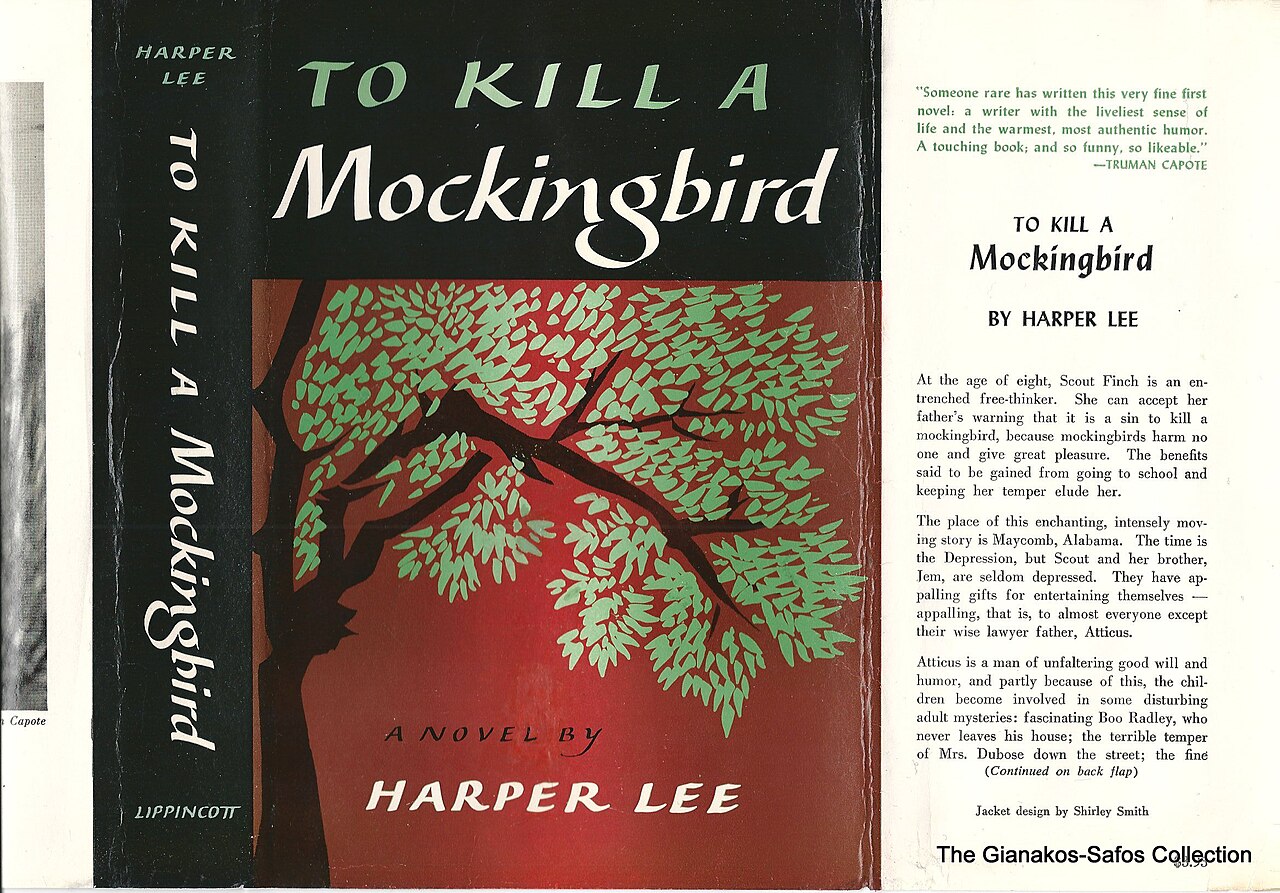
The 1960 J.B. Lippincott first-edition dust wrapper of To Kill a Mockingbird — the jacket is where most of this book's value lives. Photo by Folktroubadour, via Wikimedia Commons, CC BY 4.0.
Never do this to a book you think is valuable
Do not clean it, tape it, re-glue it, press it, rebind it, or remove the jacket. Every one of those is a value-destroying act in the eyes of a dealer. Store it flat, out of sunlight, in stable humidity, and let a professional decide what — if anything — should be done.
Real prices: what these books actually sell for
Two numbers matter and people constantly confuse them: auction results (what a specific copy fetched on a specific day) and dealer retail (what an antiquarian bookseller asks). Here are documented, checkable examples rather than internet folklore.
| Book | Documented result |
|---|---|
| Poe, Tamerlane and Other Poems (1827) | $420,000 — Sotheby's, The Library of Dr. Rodney P. Swantko, June 2024; one of only two copies in private hands (Fine Books Magazine) |
| Austen, Pride and Prejudice, 3 vols. (1813) | £92,000 — Dominic Winter, December 2022 (lot record) |
| Rowling, Harry Potter and the Philosopher's Stone (1997, one of ~500 hardbacks) | £45,201 — Lyon & Turnbull, June 2024 (lot record) |
| Steinbeck, The Grapes of Wrath (1939, Viking) | Antiquarian dealer retail commonly $8,500–$9,500 in jacket (Raptis, William Reese Co.) |
| King, Carrie (1974, Doubleday, "P6") | Dealer retail around $4,000 for Fine/Near Fine copies (example listing) |
Values move. Treat these as calibration, not quotes — and always check current AbeBooks and Biblio listings plus sold comps before you make a decision.
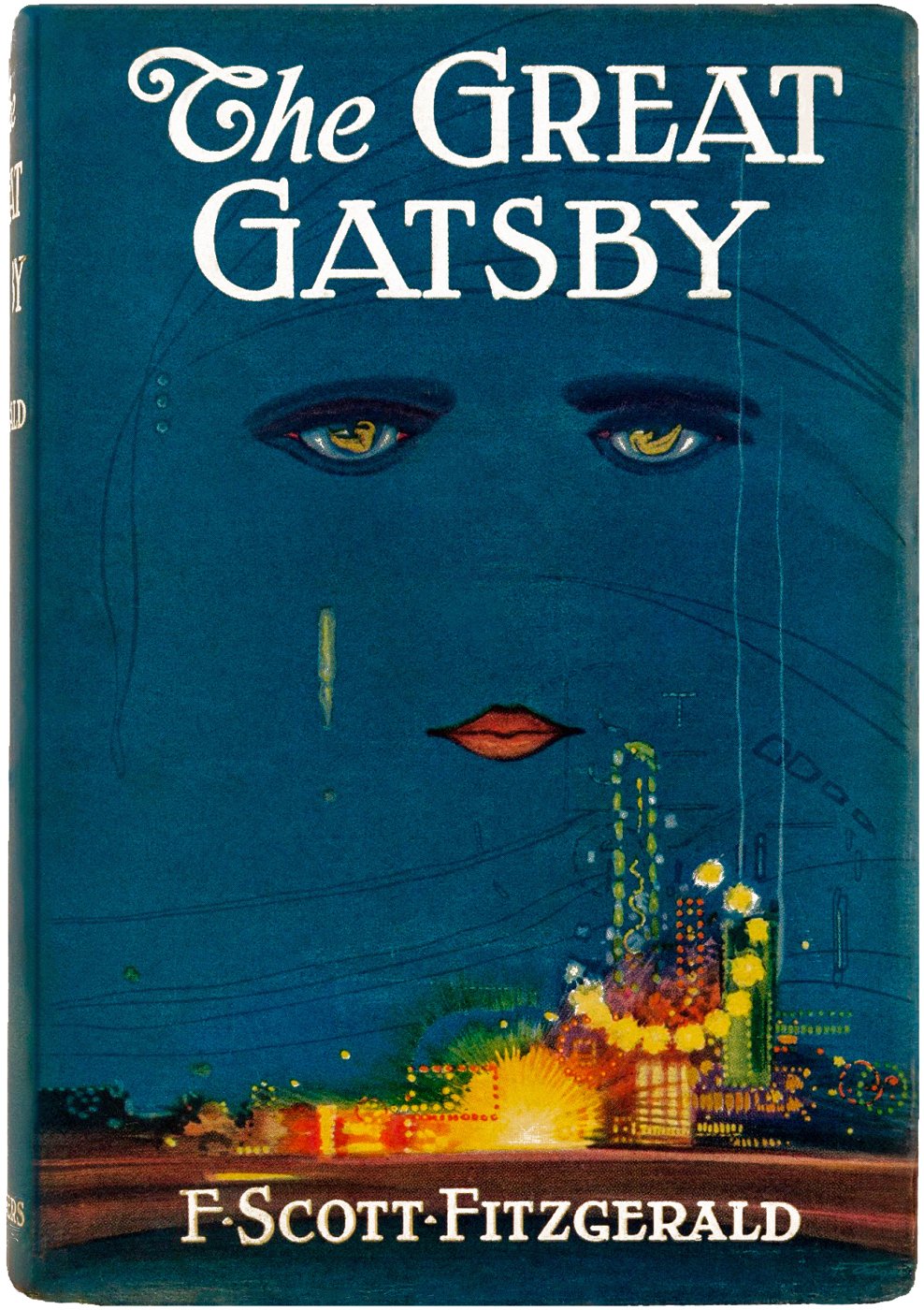
Francis Cugat's 1925 jacket art for The Great Gatsby (Charles Scribner's Sons) — one of the most valuable dust jackets in American literature, and the reason collectors handle jackets like glass. Image via Wikimedia Commons (public domain in the United States).
The pull-and-check list for estate sales
Names and titles that justify pulling every copy off the shelf and opening the copyright page:
Modern fiction — Stephen King (Carrie 1974, The Shining 1977, 'Salem's Lot 1975), Cormac McCarthy (Blood Meridian 1985, The Road 2006), Harper Lee, Kurt Vonnegut, Toni Morrison, Flannery O'Connor, Hemingway, Steinbeck, Fitzgerald.
Fantasy & science fiction — Tolkien (The Hobbit 1937, the Lord of the Rings volumes), Frank Herbert's Dune, Philip K. Dick, early Le Guin, first-state Bloomsbury Harry Potter hardbacks.
Children's and illustrated books — chronically underpriced at estate sales because they look like ordinary kids' books. Dr. Seuss (And to Think That I Saw It on Mulberry Street, Vanguard 1937), Maurice Sendak (Where the Wild Things Are, 1963), A.A. Milne (Winnie-the-Pooh, 1926), early Beatrix Potter.
Everything pre-1900 in original bindings — plus regional histories, signed local-author books, and technical firsts (scientific and medical) that generalists overlook entirely.
Want to know which collecting categories are heating up before you shop? Our trending estate sale items demand report tracks exactly that.
What to do the moment you think you've found one
- Photograph the copyright page, title page, spine, and jacket flap. Everything an appraiser needs lives in those four shots.
- Search live comps on the spot. AbeBooks and Biblio are the two largest antiquarian marketplaces; search title + author + "first edition" and read the descriptions, not just the prices — dealers list points of issue explicitly.
- Buy it if the price is low and the signals are good. At estate sale prices, being wrong costs a few dollars. Being slow costs the book.
- Get a real appraisal above ~$500. Members of the Antiquarian Booksellers' Association of America will authenticate condition and issue points. Never sell to the first person who offers.
- Use the free Ai Appraiser as a first pass. Snap a photo and get a fast read on whether an item is worth deeper research. It's a triage tool for the whole table, not a substitute for a rare-book specialist on a high-value find — and on books, the copyright page is still the final word.
Five mistakes that cost people money
- Assuming old equals valuable. An 1880 sermon collection is worth less than a 1974 Carrie. Demand, not age, sets price.
- Ignoring the jacket. People throw away the single most valuable component of a 20th-century book because it's torn.
- Skipping children's books. They look like clutter. Some of them are five-figure books.
- Trusting a "First Edition" statement alone. Cross-check the number line and the points of issue.
- "Improving" the book. Cleaning, taping, and rebinding are how a $3,000 book becomes a $300 book.
Questions & answers
Frequently asked questions
How do I know if my book is a first edition?
Open to the copyright page (the back of the title page). Look for a number line containing a 1 — the lowest digit present is the printing number — and/or a printed statement such as "First Edition" or "First Printing." Then confirm against the publisher's own convention: pre-1973 Scribner firsts carry a capital "A," Random House historically required both a statement and a number line, and Doubleday's Carrie is identified by the code "P6."
Does "first edition" always mean the book is valuable?
No. A first edition of an obscure title with no collector base is worth ordinary used-book money. Value comes from author demand, print-run scarcity, condition, an original first-issue dust jacket, and documented points of issue — the printing status alone is only the entry ticket.
How much value does the dust jacket add?
For most collectible 20th-century hardcovers, the original jacket carries the majority of the value — dealers routinely cite 70–90% on modern firsts. The same book jacketed versus bare can differ by a factor of ten. Never remove or discard a jacket, even a torn one.
What's the most valuable book that could realistically turn up at an estate sale?
A 1997 Bloomsbury Harry Potter and the Philosopher's Stone hardback — roughly 500 were printed, most went to libraries, and copies still surface from ordinary households. One sold for £45,201 at Lyon & Turnbull in June 2024. American estates more often yield mid-century literary firsts in the $500–$10,000 band.
Should I clean or repair an old book before selling it?
No. Cleaning, taping, re-gluing, pressing, and rebinding all reduce collector value, sometimes drastically. Store the book flat, away from sunlight and humidity, and let a professional appraiser or ABAA dealer advise before anything is done to it.
What is a point of issue?
A point of issue is a typo, misprint, binding detail, or jacket price found only in the earliest copies and corrected mid-run. Bibliographies document them title by title, and they're often what separates a first-state copy worth thousands from a later-state copy worth hundreds.
The bottom line
Rare books hide at estate sales for one boring reason: identifying them takes time nobody staging a house has. The copyright page takes you fifteen seconds. That asymmetry is the whole edge, and it doesn't require expertise — just the habit of opening the book.
Browse estate sales near you and check the listings for library and book photos, then set a wishlist alert for "books," "first edition," or a specific author so the next sale carrying them pings you automatically. Our guide to wishlist alerts for collectors walks through setting them up properly.
Image credits
copyright page of Lad: A Dog (E.P. Dutton, 1919), Anne of Green Gables 1908 title page, and Francis Cugat's 1925 The Great Gatsby jacket are public domain via Wikimedia Commons; the To Kill a Mockingbird dust wrapper photograph is by Folktroubadour via Wikimedia Commons, CC BY 4.0. Scene photographs of estate sale book tables were generated for this article and are illustrative, not photographs of specific books discussed.
Keep exploring
Ready to start your own treasure hunt?
Discover estate sales near you and find incredible deals.
Explore Sales Near Me
About the author
Andy
Founder, EstateSaleFinder.net
Hi, I'm Andy — a retired commercial photographer turned developer with a five-year (and counting) obsession with estate sales. I started EstateSaleFinder.net because I knew there had to be an easier, smarter way to find and list estate sales. Now I get to chase treasure and build the tool I always wished existed.