How to Spot Valuable Items at Estate Sales (Without Being an Expert)
You don't need 20 years of antique knowledge to walk out of an estate sale with $400 worth of finds. You need 8 mental checks and a phone. Here's exactly how to do it.
When I started, I stood in estate sales feeling like everyone else knew secrets I didn't. The woman next to me casually grabbing the right pottery, the older guy bee-lining to the right corner. I was lost.
It turns out, almost none of them are experts. They're using a small set of mental checks — quick filters that work across categories — to spot valuable items in seconds. Here are the eight checks I use every single Saturday.
Check #1: Flip It Over and Look at the Bottom
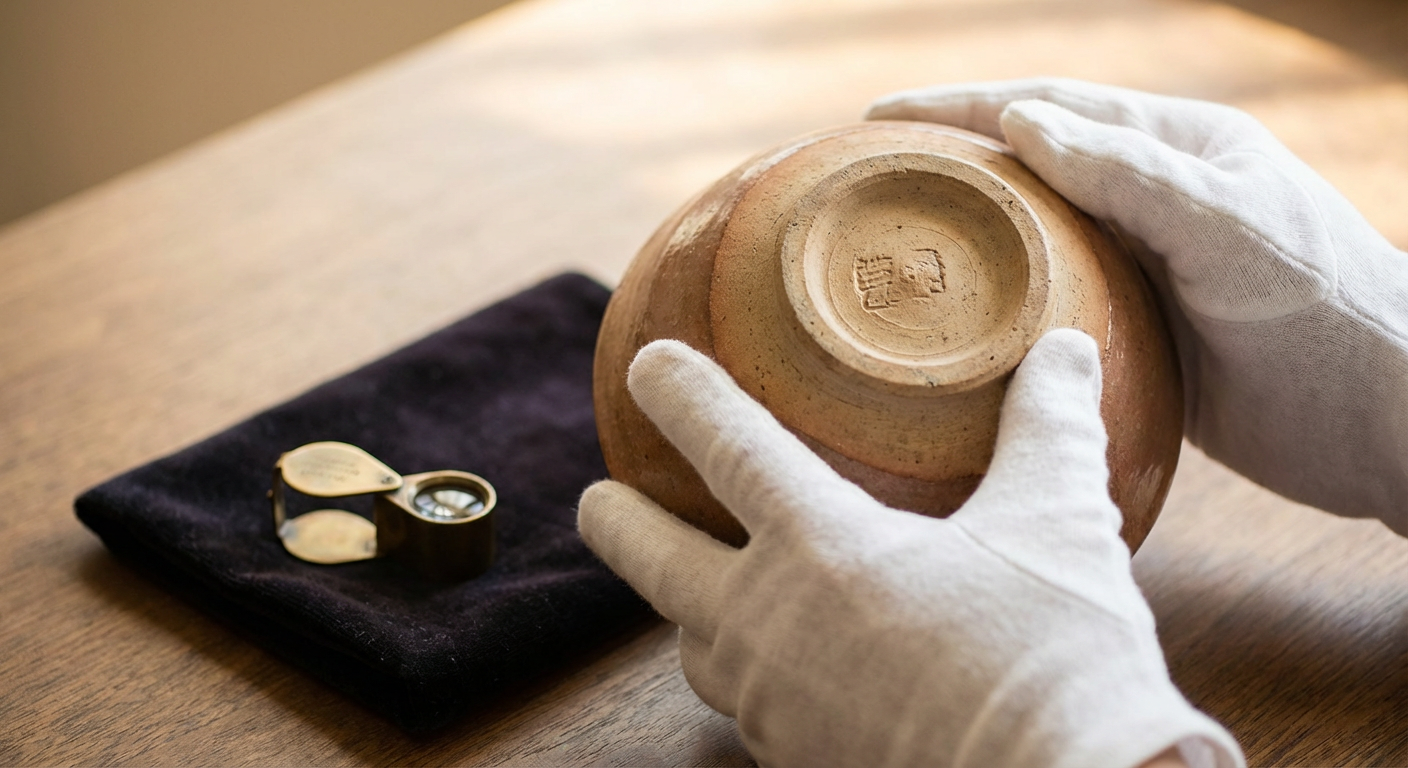
Always. Pottery, ceramics, sterling, glass, even wood furniture. The bottom is where makers stamped their identity. Roseville, McCoy, Stickley, Sterling, 925, Made in Denmark, Made in Italy, an artist signature — these are gold-flag words.
If the bottom has a stamp, mark, or signature, slow down and figure out what it says. If it has nothing, move on faster.
Check #2: Heft the Item
Real metal is heavier than plated. Real wood is heavier than veneered particleboard. A Le Creuset Dutch oven weighs noticeably more than a knockoff. A vintage Marantz receiver is dramatically heavier than a modern one.
Weight is a quick proxy for quality. If it feels surprisingly heavy, look closer.
Check #3: Look at the Joinery
For furniture: dovetail joints (interlocking trapezoids) on drawers = quality. Staples or glue blocks = mass-produced. The bottom and back of furniture tells you the truth — the front is dressed up to sell.
Check #4: Read the Country of Origin
For vintage clothing, tools, kitchenware, electronics, and toys, the country printed on the tag or stamp tells you a lot:
- Made in USA (anything pre-1990) = generally a quality flag.
- Made in Japan (1950s–80s) = often surprisingly high quality and collectible (cameras, electronics, ceramics).
- Made in West Germany = pre-1990 = quality flag.
- Made in Denmark, Italy, France = often high-end design.
- Made in Hong Kong / Taiwan / China (vintage era) = mass-market, lower value.
Check #5: Look for Maker's Marks on Silver and Jewelry
The hallmarks on the back of silver and jewelry are the entire game.
- Sterling, 925, 800, .800 = silver content.
- 14K, 18K, 750 = gold content.
- Designer marks (Trifari, Coro, Eisenberg, Weiss, Hobé) = collectible.
If you can't read the mark, snap a close-up photo and run it through the Ai Photo Appraiser. Hallmark recognition is one of Ai's strongest skills now.
Check #6: Examine the Seams and Stitching
For clothing, single-stitch construction (one row of thread) is generally older and more collectible. Double-stitch (two rows) is post-1980s mass production.
For leather goods, hand-stitching with a slight irregularity = quality. Perfect machine stitching = mass-produced.
Check #7: Recognize "Old" by Material, Not by Look
Items that look old but are actually new are everywhere. Items that look clean and modern but are actually 50+ years old are also everywhere. Material clues:
- Bakelite plastic (1930s–40s) is heavy, slightly translucent, and smells distinctive when warmed.
- Celluloid (early plastic) is lightweight, often yellow-tinged with age.
- Pressed glass (depression era) has slight surface irregularities; modern pressed glass is perfectly smooth.
- Real bone or ivory handles show grain; plastic ones don't.
Check #8: Trust the Stamp
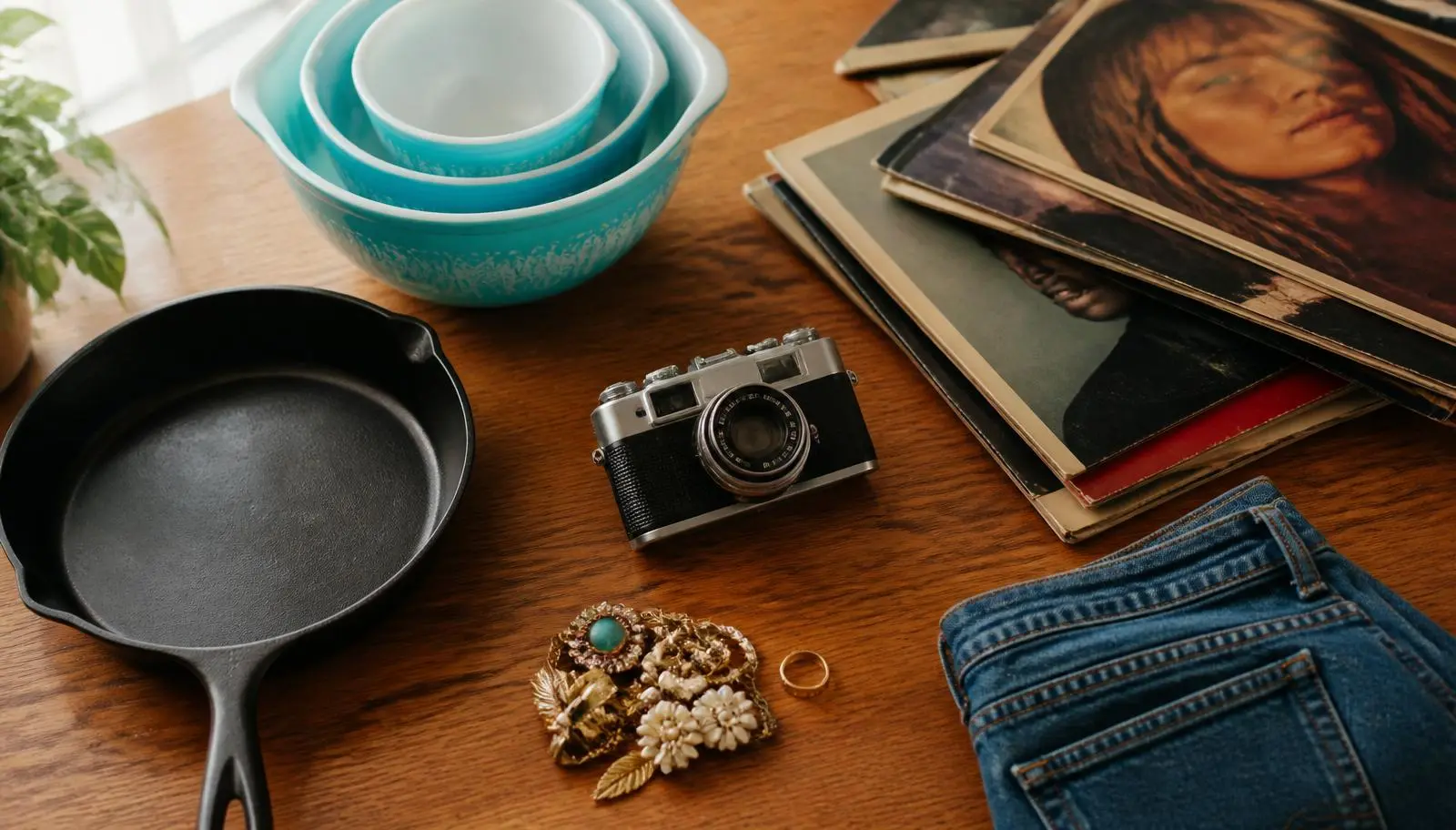
Vintage tools, vintage cookware, vintage cameras — almost everything pre-1980 has a stamp somewhere. Stanley, Starrett, Griswold, Wagner, Nikon, Canon, Hasselblad, Leica. If you don't recognize the stamp, snap a photo of it and check before you put the item back. The five-second check is what separates the people who walk out with $400 of finds from the people who walk out with $40.
The Universal Backup Check
When in doubt — and you will be in doubt constantly when you're new — pull out your phone and use the Ai Photo Appraiser. One clean photo, 5 seconds, comp range. It's the fastest way to build the intuition that veteran resellers have.
How to Build Real Knowledge Faster
The eight checks above will take you from beginner to competent within a month of regular sales. From there, the way to keep learning is:
- Pick two categories you keep buying and study them deeply (collector forums, reference books, YouTube channels).
- Use the Ai appraiser as a teacher, not just a tool. Every confirmation reinforces a pattern.
- Talk to staff at sales. Most are happy to explain what something is.
- Look up everything you didn't buy. The lost opportunity teaches as much as the win.
You Already Know More Than You Think
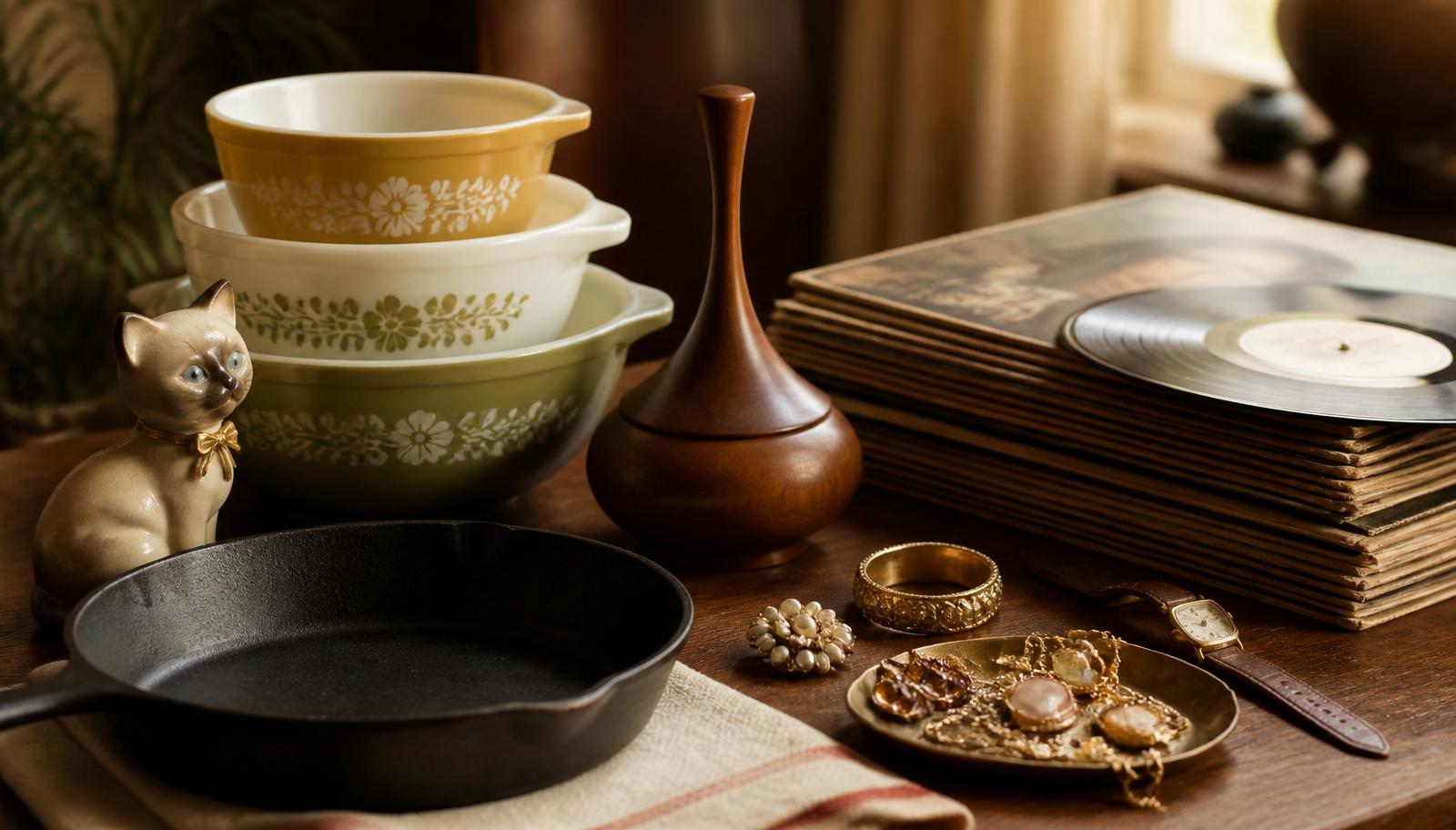
The first time you walk into an estate sale and recognize a Pyrex pattern, or spot the Sterling stamp on a teapot, or feel the weight of a Le Creuset under a stack of nothing — that's the moment it clicks. You're not pretending anymore. You actually know.
That moment will come faster than you think. The eight checks above are the launchpad.
Keep going: browse this weekend's sales near you and put these checks to work, or read the full Buyer's Guide for the deeper system.
Keep exploring
Ready to start your own treasure hunt?
Discover estate sales near you and find incredible deals.
Explore Sales Near Me
About the author
Andy
Founder, EstateSaleFinder.net
Hi, I'm Andy — a retired commercial photographer turned developer with a five-year (and counting) obsession with estate sales. I started EstateSaleFinder.net because I knew there had to be an easier, smarter way to find and list estate sales. Now I get to chase treasure and build the tool I always wished existed.