Where Are Estate Sales Advertised? Every Channel Companies Use, and How to Hear About Sales Before the Crowd
Estate sales are advertised on listing sites, on company websites and email or text lists, on Facebook and Instagram, on Nextdoor and Craigslist, and with street signs on sale morning. Here's when each channel goes out, why the address is usually held until the day before, and how to get on the lists so you hear first.
Estate sales are advertised in six main places: estate sale listing websites and apps, the estate sale company's own website and email or text list, Facebook and Instagram, neighborhood sites like Nextdoor and Craigslist, local newspapers (less often now), and street signs on sale morning. Listings usually go up one to two weeks ahead with photos and the general area, and the full address is commonly released the day before the sale.
That's the short answer. The more useful answer, if you're a shopper, is when each channel goes out and who sees it first. Ask regular shoppers where the best sales show up and you hear the same thing over and over: the company's own email list and Facebook page, often before the big listing sites fill up with photos. This guide walks through every channel in the order companies typically use them, explains why you can't get the address early, and gives you a checklist to get on the lists that matter in your area.
Quick summary for skimmers:
- Listing sites and apps (like EstateSaleFinder) are where most sales are posted first, often 1–2 weeks out, with photos and the city or ZIP.
- Company email and text lists are where loyal shoppers hear first. Sign up with every company you like.
- Facebook is nearly universal: in EstateSales.NET's 2024 industry survey, 91% of sellers said they market on Facebook, and about half use Instagram (survey highlights).
- The address is usually hidden until the day before for security. On EstateSales.NET, the default release time is 9 AM the day before (their help page).
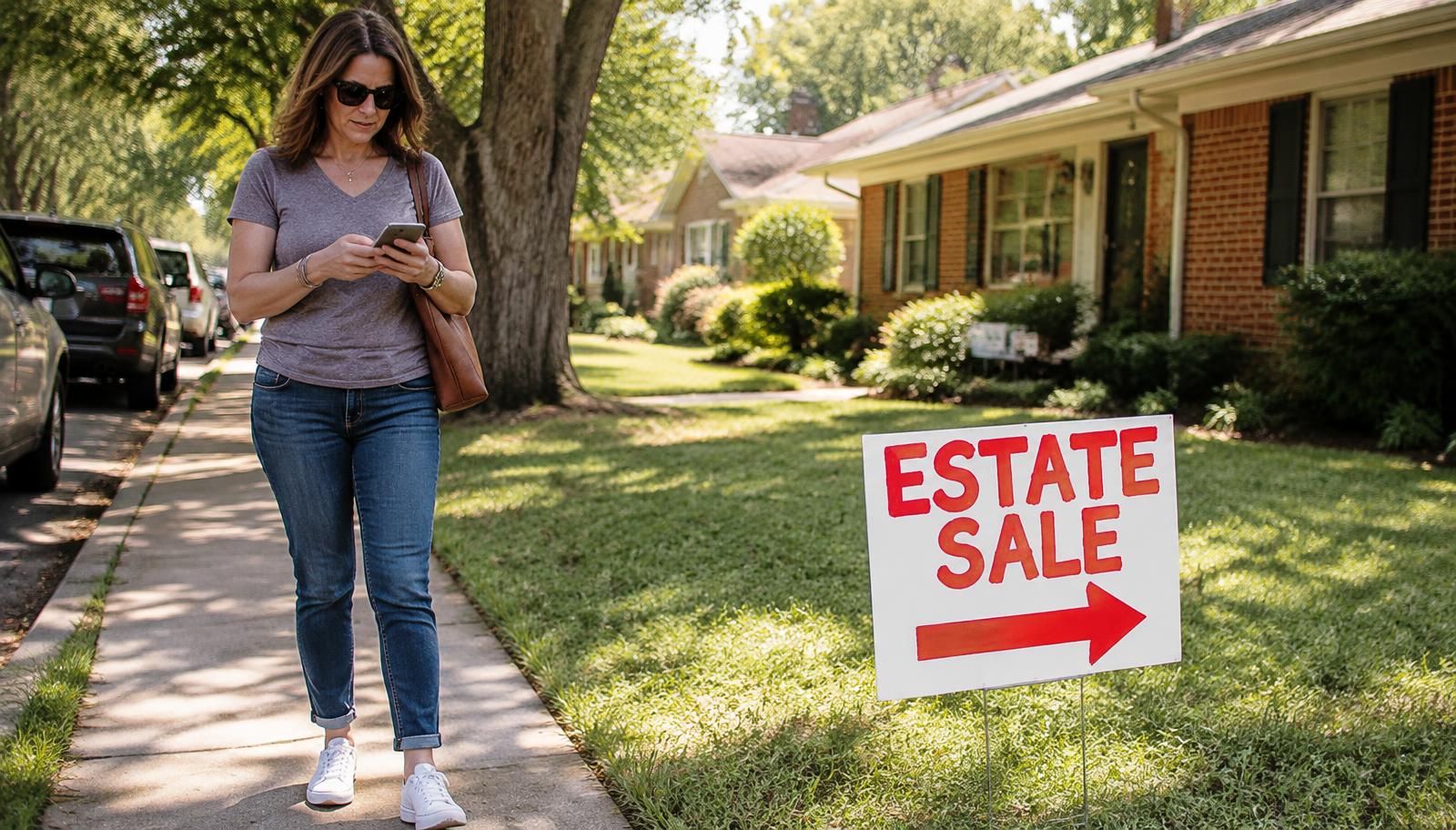
- Signs go up on sale morning, which helps neighbors but is the latest way to find out.
- Get ahead: turn on wishlist alerts for the things you collect, so matching items find you.
How are estate sales advertised?
Most estate sale companies run the same basic playbook. The details change by city and company, but the order is very consistent:
- Book the sale and photograph the house. Good photos are the single biggest advertising tool, because shoppers decide which sales to drive to based on what they can see.
- Post the listing on one or more estate sale listing sites and the company's own website, with dates, hours, photos, payment terms and the general location.
- Email and text the company's own list, usually with a photo preview and a link back to the listing.
- Post on social media: the company's Facebook page, local estate sale and antique groups, and Instagram.
- Release the address, usually the day before.
- Put out signs the morning of the sale (where the city allows them).
Here's how that looks on a calendar:
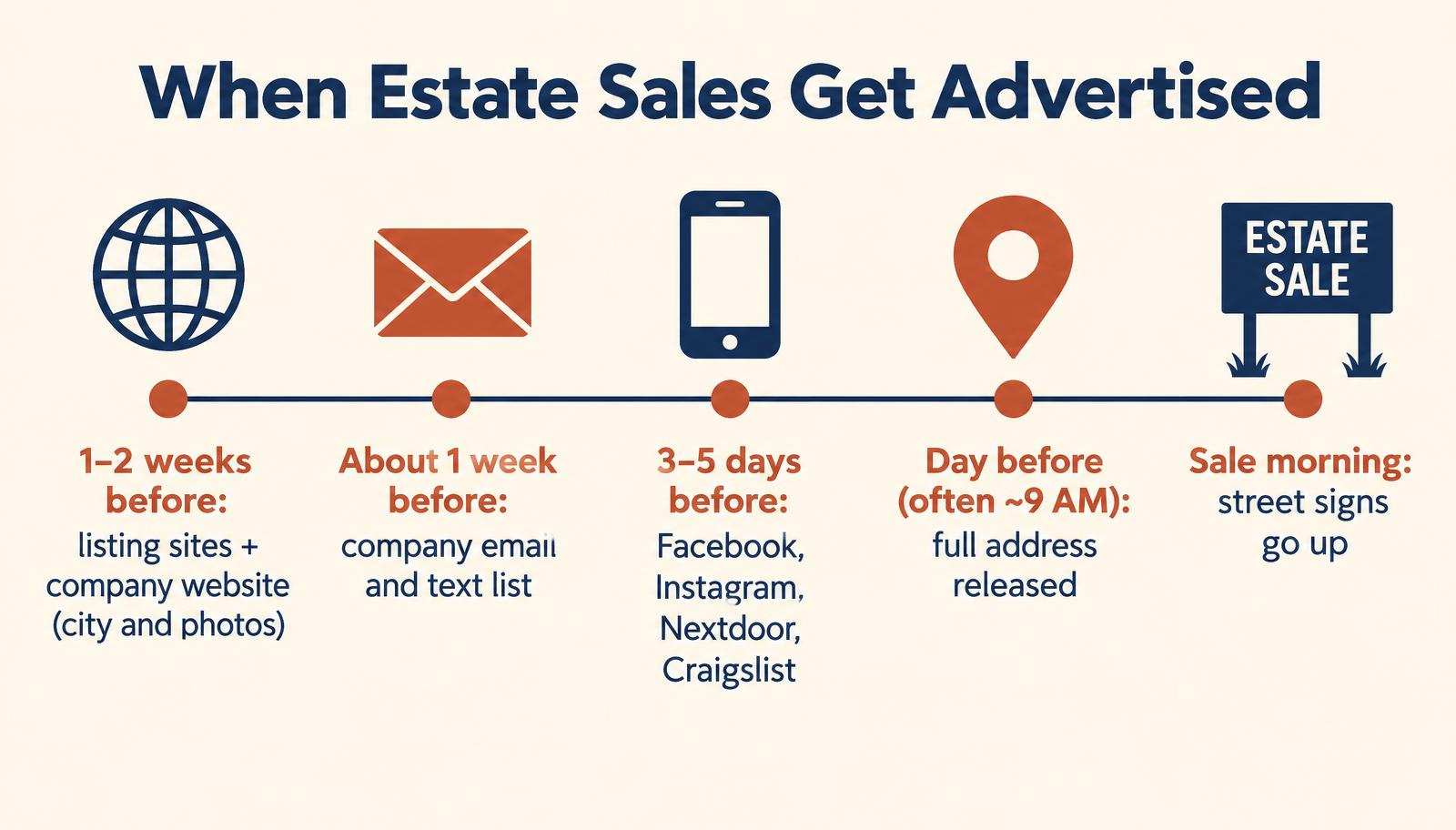
That timeline is a typical pattern, not a rule. Some companies post three weeks early for big sales with valuable collections; others post four days before because the house was booked on short notice. The order matters more than the exact days.
Every channel, explained (and when it goes out)
1. Estate sale listing websites and apps
When
usually 1–2 weeks before the sale, sometimes earlier for large sales.
These are the backbone of estate sale advertising. Companies post the sale once and it shows up for everyone searching that area. A good listing includes dates and hours, dozens or hundreds of photos, payment methods, whether there's a sign-up sheet or numbers system, and the city or ZIP code.
What to know as a shopper:
- Check photos early and often. Companies frequently add photos during the week as they finish staging.
- Search by distance, not just city. The best sale this weekend may be in the next town over.
- Read the terms. Cash only? Early bird numbers at 7 AM? Discounts on day two? It's all in the listing.
On EstateSaleFinder, you can browse sales near you on a map, see sale photos and individual items, save sales you want to hit, and plan a route for the day. If you're new to this, our guide on how to find estate sales near me covers all the search tools step by step.
2. The company's own website and email or text list
When
often the same day the listing goes live, sometimes a few days ahead of it.
This is the channel serious shoppers care about most. Many companies send a weekly email or text with their upcoming sales, a few highlight photos and the address release time. Some send a "preview" to their list before posting anywhere public.
Reddit's estate sale and reselling communities say the same thing in thread after thread: the shoppers who seem to "always know first" are simply on every local company's email list and follow their Facebook pages. There's no secret network; it's subscriptions.
How to use it
keep a short list of the companies in your area whose sales you actually like (good prices, good organization, the kind of items you buy) and subscribe to every one of them. You can find companies near you in our estate sale company directory.
3. Facebook pages, groups and Marketplace
When
typically 3–7 days before, then again the day before with the address, and often during the sale with "still available" or "50% off" updates.
Facebook is the most widely used social channel in the industry. In EstateSales.NET's 2024 industry survey of several hundred businesses, 91% of sellers said they market on Facebook (source).
Three places to watch:
- Company pages. Follow them and set notifications to "all posts" for the companies you care about.
- Local groups. Search Facebook for "estate sales [your city]" or "[your county] estate sales and auctions." Many areas have an active group where companies post every sale.
- Day-two and last-day posts. Companies often post price drops and what's left. That's how you catch half-price furniture on Sunday.
4. Instagram
When
similar timing to Facebook, often with short videos walking through the house.
Instagram use has grown a lot. About half of sellers in the same 2024 survey said they use it (source). It's especially common for companies with a lot of mid-century, designer or vintage fashion items. Video walkthroughs show the whole house in a way photos can't.
5. Nextdoor and Craigslist
When
usually a few days before, sometimes only the day before.
Smaller companies and families running their own sales still post on Craigslist's "garage and moving sales" section and on Nextdoor. These are worth a quick look for sales that never made it to the big sites, especially family-run sales in older neighborhoods.
6. Newspapers and community calendars
When
usually the week of the sale.
Print classified ads have mostly faded, but some smaller towns and senior-heavy areas still have them, along with community newsletters and church bulletins. If you shop rural areas, don't skip the local paper.
7. Street signs
When
sale morning, sometimes the night before.
Signs are the oldest form of estate sale advertising, and they still matter for neighbors and drive-by traffic. But by the time the signs are up, the regulars are already in line. Signs are rules-heavy too: many cities limit or ban signs in the public right-of-way, which is why some sales have very few.
Why is the estate sale address held back until the day before?
If you've ever wondered why the listing says "address will be posted Thursday at 9 AM," it's not to frustrate you. There are two main reasons.
Security. The house is often empty or lived in by an elderly owner, and it's full of priced, staged valuables. Posting the address two weeks out tells the whole internet exactly where those valuables are. EstateSales.org describes its hidden-address option as being "for improved security," showing only city, state and ZIP until the chosen time (EstateSales.org). EstateSales.NET releases the address at 9 AM the day before by default, with options to release it three hours before the start "for security reasons" (EstateSales.NET).
Fairness for shoppers. Holding the address keeps people from knocking on the door during setup, which is a real problem companies deal with. Most companies use a sign-up sheet or numbers system on the first morning, so everyone gets the same chance. For example, one company's FAQ says its address is "generally posted the day prior to the sale start date," and its sign-up sheet goes out 30 minutes before opening (Balderdash Estate Sales).
What this means for you
there's no legitimate shortcut to an address before it's released, and trying to find one (calling neighbors, watching for the company's trucks) is the fastest way to get banned from a company's sales. The real advantage is knowing which sale you want before the address drops, so you can plan your morning the minute it does. Our guide on how to find estate sales before they're picked over covers first-morning strategy in detail.
The "get on the lists" checklist
Do this once and you'll hear about almost every good sale in your area without searching:
- Pick your radius. Decide how far you'll actually drive on a Friday morning (20 minutes? an hour?).
- Find every company in that radius. Use the company directory and the listings near you to make a list. Ten to fifteen companies is normal for a metro area.
- Sign up for each company's email and text list. Look for a "newsletter" or "join our list" link on their website or ask at checkout.
- Follow each company on Facebook and turn on notifications for the ones whose sales you like best.
- Join one or two local estate sale groups on Facebook.
- Save your favorite sales on a listing site so you can compare them on Thursday night.
- Set wishlist alerts for what you collect or resell: "Pyrex," "Fiesta," "mid-century dresser," "Hummel," "sterling," and so on.
- Make a filter in your email that labels all estate sale emails, so they don't get buried.
- Check Thursday morning (or whenever addresses drop in your area) and plan your route.
- Unsubscribe from companies whose sales never fit you. A short, good list beats a long, noisy one.
How to use EstateSaleFinder to hear about sales first
We built EstateSaleFinder so buyers don't have to check ten places. Here's how to use it alongside company email lists:
- Estate sales near me: see every listed sale around you on a map and in a list, sorted by distance and start day.
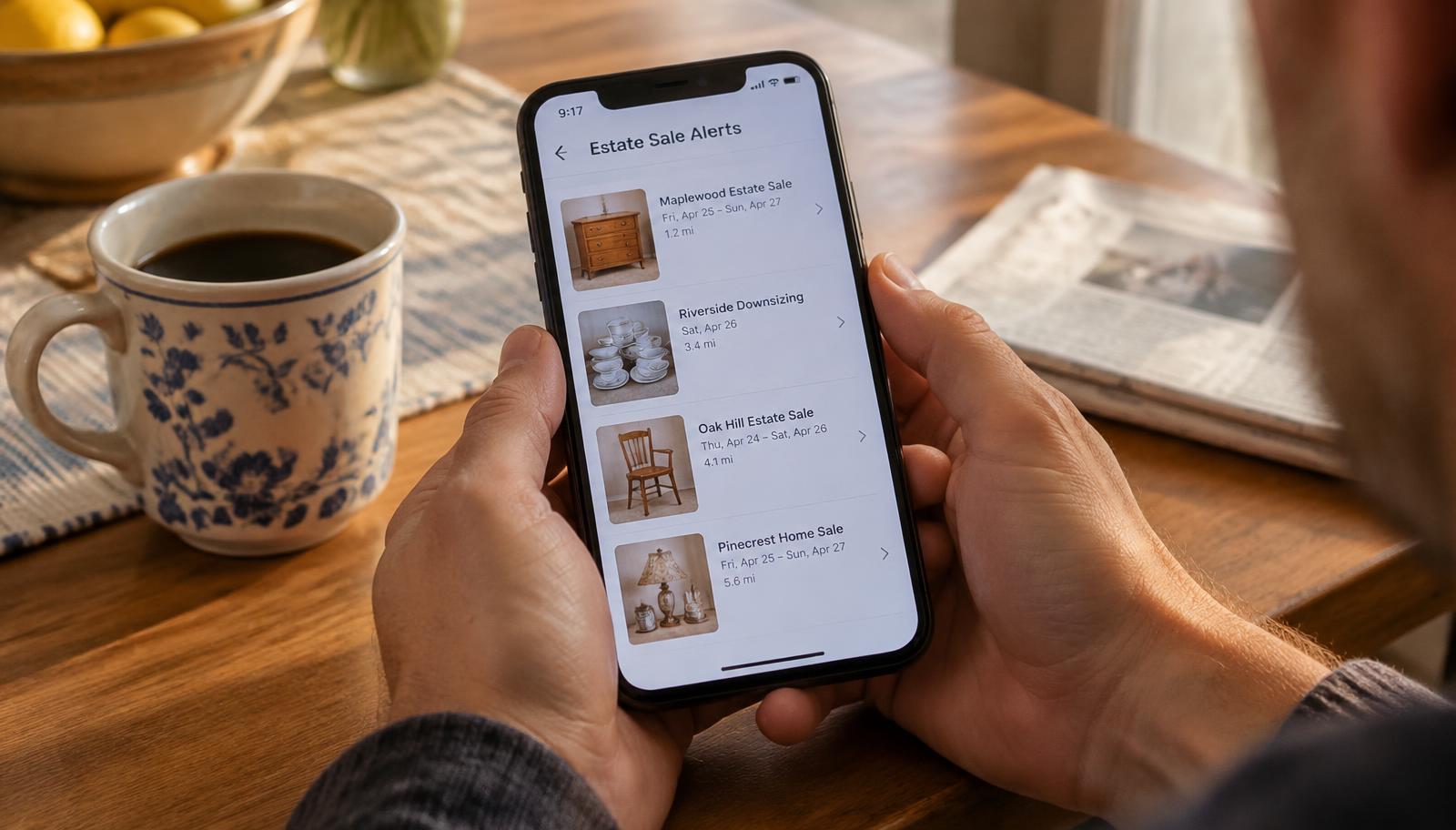
- Wishlist alerts: add the brands, patterns or items you collect. When a sale lists matching items, you get a heads-up, so you're not scrolling hundreds of photos to find the one Pyrex bowl you want. Our wishlist alerts guide shows how collectors set them up.
- Item photos, not just house photos: many sales on EstateSaleFinder have individual items listed and searchable, which makes it far easier to decide if a sale is worth the drive.
- Saved sales: save the sales you're considering, then compare them the night before.
- Company pages: every company has its own page with upcoming and past sales, so you can learn which companies match what you buy.
- Make offers on items (where the company allows it): some companies take early offers on specific items before or during the sale.
It's free for shoppers.
Where is the best place to advertise an estate sale? (A note for companies)
If you run estate sales, the short answer from the survey data and from shoppers is: use a strong listing site with lots of photos, build your own email list from day one, and post consistently on Facebook. Buyers trust companies they hear from every week.
A few quick wins:
- Photos sell the sale. List more photos than you think you need, and add item photos if you can.
- Ask every shopper to join your list at checkout. It's the one audience you own.
- Post day-two updates. "Everything 50% off" posts bring a second wave of buyers.
- Pick an address release time and stick to it. Shoppers plan around it.
We go deeper in how to advertise an estate sale, and companies can see what EstateSaleFinder offers on our page for estate sale companies.
Questions & answers
Frequently asked questions
Where are estate sales advertised?
Mainly on estate sale listing websites and apps, the company's own website and email or text list, Facebook pages and groups, Instagram, Nextdoor, Craigslist, some local newspapers, and with signs on the morning of the sale.
How do I find out about estate sales in my area?
Search a listing site by your location, sign up for the email lists of every estate sale company within driving distance, follow them on Facebook, and set alerts for the items you collect. On EstateSaleFinder, start with estate sales near me.
How far in advance are estate sales advertised?
Usually one to two weeks before the sale for the listing and photos, with the full address released the day before. Large sales are sometimes posted three weeks or more ahead; rushed sales may only get a few days.
When is the estate sale address posted?
Commonly the day before the sale. EstateSales.NET's default release is 9 AM the day before, and companies can choose to release it later, as late as three hours before the start, for security.
Why don't estate sales post the address?
For security and fairness. The house is full of priced valuables, and early addresses invite break-ins and people knocking during setup. Holding it until the day before protects the family and gives every shopper the same start.
What is the best way to hear about estate sales before everyone else?
Get on each local company's email and text list, turn on Facebook notifications for your favorite companies, and set item alerts. The shoppers who "always know first" are simply subscribed everywhere.
Are estate sales listed on Facebook Marketplace?
Some are, but most companies post on their own Facebook page and in local estate sale groups rather than Marketplace. Search Facebook for "estate sales" plus your city to find active groups.
Is there an app for estate sales near me?
Yes. EstateSaleFinder works in your phone's browser and can be added to your home screen. It shows sales near you on a map, with photos and items, and sends alerts for things on your wishlist.
Do estate sale companies have mailing lists?
Most established companies do, by email, text or both. Ask at checkout or look for a newsletter signup on their website. It's the single best way to hear about their sales first.
Why do some estate sales have no signs?
Many cities restrict or ban signs in the public right-of-way, and some neighborhoods and homeowners associations don't allow them. Those sales rely more on online listings and email lists.
Keep reading
Sources checked October 22, 2026: EstateSales.NET help center and 2024 industry survey highlights, the EstateSales.org knowledge base, and a sample company FAQ (Balderdash Estate Sales). Timelines are typical patterns; individual companies vary.
Keep exploring
Ready to start your own treasure hunt?
Discover estate sales near you and find incredible deals.
Explore Sales Near Me
About the author
Andy
Founder, EstateSaleFinder.net
Hi, I'm Andy — a retired commercial photographer turned developer with a five-year (and counting) obsession with estate sales. I started EstateSaleFinder.net because I knew there had to be an easier, smarter way to find and list estate sales. Now I get to chase treasure and build the tool I always wished existed.