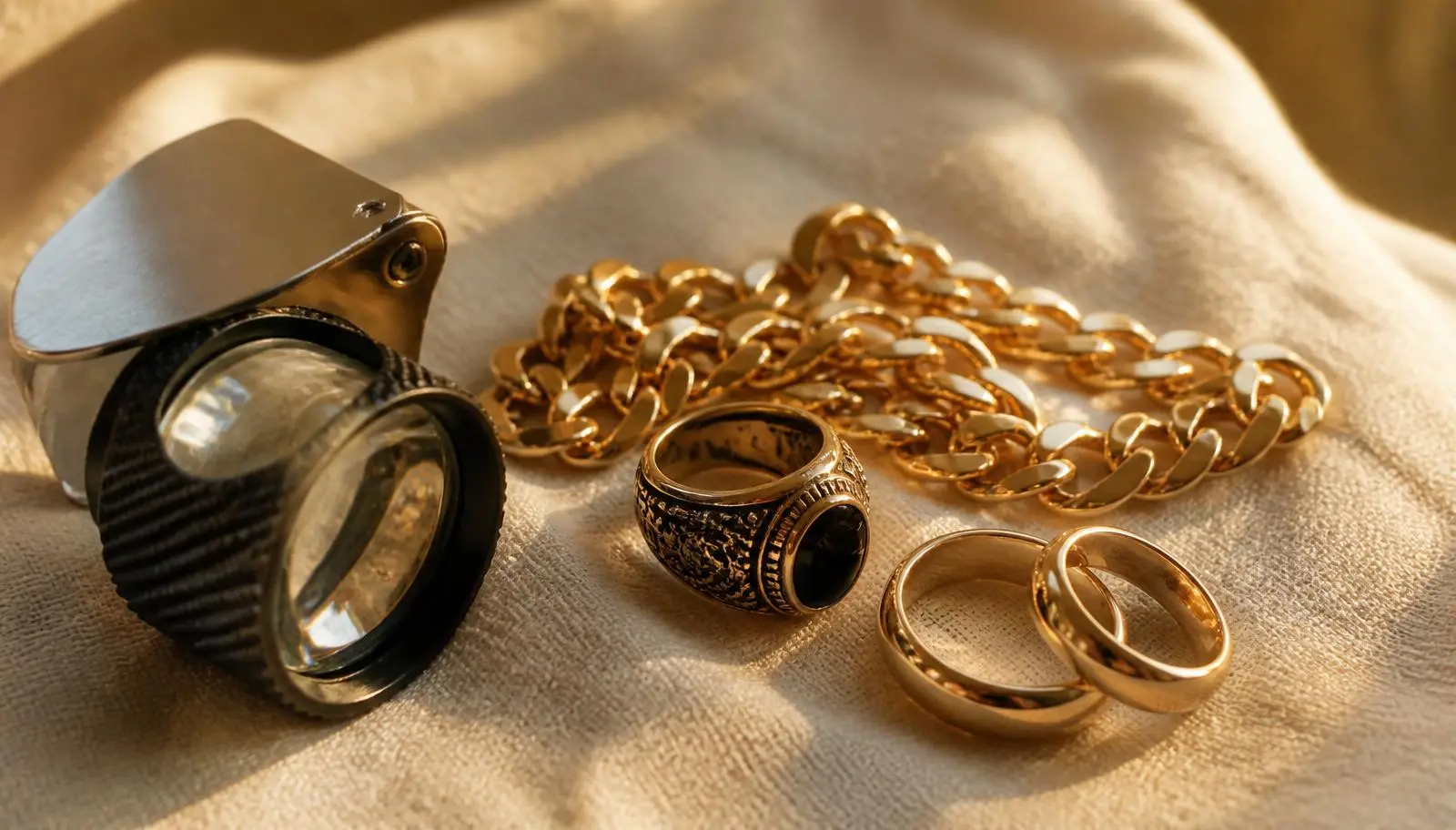
How to Tell If Gold Is Real: 7 Tests That Actually Work
Real gold is heavy, non-magnetic, doesn't tarnish, and almost always stamped. A friendly, field-tested guide to reading karat marks, spotting gold-filled and plated fakes, running the magnet and density checks, and turning "it's real" into an actual dollar figure.
Quick answer
Real gold is heavy for its size, non-magnetic, doesn't tarnish or flake, and almost always carries a karat or fineness stamp — 10K/417, 14K/585, 18K/750, 22K/916 or 24K/999. The fastest reliable sequence at a table is: read the stamp with a loupe, check that a magnet doesn't grab it, weigh it and feel the heft, look for brassy wear at edges and clasps, then confirm anything valuable with an acid test or an XRF scan at a jeweler. No single home test proves gold — the stack of clues does.
I've been picking through estate sale jewelry bins for five years, and I'll tell you the honest truth up front: most of what looks like gold isn't. But the pieces that are gold get mispriced constantly, because the people pricing a whole house have thirty seconds per item and no loupe. Learning to read gold in under a minute is probably the single highest-value skill you can bring to a sale.
Here's how to do it — friendly version, no chemistry degree required.
Start with the stamp: karat and fineness marks
Almost every piece of solid gold made for the U.S. or European market in the last century is stamped somewhere discreet — the inside of a ring shank, the tab next to a bracelet clasp, the back of a pendant bail, the underside of an earring post.
You'll see one of two systems: karat (parts out of 24) or millesimal fineness (parts per 1,000).
| Stamp | Fineness | Gold content | What it usually means |
|---|---|---|---|
| 24K / 999 / 9999 | .999+ | 99.9% | Bullion, some Asian jewelry — very soft |
| 22K / 916 | .916 | 91.6% | Indian & Middle Eastern jewelry |
| 18K / 750 | .750 | 75% | Fine European & designer jewelry |
| 14K / 585 / 583 | .585 | 58.5% | The American workhorse standard |
| 10K / 417 | .417 | 41.7% | Class rings, mass-market chains |
| 9K / 375 | .375 | 37.5% | British and Australian pieces |
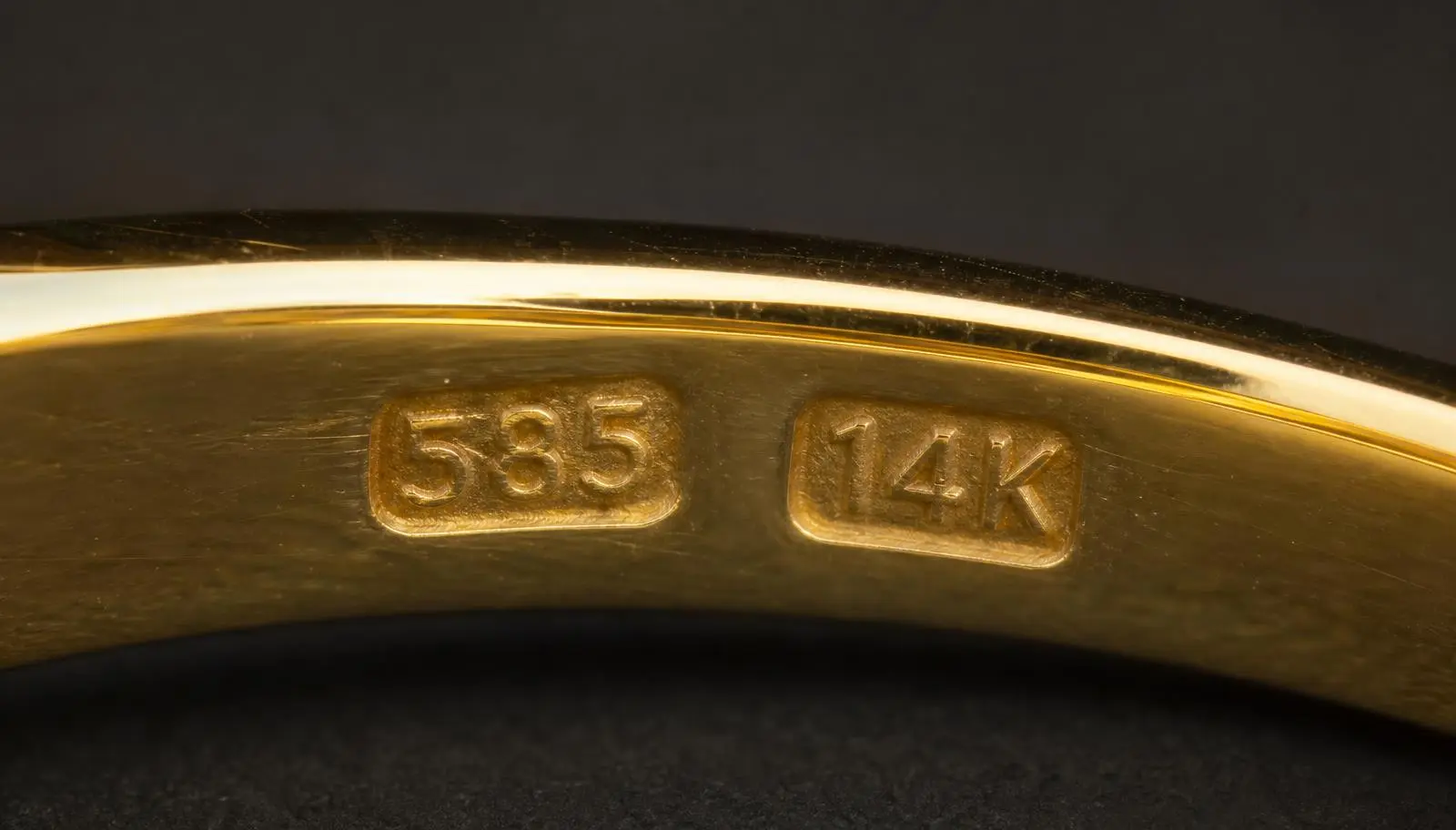
A magnifying loupe (10x, about $10) turns this from squinting into reading. Marks are tiny, often worn, and frequently sitting under a layer of grime.
Which stamps mean it is not solid gold?
This is where the money is won and lost. These marks all mean "gold on the outside, something cheap underneath":
- GP — gold plated (a microscopically thin electroplated layer)
- GF, 1/20 12K GF, 14K GF — gold filled: a bonded layer that under the U.S. FTC Jewelry Guides must be at least 1/20th of the item's weight in gold
- HGE / HGP — heavy gold electroplate
- RGP — rolled gold plate
- Vermeil — sterling silver base with a gold layer (the silver still has value)
- GE, EP, EPNS — electroplate
- 925 with a gold color — sterling underneath, gold-toned finish
One important caution: a stamp is a claim, not proof. Counterfeit "14K" stamps exist, and a genuine stamp can sit on a repaired piece with base-metal solder. Treat the mark as your first clue, not your verdict.
What if there's no stamp at all?
Unmarked doesn't mean fake. Handmade pieces, very old European work, worn-down bands, and jewelry with the stamped section cut out during resizing are all commonly unmarked and genuinely gold. It just means you have to lean on the physical tests below.
The tests you can actually do at a sale table
The magnet test (a red-flag screen, not proof)
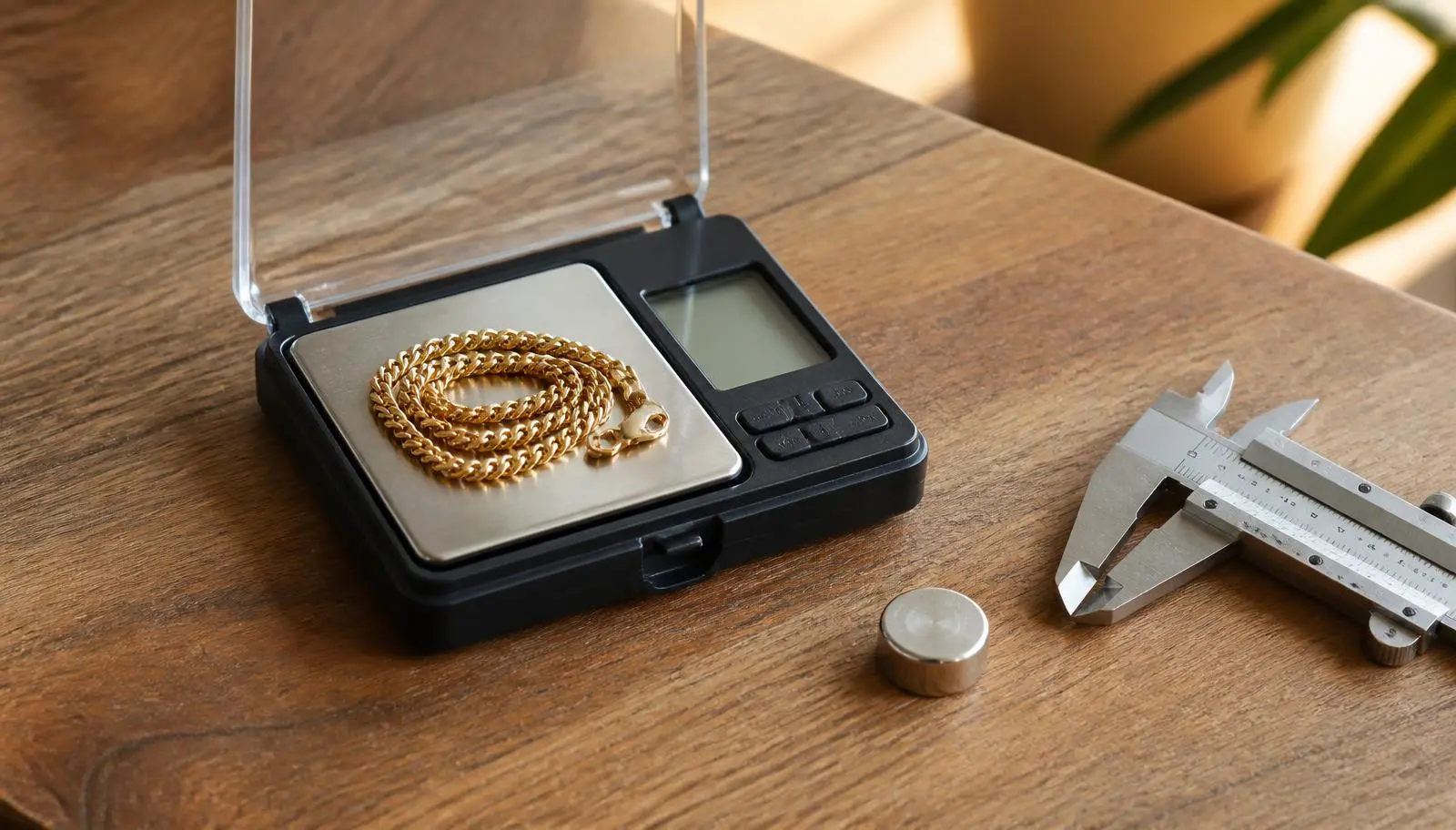
Gold is not magnetic. Neither are silver, copper, brass, or aluminum — so a magnet only catches iron and steel cores. Hold a strong neodymium magnet near the piece: if it jumps or drags, you've found a steel-cored fake or a plated base-metal piece, and you can stop. If nothing happens, you've learned very little. Plenty of convincing fakes are non-magnetic brass.
Worth doing anyway: it takes two seconds and it eliminates a chunk of costume jewelry immediately. Note that clasps, spring bars, and pin backs are sometimes steel on otherwise-genuine pieces, so test the body of the item.
Heft and the density test
This is the test the pros actually trust, because gold is remarkably dense — 19.3 g/cm³ according to the Royal Society of Chemistry, nearly twice as dense as lead-free brass and more than twice steel. Alloyed jewelry gold is lighter than pure but still heavy:
| Alloy | Approximate density (g/cm³) |
|---|---|
| Pure gold (24K) | 19.3 |
| 18K yellow | 15.2 – 15.9 |
| 14K yellow | 12.9 – 13.4 |
| 10K yellow | 11.4 – 11.9 |
| Sterling silver | 10.4 |
| Brass | 8.4 – 8.7 |
| Stainless steel | 7.8 – 8.0 |
Practically, that means a real gold ring feels startlingly heavy for its size — hollow-feeling "gold" is a bad sign. To get an actual number, weigh the piece dry, then weigh it submerged in water and divide the dry weight by the weight loss. That works beautifully on plain bands and chains, and poorly on anything with stones, hollow construction, or solder, all of which skew the math.
Look at the wear points
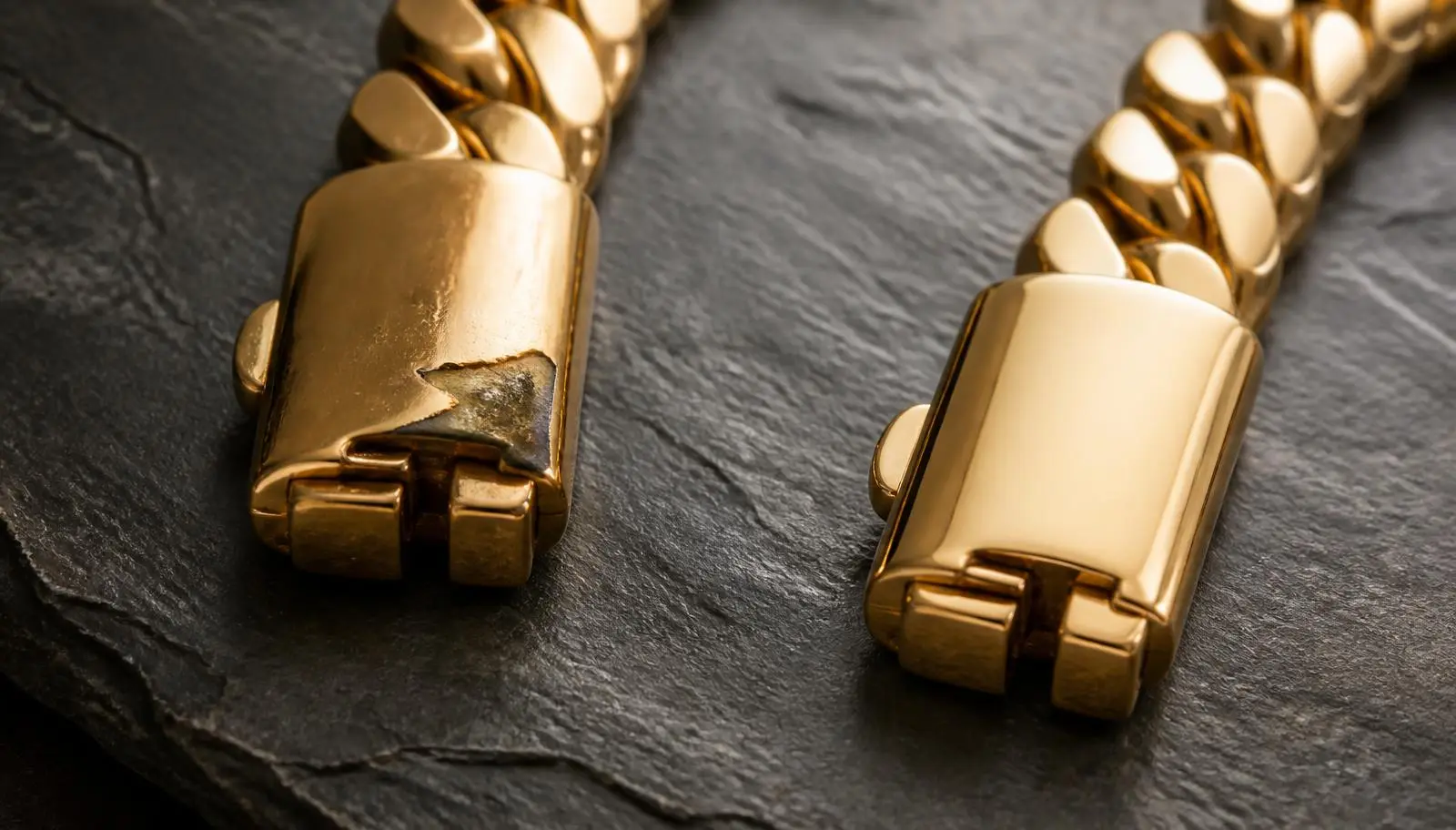
Plating fails first where fingers and fabric rub: clasp edges, chain link crests, ring shank bottoms, earring posts, the high points of engraving. Tilt the piece under a light and hunt for a pinkish, brassy, or gray patch peeking through. Solid gold wears thinner, never a different color.
Also check the inside of chain links and ring interiors for green or black residue — that's oxidized base metal underneath, which solid gold doesn't produce.
The acid (touchstone) test
The touchstone test is the classic jeweler's method: you rub the item on a slate stone to leave a streak, apply graded nitric acid solutions, and see which karat the streak survives. GIA has a clear step-by-step in its bench tip on the touchstone method, including the safety gear you need.
Two honest caveats: it uses corrosive acid (gloves, goggles, ventilation, baking soda on hand), and it only tests the surface unless you file a notch — which means a plated item can read as gold if you're careless. Kits run $20–$40. Never do this on somebody else's merchandise before you buy it.
Tests to skip entirely
- The bite test. Gold is soft, but so is lead. You're risking your teeth for nothing.
- The vinegar / lemon test. Real gold won't react, but neither will stainless steel or a well-plated piece.
- The ceramic scratch test. It damages the item, and results are ambiguous.
- The skin discoloration test. Green fingers point at copper alloys — which are also inside genuine 10K gold.
- The lighter test. You'll darken finishes, burn off patina, and possibly damage stones.
When should you get it professionally tested?
Once a piece looks like it might be worth more than about $100, stop guessing. Ask a local jeweler or a coin/bullion dealer for an XRF scan — an X-ray fluorescence reading that identifies the alloy in seconds without a mark on the item. Many will do it free or for a few dollars while you wait. For bullion bars, high-karat coins, or anything with an unclear provenance, a dealer's ultrasound or a formal assay is the next step up; the LBMA publishes the benchmark prices those settlements are based on.
Coins deserve their own caution: counterfeit sovereigns, Krugerrands and pre-1933 U.S. gold pieces are common, and the tell is usually weight-and-diameter precision rather than metal color. The U.S. Mint's coin specification data is a good reference for the genuine numbers.
Turning "it's real" into "here's what it's worth"
Once you know the karat and the weight, melt value is simple arithmetic:
(grams) × (karat fraction) × (spot price per gram) = melt value
So a 14K chain weighing 22 grams, with gold at (say) $105/gram: 22 × 0.585 × 105 = about $1,352 in gold content. Dealers pay a percentage of that — commonly 70–90% for clean, marked scrap — because they carry refining costs and risk.
Two unit conversions worth memorizing: gold trades by the troy ounce (31.1035 grams, not the 28.35 g of a kitchen ounce), and jewelry scrap is often quoted in pennyweight (dwt), which is 1.555 grams.
Use the Metals Calculator instead of doing math in a driveway
We built this exact math into EstateSaleFinder so you don't have to. The Metals Calculator — included with our Pro plans — pulls live spot prices for gold, silver, platinum and palladium, and lets you enter weight in grams, pennyweight, or troy ounces at any karat to get instant melt value, plus a realistic dealer-payout range. It's the tool I open standing in someone's hallway with a tangle of chain in my hand.
Pair it with the free Ai Appraiser: photograph a piece and it reads marks, identifies the style, and gives you a market range for the item as jewelry, which is often well above melt for designer or period work. Treat every Ai number as a suggestion for triage, never a final appraisal.
And if you want the sales to come to you, set a wishlist alert for terms like "gold," "14K," "jewelry," or "estate jewelry" — we'll ping you when a nearby sale mentions them.
Questions & answers
Frequently asked questions
Does real gold tarnish?
Pure gold does not tarnish, rust, or corrode. Alloyed gold can develop a very faint dullness from the copper and silver mixed in, and skin oils or soap film can make it look cloudy — but a piece with black, green, or flaking patches is showing you the base metal underneath.
Will a magnet stick to real gold?
No. Gold is non-magnetic, so a strong magnet pulling on a piece means there's iron or steel involved. The reverse isn't true, though: brass, copper and many pot-metal alloys are also non-magnetic, so passing the magnet test proves nothing on its own.
What does 585 mean on gold?
585 is millesimal fineness for 58.5% gold, which is the European way of stamping 14K. Likewise 750 = 18K, 916 = 22K, 417 = 10K, and 999 = 24K.
Is gold-filled jewelry worth anything?
Yes, modestly. Gold-filled must contain at least 1/20 of its weight in gold under FTC rules, so a heavy Victorian gold-filled locket can carry real recoverable value — and antique gold-filled pieces frequently sell for more as jewelry than as scrap. Gold plated is a different story: the layer is measured in microns and is essentially worthless as metal.
How can I tell if gold is real without any tools?
Look for a karat stamp, judge the heft against a same-size known object, and inspect wear points for brassy show-through. That trio catches most fakes. But "without tools" always means "without certainty" — a $10 loupe and a $12 pocket scale change everything.
Is white gold real gold?
Yes. White gold is gold alloyed with palladium, nickel or silver and usually finished with rhodium plating, which is what makes it bright white. It's stamped exactly like yellow gold — 14K, 585, 750 — and the rhodium wearing off to reveal a warmer tone underneath is normal aging, not a fake.
Can jewelers test gold for free?
Many local jewelers, pawn shops and bullion dealers will run a quick XRF or acid test at no charge, especially if you might sell to them. It's worth calling ahead. Independent appraisers charge by the hour and are the right choice for insurance or estate documentation rather than a quick purity check.
The one-minute field routine
- Loupe the stamp — inside the shank, the clasp tab, the post.
- Magnet check the body of the piece.
- Weigh it, or at minimum feel the heft.
- Scan every wear point for brassy show-through.
- Run the karat and grams through the Metals Calculator.
- If it clears $100, get an XRF before you resell it.
That's it. Six steps, under a minute once you've done it a dozen times, and it is the difference between walking past a $3 tangle and walking out with a $400 chain.
Related reading:
A note on the photos: every image in this article was created in-house for EstateSaleFinder, so there's no third-party copyright to credit — you're welcome to reference this page if you use one. Nothing here is a substitute for a professional appraisal, and I'm a picker, not a certified gemologist.
Keep exploring
Ready to start your own treasure hunt?
Discover estate sales near you and find incredible deals.
Explore Sales Near Me
About the author
Andy
Founder, EstateSaleFinder.net
Hi, I'm Andy — a retired commercial photographer turned developer with a five-year (and counting) obsession with estate sales. I started EstateSaleFinder.net because I knew there had to be an easier, smarter way to find and list estate sales. Now I get to chase treasure and build the tool I always wished existed.