Hunting for Weight: How to Spot the Real "Melt Value" Hidden in Costume Jewelry Bins
The $2 jewelry bin at the back of the estate sale is where the money hides. A tactical, hands-on guide to scanning tangled costume jewelry for mislabeled sterling silver (925) and solid gold scrap — the marks that matter, the magnet-and-weight tests you can do at the table, and the simple melt-value math that tells you when a dollar bin is really a pile of cash.
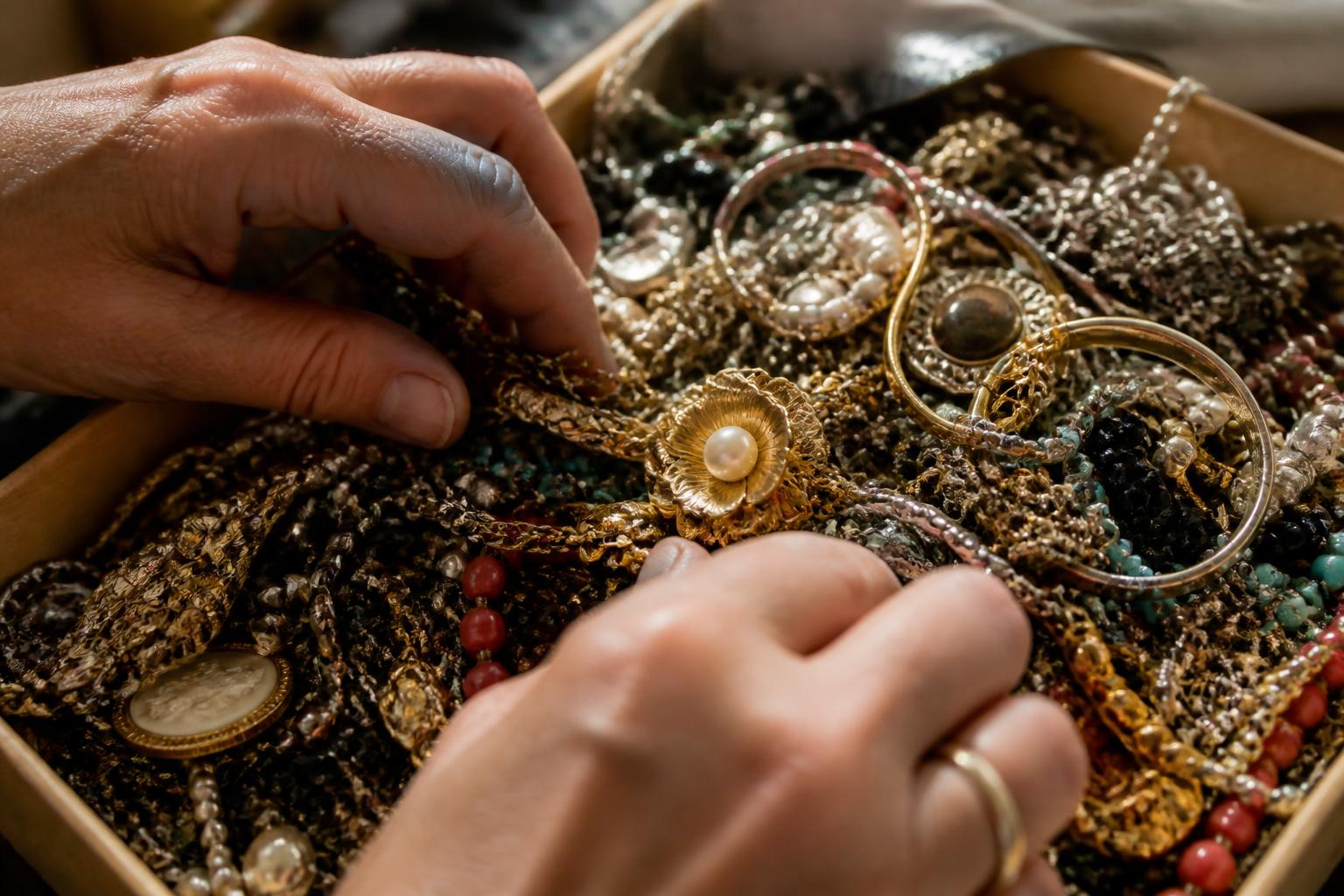
Every seasoned estate sale hunter eventually develops the same instinct: walk past the polished glass display case and head straight for the chipped Tupperware bowl, the tangled shoebox, the "$2 each / 3 for $5" jewelry bin nobody else wants to touch.
That bin is where the money hides.
Estate sale staff price the display jewelry. They almost never price the bin — there's too much of it, it's tangled, and most of it genuinely is worthless plastic and plated brass. But mixed into the junk, more often than you'd think, is a snapped 14K chain, a lone sterling earring whose mate is long gone, or a heavy class ring somebody tossed in decades ago. Those pieces have melt value: they're worth real money for the metal alone, regardless of how ugly or broken they are.
This is the tactical guide to finding them — fast, at the table, with tools that fit in your pocket.
What "Melt Value" Actually Means
Melt value is the worth of an item based purely on the precious metal it contains, if you melted it down to nothing. It ignores brand, beauty, age, and craftsmanship. A kinked, unwearable 14K gold chain and a pristine one of the same weight have the same melt value.
This is your safety net as a hunter. You don't need to guess whether a piece is collectible or designer. If it's solid gold or solid silver, it has a hard floor of value set by the global metal market — and that floor is often many times what the bin is charging.
Three numbers drive melt value:
- Weight — how much metal is there (in grams, troy ounces, or pennyweights)
- Purity — what fraction of that weight is actually the precious metal (the karat or the silver standard)
- Spot price — the live market price of gold or silver that day
Get those three and you can price any scrap piece in about ten seconds. We'll get to the math. First, the hunt.
Step 1: Read the Marks — Vintage Jewelry Hallmarks That Mean Money
Before any test, flip the piece over and look for a stamp. On rings it's inside the band. On chains it's on the clasp or a little tag near the clasp. On earrings it's on the post or the back. On brooches it's on the pin stem or the back plate. Bring a jeweler's loupe or use your phone camera's zoom — these marks are tiny and often worn.
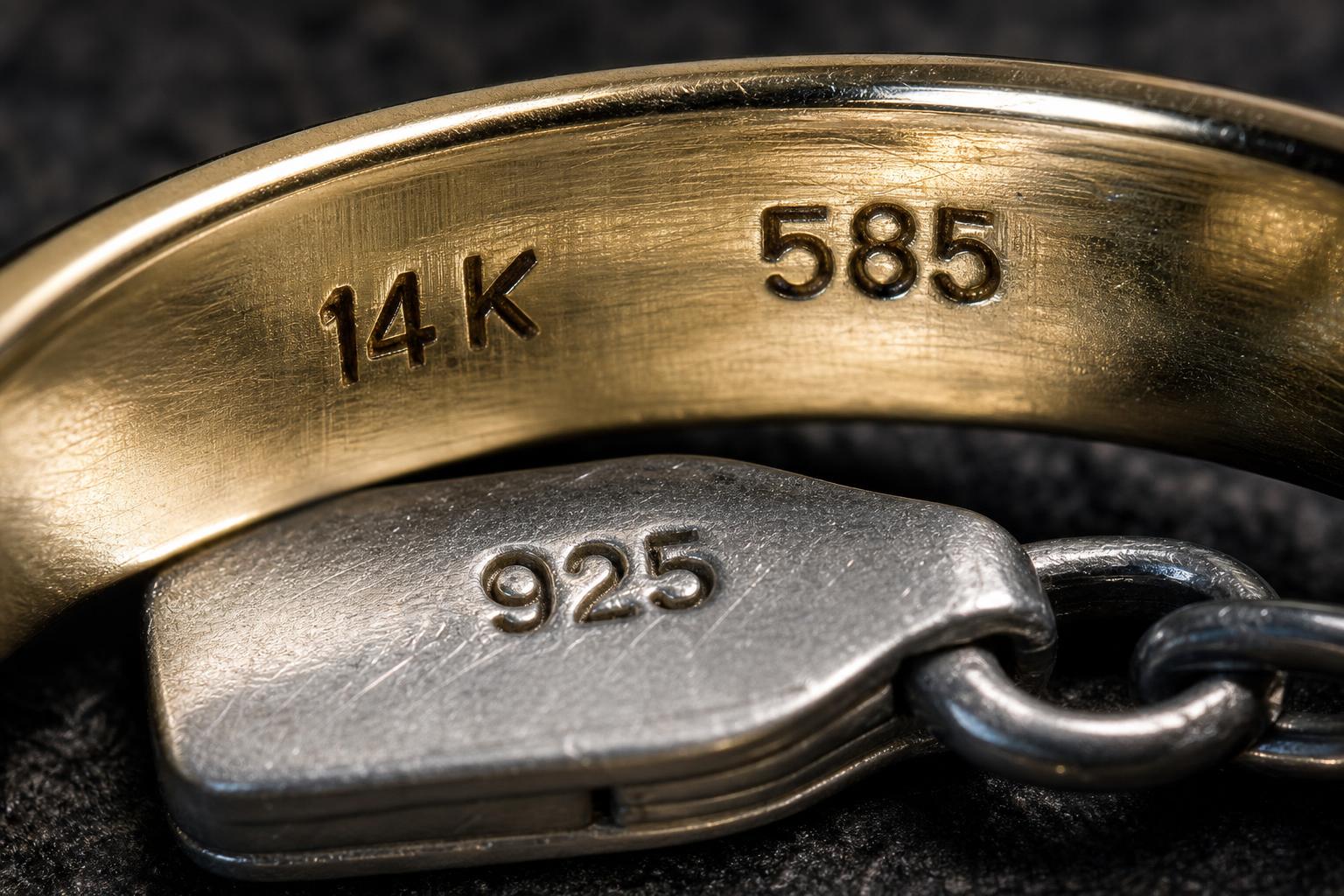
Gold marks worth keeping
Gold purity is stamped two ways — the American karat system and the European three-digit "parts per thousand" system. They mean the same thing:
- 10K = 417 → 41.7% gold (the US minimum to legally call something "gold")
- 14K = 585 (sometimes 583) → 58.5% gold — the most common solid-gold mark you'll find in American bins
- 18K = 750 → 75% gold
- 22K = 916/917 → 91.6% gold, common in Indian and Middle Eastern pieces
- 24K = 999 → 99.9% pure gold, soft and rich yellow
Any of those = real, solid gold with real melt value. Keep it.
Gold marks that are NOT solid gold
This is where most beginners lose money — by buying plated junk or by passing on solid gold they mistook for plated. Learn these:
- GF (e.g. "1/20 12K GF") → Gold-Filled. A thick layer of gold mechanically bonded to a base-metal core. Not solid, but it must be at least 5% gold by weight, so heavier gold-filled lots can have modest scrap value. Worth grabbing in quantity, not for a single earring.
- GP, GEP, HGE, RGP → Gold Plated / Electroplated / Heavy Gold Electroplate / Rolled Gold Plate. A microscopically thin coating. Melt value is effectively zero. Pass.
- Vermeil → sterling silver with a gold coating. The silver underneath has melt value; the gold does not.
- No mark at all → Could be anything. Don't assume. Move to the tests below.
Field rule: "K" means karat (solid gold). Letters after a number — GF, GP, GE — almost always mean it's coated, not solid. When in doubt, the number alone (417, 585, 750) is the friendliest sign.
Silver marks worth keeping
Silver is simpler. The magic number is 925:
- 925 / "Sterling" / ".925" → 92.5% silver. This is sterling, the standard worth chasing.
- 800, 835, 900 → European and "coin" silver standards. Lower purity but still real silver with melt value.
- A maker's mark with no number → many older US makers stamped only their name. Cross-check it; a lot of unmarked-looking flatware and jewelry is coin or sterling.
Silver marks that are NOT silver
- EPNS → Electro-Plated Nickel Silver. The word "silver" is a cruel trick here — there is no silver in it. It's nickel and copper with a flash of plating. Pass.
- "Nickel Silver," "German Silver," "Alpaca" → same story. No silver. Pass.
- 925 on something suspiciously light and magnetic → counterfeit stamp. Trust the tests over the stamp.
For a deeper read on the four-mark systems, lion stamps, and how to date a piece by its hallmarks, see our companion guide: Sterling Silver Identification: How to Read Hallmarks.
Step 2: The Magnet Test (Your Single Best Pocket Tool)
Carry a small strong magnet (a neodymium one from the hardware store is perfect). Neither gold nor silver is magnetic. If a chain leaps up and clings to the magnet, the core is steel or another base metal — it is not solid precious metal, no matter what it's stamped.
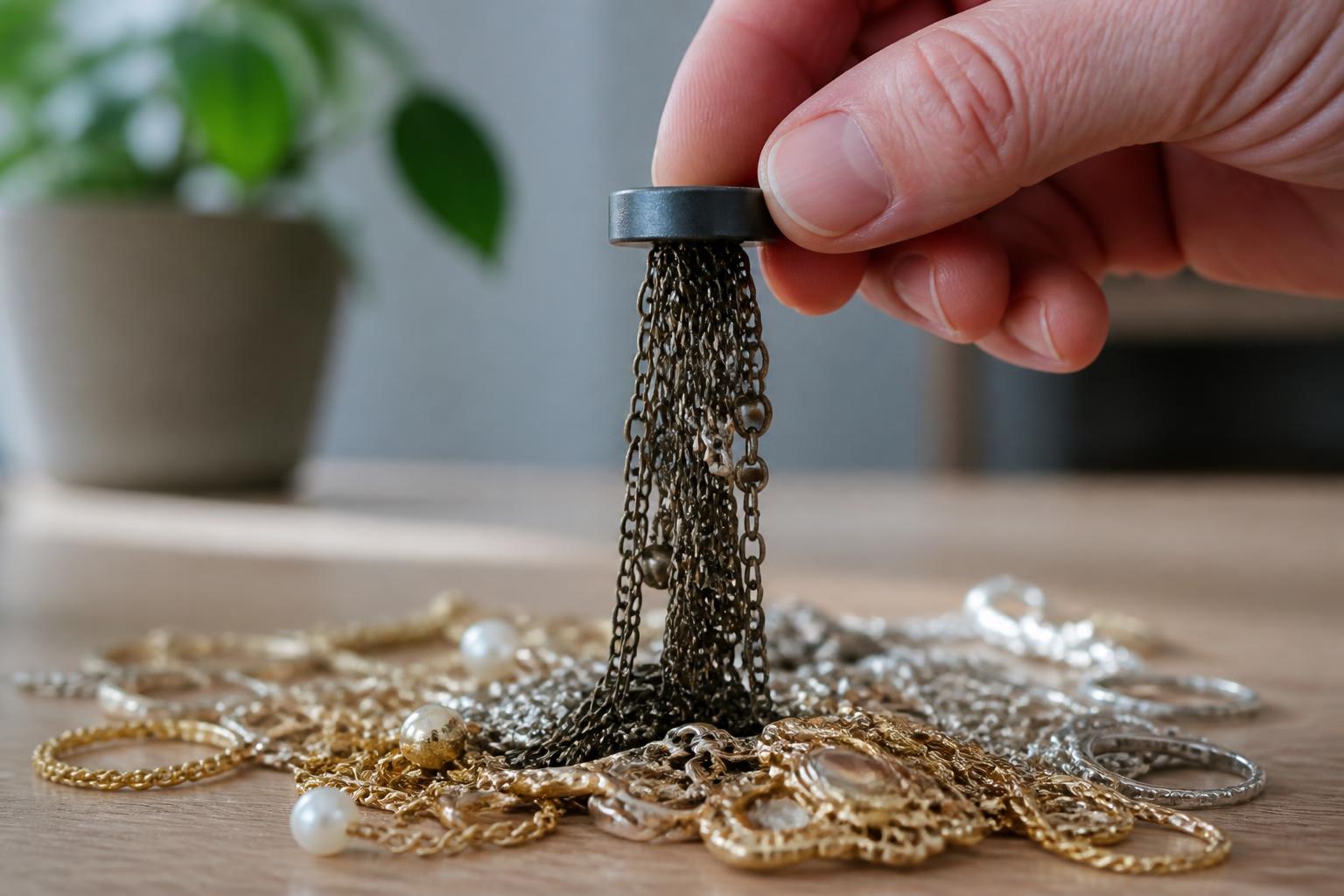
Drag the magnet slowly across the whole bin. Everything that jumps is base metal — set it aside instantly. Everything that ignores the magnet earns a closer look. This one move clears 70% of a bin in thirty seconds.
A caveat: the magnet test rules things out, it doesn't prove gold. A non-magnetic piece could still be brass, lead, or pot metal. It just earns a spot in your "look closer" pile.
Step 3: Feel the Weight
Gold is dense — far denser than the base metals that imitate it. A solid gold ring has a surprising, satisfying heft for its size; a hollow plated ring feels like a toy. Once you've handled a few real pieces, your fingers start flagging the heavy ones before your eyes even find the stamp.
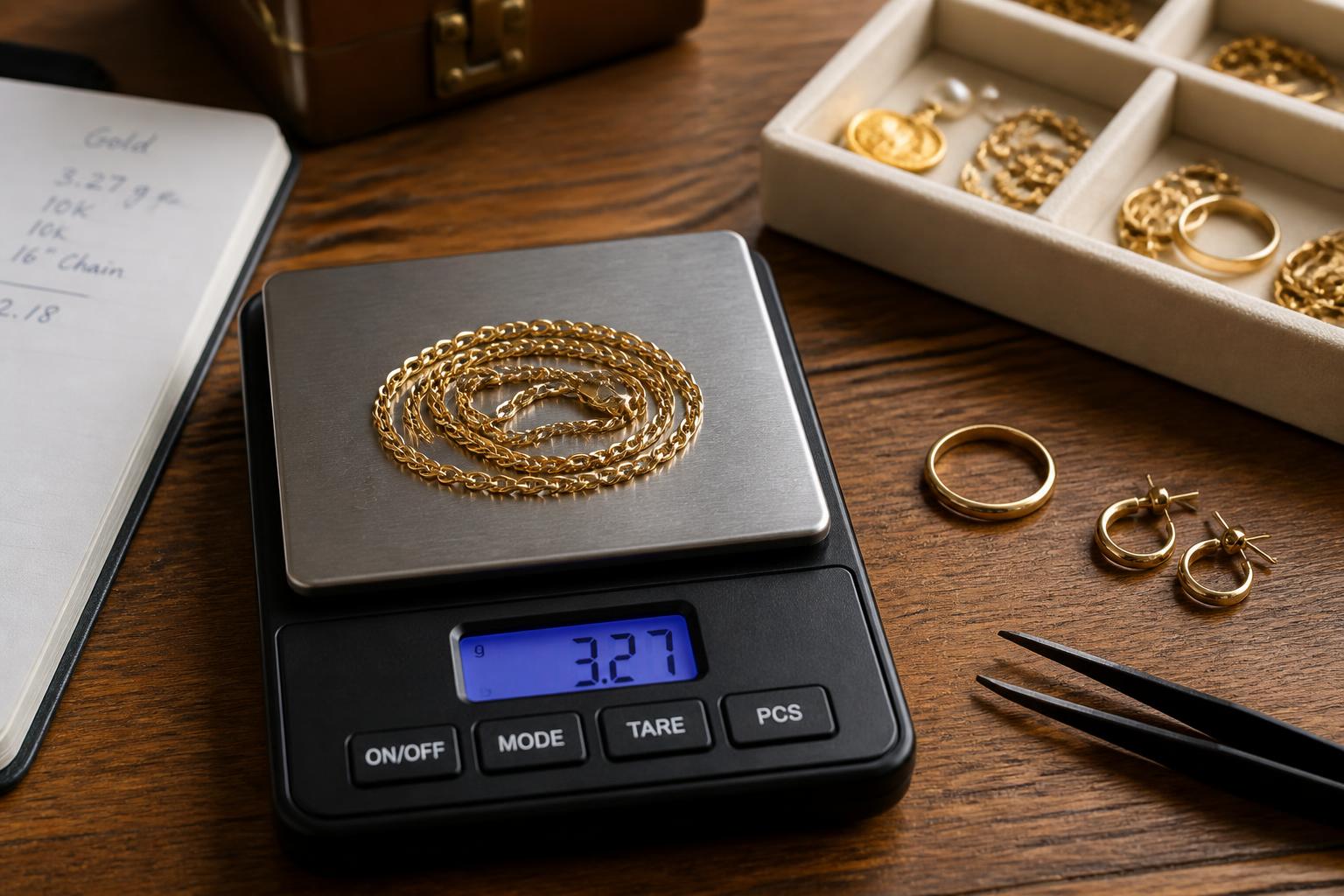
A cheap digital jewelry scale (the kind that reads to 0.01 g) is the difference between guessing and knowing. Weigh your "keep" pieces, jot the grams, and you're ready to do the only math that matters.
Step 4: The Melt-Value Math (Do It at the Table)
Here's the whole formula:
Melt value = Weight × Purity × Spot price (per the same unit of weight)
Let's price the 14K chain from the photo — 3.27 grams of 14K gold.
- Purity: 14K = 0.585
- Pure gold content: 3.27 g × 0.585 = 1.91 g of pure gold
- Spot price: say gold is around $4,000 per troy ounce. One troy ounce = 31.1 g, so that's about $128 per gram of pure gold.
- Melt value: 1.91 g × $128 = about $245
That snapped, unwearable little chain in the $2 bin is worth roughly $245 in gold alone. Even after a refiner or buyer takes their cut (typically paying 70–90% of melt for scrap), you're looking at a $170–$220 piece you bought for two dollars.
Silver works the same way. A sterling pendant weighing 20 g, at a silver spot of ~$58/troy oz (≈ $1.87/g):
- 20 g × 0.925 = 18.5 g pure silver
- 18.5 g × $1.87 = about $35 — from a single bin piece.
Two honest notes:
- Spot prices move daily. Check the live gold and silver price before you shop; the numbers above are illustrative for mid-2026, not gospel.
- Subtract for stones and non-gold parts. A ring's gemstone, the steel spring in a clasp, or an enamel face all add weight that isn't precious metal. For rough fieldwork, knock off a little for obvious non-metal bits, or weigh after the fact.
Step 5: Sort Fast, Decide Faster
You won't have time to weigh every piece at a crowded sale. Build a two-pile habit right in your hand:
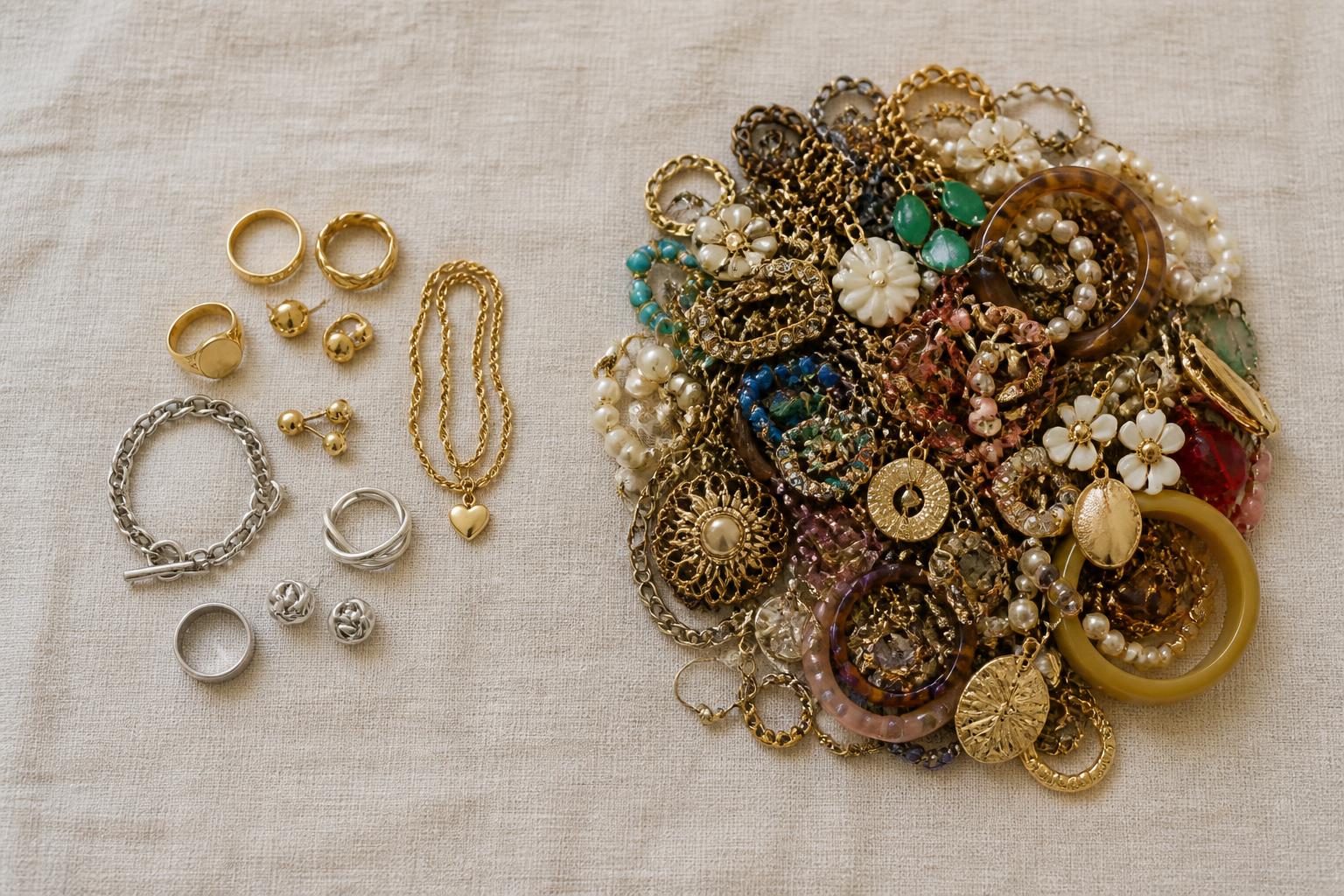
- Keep pile: anything marked 417/585/750/10K/14K/18K, anything marked 925/Sterling/800/900, anything heavy and non-magnetic worth a second look.
- Pass pile: anything that grabs the magnet, anything marked GP/GE/HGE/RGP/EPNS, anything suspiciously light.
Buy the whole keep pile. At $2–$5 a piece, you only need one real gold chain to turn a $30 handful of bin jewelry into a profitable afternoon — and the broken, unwearable pieces are exactly the ones other shoppers leave behind.
A Few Honest Warnings
- Don't damage merchandise. Acid and scratch tests belong at home on pieces you've bought, never on a seller's table.
- A stamp is a claim, not a guarantee. Counterfeit "925" and "14K" stamps exist. The magnet + weight + math combo is what protects you.
- Melt value is the floor, not the ceiling. A signed Tiffany sterling piece, a vintage designer brooch, or an antique gold locket is often worth far more intact than melted. When a keep-pile piece is also beautiful or signed, research it before you scrap it.
Bring the Whole Toolkit to the Next Sale
The hunters who consistently pull gold out of dollar bins aren't lucky — they're equipped. A loupe, a magnet, a tiny scale, and these few marks memorized will change how you shop forever.
When you're standing over a bin and the stamp is too worn to read, snap a photo and let our Ai Appraiser read the hallmark, estimate the metal, and give you a value range on the spot. And before you drive anywhere, use EstateSaleFinder to find the sales near you most likely to have the deep, unpriced jewelry bins worth digging through.
The display case is for everyone else. The bin is for you.
Keep exploring
Ready to start your own treasure hunt?
Discover estate sales near you and find incredible deals.
Explore Sales Near Me
About the author
Andy
Founder, EstateSaleFinder.net
Hi, I'm Andy — a retired commercial photographer turned developer with a five-year (and counting) obsession with estate sales. I started EstateSaleFinder.net because I knew there had to be an easier, smarter way to find and list estate sales. Now I get to chase treasure and build the tool I always wished existed.