
What Does a Lion on Silver Mean? Lion Passant, Leopard's Head, Date Letters and the Fake "Hallmarks" on Silver Plate
A walking lion means English sterling, but only beside a town mark. How to read all five British hallmarks, what left-facing and rampant lions mean, how to spot pseudo-hallmarks on plate, and a 60-second sale-floor check.
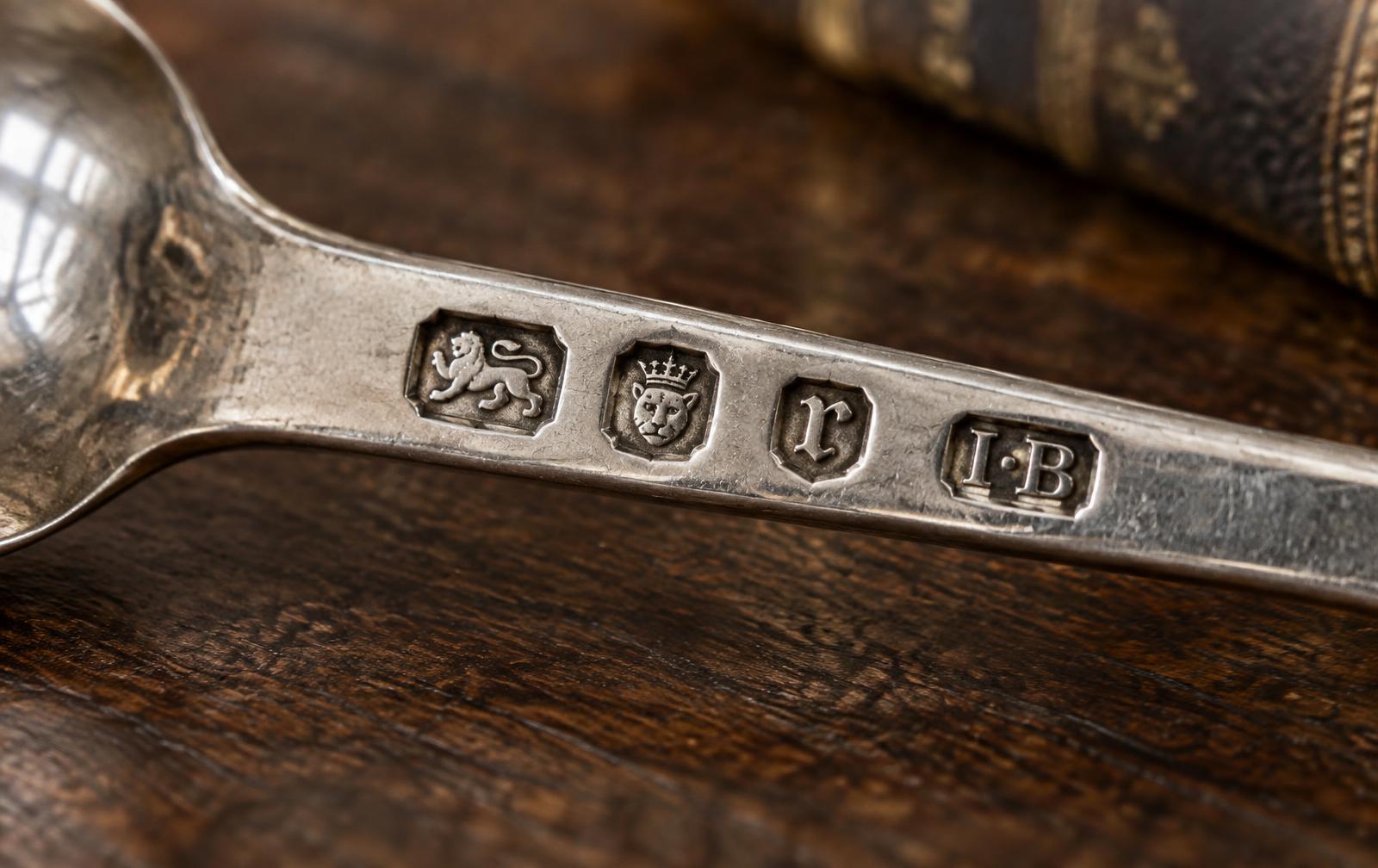
A walking lion on silver, called a lion passant, is the English sterling mark. It means the piece was tested at an official assay office and found to be at least 925 parts pure silver per thousand. On English silver it has been used since 1544. A real one sits in a row with a town mark (such as a leopard's head for London), a date letter and a maker's mark.
That's the short answer. The longer one is what keeps you from paying sterling money for silver plate: how to read the whole row of marks, what the different lions and leopards mean, which "hallmarks" are only decoration, and what a quick sale-floor check looks like.
Quick summary for skimmers:
- Lion passant (walking lion): English sterling, 92.5% silver, tested at an assay office.
- Leopard's head: the London assay office's town mark. Birmingham used an anchor, Sheffield a crown (later a rose).
- Date letter: a single letter in a shield that tells you the year, but only when you match the letter's style and the shield shape to the right office's chart.
- Monarch's head: the duty mark, showing tax was paid, used from 1784 to 1890.
- Fakes and look-alikes: rows of stars, birds, crowns or shields, plus stamps like EPNS or A1, usually mean silver plate. Gorham's lion, anchor and G is American.
What does a lion on silver mean?
On British silver, a lion is almost always the standard mark: the stamp that says the metal met a legal purity. The Silver Society, a UK charity devoted to silver research, explains that British hallmarks from the 1700s to early 1900s usually have four or five separate marks, and that the standard mark shows the metal was tested and met the sterling standard of at least 925 parts per thousand (The Silver Society).
The Metropolitan Museum of Art describes the same system: in London, Birmingham and Sheffield, the busiest assay towns, the sterling mark was the lion passant, "a lion in left profile walking to the left" (The Met).
So when a seller writes "lion hallmark" on a tag, the useful question isn't "is there a lion?" It's "is there a lion plus the other marks that only an assay office could strike?"
Does a lion passant always mean sterling?
On genuine British hallmarks, yes: the lion passant is the sterling standard mark. The trouble is that a lion is easy to copy. Makers of silver plate in Britain and America often stamped little lions, shields and letters to look like hallmarks. A lion on its own, with nothing that identifies a town, isn't proof of anything. Treat it as a reason to look closer, not a reason to pay.
The five standard marks on British silver, and what each one means
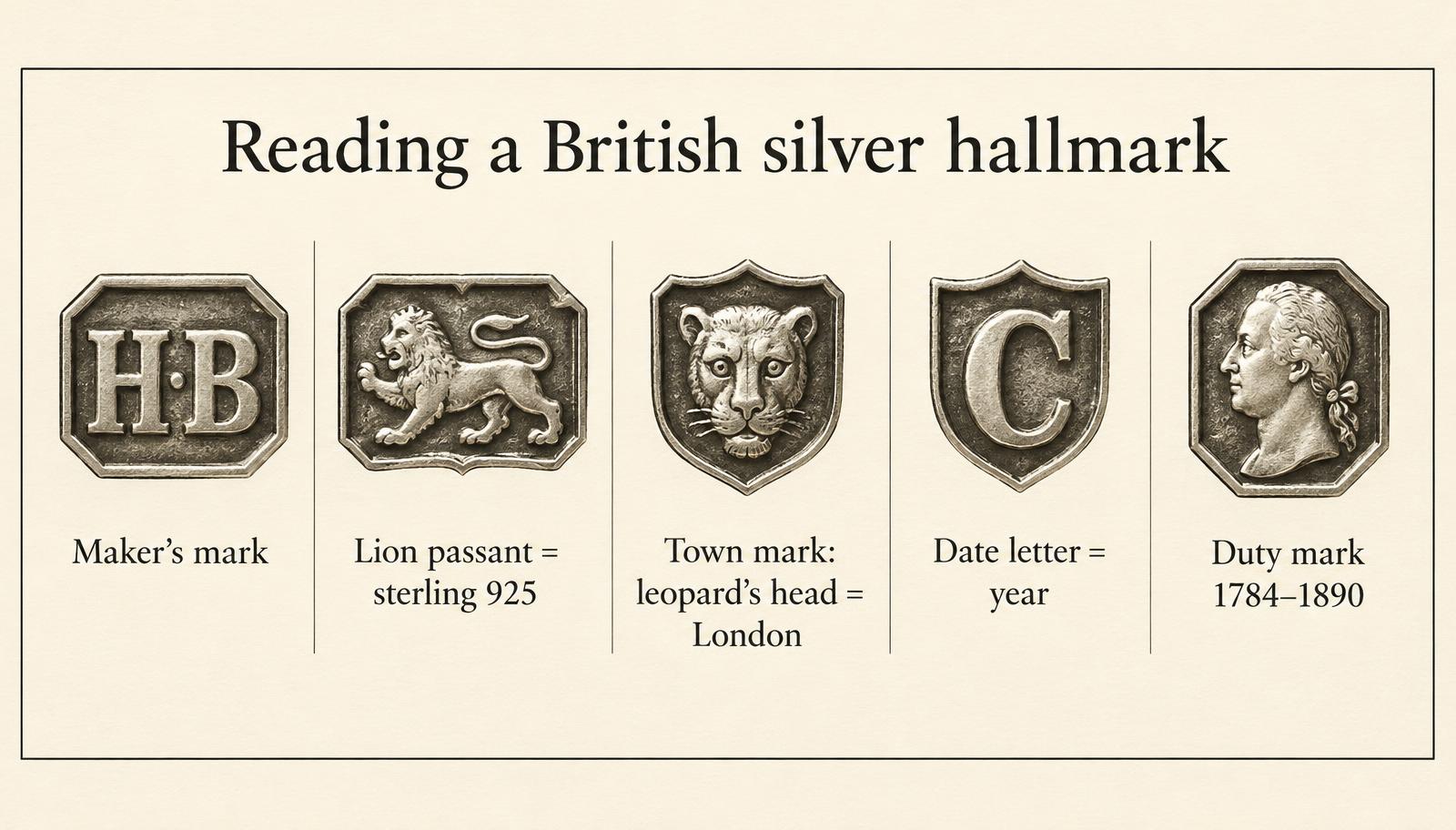
Here's the usual set on 18th- and 19th-century British silver, based on The Silver Society's guide and The Met's essay.
| Mark | What it looks like | What it tells you |
|---|---|---|
| Maker's (sponsor's) mark | Initials, usually in a small cartouche | Who made or sent the piece for testing |
| Standard mark | Lion passant in England; a thistle (Edinburgh) or crowned harp (Dublin) elsewhere | The metal is sterling, 925 parts per thousand |
| Town (assay office) mark | Leopard's head for London, anchor for Birmingham, crown for Sheffield | Which office tested it |
| Date letter | One letter inside a shield | The year of testing |
| Duty mark | The reigning monarch's head in profile | Tax was paid; used 1784 to 1890 |
The maker's mark
The maker's mark has been required alongside the leopard's head since 1363, according to the Goldsmiths' Company Assay Office in London (Assay Office London). It's usually two or three initials. Famous names like Paul Storr or Hester Bateman add real value, but only after the rest of the row checks out.
The lion passant
This is the purity mark. Look for a lion in profile, walking, with one front paw raised. In older marks (roughly the mid-1500s to about 1820) the lion turns its face toward you; that's called lion passant guardant. Later lions look straight ahead along their path.
The leopard's head (London's town mark)
The leopard's head is the oldest mark of all. The London Assay Office traces it to a 1300 statute of Edward I, which required silver to be marked with the leopard's head before leaving the maker (Assay Office London). A crown was added later, and the crowned version is what you'll see on most Georgian London silver. If someone asks "what is a leopard head hallmark?", the answer is: London.
The date letter
Each assay office used its own alphabet cycle, changing the letter once a year. London first used a date letter in 1477, according to the reference site silvermakersmarks.co.uk (London Date Letters). The letter alone is never enough; more on that below.
The duty mark (the monarch's head)
From 1784 to 1890, British silver carried a small portrait of the reigning king or queen to show duty had been paid. If you see a head in profile next to a lion, you're almost certainly looking at a piece from that 106-year window.
Lion facing left, lion facing right, lion rampant and crowned leopards
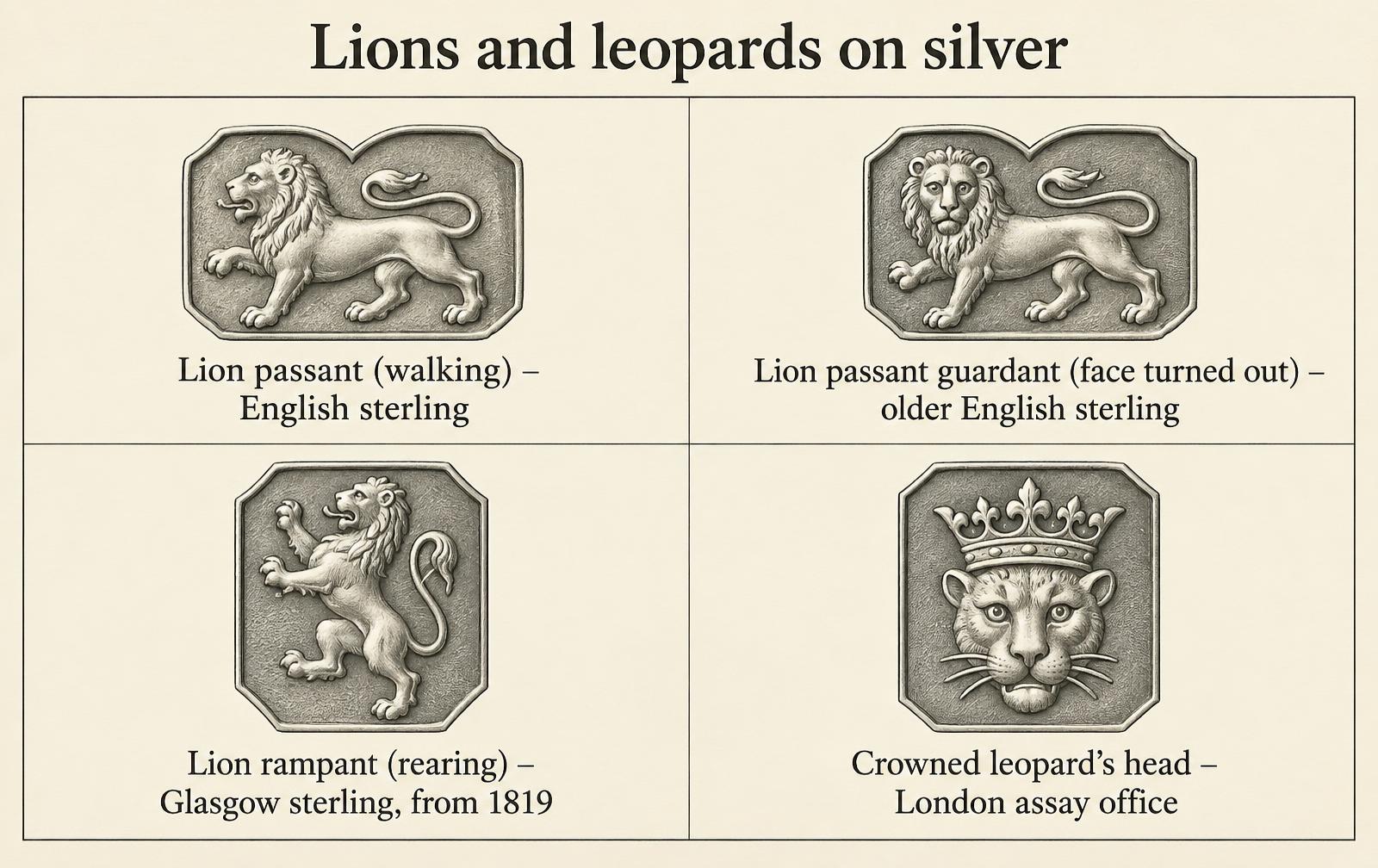
People search for "silver hallmark lion facing left" and "lion facing right" because they've noticed the lion's direction varies. Here's what to make of it.
- Lion walking left (passant): the standard English sterling lion. The Met describes it as walking to the left.
- Lion with its face turned out (passant guardant): older English sterling. Still sterling.
- Lion facing right: not the usual British orientation. Some American and continental makers used right-facing or otherwise "different" lions in their own trademarks. Treat a right-facing lion with no town mark as unconfirmed until you identify the maker.
- Lion rampant (rearing up): the Glasgow assay office's sterling mark, introduced in the 19th century. Glasgow's town mark is a tree, fish, bell and bird, so a lion rampant usually travels with that busy little emblem.
- Crowned leopard's head: London's town mark, not a purity mark. Don't confuse it with the lion.
Fake hallmarks: what silver plate marks look like
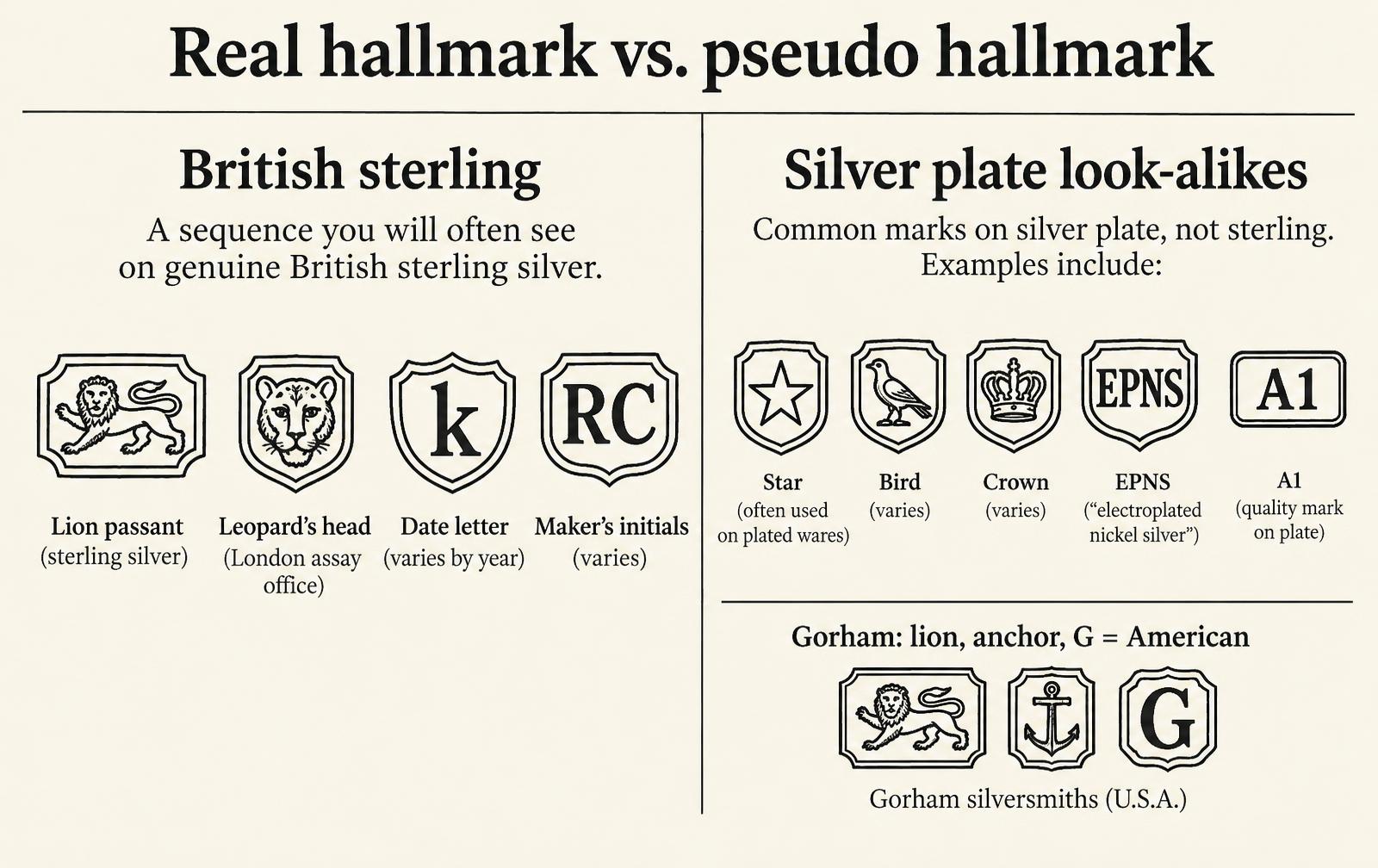
Collectors call these pseudo-hallmarks: marks designed to resemble the real thing. The Silver Society's guide covers "marks that are not hallmarks" for exactly this reason. Warning signs:
- A row of identical small shields containing stars, birds, crowns or letters, with no lion and no recognizable town mark.
- EPNS (electroplated nickel silver), EP, EPBM (electroplated Britannia metal) or A1. These are plate marks. A1 is a quality grade for plate, not a purity mark.
- "Sheffield" or "Sheffield plate" spelled out in words. Real Sheffield assay marks are symbols, not the word.
- Gorham's lion, anchor and G. Gorham, the Rhode Island silversmith, used a lion, an anchor and a capital G as its trademark. It looks British at a glance, but it's American. Gorham sterling is usually also stamped STERLING; Gorham plate is not.
- "Nickel silver" or "German silver." These contain no silver at all.
A lion on its own is the most common trap. If there's a lion but nothing that tells you a town, keep testing before you pay sterling prices.
Why the shape of the shield around the date letter matters
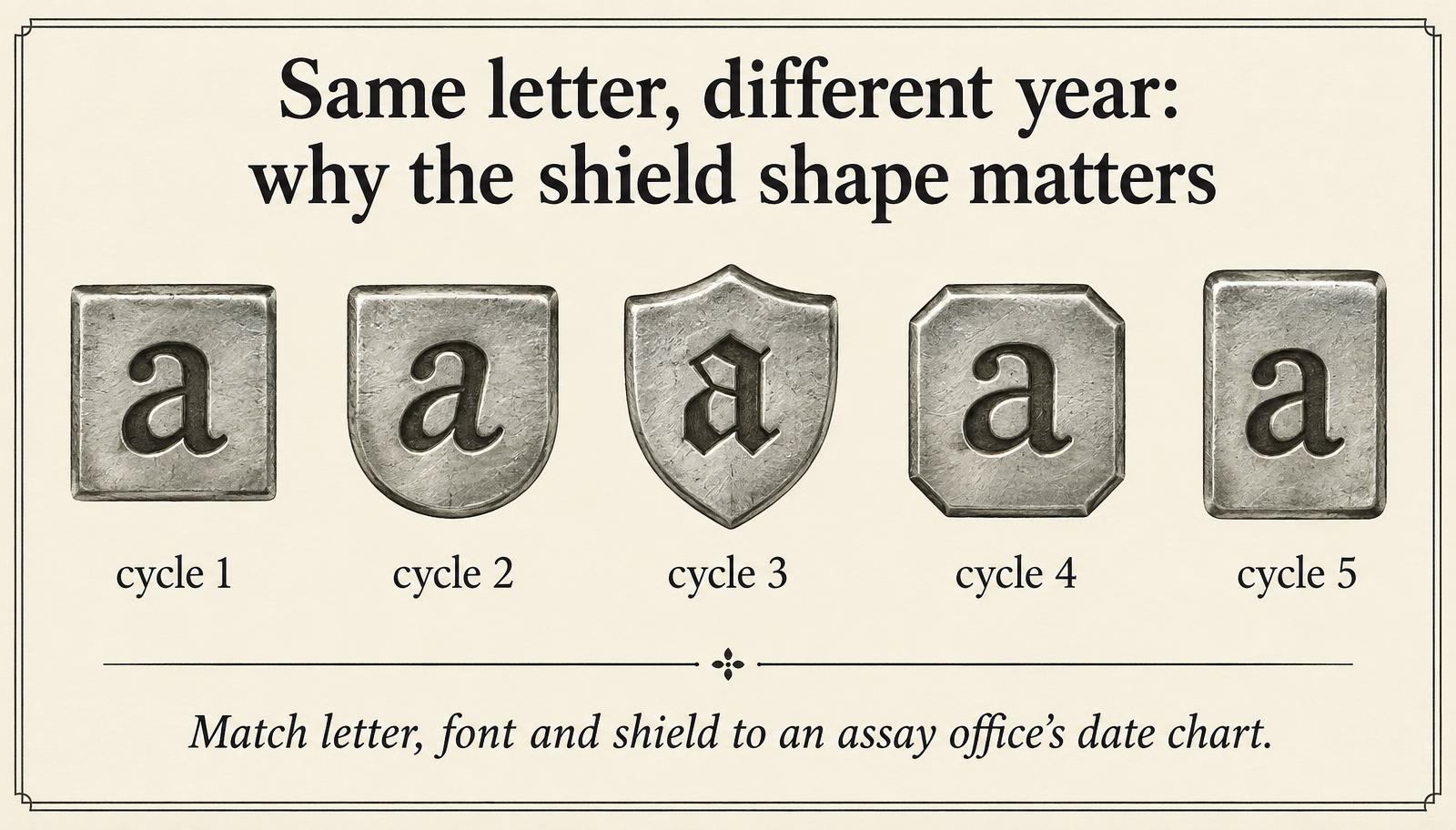
Each assay office ran its alphabet in cycles of about 20 letters, then started again with a new font and a new shield shape. That means a lowercase "a" might mean five or six different years at the same office. Three things together pin the year:
- The office (from the town mark).
- The letter's style: capital or lowercase, Roman, Gothic or script.
- The outline of the shield around it: square, round-bottomed, pointed, with cut corners.
Look all three up together on a date chart for that office. The silvermakersmarks.co.uk London chart is a good free starting point. Since 1975, all British offices change the letter every January 1 and share the same letter for a given year (London Date Letters).
A real example: a pair of London spoons from 1775 and 1777
Essex Jewelry Antiques listed a pair of English Georgian sterling table spoons dated 1775 and 1777 at $937.09 when we checked. Their description reads like a textbook hallmark row (Essex Jewelry Antiques):
- one spoon: lion passant (sterling), crowned leopard's head (London), date letter B for 1777, maker's mark TN, possibly Thomas Northcote
- the other: lion passant, crowned leopard's head, date letter U for 1775, maker's mark WF, possibly William Fearn
- each about 9¼ inches long, together 159 grams, with an engraved stag crest and no repairs
Notice what made them sellable: a complete row, a clean condition report and a stated weight. The same shop listed a single 1777 London spoon by Thomas Chawner at $134 (Essex Jewelry Antiques). Dealer asking prices aren't what you'll get selling; they're a sense of the range.
A 60-second hallmark check on the estate sale floor
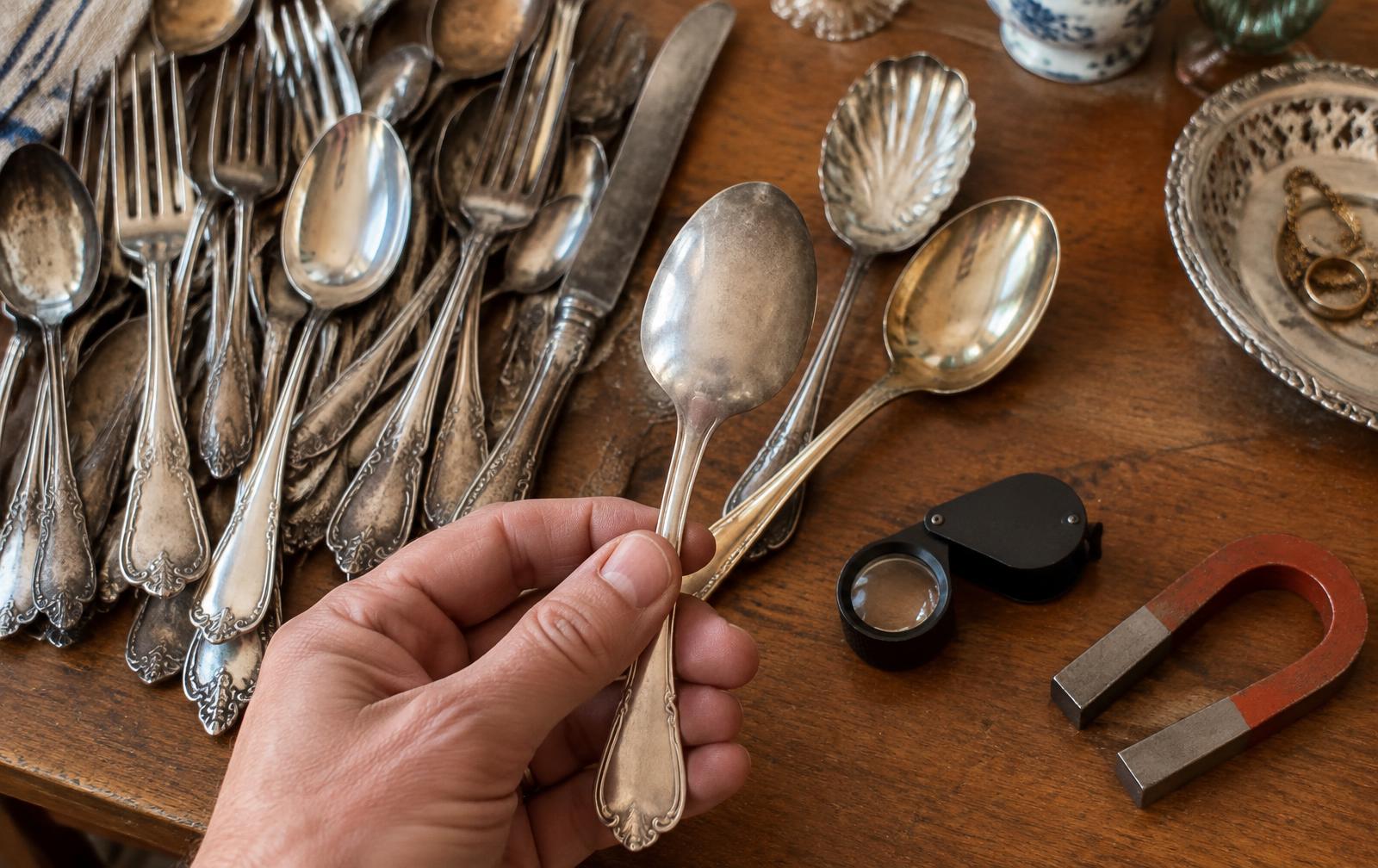
Bring a 10x loupe and a small magnet. Then:
- Flip it over. Spoons and forks are marked on the back of the stem; bowls and trays underneath or near the rim.
- Count the marks. Three to five small, separate punches in a row is a good sign.
- Find the lion, then find the town. Lion plus a leopard's head, anchor, crown or rose is worth buying at a sterling price. A lion with no town mark: test before you pay.
- Look for plate words. EPNS, EP, A1, "nickel silver" or "Sheffield" in letters means plate.
- Try the magnet. Silver isn't magnetic. If the magnet grabs hard, it's not solid silver. (Not sticking doesn't prove sterling; brass and copper don't stick either.)
- Look for wear. Pink or yellow metal showing through on high points means plating wearing off.
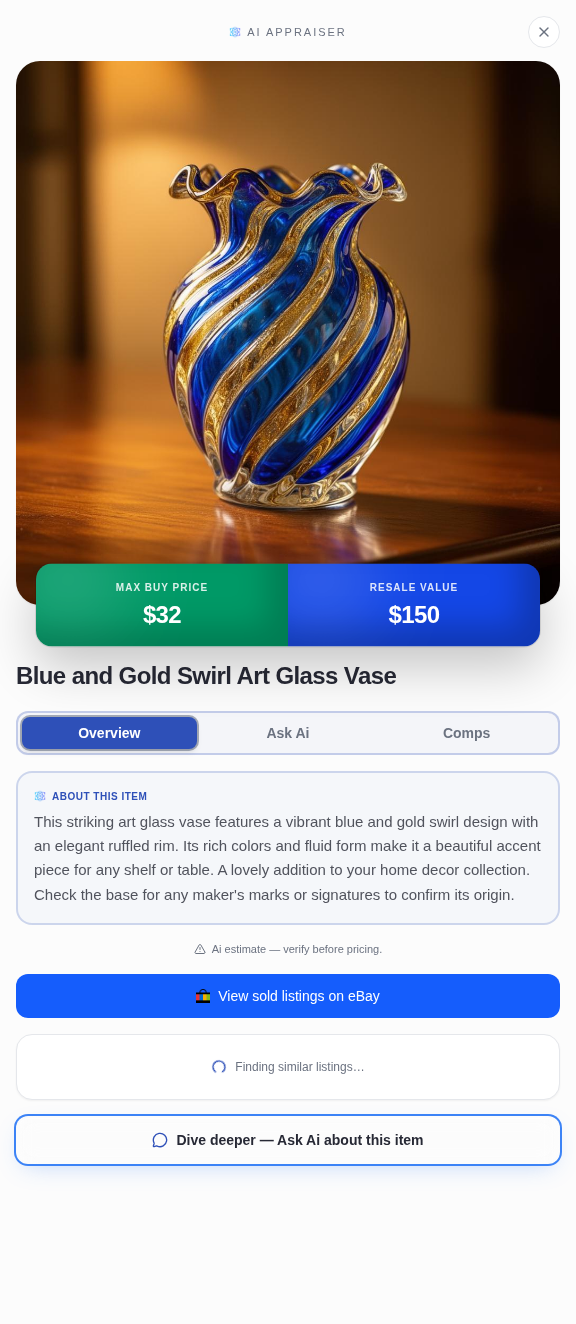
- Snap a photo. Use the Ai Appraiser for a suggested identification, and save the find to your notes.
Many estate sale companies already separate sterling from plate. If something's priced like plate but carries a full row, ask a staff member politely; most will be glad you told them before checkout or happy to sell it to you as priced.
How to tell what silver is worth
Sterling's floor value is its silver content. To estimate it, multiply the weight in grams by 0.925, then by the current silver spot price per gram (the per-troy-ounce price divided by 31.1). Dealers and pawn shops pay below that figure to cover refining and profit, so don't expect full melt. Antique pieces with full hallmarks, good makers or crests often sell for well above melt to collectors. Read our guide to melt value in costume jewelry bins for the step-by-step math.
Questions & answers
Frequently asked questions
What are the most valuable marks on silver?
A complete British row from a sought-after maker (Paul Storr, Hester Bateman, the Bateman family, Paul de Lamerie) is the most valuable combination. Early date letters, rare provincial town marks and original crests can add value. A lion alone adds nothing until the rest is confirmed.
What is the best mark on silver?
There's no single "best" mark. For buying at a sale, the most useful is a clear lion passant next to a recognizable town mark, because together they prove sterling.
What are the 5 standard silver marks and their meanings?
Maker's mark (who made it), standard mark (the lion passant for sterling), town mark (which assay office), date letter (the year) and, from 1784 to 1890, the duty mark (the monarch's head, showing tax was paid).
How much is 1 gram of 925 sterling silver worth?
About 0.925 times the current price of one gram of pure silver. Check a live spot price, divide the troy-ounce price by 31.1, and multiply by 0.925. That's melt value; buyers usually pay less.
How much will a pawn shop pay for 925 silver?
Usually a share of melt value, not the full amount, and the percentage varies by shop and day. Get a few quotes, weigh the piece yourself first, and remember antique hallmarked pieces may sell for more to collectors than to a pawn shop.
What does a leopard head hallmark mean?
It's the London Assay Office's town mark. On older silver it wears a crown; the crown was dropped in the 1820s.
What does a lion rampant mark on silver mean?
A rearing lion is the Glasgow assay office's sterling mark. Look for Glasgow's town mark (a tree with a bird, bell and fish) beside it.
Sources
Related reading:
Sources checked October 27, 2026. Dealer prices are asking prices, not appraisals. Hallmark diagrams are illustrations; confirm dates with a published date chart for the specific assay office.
Keep exploring
Ready to start your own treasure hunt?
Discover estate sales near you and find incredible deals.
Explore Sales Near Me
About the author
Andy
Founder, EstateSaleFinder.net
Hi, I'm Andy — a retired commercial photographer turned developer with a five-year (and counting) obsession with estate sales. I started EstateSaleFinder.net because I knew there had to be an easier, smarter way to find and list estate sales. Now I get to chase treasure and build the tool I always wished existed.