

Someone Left You a House Full of Stuff. Here's How to Find Out If Any of It Is Actually Valuable (Before You Accidentally Give Away a Fortune)
Every week, a family donates a $4,000 sterling tea service, a $1,200 oil painting, or a $600 set of midcentury chairs because nobody knew what they were looking at. This guide walks you through the seven categories of inherited items most likely to surprise you — what makes each one valuable, what to photograph, and when to call in an estate sale company instead of doing it yourself.
Most of what is in the house is not valuable. We need to start there honestly so you don't spend the next three months getting your hopes up over a china cabinet that's worth $80.
But some of it almost certainly is, and the categories that surprise people are not the ones you'd guess. The framed prints on the wall are mostly worth their frames. The "antique" dining set Grandma was so proud of is often a 1980s reproduction. Meanwhile the dusty silver tray on top of the cabinet that nobody noticed is sterling, weighs 38 ounces, and is worth $1,400 just for the metal — before anyone considers the maker.
Here is how to triage the contents of an inherited home, in the right order, without missing the things that matter.
Before You Touch Anything: One Rule
Photograph every room before you move a single object.
Wide shots from each corner. This serves three purposes: it gives you a visual inventory, it captures any items the family will later disagree about, and — most importantly — it lets a professional estate sale company quote you remotely if you decide to go that route. Companies giving virtual estimates from photos is now the norm; it costs nothing and saves you the assumption that you have to handle this alone.
OK. Now to the categories that actually matter.
Category 1 — Sterling Silver
This is the single most underestimated category in American inheritance. Most people see "silverware" and assume it's nothing. In reality, the average mid-century American household has $400–$2,500 of sterling silver scattered through the dining room, the china cabinet, and a top dresser drawer — even before any maker premium.
The tell
Look on the underside of every silver-looking object — flatware, trays, tea sets, candlesticks, picture frames, baby cups, bowls. You are looking for one of these stamps:
- "STERLING" or "925" — solid sterling. Yes.
- "COIN" — early American silver, 90% pure. Yes.
- "EPNS," "Silverplate," "A1," "Triple Plate" — silver-plated. Worth a small amount, not the same conversation.
- A lion passant (small lion in a shield) and a series of letter date marks — English sterling. Often more valuable than American.
A modest sterling tea service runs $800–$3,000 in scrap value alone. Add a maker like Tiffany, Gorham, Reed & Barton, or International, and you're past $4,000.
Category 2 — Paintings and Original Art
Almost every inherited home has at least one painting hanging on a wall that the family never thought twice about.
Three things make a painting valuable:
- Signed, original oil on canvas (not a print under glass) — the back of the canvas should look like it has paint on it through to the back, not a flat, even surface.
- A name you can google — even regional artists from a specific era can run into the four figures.
- An old gallery label or auction tag on the back of the frame — this is a strong signal someone valued it before.
Take the painting off the wall and photograph the back. The back tells the story.
Category 3 — China and Crystal (Yes, Really)
The instinct here is to assume china isn't worth anything because nobody hosts dinner parties anymore. That instinct is mostly correct. Mostly.
Watch for:
- Flora Danica (Royal Copenhagen) — a single dinner plate is $400–$1,200.
- Herend with a Hungarian mark — $80–$300 per piece.
- Meissen with the crossed-swords mark — same range, sometimes much more.
- Limoges with a hand-painted artist's signature — not the bulk export Limoges from the 1970s.
- Waterford crystal in retired patterns (Lismore is bulk; Comeragh, Curraghmore, Glenmede are not).
The signal: a maker's mark on the back, a country of origin, and either a Western European country (Denmark, Germany, France, Hungary) or an unusual color/pattern.
Category 4 — Mid-Century Modern Furniture
If a chair, sideboard, or dresser in the house has clean Scandinavian lines, teak or rosewood wood, and a tag underneath with a Danish or American maker's name (Hans Wegner, Arne Jacobsen, Eames, Knoll, Herman Miller, Heywood-Wakefield, Drexel "Declaration" line), you may be looking at hundreds to many thousands of dollars per piece.
The tell
turn the piece over or look inside a drawer. Look for a stamped or burned-in name, a paper label, or a metal medallion. That label is the difference between $200 and $4,000.
Category 5 — Jewelry
Most costume jewelry is exactly what it looks like — pretty, sentimental, not financially valuable. But pulled out of every velvet box, you tend to find one or two pieces that matter.
The tell:
- A "10K," "14K," "18K," "750," or "585" stamp on the inside of any band — solid gold.
- A "925" stamp — sterling, valuable for the metal.
- Hallmarked vintage designer pieces — Tiffany & Co., David Yurman, Cartier, Bulgari, vintage Trifari (yes, Trifari).
- Loose stones in a small envelope or paper packet — old families often kept loose diamonds and colored stones from broken pieces.
Category 6 — Vintage Tools and Garage Items
Possibly the most overlooked category in this whole list. Heads up:
- Stanley plane — model number 4½ or higher, type 11–17 era, can run $80–$400.
- Disston handsaws with the medallion on the handle — $40–$200.
- Vintage Snap-On, Cornwell, Mac Tools — collectors pay 60–80% of new pricing for old hand tools.
- Cast iron Wagner Ware and Griswold skillets — Griswold "small block" from the 1930s–40s, $80–$300 per skillet.
Garages are where heirs leave the most money on the table. Photograph everything before you donate the workbench.

Category 7 — Books, Records, and "Paper"
Almost all books and almost all records are worth $1–$3 each. But the long tail is exceptional.
- First edition hardcovers from 1900–1965 — especially fiction with a dust jacket intact.
- Signed first editions — a signed Hemingway or Steinbeck first edition is a four-figure item easily.
- Pre-1985 vinyl in clean condition — jazz, original Beatles, original Bowie pressings.
- Comic books from before 1980, especially superhero titles — these are basically lottery tickets.
- Old maps, autograph letters, vintage advertising — far more valuable than people assume.
When in doubt, photograph the title page (with the year) and the dust jacket spine.
How the Ai Appraiser Fits In
You are about to walk through a house with 4,000 individual objects and three weeks to make decisions. You cannot get a professional appraisal on every object. You shouldn't have to.
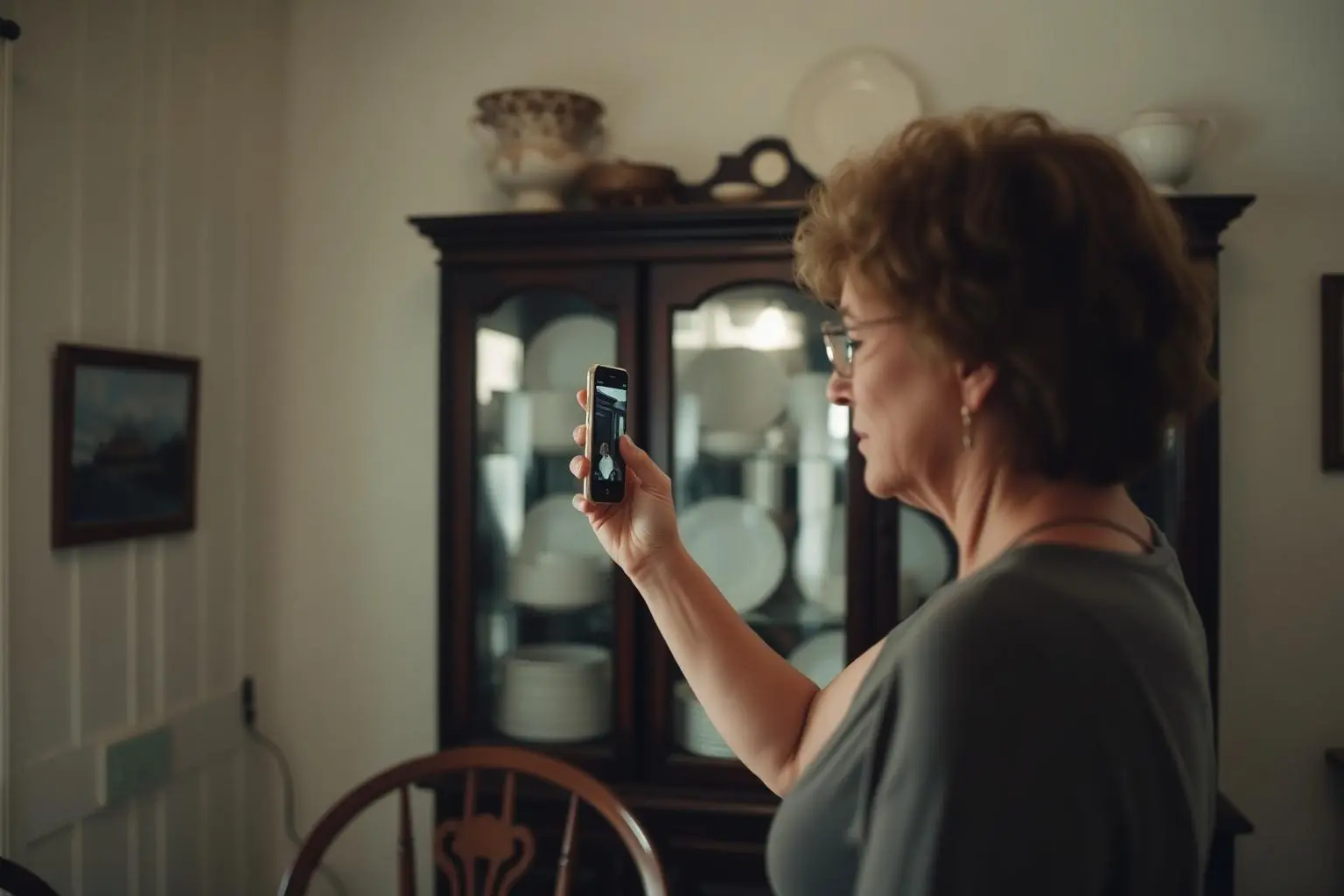
The Ai appraiser is built exactly for this moment: stand in front of any item, photograph it from a few angles plus the maker's mark, and within seconds you see what comparable pieces have actually sold for. You'll know in an afternoon whether the contents of the house are mostly mid-range household goods or whether there are 30 items worth pulling out of the donation pile and getting properly valued.
The Real Decision: DIY or Hire an Estate Sale Company
After you've done a one-pass triage with the Ai appraiser, you'll fall into one of three buckets:
- Mostly low-value contents, some sentimental items. A donation truck and a weekend with family handles it.
- A handful of valuable items, otherwise mid-range. Sell the standout pieces individually online (or take them to a local auction house), donate the rest.
- Multiple categories of value spread through the whole house — silver, mid-century, jewelry, art, books. Hire a professional estate sale company.
That third scenario is where families lose the most money trying to do it themselves. A reputable estate sale company will inventory, price, market, and run a public sale, typically in 2–4 weeks, and handle the donation truck for the leftovers. They take 30–40% of gross sales. On a house with real contents, you net more than you would handling it alone — by a lot — and you keep your weekends.
Find a Reputable Estate Sale Company in Your Area
Two things matter when hiring: licensing and reputation.
You have one chance to do this right. The good news is that "right" doesn't require you to become an antiques expert in three weeks. It requires one careful walk through with a phone, a photograph of every maker's mark, and a willingness to pause before anything goes in the donation truck.
Keep exploring
Ready to start your own treasure hunt?
Discover estate sales near you and find incredible deals.
Explore Sales Near Me
About the author
Andy
Founder, EstateSaleFinder.net
Hi, I'm Andy — a retired commercial photographer turned developer with a five-year (and counting) obsession with estate sales. I started EstateSaleFinder.net because I knew there had to be an easier, smarter way to find and list estate sales. Now I get to chase treasure and build the tool I always wished existed.