
Are Old Quilts Worth Anything? How to Date, Value, and Sell an Antique Quilt (Before It Goes in the Donation Pile)
An 8-step check at home, a fabric dating cheat sheet, real auction prices from $400 to $7,500, what ruins value, where to get a quilt appraised and where to sell it.
Most old quilts are worth something, but only a few are worth a lot. Many everyday 1930s to 1950s quilts sell for tens to a few hundred dollars, and the best Amish, signed or pre-1900 quilts can bring thousands at auction. To find out which one you have, date it by its newest fabric. Check whether it was quilted by hand, grade the condition, and get a certified appraiser for anything rare.
Quick summary
- Most are worth something, few are worth a lot. At recent auctions, Double Wedding Ring quilts sold for $400 and $800. An Amish Diamond in a Square sold for $1,500, and a documented 1800s Amish Center Diamond sold for $7,500. The full list, with sources, is below.
- Date it by the newest fabric, not the oldest. People saved scraps for decades, so "the latest fabric in the quilt sets the earliest date it could have been finished" (American Antiques).
- Hand quilting isn't automatically worth more. The Professional Association of Appraisers – Quilted Textiles (PAAQT) says hand or machine quilting "does not automatically give an increase or decrease in value" (PAAQT).
- Condition matters most. PAAQT calls condition "a major factor," and fading, holes, stains and shredding reduce value.
- Don't wash it first. Ask a specialist before you wash, dry-clean or iron an old quilt.
- Our own data: 943 of about 217,000 items listed on EstateSaleFinder mention quilts. 20 are Double Wedding Ring quilts and 19 are chenille pieces.
Are old quilts worth anything?
Yes, but the range is huge. Value depends on six things PAAQT appraisers weigh: condition, how well it was sewn, the amount and spread of the quilting, the design and colors, who made it, and its history (PAAQT). Age helps, but a worn 1880s quilt can sell for less than a crisp 1930s one.
Real auction results show the spread better than any price guide:
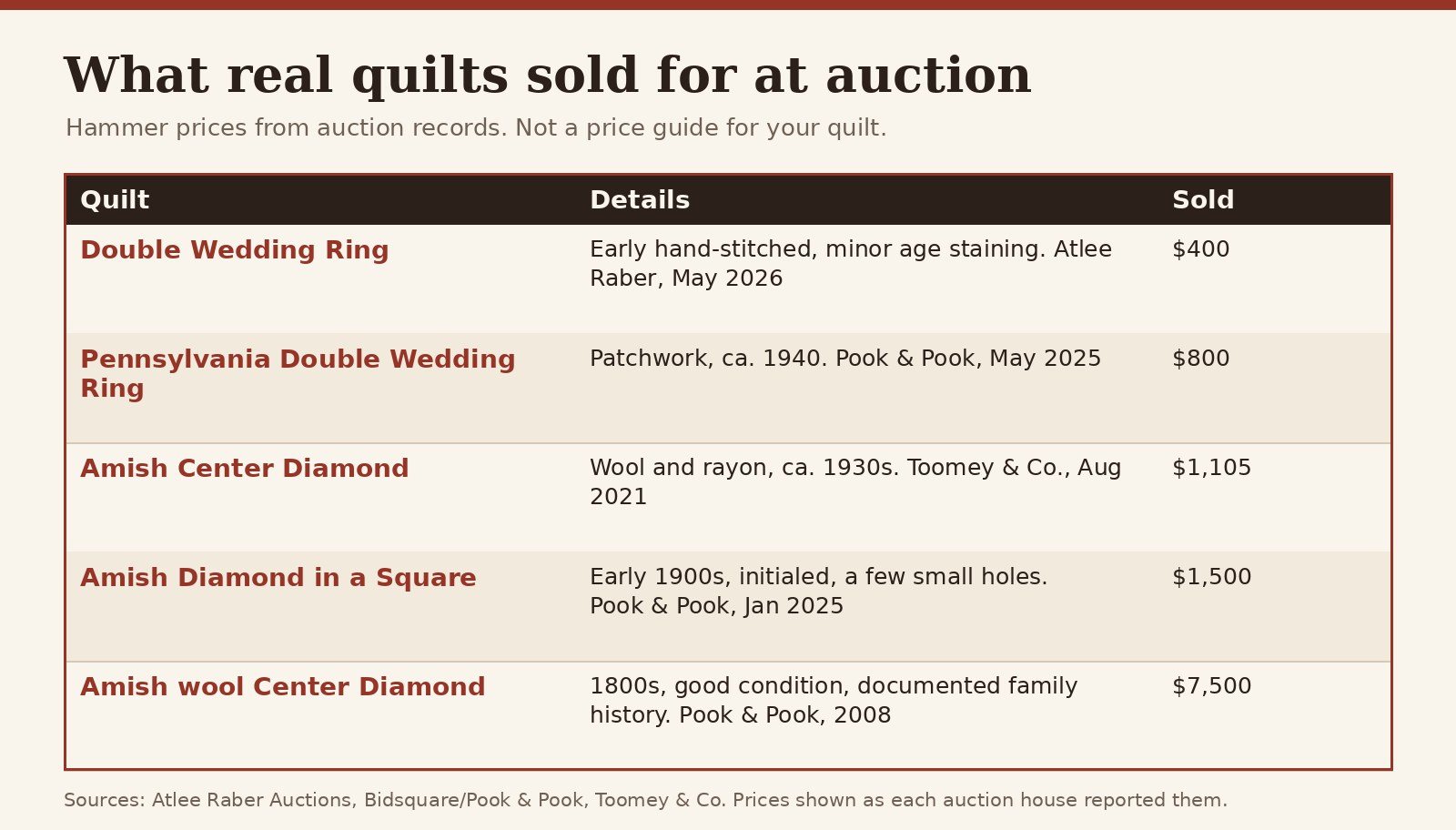
These come from Atlee Raber Auctions, Pook & Pook on Bidsquare, Toomey & Co., and Pook & Pook's Diamond in a Square and 1800s Center Diamond results. The $7,500 quilt was in good condition, with no fading or repairs. Its family history was also written down. That's the pattern: condition and history move the price.
Are old handmade quilts worth anything if they're worn?
Usually less, but not nothing. Worn quilts still sell to decorators, crafters and people who want a "cutter" for pillows or stuffed animals. Still, never cut a quilt up yourself, because a whole quilt is worth more than its pieces. A worn quilt with a strong pattern, good color or a family story can still sell well at an estate sale.
Quilt, comforter or chenille bedspread: what do you have?
- Quilt: three layers (top, batting and back) held together by rows of stitching you can see on both sides.
- Tied quilt or comforter: the same layers, but held by yarn or thread knots every few inches instead of stitched lines. They're often thicker and are usually worth less than a finely quilted piece.
- Chenille bedspread: one layer of cotton with raised, fuzzy tufts in rows or patterns, with no batting and no quilting. Chenille is its own collecting category. People buy it for color, pattern and condition, especially in clean, bright pieces. Judge it as a bedspread, not as a quilt.
How to tell if a quilt is vintage or antique: the 8-step check
Use good daylight and clean, dry hands, and lay the quilt on a clean bed or sheet.
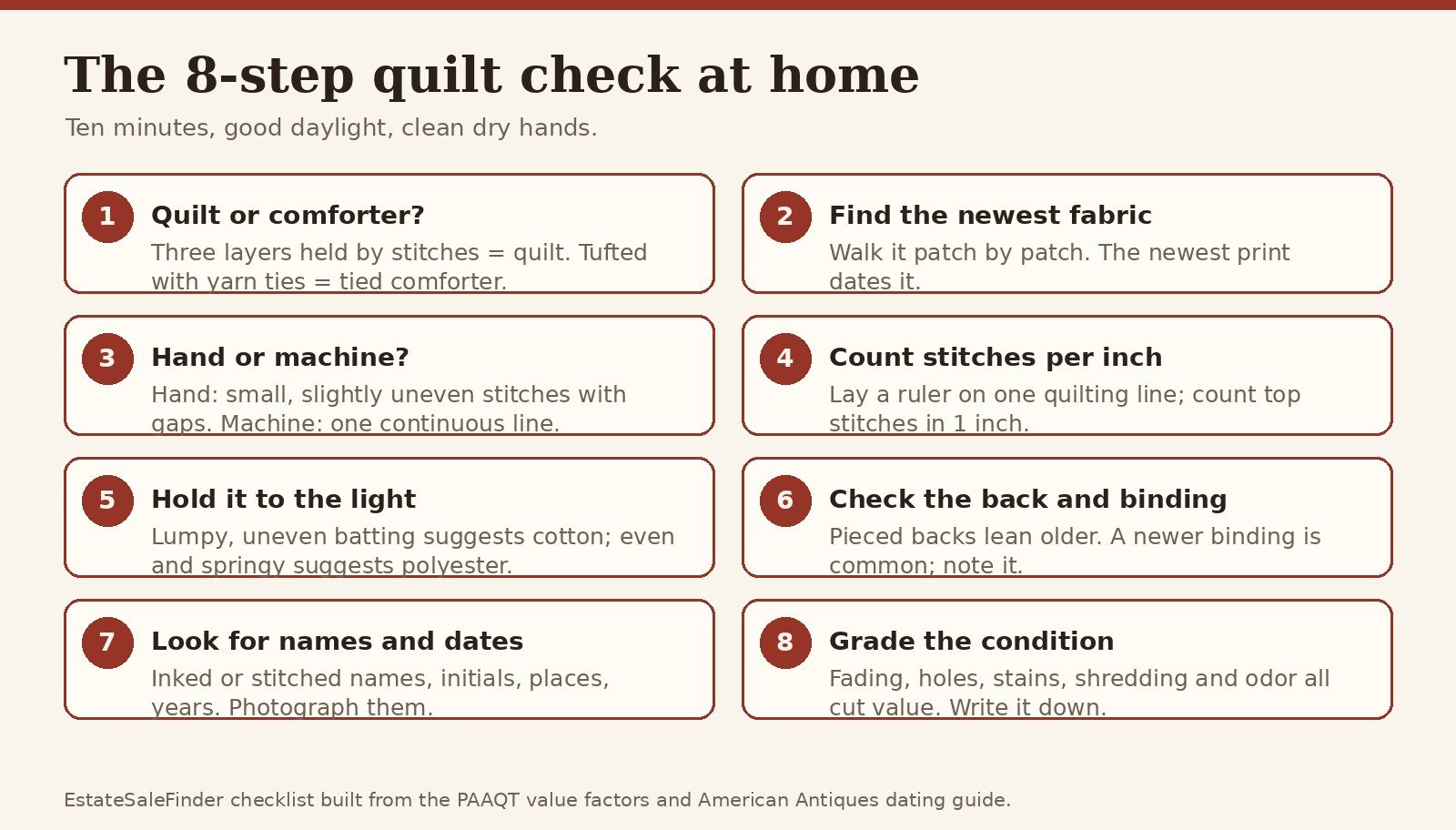
- Decide what it is. Is it a stitched quilt, a tied comforter or chenille? (See above.)
- Find the newest fabric. Walk the quilt patch by patch. Flag anything that looks newer than the rest, and check whether it's original or a later repair (American Antiques).
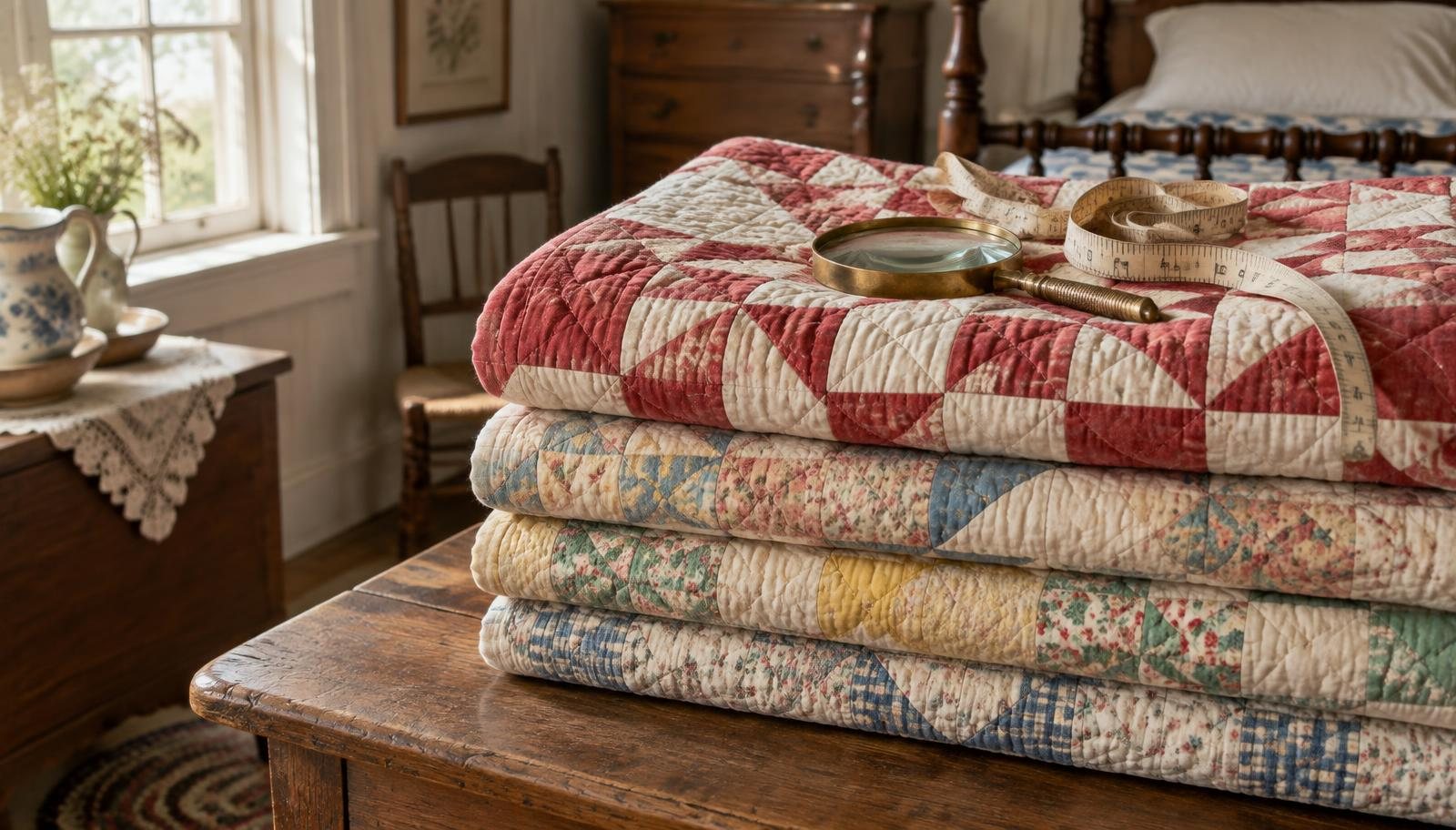
- Hand or machine quilting? Hand quilting shows small running stitches with gaps between them, and their length varies with the maker's skill. Long-arm or computer quilting shows very even, continuous patterns across the whole quilt, which is usually a modern finish. Machine piecing doesn't mean modern, because home sewing machines spread through American homes in the later 1800s.
- Count stitches per inch. Lay a ruler along one line of quilting and count the stitches on top in one inch. Museums record this. A Double Wedding Ring in the International Quilt Museum's collection is listed at 7 stitches per inch (International Quilt Museum). Write your number down for the appraiser.
- Hold it up to a window. Lumps, thin spots or tiny seeds in the batting suggest older cotton. Even, springy batting suggests polyester, which became common in the mid-1900s.
- Check the back and binding. Older backs are often pieced from several narrower lengths of fabric. A binding was often replaced when it wore out, so a newer binding on an old quilt is normal. Just note it.
- Look for names, initials and dates. Check the corners, back and binding for ink or stitching. The $1,500 Pook & Pook quilt above was initialed "CLS."
- Grade the condition honestly. Note fading, holes, stains, shredding, odor and repairs. Take photos of each.
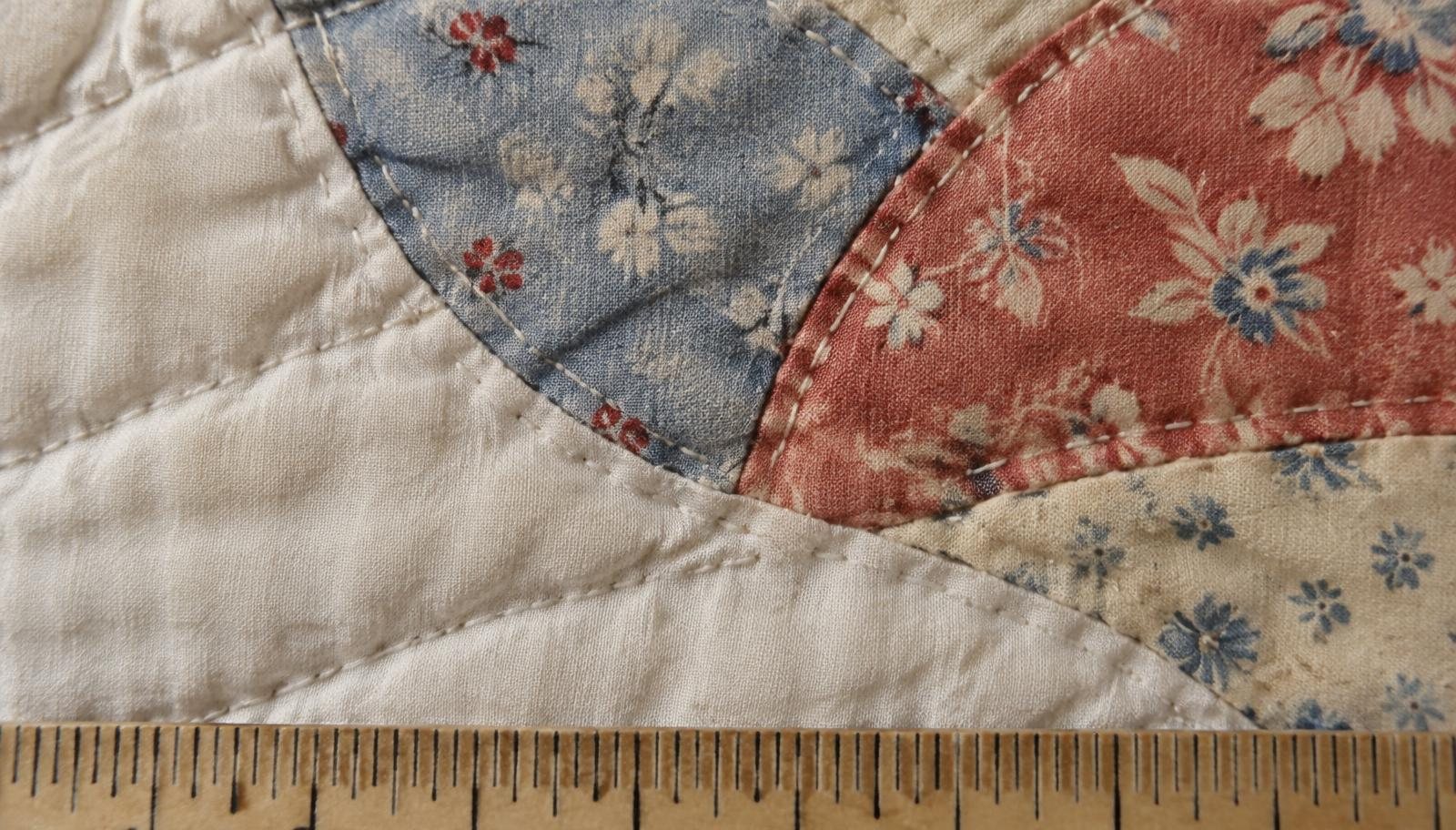
How do you date a quilt by its fabric?
The rule experts repeat: date the quilt by its newest original fabric. A quilt can hold fabric that's decades older than the quilt itself. Tops and quilting can also be decades apart. It was normal for a pieced top to sit in a drawer and be quilted later by a daughter or granddaughter. If the fabrics look 1880s and the batting is polyester, it's likely a Victorian top finished in the 1970s (Cousin Chart). That's still a real quilt, but describe it honestly.
The Quilters' Guild research guide gives the same warning about family stories: "do the facts you have been given with the quilt fit the physical evidence?" (Quilters' Guild).
Fabric dating cheat sheet
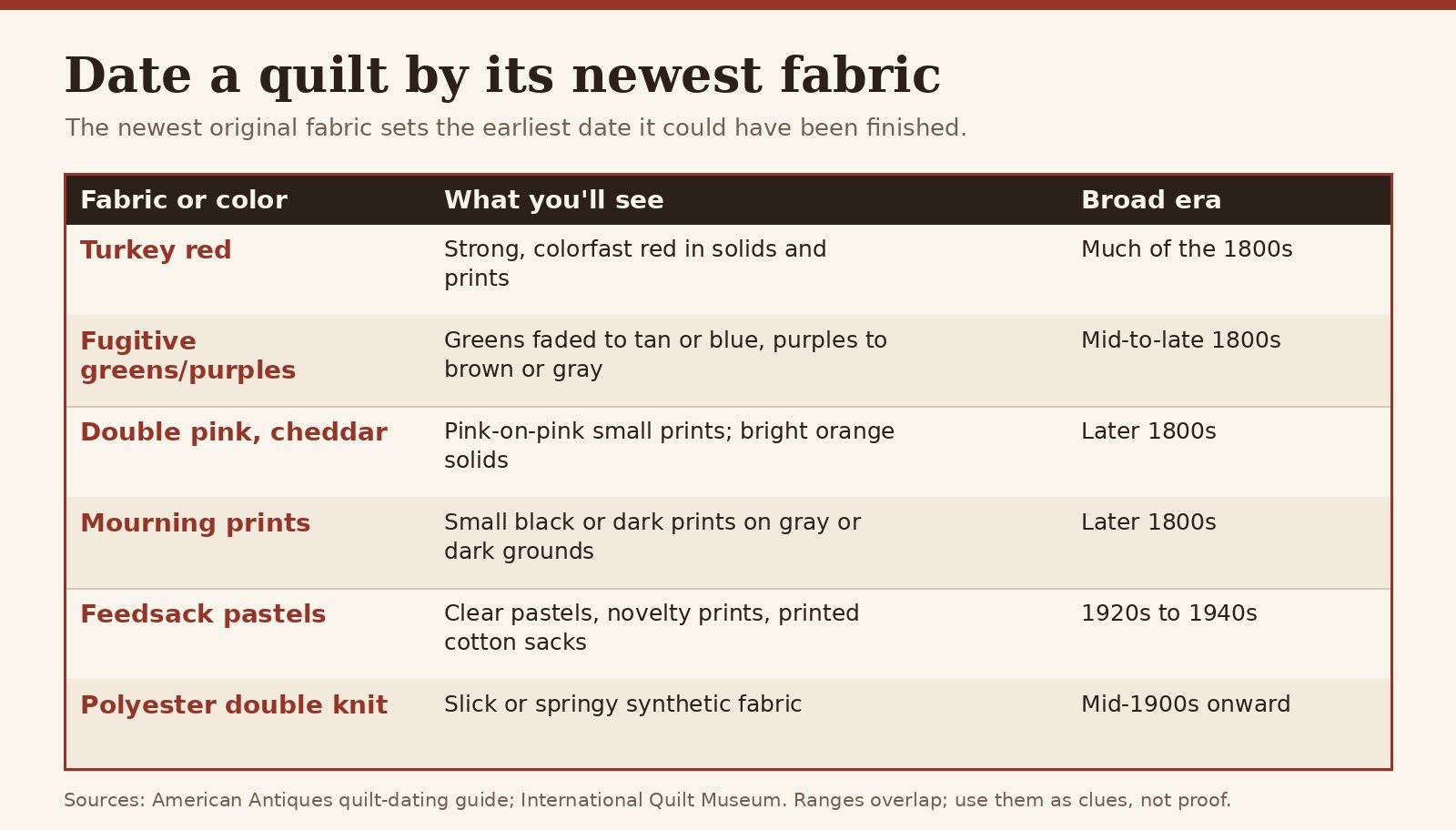
| Fabric or color | What you'll see | Broad era |
|---|---|---|
| Turkey red | Strong, colorfast red in solids and prints | Much of the 1800s |
| Fugitive greens and purples | Greens faded to tan or blue; purples to brown or gray | Mid-to-late 1800s |
| Double pinks, cheddar orange | Pink-on-pink small prints; bright orange solids | Later 1800s |
| Mourning prints | Small black or dark prints on gray or dark grounds | Later 1800s |
| Feedsack pastels | Clear pastels, novelty prints, printed cotton sacks | 1920s to 1940s |
| Polyester double knit | Slick or springy synthetic fabric | Mid-1900s onward |
Source: American Antiques dating guide. Ranges overlap, and regional and family habits vary.
Are feedsack quilts valuable?
They're popular, and they sell steadily. Feed sacks were cotton bags for flour, sugar, feed and other dry goods. Their use "took off during World War II and continued through the 1960s" (International Quilt Museum). Buyers love the cheerful prints, but because so many were made, most feedsack quilts are mid-priced. Clean, bright, well-made examples do best.
Quilt patterns people ask about
During the Great Depression, some patterns "were published repeatedly, like Grandmother's Flower Garden, Dresden Plate, and Double Wedding Ring" (World Quilts, International Quilt Museum). That's why you'll see so many of them at estate sales.
- Double Wedding Ring: interlocking rings of small curved pieces. It's common from the 1930s, so value rides on condition and workmanship. The auction examples above sold for $400 and $800.
- Grandmother's Flower Garden: hexagon "flowers" around a center, often in 1930s pastels. Hand-pieced ones are labor-intensive, but there are plenty of them on the market.
- Amish Center Diamond and Diamond in a Square: bold solid colors, often wool, with dense quilting. These are heavily collected, and they are also heavily copied. See "fakes" below.
What ruins a quilt's value?
- Washing it in a machine. Dyes run, old fabric shreds and batting clumps.
- Mildew and odor, usually from basement or attic storage.
- Sunlight. UV light fades dyes and weakens fibers. Brown and black dyes and silks are especially sensitive (Rutherford B. Hayes Presidential Library).
- Cutting it down. A full-size quilt cut into a smaller one loses value, and experienced buyers can tell. One quilt historian describes buying a "child's" Log Cabin quilt at auction that was really a cut-down large one (Collectors Weekly).
- Shattered silk. Victorian crazy-quilt silks can split into shreds, and that "cannot be reversed" (American Antiques).
Should I wash an old quilt before selling it?
No. Sell it as it is. The National Archives advises thinking about "the value and condition of your textiles before undertaking any washing, mending, or dry cleaning" (National Archives). To remove loose dust, the Smithsonian describes vacuuming on low suction through a piece of fiberglass screen (Smithsonian). For anything you think is valuable, ask a textile conservator or appraiser first. Our guide to cleaning antiques without ruining them covers the same rule for other items.
Spotting reproductions and imports
Many hand-quilted quilts have been made overseas for the decorator market, sometimes in Amish-style colors, and some are later sold as old (American Antiques). Warning signs include fabrics that are all crisp and new, and the same fabric quality throughout. Very even, uniform stitching with no wear at the edges is another sign. Be careful when a "100-year-old" quilt shows no fading at the folds.
Insurance appraisal vs. fair market value: which do you need?
PAAQT appraisers write appraisals for insurance, donations, estate settlement and sales. For a sale, the appraiser sets "Market Value based on sales of comparable items." Donations are "always appraised at fair market value" (PAAQT). An insurance value is usually higher, because it's what it would cost to replace the quilt. Don't price a quilt for sale from an insurance number.
Where can I get a quilt appraised?
Use PAAQT's "Find a Quilt Appraiser" directory (PAAQT). Its members follow USPAP appraisal standards and are tested and certified. A good appraiser will want to see the quilt in person. One appraiser writes that photographs "can never tell the whole story" (BadAss Quilters Society). Before you go, get our guides on whether you need an appraisal before an estate sale and how to appraise estate sale items.
When to pay for one
pre-1900 quilts, Amish quilts, signed or dated quilts, quilts with written family history, and anything you'd be upset to sell for $50.
Where to sell vintage quilts
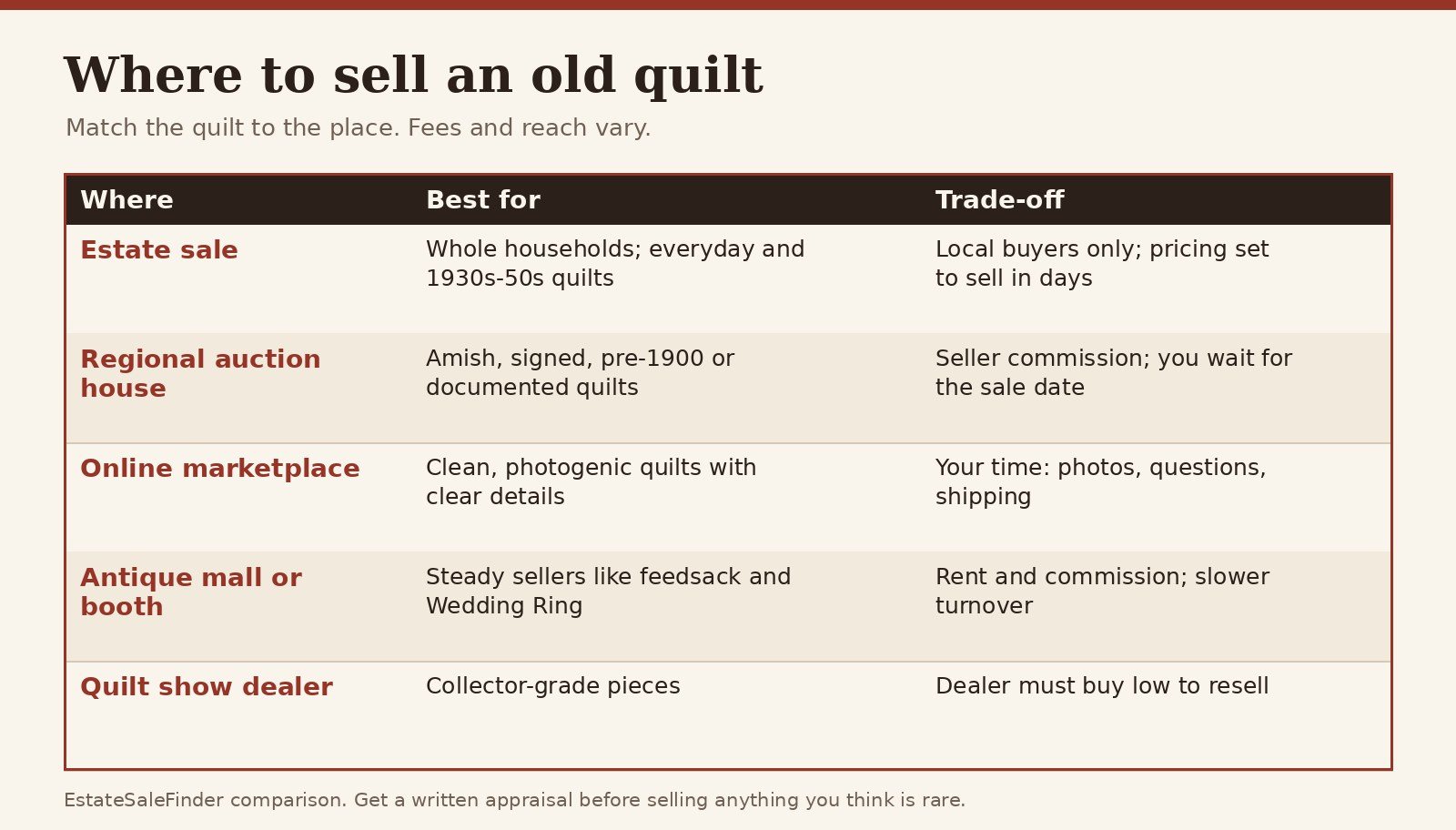
| Where | Best for | Trade-off |
|---|---|---|
| Estate sale | Whole households; everyday and 1930s–50s quilts | Local buyers; priced to sell in days |
| Regional auction house | Amish, signed, pre-1900 or documented quilts | Seller commission; wait for the sale date |
| Online marketplace | Clean, photogenic quilts with clear details | Your time: photos, questions, shipping |
| Antique mall or booth | Steady sellers like feedsack and Wedding Ring | Rent and commission; slower |
| Quilt show dealer | Collector-grade pieces | They must buy low to resell |
If you're clearing a whole house, an estate sale company can sell the quilts along with everything else. Find an estate sale company near you, or read how to find a good one.
How much is a 100-year-old quilt worth?
There's no single number. A 100-year-old quilt in rough condition may bring under $100. A clean, finely quilted one with a strong design can bring hundreds, and a documented Amish or exceptional quilt can bring thousands. In the auction list above, the $7,500 1800s Center Diamond was in good condition with documented history. A worn quilt of the same age would bring far less. Age alone doesn't set the price.
How to store a quilt until it sells
- Keep it cool, dry and dark. Skip the attic and basement. The Hayes Library recommends 65–75°F and 45–55% humidity (Hayes Library).
- No plastic bags. Wrap it in a clean cotton sheet or muslin, because textiles need some air movement (Smithsonian).
- Pad the folds. Use acid-free tissue or muslin, or roll it around an acid-free tube. Refold it differently every few months.
- Lift it with two hands. Large old quilts often can't bear their own weight (National Archives).
For estate sale companies: display and pricing tips
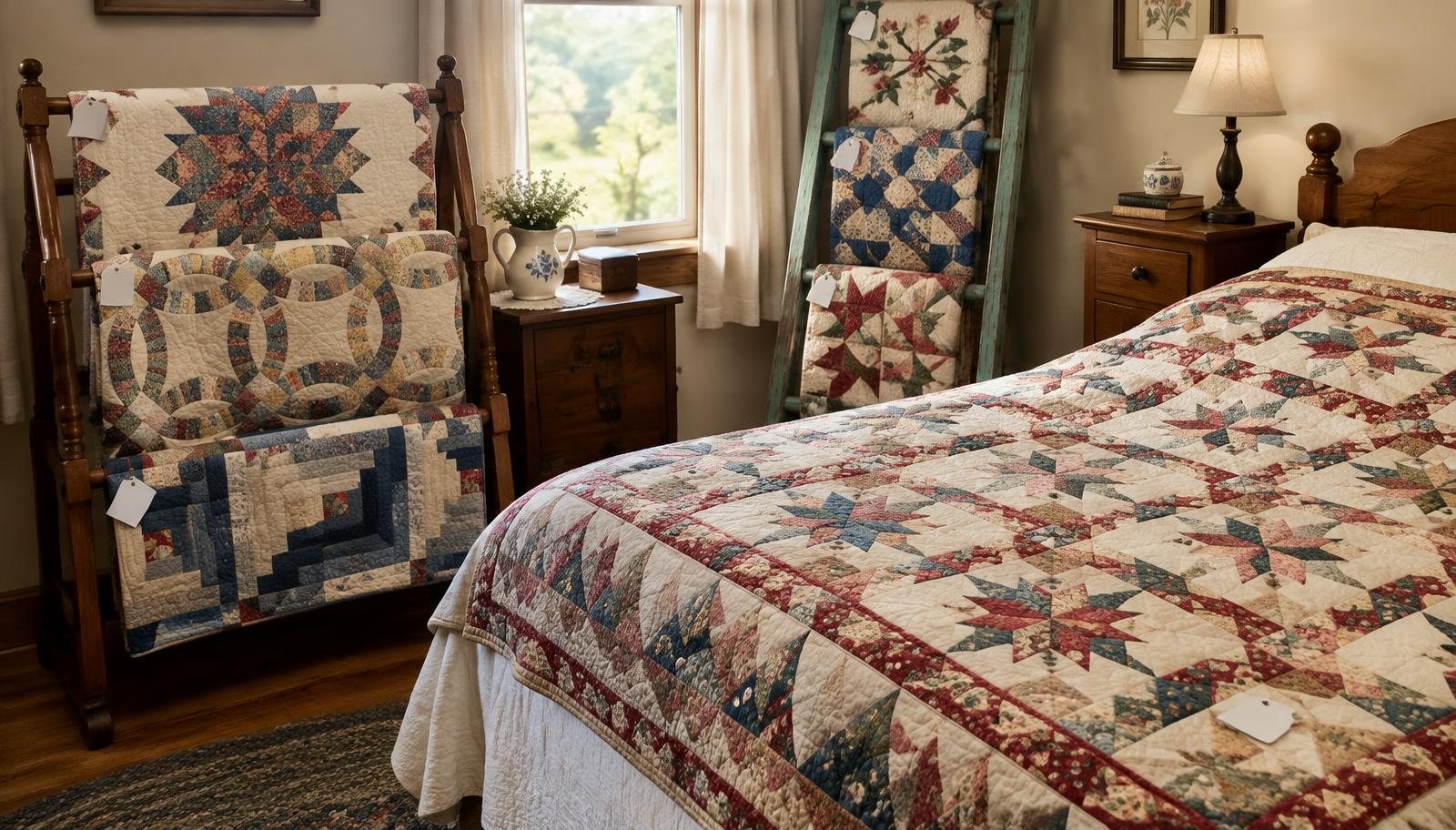
- Open the best one on a bed. Shoppers buy patterns they can see. Rack or ladder-hang the rest so each pattern shows.
- Pin tags, don't tape them. Use a safety pin through the binding, never tape or stickers on the fabric.
- Write the facts on the tag: pattern, size, whether it's hand quilted, and any known maker or date. "Hand quilted, ca. 1930s, Double Wedding Ring, 82×67" sells better than "Quilt $40."
- Pull the rare ones before the sale. Consign Amish, signed or pre-1900 pieces to an auction house or get them appraised first.
- Photograph quilts for your listing. Quilts are popular search terms. On EstateSaleFinder, shoppers can save wishlist keywords and get alerts when matching items are listed. Ai pricing can suggest a starting point, but it's only a suggestion, so check it against real sold results.
Before it goes in the donation pile
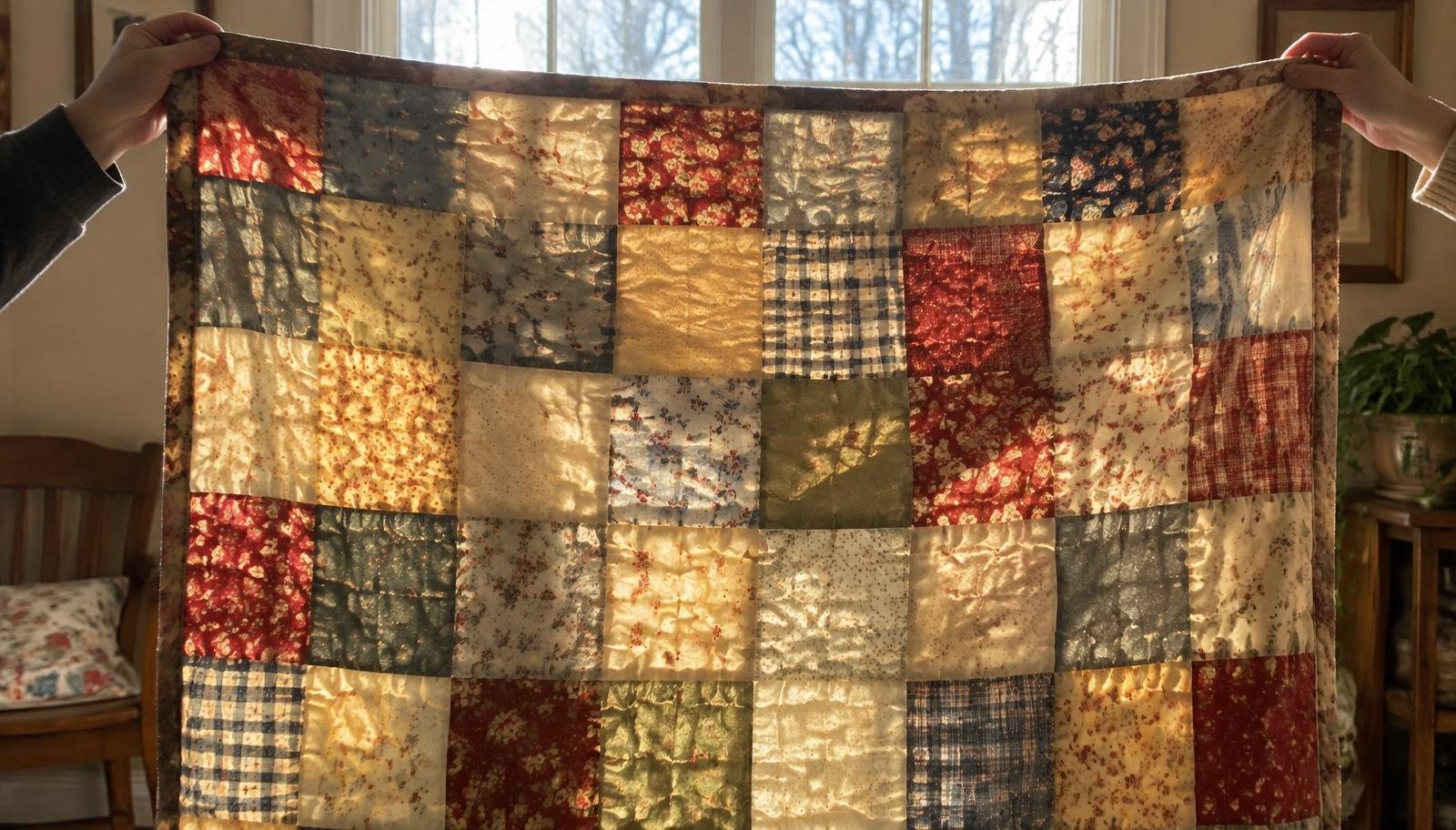
Quilts are one of the most common things families give away too early. Our list of what not to throw away before an estate sale puts handmade quilts on it for a reason. If you're sorting a parent's things, read valuing inherited items before you give away a fortune. Shoppers hunting the cozy look can use our grandmacore shopping list.
FAQ
Is hand quilting worth more than machine quilting?
Not automatically. PAAQT says each method "is evaluated on its complexity, execution, and amount" (PAAQT). Fine, dense hand quilting is valued for its skill, and so is excellent machine work.
Should I wash an old quilt before selling it?
No. Washing can make dyes run and weaken old fabric. Sell it as it is, and ask a textile conservator before you clean anything valuable.
Where can I get a quilt appraised?
Look in PAAQT's "Find a Quilt Appraiser" directory at paaqt.com. Choose an appraiser who will see the quilt in person and give you a written appraisal.
Are feedsack quilts valuable?
They're popular and sell steadily. Most are mid-priced because so many were made. Bright, clean, well-made ones do best.
How much is a 100-year-old quilt worth?
It can be anywhere from under $100 to thousands, depending on condition, workmanship, design and history. Get a written appraisal for anything pre-1900, Amish, signed or documented.
Are old chenille bedspreads worth anything?
Yes. Clean, bright chenille with a strong pattern has a following with vintage decorators. Price it as a chenille bedspread, not as a quilt, and check recent sold listings for the same pattern.
Related guides
For the machine that may have made the quilt, see old Singer identification and value.
Sources
- PAAQT: Quilt Appraisal Facts
- PAAQT: Professional Association of Appraisers – Quilted Textiles
- American Antiques: How to Date Antique Quilts
- The Quilters' Guild: Introduction to Quilt-Based Research (PDF)
- Cousin Chart: How to Date an Old Family Quilt
- International Quilt Museum: Double Wedding Ring, 1930–1940
- International Quilt Museum: Feed Sacks: An American Fairy Tale
- World Quilts: Frugal Fashion, The Great Depression Story
- Smithsonian: How do I store antique textiles at home?
- National Archives: Preserving Textiles
- Rutherford B. Hayes Presidential Library: Tips for Storing and Caring for Quilts
- Collectors Weekly: Identifying and Collecting Antique Quilts
- Atlee Raber Auctions: Double Wedding Ring Quilt, Lot 581
- Bidsquare / Pook & Pook: Pennsylvania Double Wedding Ring quilt
- Toomey & Co.: Amish Center Diamond quilt, Lot 93
- Pook & Pook: Amish Diamond in a Square quilt
- Pook & Pook: Amish wool Center Diamond quilt, 19th c.
- BadAss Quilters Society: Quilt Appraisal, Part Two
Sources checked November 11, 2026. Photos are Ai-generated illustrations; charts are EstateSaleFinder diagrams built from the sources above. Auction results are past sales, not a price guide for your quilt. EstateSaleFinder item counts are from our own listings as of November 11, 2026.
Keep exploring
Ready to start your own treasure hunt?
Discover estate sales near you and find incredible deals.
Explore Sales Near Me
About the author
Andy
Founder, EstateSaleFinder.net
Hi, I'm Andy — a retired commercial photographer turned developer with a five-year (and counting) obsession with estate sales. I started EstateSaleFinder.net because I knew there had to be an easier, smarter way to find and list estate sales. Now I get to chase treasure and build the tool I always wished existed.