
From the sewing room · Identification & value
Are Old Singer Sewing Machines Worth Anything? Identify Yours Before You Price It
November 14, 202615 min readSource-checked guide
Find old Singer sewing machine value with serial-number steps, 221 vs 222K clues, verified auction examples, and honest advice for inherited machines.
Old Singer sewing machines can be worth selling, but the model matters more than age. Verified 2026 auction pages show Featherweight examples at $260.55 and $310 in winning bids. Those are examples, not a universal value. Identify the model, check completeness and safety, and compare matching sold machines before pricing yours.
The cabinet in the spare bedroom looks heavy, beautiful and old. The little black machine in its case looks almost like a toy. Either could be useful; neither can be valued from the word Singer alone. For families clearing a home, the important first decision is not “what sticker goes on this?” It is “which machine is this, and what belongs with it?”
This guide separates three things that are often mixed together: identification, historical dating and current market evidence. A serial register helps with the first two. A completed sale helps with the third. Neither a dramatic asking price nor an attractive gold decal proves what your machine will bring locally.
Start here: keep the sewing machine together
Before emptying the cabinet, put the case, controller, cords, manual, bobbins and attachments beside the machine. Photograph the group before moving anything. Small parts in a drawer may belong to the machine; a generic cardboard box might hold its original feet and paperwork. A family member who quilts may value this equipment as a working tool even when nobody wants the cabinet.
Don't plug an unfamiliar vintage machine into the wall just to see whether it works. A cracked controller, damaged insulation or an unknown electrical conversion changes the inspection. “Untested” is an honest condition description. “Works” should mean more than the light coming on. If you cannot check it safely, stop and let a technician do that part.
If a whole house is being cleared, arrange a company walkthrough before disposing of sewing supplies. Our guide to valuing inherited items explains why quick decluttering can separate a useful set into less useful pieces.
What do old Singer sewing machines actually sell for?
There is no single old Singer price. A machine-only listing, a complete portable with a case, a technician-serviced example and a cabinet requiring local pickup are different products. The table below deliberately keeps the evidence labels visible instead of treating an outside site's median as an appraisal.
| Machine / evidence | Observed price | What that figure means |
|---|---|---|
| Featherweight, Auction Ohio lot 85 | $260.55 | Winning bid on a completed page, updated July 17, 2026; not an all-in purchase price |
| 1935 Featherweight 221, Fletcher Auctions lot 24 | $310 | Winning bid on a completed page, updated August 6, 2026; catalog describes case, pedal, paperwork and attachments |
| Black 221, FlipTip tracked sample | $415 median | Publisher-reported 14 completed eBay sales, August–October 2026; individual transactions not independently audited here |
| 222K free-arm, FlipTip tracked sample | $1,793 median | Publisher-reported 22 sales; a different, less common model, not a value for every small black Singer |
| 401A, FlipTip tracked sample | $199 median | Publisher-reported 24 sales, not a verified value for your machine |
| 66 Red Eye head, FlipTip tracked sample | $112 median | Publisher-reported 22 sales of machine heads/as-is examples, not cabinet-and-machine sets |
Sources
the two directly readable completed pages are Auction Ohio lot 85 and Fletcher Auctions lot 24. The four medians are attributed to FlipTip's October 29, 2026 summary, which reports 82 sales between August 1 and October 28. We verified what that page reports, not its underlying eBay transaction dataset. The pages show different markets and should not be averaged together.
Use those numbers to decide what deserves research, not to set an automatic sticker price. In particular, do not call $1,793 the value of an unidentified Singer. A 222K is a specific model. Shipping, buyer premiums, taxes, refurbishment and local demand can make the same nominal number mean something quite different to the seller.
Why not label the table “sold prices as of October 2026”?
That label would imply all entries were independently verified, comparable transactions from the same period. They are not. Two are public completed auction records; four are an outside publisher's summary of eBay records. Honest attribution is more useful than a precise-looking chart whose evidence is hidden.
You can search eBay sold Singer 221 listings to make your own comparison. Read the full description. Exclude parts, empty cases, bundles and machines with different restoration or testing status. A crossed-out Best Offer asking price is not necessarily the amount paid. Record the date you checked, the condition and whether shipping was included.
How do I tell what year my Singer sewing machine is?
Use the full serial number, not the Singer badge, motor label or a casting number. The ISMACS serial-number database has separate tables for machines with no letter prefix, one-letter prefixes and two-letter prefixes. The pasted brief's “two letters and six digits” fits Featherweights, not every old Singer ever made.
For a Featherweight, the Singer Featherweight Shop's dating guide says the stamped number is underneath near a raised corner of the casting. Very early 1933 examples can have it beneath the removable bottom pan. Protect the machine and its finish while looking; never lift a heavy cabinet-mounted machine alone or force it out of its hinges.
- Photograph the whole machine, then the stamped number in good light.
- Copy every prefix letter and digit, including leading zeros.
- Choose the matching ISMACS prefix table, or the no-letter table.
- Find the row whose starting and ending register numbers include yours.
- Record the model/class and the allotted date, then compare the physical machine with that model.
- Save the source link with your listing notes; if the stamp is unclear, photograph it again rather than guessing.
An allotment date is a batch assignment date. It is not proof the particular machine was assembled, purchased or first used that day. Avoid a listing headline claiming an exact birthday unless your evidence actually supports it. The register can be excellent historical evidence without saying more than it knows.
The evidence bench
A real 222K, not a generated look-alike
221: fixed main bed
The left extension folds up. That does not make it a free-arm machine. The main bed does not slide off.
222K: removable bed
A bed retaining screw and removable bed expose the free arm. A Sew/Darn lever lowers the feed dogs.
Model differences: The Singer Featherweight Shop. Never force a part to confirm a model.
Serial-number worked example: AD541546
AD selects the AD table; 541546 falls in register range 541546–551545.
That row names model 221 and an allotment date of October 3, 1933. It is a batch assignment date, not proof this particular machine was assembled that day.
Check the original ISMACS registerA worked example you can check yourself
In the ISMACS AD register, AD541546 through AD551545 are assigned to model 221, quantity 10,000, on October 3, 1933. That is why an example number in that range points toward an early 221 batch. This is an illustration of reading the record, not a serial number from a machine we are selling.
The range matters as much as the prefix. A prefix table contains multiple models. “AD means Featherweight” is not a safe shortcut. If the row and the object disagree, recheck the stamp and ask a specialist. Historical tables can contain recording errors; don't turn an inconsistency into a claim that the machine is exceptionally rare.
How can I tell a Singer 221 from a 222K?
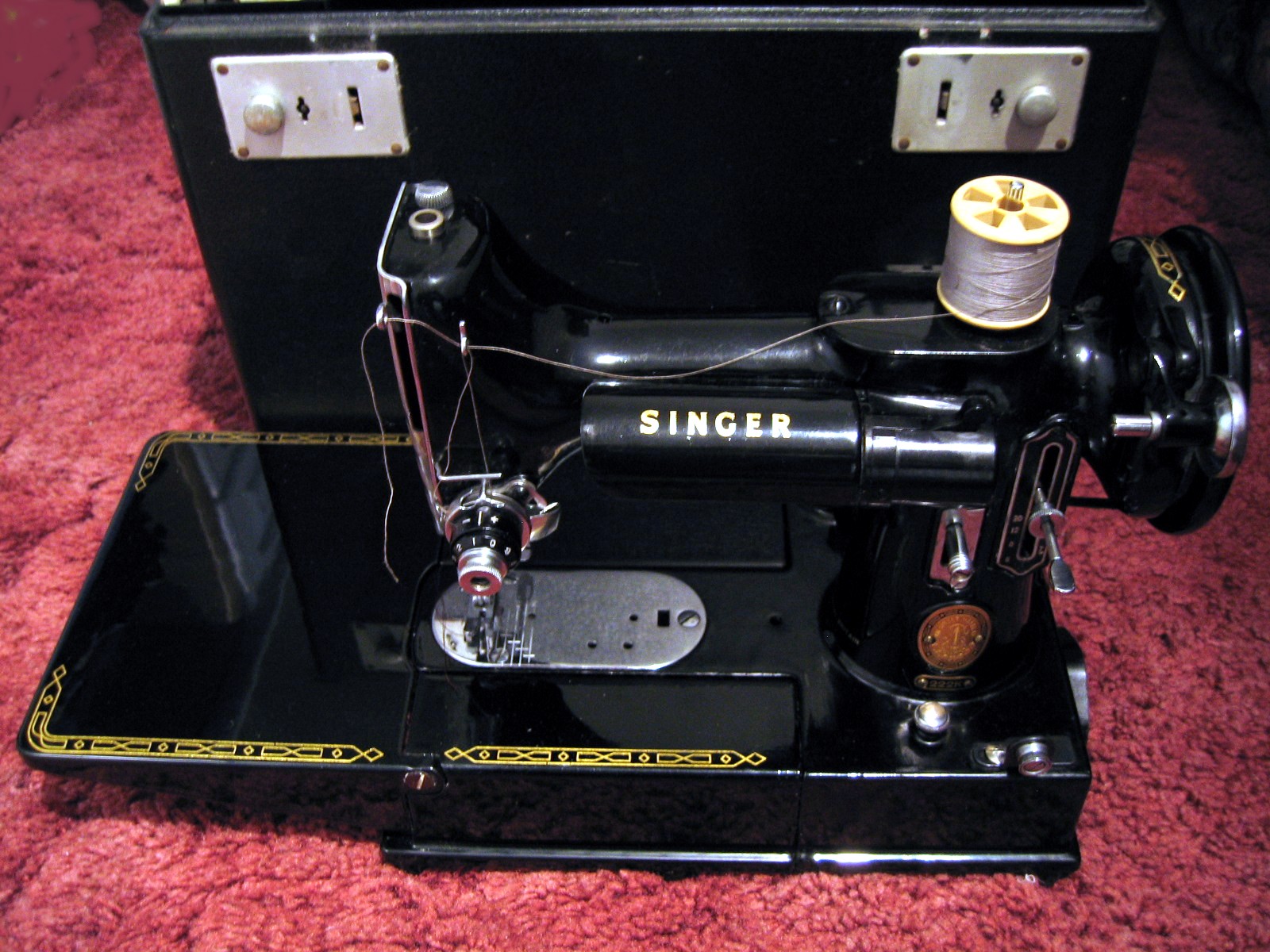
Both are compact Featherweights, but the useful distinction is mechanical. According to the Singer Featherweight Shop's 221-versus-222 comparison, the 221's main bed does not remove. The 222's bed can slide off after its retaining screw is released, exposing a small free arm. The 222 also has a Sew/Darn lever that lowers the feed dogs.
| Identification clue | 221 | 222K |
|---|---|---|
| Left bed extension | Folds upward | Folds upward |
| Main bed removal | Not designed to slide off | Removable to expose free arm |
| Sew/Darn lever | No separate Sew/Darn lever | Separate Sew/Darn control |
| Best confirmation | Full serial range plus physical model details | Full serial range, retaining screw and model details |
The fold-up extension alone does not identify a 222K. Many misleading descriptions treat any folding bed as a free arm. Don't unscrew random fittings at an estate sale to test a seller's claim. Ask for photographs or permission, and have a specialist confirm a valuable purchase.
The real reference photograph above shows a 1954 222K with its bed fitted. It is useful for the overall shape and front controls, but it does not show the free arm exposed. That distinction is intentional: a picture should tell you what is actually visible, not invite you to imagine a feature hidden inside it.
Why do quilters want Featherweights?
The ISMACS Featherweight history describes the appeal of a compact aluminum straight-stitch machine to quilters: portability, mechanical simplicity and a reliable straight stitch for piecing. This is not the same as needing every feature on a modern machine. A practical sewing audience helps explain demand beyond age or display value.
The same history places US 221 production from 1933 to 1964 and discusses later British white 221K production. Factory, finish, motor and market can complicate a date story; a gold-decorated black machine is not the only Featherweight appearance. Use exact records instead of “all white ones are this year” rules.
What adds value to an old Singer?
Singer's own value guide identifies model, condition, accessories, rarity and provenance as factors. Translate that into a listing a buyer can inspect rather than a list of enthusiastic adjectives.
Completeness
Photograph the machine, fitted case, controller, cords, bobbins, attachments and manual together. Note missing items explicitly. Do not assume every bobbin in the drawer fits the machine or that an attachment kit from another model completes it. A mismatched accessory can be useful without being original.
Condition
Show finish wear, decal loss, corrosion, repaired wiring, replaced parts and case damage. A glossy machine may be repainted; a cosmetically worn machine may still sew well. Those are different types of value. Keep “original finish,” “repainted” and “not determined” separate in your notes.
Demonstrated sewing
If it is electrically safe and the owner permits a demonstration, a scrap showing an actual seam is better evidence than a motor noise. Describe exactly what was checked. A light turning on does not prove correct tension, a complete bobbin mechanism or a reliable controller.
Documentation
Original purchase papers or family photographs can help tell its history. A family story alone does not prove a rare model or a celebrity connection. Remove personal addresses and account information before sharing paperwork publicly. Keep an unredacted original privately if the family wants it.
What kills value—or changes the right buyer?
A seized mechanism, missing controller, cracked case, corrosion, missing bobbin components or uncertain voltage can shift a machine from a ready-to-use buyer to a repair buyer. That does not mean it must go in the trash. It means the description and comparison set need to change.
Avoid cosmetic “improvements” before identification. Abrasive polishing or aggressive cleaning can damage original surfaces and decorations. Our antique cleaning guide explains the identify-first approach. For machine-specific care, follow the correct manual or technician's advice instead of a generic social-media restoration recipe.
A seller should not conceal a repair behind “vintage charm.” Buyers want to know whether the original finish survives and whether the machine was repainted or electrically modified. Equally, an old machine should not be advertised as safely ready to sew without an appropriate check. Accurate uncertainty is preferable to a confident statement you cannot back up.
Are old Singer treadle machines worth anything?
They can be, but assess the machine head, cabinet and treadle stand separately. A local buyer may want an operational treadle setup; another may want the cabinet; a third may want only a particular head. The pickup burden can dominate the result. A beautiful cabinet is not automatically valuable enough to ship across the country.
Don't apply the 66 Red Eye head median above to every treadle cabinet. It describes an outside publisher's sample of a specific kind of machine-only listing. A different model, decorative pattern, cabinet condition or complete drive mechanism calls for a different comparison. Red Eye and Lotus are not interchangeable decoration names.
Before separating anything, photograph the cabinet open and closed, machine mounting, treadle mechanism and all drawers. Measure the furniture and describe stairs or loading restrictions privately to a buyer without publishing the sale address in this article. Let a family member or technician check how the head is mounted before removal. Preserve a complete working setup when that is the sensible selling unit.
The 60-second estate-sale inspection
This is a non-powered triage, not a safety certificate or a complete mechanical test. It works for shoppers and for a family deciding what needs more research.
- Read the model claim, then photograph the whole machine and serial stamp.
- Check whether the case, controller and obvious accessories are present.
- Look for frayed wiring, cracked electrical parts, corrosion and missing pieces without plugging it in.
- Compare the fixed-versus-removable bed clues if a Featherweight is claimed; don't force fittings.
- Ask what “tested” means and whether any servicing or repainting is documented.
- Decide whether to buy for sewing, collecting, repair or furniture; each goal needs a different price comparison.
If you cannot safely locate the number or inspect the electrical components, the useful outcome is “needs a specialist,” not “failed.” The goal is to avoid confusing a common machine, an incomplete machine and a desirable model—not to perform a restoration at the sale.
Should I get it serviced before selling?
Get a quote before authorizing service. Compare the cost, likely buyer audience and the time available to clear the house. A desirable portable may benefit from documented servicing; a heavy cabinet machine with weak local demand may not return the expenditure. There is no verified universal percentage uplift, so this guide does not invent one.
Ask the technician what will be repaired, whether original components can be retained, what electrical checks are included and what documentation you will receive. Keep the receipt. If you sell unserviced, disclose that choice and price against unserviced machines rather than refurbished dealer stock.
For a whole-house sale, ask the company whether it already has a sewing-machine specialist or quilter audience. Sometimes the better decision is to document it well and sell honestly, not delay the estate schedule for a speculative restoration.
Where should you sell an old Singer?
| Selling route | Useful when | Trade-off to check |
|---|---|---|
| Estate sale company | The machine is part of a house full of contents | Ask for exact model research and a complete accessory grouping |
| Local sewing-machine specialist | A working or repairable machine has a practical audience | Compare outright offer versus consignment and service charges |
| Online marketplace | A portable model can be packed safely | Shipping, returns, fees and damage risks matter |
| Local furniture buyer | The cabinet is the attraction | Measurements, loading and local demand dominate |
| Specialist auction | A scarce, documented example needs collector attention | Commission, buyer premium and timing differ from an estate sale |
Those are separate routes, not instructions to turn an estate sale into an auction. If an auction is appropriate for one object, discuss that separately with the family and company. A successful specialist auction does not establish the retail tag for the rest of the house.
For a listing, name the exact model when verified, provide the serial reference, list included accessories and describe testing. Do not publicly show documents with a home address. Our estate sale pricing guide explains why a local sticker and an online sold record are not automatically the same number.
A listing that gives buyers usable evidence
A good description might say: “Singer Featherweight 221, serial number photographed; register lookup saved in our notes. Includes fitted case, controller and pictured attachments. Finish wear shown. Electrical and stitch test not performed.” Replace each statement with what is actually true for your machine. This is a writing example, not a machine on our site.
Make the photograph order work like an inspection: whole machine first, complete accessories second, stamp third, condition close-ups next. Add a safe stitch demonstration only if one was actually performed. Keep the original files so a buyer can enlarge details. A pretty sewing-room illustration should never substitute for the actual item's evidence photos.
EstateSaleFinder's Ai Appraiser can help form a suggested identification from photographs. Add a serial-stamp close-up and model hint, then verify the result against ISMACS and appropriate sold listings. It is a research starting point, not an authenticity certificate, electrical inspection or final price.
For quilters, resellers and families
Quilters should ask about actual stitch performance, safe electrics and the correct accessories. Resellers should work backward from net proceeds after fees, packing, repair and time, not from the highest asking price they can find. Families should preserve the machine's context before emptying drawers or donating the case.
If quilts are part of the same room, read are old quilts worth anything? before cutting or laundering them. A sewing room can hold valuable fabric, tools and family history without every item being expensive. Our guide to items secretly worth $500 or more is another reason to identify first, but no machine deserves that label without evidence.
Shoppers can save “sewing machine” or “Featherweight” in their wish list and inspect sale photos before traveling. This guide does not claim a count of current machines or wish lists because no independently checked platform count was included in the research.
Questions & answers
Frequently asked questions
How do I tell what year my Singer is?
Copy its full serial stamp and use the correct ISMACS prefix or no-prefix table. Record the model and allotment date. For Featherweights, look underneath as described by the specialist dating guide. The allotment date is a batch date, not an exact assembly birthday.
What is the most valuable old Singer sewing machine?
There is no defensible single answer across all rare, industrial and historically important Singers. Among the household models in the cited outside sample, the 222K has the highest reported median. That does not establish an all-time record or the value of an unidentified machine.
How do I tell a 221 from a 222K?
The 221 has a fixed main bed; the 222K has a removable bed exposing a free arm and a Sew/Darn lever. Both can have a folding left extension. Confirm with the full serial range and model details, not the folding extension alone.
Are treadle machines worth selling?
Possibly. Identify the head and evaluate the complete cabinet and treadle mechanism in your local market. Keep components together while researching. A machine-head sold price is not a cabinet-set price.
Should I plug it in to prove it works?
Not if its wiring, controller or electrical specification is uncertain. Disclose “untested” and get appropriate advice. A light or spinning motor alone does not establish safe operation or successful stitching.
Are the quoted prices an appraisal?
No. They are separately labeled historical winning bids and publisher-reported medians. Compare current, matching sold machines and account for condition, selling route and costs before deciding a price.
Sources and evidence notes
- ISMACS Singer serial-number database and AD register.
- The Singer Featherweight Shop: dating guide and 221 versus 222.
- ISMACS: Quilter's Treasure.
- Singer: what influences sewing-machine value.
- Auction Ohio lot 85 and Fletcher Auctions lot 24, completed records checked November 14, 2026.
- FlipTip: 82-sale summary, attributed secondary data; not independently audited eBay records.
- Panjigally's real Singer 222K photograph, CC BY-SA 4.0, used unaltered.
Researched November 14, 2026. Prices are evidence examples, not promised proceeds. The reference photograph depicts a real machine; the separately labeled sewing-room scene is an Ai-generated illustration. No sale addresses are shown.
Keep exploring
Identify your machine before setting a price
Photograph the machine and serial stamp for suggested identification, then confirm the model and sold comparisons yourself.
Open the Ai Appraiser
About the author
Andy
Founder, EstateSaleFinder.net
Hi, I'm Andy — a retired commercial photographer turned developer with a five-year (and counting) obsession with estate sales. I started EstateSaleFinder.net because I knew there had to be an easier, smarter way to find and list estate sales. Now I get to chase treasure and build the tool I always wished existed.