
From the attic boxes · Holiday collectibles
Are Department 56 Villages Worth Anything? Which Pieces Sell, Which Don't, and How to Price or Buy Them in 2026
November 16, 20269 min readSource-checked guide
Are Department 56 villages worth anything? Most houses sell for $15–$75; see which rare pieces bring hundreds, what kills value, and how to price or buy them.
Most Department 56 village houses sell for roughly $15 to $75 today, often below what they cost new. The exceptions are early Original Snow Village pieces, early limited Dickens' Village buildings like the Mill and Norman Church, big landmark buildings and short-run licensed pieces, which can bring hundreds or more. The box, sleeve, working light and no chips matter most.
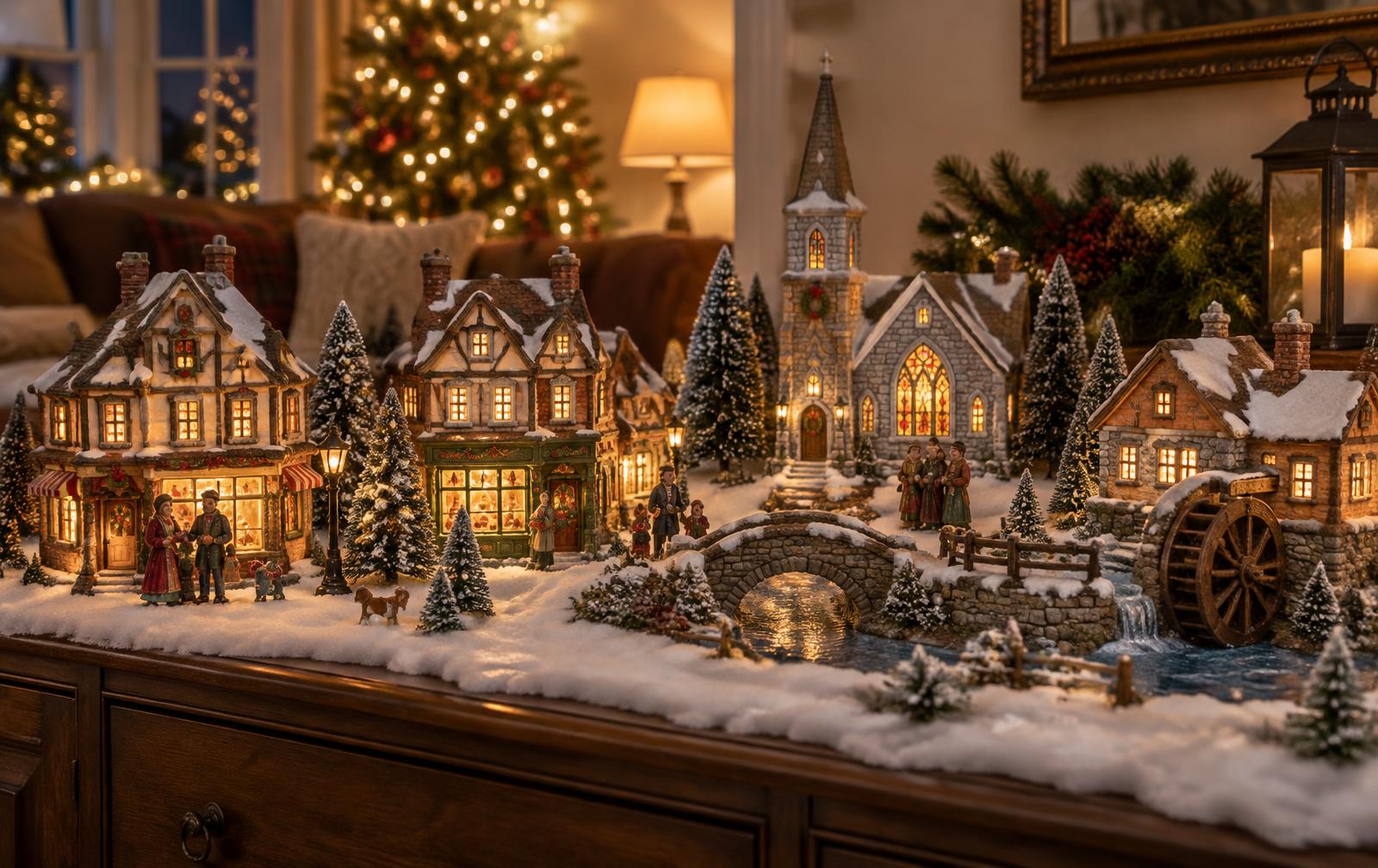
Every December, somebody carries a stack of white cardboard boxes down from the attic. Inside are the little lighted houses: a bakery, a church, a row of Victorian shops, a mill with a water wheel. If those boxes belonged to a parent or grandparent, the question comes fast. Are these worth anything?
Some are. Most are worth more as a display than as an investment. This guide shows how to identify what you have, which pieces deserve a second look, what kills value, and how to price or buy them at an estate sale. Every dollar figure is linked to its source: completed eBay sales, price-guide data or dealer estimates. None of them is a guarantee.
The short answer: are Department 56 villages worth anything?
Yes, but usually modestly. ValueMyCollection, an independent price guide that tracks completed eBay sales, says that across 961 buildings in its 2026 data, "the typical Dickens' Village building sells for about $62; the typical North Pole Series building sells for about $75; the typical Christmas in the City building sells for about $95" (ValueMyCollection, Nov 2026). Its highest verified sale was the Dickens' Village Mill, at $1,100.
The same data shows how much value depends on the series: only about a third of Dickens' Village buildings sold above their original retail price, compared with 42% of Christmas in the City buildings.
Is Department 56 still in business?
Yes. Department 56 began in 1976 as a division of Bachman's, the Minneapolis florist, whose wholesale gift department happened to be number 56. It's now owned by Enesco and based in Eden Prairie, Minnesota (Department 56, Wikipedia). New pieces come out every year, and the company keeps a searchable retired products list.
How to identify a Department 56 piece
Turn the house over, gently, over a towel.
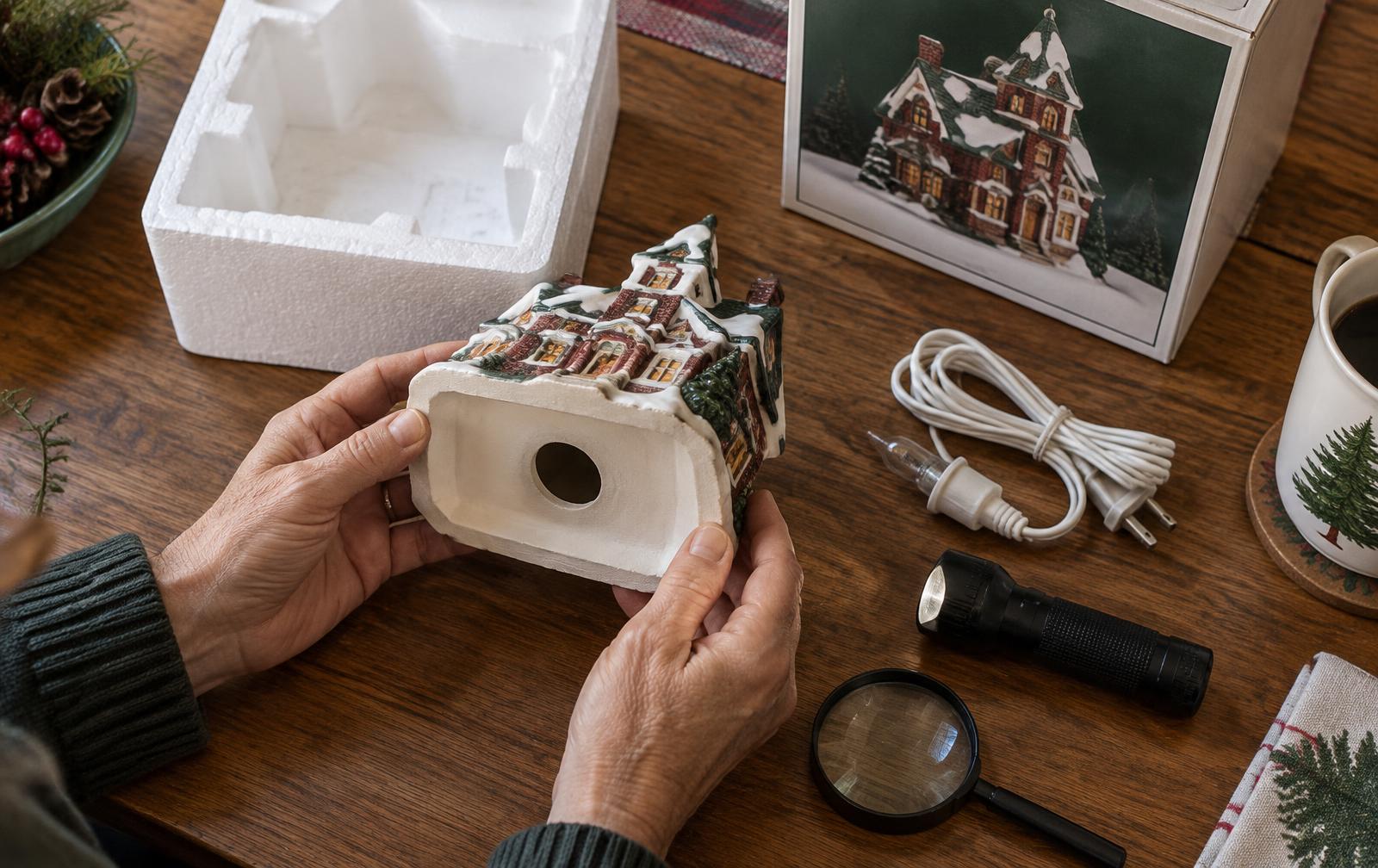
- The bottom. Look for a "Department 56" stamp, an embossed mark or a sticker with the copyright year. The Village Chronicler's history notes the company began using inscriptions on the bottom of lit buildings in 1979, and white stickers with the copyright year in 1980 (The Village Chronicler).
- The copyright year isn't always the release year. It can be the design year. Use the item number to confirm.
- The item number. It's printed on the box end and often on the bottom, sometimes written as 56.XXXXX. The 1976 Mountain Lodge, for example, is 56.50013 (Department 56 Retirements).
- The series. Snow Village (American small-town), Dickens' Village (Victorian England), Christmas in the City, North Pole, New England, Alpine and licensed lines like Harry Potter, the Grinch and Christmas Vacation.
- The box. A white box with a picture sleeve, plus a fitted styrofoam insert, is standard for later pieces.
If there's no mark at all and no box, it may be another brand. Lemax, Hawthorne Village and store brands all make lighted villages.
Department 56 value by type
| What you have | Realistic range | Why |
|---|---|---|
| Common retired Snow Village or Dickens' Village house | About $15–$75 | Made in large numbers; many sell below original retail |
| Typical Christmas in the City building | Often near $95 | Holds value best of the big series (ValueMyCollection) |
| Accessories, figures, trees | A few dollars each; better in lots | Plentiful; buyers want sets |
| Big landmark buildings | Often hundreds | Showpieces with steady demand |
| Early or limited pieces | Hundreds to $1,000+ | Small runs and early years |
| Retired licensed pieces | Hundreds, occasionally more | Fans of the movie or book compete with collectors |
Ranges come from the ValueMyCollection pages and market reports linked in this article. Prices are single sales, they swing by season, and condition changes them a lot.
The most valuable Department 56 pieces to look for
The short list
Pieces worth a second look
Original Snow Village "Original Six"
1976–1979
The first six lit houses, including The Inn and Mountain Lodge. Early, and rarely complete.
Adobe House & Mission Church
1979–1980
Short runs from the 1979 Snow Village release; collectors call them among the most elusive.
Dickens' Village Mill
1985, limited to 2,500
Early Dickens' Village, small edition, often mislabeled "Cottage" on the box.
Norman Church
Early Dickens' Village
A legendary early limited piece, trading around 10x original retail.
Big landmarks
Buckingham Palace, Statue of Liberty, Singer Building
Large, showy Historical Landmark pieces that anchor a display.
Buckingham Palace $430–$550; Statue of Liberty $1,100 (one sale)
Short-run licensed pieces
Harry Potter, Grinch, Christmas Vacation
Retired licensed buildings chased by fans outside the village hobby.
Single sales and dealer estimates, not guaranteed prices. Condition and the box change everything.
A correction on the usual story: the "Original Six" Snow Village houses date to 1976, not 1979. They were retired in 1979, when twelve new buildings arrived, including three of the most elusive pieces, the Mission Church, Adobe House and Mobile Home (The Village Chronicler). Early doesn't always mean expensive, though. A boxed 1976 The Inn, one of the six, sold for $125 on eBay in 2020 (CollectionHero).
What is the most valuable Department 56 piece?
In ValueMyCollection's 2026 sold data, the top single village building was the Dickens' Village Mill at $1,100, and its market report lists the Harry Potter Whomping Willow selling between $1,350 and $1,625 (ValueMyCollection). One Canadian dealer explains why the Mill stands out: it was a 1985 limited edition of 2,500, and some boxes are labeled "Dickens' Village Cottage," so it can hide in plain sight (Vintage Villages).
What kills Department 56 value
Before you price it
Tick what this house has
Bottom of the range: price as display decor, or bundle it.
A rough guide, not an appraisal. Always check sold listings for the exact item number.
- No box. Collectors want the box, sleeve and insert. Missing packaging can cut value sharply, and it's the single most common problem in estate lots.
- Chips and cracks. Check chimneys, roof edges, railings and icicles. A tiny chip on a fragile corner matters.
- Glued repairs. Look closely at chimneys and signs.
- Missing parts. Many sets came with signs, trees or figures. "Set of 3" with two pieces is a different item.
- Yellowing, attic heat and smoke. Paint and the white "snow" can discolor.
- Wrong or missing light cord. A working original cord helps; a missing one is a small deduction.
Where and when to sell Department 56
- Timing: demand rises from late September through December, ValueMyCollection notes. Listing in January means fewer buyers.
- eBay: best for the rare and licensed pieces. Search sold listings by item number, not by name.
- Facebook Marketplace and collector groups: good for whole collections to local buyers who will pick up.
- Estate sales: the easiest way to sell a large mixed collection in one weekend. Shoppers looking for Christmas decor will buy the common houses; collectors hunt for the short list above.
- Specialty dealers: offer wholesale prices but buy entire collections.
How do I sell a whole Department 56 collection?
Make a list: name, item number, box yes or no, chips yes or no. Pull out anything from the short list and price those individually. Group the common houses by series. A whole Dickens' Village "street" with boxes sells better as a set than ten separate listings. If the collection is part of a full house, an estate sale company can price and sell it with everything else.
Pricing tips for estate sale companies
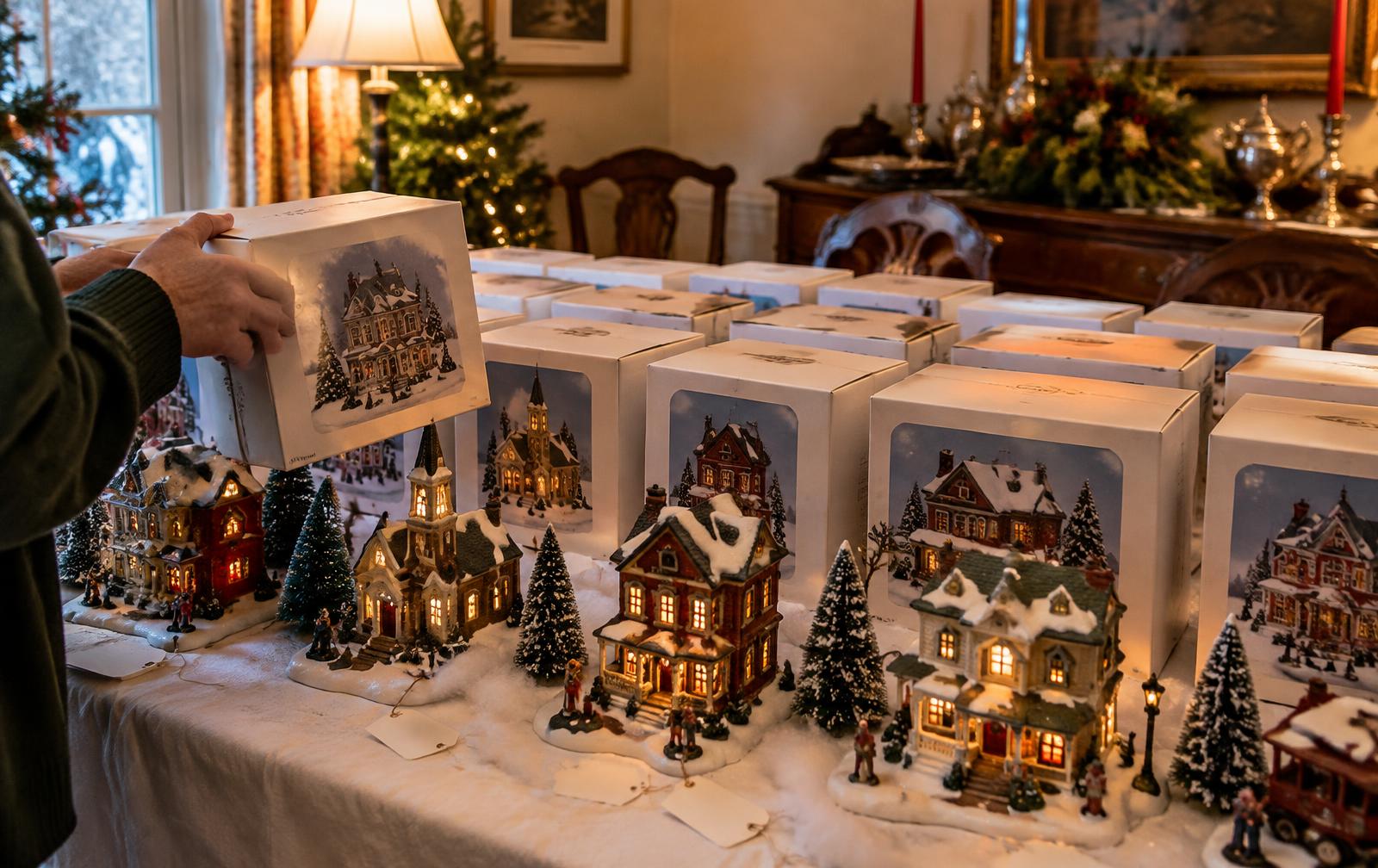
- Price by item number, from sold listings, during the same season if possible.
- Display them lit. A plugged-in village on a table with cotton snow sells far better than a wall of boxes.
- Keep each house with its own box. Tape the box shut with the house inside, or label boxes and display houses separately.
- Pull the short list for presale photos. The Mill, Norman Church, landmarks and licensed pieces belong in your listing photos.
- Bundle accessories by the bag. Figures and trees move faster in a $10 bag than at $2 each.
- Mark down late. Common houses sell well at half price on the last day, especially before Christmas.
You can photograph a piece and get a suggested identification with the Ai Appraiser, then check sold comparisons for the item number yourself.
A buying guide for treasure hunters
- Bring a small flashlight. Shine it inside the house to spot cracks you can't see from outside.
- Check the bottom against the box. Mismatched boxes happen.
- Buy the box, not just the house. A boxed common house is easier to resell than an unboxed rare one.
- Watch December prices. Sale-day prices in early December are often higher; the last day of a sale is where deals are.
- Find them first. Search estate sales near you and save "Department 56" as a wishlist keyword so new sales alert you.
Are Lemax and Department 56 the same scale?
Close enough to mix, and neither is a true model scale. Lemax itself says the two brands "are often compatible and can be used together in the same holiday display" (Lemax). Collectors who have measured them put the buildings near 1:55 and the figures much larger, around 1:24 (The Silicon Underground).
Diagram · a 6-foot person at each scale
≈ 1:55O-gauge trains
≈ 1:48Village figures
≈ 1:24
Lemax is generally the more affordable line and rarely has collector resale value. Department 56 is the one worth researching.
More "is it worth anything?" guides
Holiday decor runs in families. See vintage Christmas decorations worth money, and our guides to old quilts, old crystal, Oriental rugs and Singer sewing machines.
Questions & answers
Frequently asked questions
Are Department 56 villages worth anything?
Usually a modest amount: most houses sell for roughly $15 to $75, often below original retail. Early, limited, landmark and retired licensed pieces in their boxes can bring hundreds or more.
What is the most valuable Department 56 piece?
In 2026 sold data from ValueMyCollection, the Dickens' Village Mill topped village buildings at $1,100, and the Harry Potter Whomping Willow has sold for $1,350 to $1,625. Single sales vary.
Are retired Department 56 pieces valuable?
Retired doesn't mean rare. Most retired pieces were made in large numbers. Value comes from early years, small editions, strong demand and condition.
Does the box matter?
Yes, a lot. Collectors want the original box, picture sleeve and foam insert. An unboxed piece usually sells for noticeably less.
How do I sell a whole collection?
List every piece by item number and condition, price the standouts on their own, group the rest by series, and sell during the fall season. An estate sale company can handle a large collection with the rest of a house.
Is Department 56 still in business?
Yes. It's owned by Enesco, based in Eden Prairie, Minnesota, and still releases new village pieces every year.
Are Lemax and Department 56 the same scale?
Roughly. Neither publishes an official scale, but buildings from both measure near 1:55 and mix well in one display.
Prices checked November 2026 from the linked price guides and sold listings. Department 56 is a trademark of its owner; EstateSaleFinder.net is not affiliated with Department 56, Enesco or ValueMyCollection.
Keep exploring
Photograph it, then check the item number
Get a suggested identification from a photo, then confirm the item number and sold comparisons yourself.
Open the Ai Appraiser
About the author
Andy
Founder, EstateSaleFinder.net
Hi, I'm Andy — a retired commercial photographer turned developer with a five-year (and counting) obsession with estate sales. I started EstateSaleFinder.net because I knew there had to be an easier, smarter way to find and list estate sales. Now I get to chase treasure and build the tool I always wished existed.