
Off the floor · Identification & value
Are Old Oriental Rugs Worth Anything? Hand-Knotted vs. Machine-Made, Real Persian Clues and What They Sell For
November 15, 202613 min readSource-checked guide
Are old Oriental rugs worth anything? Do the 60-second flip test, spot a real Persian, learn what drives value, legal resale rules and where to sell.
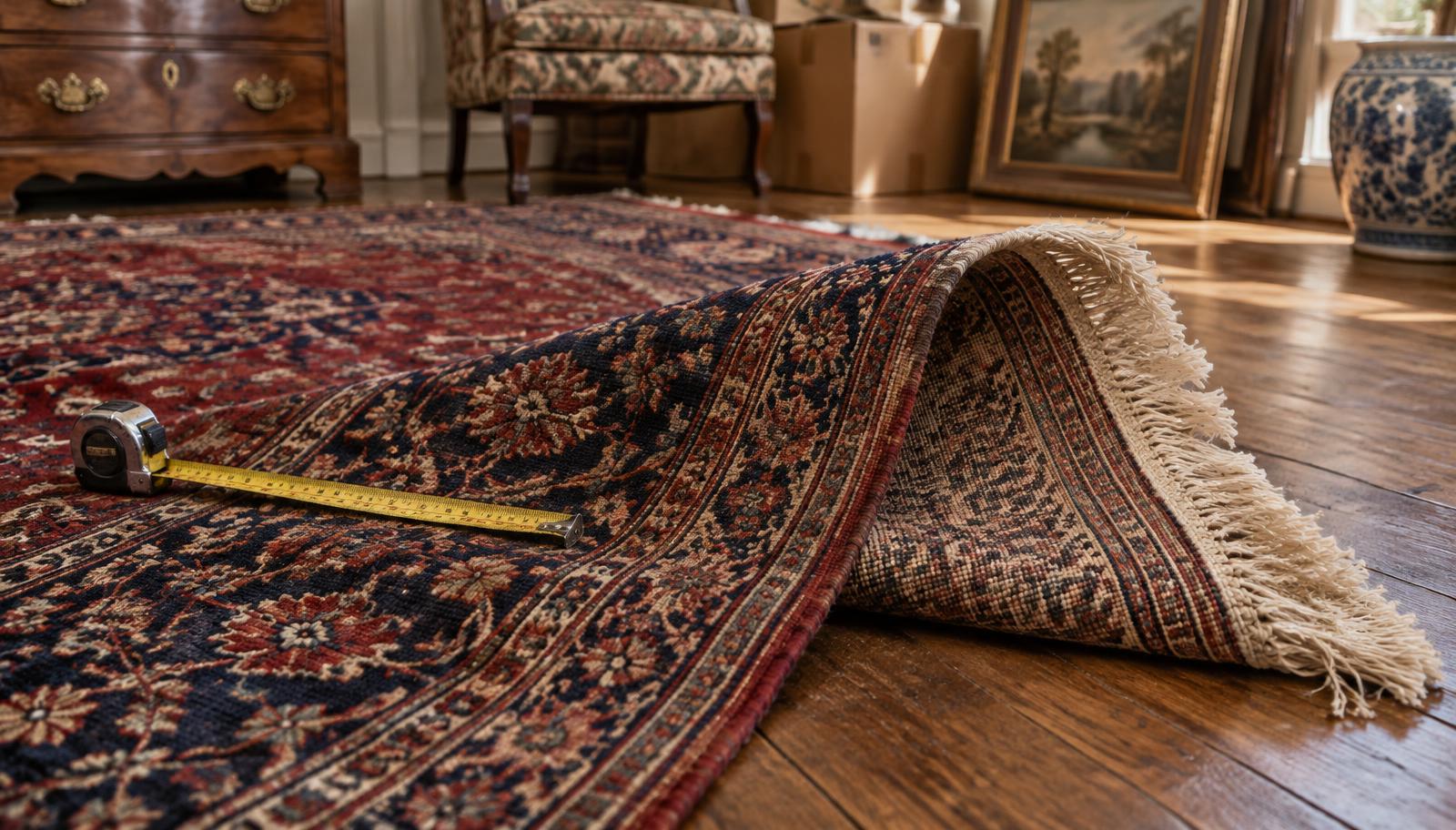
Most old Oriental rugs sell for a few hundred dollars, not thousands. The exceptions are antique, finely knotted, natural-dye or silk rugs in good condition. Flip a corner over: if the design shows clearly on the back in small, slightly uneven knots and the fringe runs straight out of the rug, it is probably hand-knotted and worth a closer look before you price it.
Almost every estate has one. A red and navy rug under the dining table, a runner in the hall, a rolled one behind the water heater that nobody has looked at since 1985. Families tend to assume one of two things: that it is a priceless Persian heirloom, or that it is a dusty old rug worth nothing. Usually the truth sits in between, and the difference between those outcomes comes down to a few things you can check yourself in a few minutes.
This guide walks through the same order a careful estate sale pricer uses: how it was made, what it is made of, where it was made, how old it is and what shape it is in. Then it covers what that means for a price, who to ask for a second opinion, and where these rugs actually sell.
The short answer: are old Oriental rugs worth anything?
Yes, but the range is enormous, and the typical number is modest. Ordinary 20th-century wool rugs, even genuinely hand-knotted ones, are plentiful on the secondhand market. Dealers and pickers posting on Reddit regularly describe them in the low hundreds. One r/orientalrugs commenter judged a 40- to 50-year-old village rug from northwest Iran at "probably $150-$200 at auction best case" (Reddit, May 2025). Another seller in r/Antiques was told by a local antique shop that their inherited rug was "a dime a dozen" at $200 to $300 (Reddit, May 2025). And in a much-upvoted r/whatsthisworth thread, one person said the estate buyer who cleared their mother's house told them up front he would not buy any rugs at all, because they don't sell and dealers already have plenty (Reddit, May 2024).
Those are anecdotes, not a price table, and we present them that way. They are useful because they match what estate sale companies see on sale day: most rugs sell, but they sell at used-furniture prices. A small share are different, and those are the ones worth slowing down for.
What do old Oriental rugs actually sell for now?
We are not publishing a price table, on purpose. Rug prices depend so heavily on size, origin, knot density, age, dyes and condition that an "average Persian rug price" would mislead more people than it helps. Instead, use this rule of thumb:
| What you have | Realistic expectation | What to do next |
|---|---|---|
| Machine-made "Oriental-style" rug | Priced like used decor | Price by size, fiber and condition |
| Hand-tufted wool rug | Priced like used decor, sometimes less | Same as above; don't call it hand-knotted |
| Ordinary 20th-century hand-knotted wool rug | Often a few hundred dollars (anecdotal) | Measure, photograph, check sold comparisons |
| Antique, finely knotted, natural-dye or silk rug in good condition | Can be much more | Get a specialist opinion before pricing |
To build your own evidence, search completed sales instead of asking prices. On eBay, filter to sold listings: for example, sold hand-knotted Persian rugs. Compare only rugs of similar size, origin and condition, and remember shipping a 9-by-12 rug is expensive, which pulls online prices down.
The 60-second flip test: hand-knotted, hand-tufted or machine-made?
Construction is the first and biggest value question, and the back of the rug answers it. Rug sellers and reference sites describe the same core checks: the back, the fringe, the regularity of the pattern, and what you see when you part the pile (Mussallem Rugs, Catalina Rug, Rug Wiki).
The 60-second flip test
Turn a corner over. What do you see?
1. The back
2. The fringe
Pick one answer in each row to see what it usually means.
A screening test, not an appraisal. Methods: Mussallem Rugs, Catalina Rug, Rug Wiki.
What does the back of a hand-knotted rug look like?
On a hand-knotted rug, the pattern on the back is nearly as clear as the front, made of thousands of tiny individual knots that are slightly irregular in size and position. On a machine-made rug, the back looks like a perfectly regular woven grid, often stiff, and the colors look paler. On a hand-tufted rug, you usually see a cloth or canvas backing glued on, and the design is hidden completely.
How can I tell if a rug is hand-knotted or machine-made from the fringe?
On a hand-knotted rug, the fringe is the end of the warp threads, the structural threads the whole rug is tied onto. It runs straight out of the body of the rug. On many machine-made and tufted rugs, the fringe is a separate strip stitched or glued on after the fact. Caveat: fringes get repaired and replaced, so use this as a second check, not the only one.
Symmetry, labels and the bend test
People are not machines. Hand-knotted rugs almost always show small variations: a border that doesn't turn the corner perfectly, a motif that differs from one end to the other, or bands of slightly different color where a new batch of wool was used (called abrash). A pattern that repeats with mathematical precision points toward machine production.
Labels help in one direction only. A sewn-on label reading "100% polypropylene," "power loomed" or a big-box brand name settles it. A label that says "Persian design" or "Oriental" tells you about the look, not the origin. Fold a corner back with the pile facing out: on a hand-knotted rug you can often see the rows of knots at the base of the pile.
| Feature | Hand-knotted | Hand-tufted | Machine-made |
|---|---|---|---|
| Back of rug | Design visible, small uneven knots | Cloth or canvas backing hides design | Very even grid, often stiff |
| Fringe | Continuation of the warp | Usually sewn or glued on | Usually sewn or glued on, or none |
| Pattern | Small irregularities, abrash | Even | Perfectly even |
| Typical resale | Varies widely; most modest, some valuable | Decor pricing | Decor pricing |
What makes an old Oriental rug valuable?
Once you know a rug is hand-knotted, value comes from a handful of factors working together. No single one guarantees a high price.
- Age. In the rug trade, "antique" usually means roughly 100 years or older, and "semi-antique" somewhere younger than that. Families often overestimate age; a rug bought in the 1970s is vintage, not antique.
- Origin and weaving group. Rugs from named weaving centers and tribal groups are studied and collected. Many rugs are simply "Persian design" made elsewhere, which is not the same thing.
- Knot density. More knots per square inch means more labor and finer detail. Count a one-inch square on the back, across and down, and multiply. A higher count isn't automatically more valuable, but very coarse rugs rarely bring premium prices.
- Dyes. Collectors pay more for natural dyes, which age into softer, more varied color. Harsh, flat or bleeding color can point to synthetic dyes.
- Materials. Wool on a cotton foundation is the most common. Silk rugs, or wool with silk highlights, are a different category, and so are fakes of them: "art silk" (rayon or mercerized cotton) is common.
- Size and shape. Room-size rugs and long runners are useful sizes. Odd sizes and very large rugs can be harder to sell because shipping and placement are harder.
- Condition. This is where many otherwise-good rugs lose their value. See the next section.
"Persian style" vs. actually made in Iran
"Persian" gets used loosely. Strictly, it means a rug woven in Iran. Rugs in Persian designs are also woven in India, Pakistan, China, Turkey, Afghanistan and elsewhere, and many are good rugs in their own right. But the label should match the evidence. If you can't confirm origin, describe the rug as "Persian-design" or "Oriental-style" and let the photographs speak.
Is it legal to sell a Persian rug in the U.S.?
Generally yes, for a rug that is already here. U.S. sanctions ended the general authorization to import Iranian-origin carpets after a wind-down period that ran through 11:59 p.m. Eastern Daylight Time on August 6, 2018 (31 CFR 560.534; OFAC announcement, June 27, 2018). Separately, the sanctions regulations authorize "all domestic transactions with respect to Iranian-origin goods located in the United States," except goods blocked under the regulations (31 CFR 560.518).
In plain English: reselling a Persian rug that is already in the United States, such as one from Grandma's living room, is a domestic transaction the rules authorize. Importing a new one from Iran or a third country is not allowed. Exporting raises its own questions. This is a summary of the regulations, not legal advice; if a sale involves shipping abroad or anything unusual, ask a lawyer who handles sanctions.
What damage kills an Oriental rug's value?
Condition can turn a valuable rug into a decorative one. Look over the whole rug, front and back, in good daylight.
- Moths and carpet beetles. Look for bare tracks, crusty webbing and pale sandy debris, especially under furniture and along edges that never saw light or foot traffic. Active infestation spreads; bag a suspect rug before it goes near others.
- Pet urine. Look for dark rings, stiff or brittle spots, color bleeding and odor. Urine damage can rot the foundation, not just stain the pile.
- Dry rot. Fold a small section gently. Cracking sounds or stiff, brittle foundation threads are a serious problem and costly to fix.
- Wear down to the knots. Even wear on an antique rug is expected. Holes, bald patches and exposed foundation lower the value.
- Color run. Dyes bleeding into the white areas, often from a bad wash, are hard to reverse.
- Bad repairs and painted spots. Some worn rugs have had bare patches colored in with marker or paint. Look closely at worn areas.
Should I clean or repair a rug before selling it?
No, not before you get an opinion. Washing a rug at home or with a regular carpet cleaner can set stains, make dyes run, shrink it or worsen dry rot. Repairs done badly can lower value. A specialist may tell you the rug is worth professional cleaning, or that it isn't worth the cost. Either way, you want that answer before you spend money. Vacuuming lightly and letting it air out is usually fine. If you are cleaning out a house, our guide to cleaning antiques without ruining them follows the same rule: identify first, clean second.
Who to ask for a rug value, and why one quote isn't enough
You have three types of help, and they answer different questions.
- An independent appraiser is paid for an opinion, not for buying the rug. Use one for insurance, estate tax or high-value rugs. Ask about their rug credentials. Our guide to whether you need an appraisal before an estate sale explains when it's worth paying.
- A rug dealer or rug cleaner knows the market well. If they offer to buy the rug, their quote is a purchase price, and it should be lower than retail, because they have to clean, store and resell it. That is why rug dealers often quote "so low." It isn't necessarily a lowball; it's the wholesale end of the market.
- An estate sale company prices for the shoppers who actually come to your sale. They will tell you whether a rug belongs on the floor at the sale, in an online auction, or with a specialist.
Get more than one opinion for any rug that passes the flip test and looks old, fine or silk. Send everyone the same set of photos and measurements so the opinions are comparable.
Photos to take before asking anyone
- The whole rug, flat, from above.
- The back, whole and close up with a ruler for knot count.
- Both ends showing the fringe and how it attaches.
- Each corner and the side edges.
- Any labels, front and back.
- Every area of damage, close up.
- Measurements, length and width, not including fringe.
Where to sell an old Oriental rug
- At the estate sale. Rugs on the floor are hard to shop; good companies roll them back or hang them so buyers can see the backs. This is the right place for most ordinary rugs. Learn how pricing works in our guide to pricing estate sale items.
- In an online estate auction. Useful for rugs that need a wider audience, as long as the photos show the back and the condition. See estate sale or online auction.
- Through a rug dealer or specialist auction house. Best for antique, very fine or silk rugs that passed a specialist's look.
- Consignment or local listings. Possible for room-size rugs in good shape, but pickup and the size of the rug limit who can buy.
On EstateSaleFinder right now
As of November 15, 2026, sellers on EstateSaleFinder.net had tagged 476 item photos as Persian, Oriental or hand-knotted rugs across 180 estate sales, and only one of those photos was marked sold. That count comes from item labels on our own listings, not from verified identifications, and many sellers don't mark items sold, so read it as a sign of how common these rugs are, not as a sell-through rate. The takeaway matches the anecdotes: rugs are everywhere, which is why the handful of exceptional ones need to be spotted early.
Tips for buyers at estate sales
- Bring a small flashlight and a tape measure. Ask before flipping a rug; good staff will help.
- Check the back and the fringe before looking at the price.
- Look underneath for moths and rot along the edges, and sniff for pet urine.
- A sale-day price on an ordinary hand-knotted rug can be a fair deal for a buyer who wants a durable rug to use. Don't overpay expecting resale profit unless you know the category.
Tips for estate sale companies
- Do the flip test during the walkthrough and photograph every rug's back and corners for the listing.
- Separate likely-special rugs (antique, fine, silk, collectible types) from decor rugs early, and send photos to a specialist before sale day.
- Describe honestly: "hand-knotted wool, Persian design, origin not confirmed" sells better long-term than an unproven claim.
- Roll back or hang rugs so shoppers can see the backs without moving furniture.
- If rugs go to an online auction, include the back photo and measurements in every lot.
When a whole house needs pricing, find a local estate sale company that will walk the home with you. For other "is it worth anything?" questions, see our guides to old quilts, brown furniture and how to appraise estate sale items. The Ai Appraiser can give a suggested identification from photos of the front, back and corners, and it is a starting point, not an appraisal.
Questions & answers
Frequently asked questions
Is my Persian rug real?
Start with the flip test. A design that shows clearly on the back in small, slightly uneven knots and a fringe that runs out of the rug body point to hand-knotting. "Persian" strictly means woven in Iran; confirming origin usually takes a specialist, so describe an unconfirmed rug as "Persian-design."
Is it legal to sell a Persian rug in the U.S.?
For a rug already in the United States, generally yes: 31 CFR 560.518 authorizes domestic transactions in Iranian-origin goods located in the U.S., except blocked goods. Importing Iranian-origin carpets has not been generally authorized since the wind-down ended August 6, 2018. This is not legal advice.
Do moths ruin a rug's value?
Moth damage can seriously reduce value, especially bare tracks through the pile or into the foundation. Light, old damage on an otherwise good antique rug may be repairable, but active infestation should be isolated and treated before the rug is sold or stored with other textiles.
Should I clean a rug before selling it?
Not before getting an opinion. Home washing and ordinary carpet cleaning can make dyes run, set stains or worsen rot. A light vacuum is usually fine. Let a specialist decide whether professional cleaning is worth the cost.
Why do rug dealers quote so low?
A dealer who offers to buy your rug is quoting a wholesale price: they still have to clean, store, market and resell it, often slowly. That's why a purchase offer is lower than a retail or appraisal figure. Compare offers using the same photos and measurements.
How do I count knots per square inch?
On the back of the rug, measure one inch along the width and count the knots in that row, then count the knots in one inch down the length. Multiply the two numbers. Count in a few spots and use a ruler for accuracy.
Keep exploring
Flip it, photograph it, then price it
Photograph the front, the back and a corner for a suggested identification, then get a specialist opinion on anything antique, silk or finely knotted.
Open the Ai Appraiser
About the author
Andy
Founder, EstateSaleFinder.net
Hi, I'm Andy — a retired commercial photographer turned developer with a five-year (and counting) obsession with estate sales. I started EstateSaleFinder.net because I knew there had to be an easier, smarter way to find and list estate sales. Now I get to chase treasure and build the tool I always wished existed.