
The first weeks · Practical family guide
What to Do With Medical Equipment and Medications After Someone Dies: Return, Donate, Sell or Dispose
November 15, 202610 min readSource-checked guide
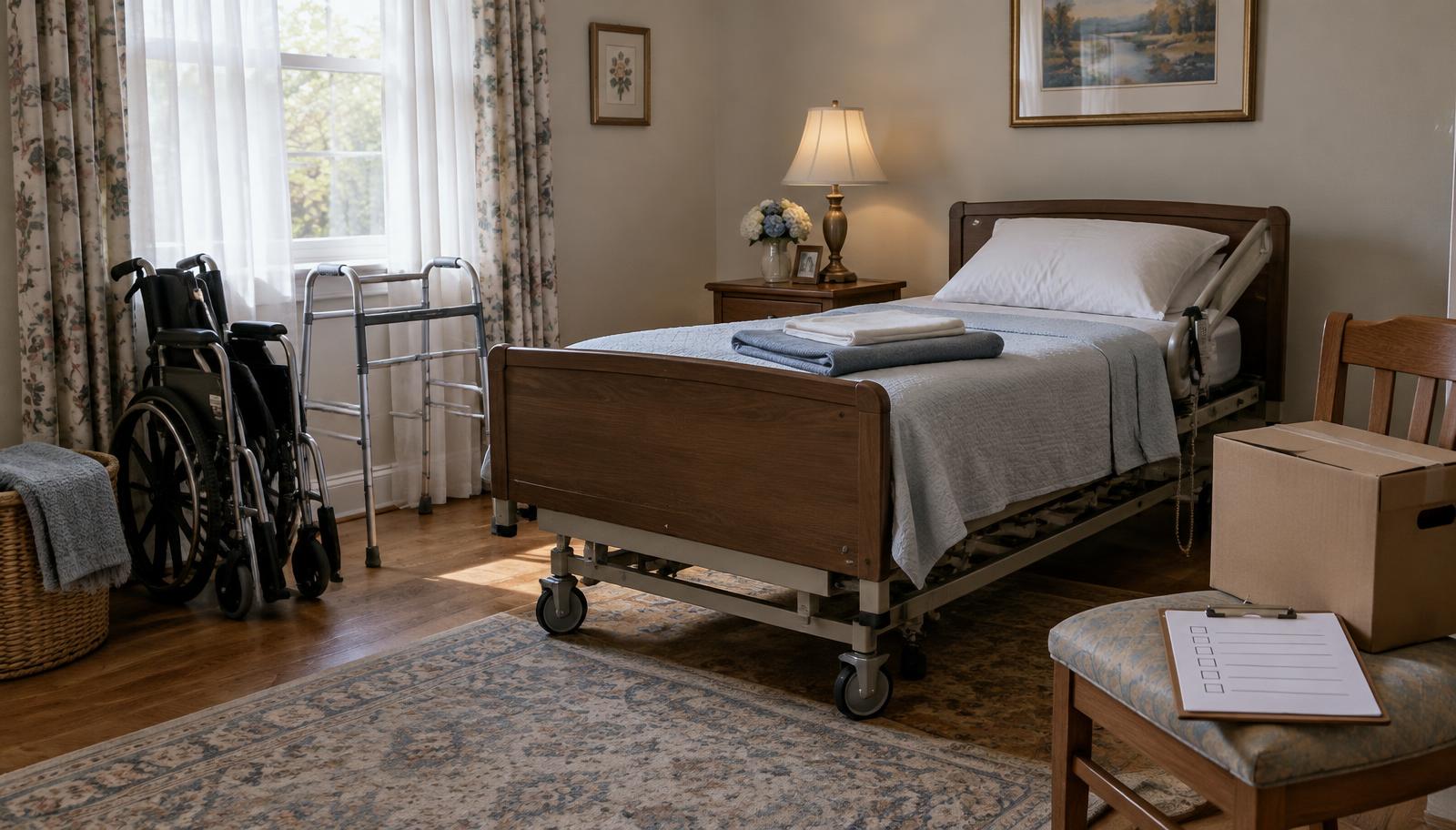
What to do with medical equipment after death: return hospice beds and oxygen, donate wheelchairs, and dispose of medications the FDA-approved way.
First find out who owns each item. Hospital beds and oxygen equipment are often rented through hospice or a medical supplier and must go back to them. Equipment the family owns, like walkers and wheelchairs, can usually be donated to a medical equipment loan closet. Take leftover medications to a pharmacy kiosk, DEA take-back site or mail-back envelope; flush only drugs on the FDA's flush list.
In the days after someone dies at home, the medical equipment is often the first thing the family has to deal with, and the hardest to look at. The hospital bed is still in the living room. The oxygen concentrator hums in the corner until someone turns it off. There are pill bottles on every counter. Nobody knows who to call, and nobody wants to make a mistake.
This guide sorts it out in plain steps: who to call first, what has to go back, what can be donated or sold, how to dispose of medications safely, and what an estate sale company will and won't handle afterward. It is general information, not medical or legal advice. When a hospice, supplier or pharmacist gives you specific instructions, follow theirs.
The short answer: what to do with medical equipment after someone dies
Work through three questions for every item, in this order:
- Who owns it? Rented, hospice-provided or owned outright. This decides almost everything.
- Is it a prescription item? Oxygen, CPAP machines and some other devices are prescribed. Resale and donation rules are tighter.
- Is it clean, complete and working? Donation programs generally take only items in good condition.
Then each item lands in one of four piles: return, donate, sell or recycle and discard. Medications are a separate pile with their own rules, covered below.
Room by room
Which item are you looking at?
Most likely next step
Usually return
Often rented through hospice or a medical supplier. Call the supplier on the label to schedule pickup before moving it.
All items, for reference
- Hospital bed — Usually return
- Often rented through hospice or a medical supplier. Call the supplier on the label to schedule pickup before moving it.
- Oxygen concentrator or tanks — Return
- Oxygen equipment is commonly rented. Keep it away from flames and heat, and let the supplier collect tanks, tubing and the concentrator.
- CPAP or BiPAP — Ask, then donate or recycle
- Check whether it was rented. CPAPs are prescription devices; many marketplaces won't allow listings, so ask the supplier or a donation program first.
- Power wheelchair or scooter — Return or donate
- Confirm who owns it. Owned chairs can go to loan closets; ask a supplier how to handle large batteries.
- Manual wheelchair, walker, cane — Donate (or sell if owned)
- Usually owned outright. Medical equipment loan closets, churches and community groups commonly accept clean, working pieces.
- Lift chair — Sell or donate
- Owned furniture with a motor. An estate sale company can usually sell a clean, working one.
- Shower chair, commode, grab bars — Donate or discard
- Check what the local loan closet accepts. Used toileting items are often declined.
- Unopened supplies — Donate
- Sealed gloves, pads and dressings are often welcomed by loan closets or clinics. Opened supplies usually are not.
- Medications — Take back
- Use a pharmacy kiosk, DEA take-back site or mail-back envelope. Flush only drugs on the FDA flush list. Never sell or give away.
General guidance, not medical advice. Confirm with the hospice or supplier. Sources: FDA flush list, Medicare oxygen coverage, Meta commerce policy.
Who to call first
Start with the companies whose names are on the equipment. Look for a sticker or tag on the hospital bed frame, the oxygen concentrator and the wheelchair. That label usually names the supplier and a phone number.
- The hospice agency, if the person was in hospice. Medicare's hospice benefit includes equipment and supplies for the terminal illness and related conditions, arranged by the hospice team (Medicare Hospice Benefits booklet). Equipment the hospice arranged is usually collected by the hospice or its supplier.
- The medical equipment supplier, for anything rented outside hospice, especially beds, oxygen and power chairs.
- The oxygen supplier, if different. Ask them to stop deliveries and pick up tanks and the concentrator.
- The pharmacy, to cancel automatic refills and deliveries, and to ask about drug take-back.
Write the numbers down as you find them. Our printable checklist below has space for each.
Does hospice pick up equipment after a death?
Usually, for equipment the hospice provided, but the timing varies by agency and supplier, so call to schedule pickup. Don't move heavy beds or oxygen equipment yourself if the supplier will collect them. Keep any pickup receipts.
Who pays for rented equipment after a death?
Rental billing generally stops at death. A long-standing Medicare instruction to equipment claim processors says rentals "are allowed after the date of death for the remainder of the month," as long as the rental period began before the death (CMS Program Memorandum B-00-56). That memo is from 2000 and speaks to Medicare claims, not to private insurance or private rentals. Ask the supplier for the date billing ends, and don't pay a bill for months after the death without asking why.
Item by item: return, donate, sell or recycle
| Item | Usually | Why |
|---|---|---|
| Hospital bed | Return | Often rented through hospice or a supplier |
| Oxygen concentrator, tanks, tubing | Return | Commonly rented; supplier collects tanks |
| CPAP or BiPAP | Ask supplier; donate or recycle | Prescription device; marketplaces often block listings |
| Power wheelchair or scooter | Return or donate | Ownership varies; large batteries need care |
| Manual wheelchair, walker, rollator, cane | Donate or sell | Usually owned outright |
| Lift chair | Sell or donate | Owned furniture; sells if clean and working |
| Shower chair, tub bench, commode | Donate or discard | Many programs decline used toileting items |
| Unopened supplies (gloves, pads, dressings) | Donate | Sealed items are often welcome |
| Opened supplies | Discard | Generally not accepted |
| Medications | Take back | Never sell or give away |
Medicare itself explains that different equipment is handled differently: some must be rented, some bought, and some become your property after a certain number of rental payments (Medicare.gov, oxygen equipment). That's why "who owns it" has to be asked item by item, even within the same house.
Hospital beds
Most families never owned the bed. Check the frame for a supplier sticker and call to schedule pickup. If it turns out to be owned, many loan closets accept clean, working electric beds, but they're heavy and some groups can't collect them. Ask before you promise one.
Oxygen equipment
Turn off the concentrator once it is no longer needed and keep tanks upright, away from heat, open flames and cigarettes until the supplier picks them up. Oxygen makes fires burn hotter and faster. Don't try to empty, sell or throw away oxygen tanks; the supplier owns them in most cases and has to collect them.
Can you sell a used CPAP?
It's complicated. CPAP machines are prescription devices, and many marketplaces won't allow medical device listings. Meta's commerce policy, which covers Facebook Marketplace, says commerce content "may not promote the sale of medical devices" (Meta commerce policy). We have seen secondary sources claim it's illegal for individuals to resell a used CPAP, but we couldn't confirm that, so we're not stating it as fact. The practical route: check whether it was rented, then ask the supplier or a CPAP donation or recycling program what they accept.
Wheelchairs, walkers and other owned mobility aids
These are the easiest to give a second life. Medical equipment loan closets, sometimes run by churches, senior centers, nonprofits or local service groups, lend equipment to people in the community. Veterans' groups sometimes accept items for local veterans too. Call ahead: each program has its own list of what it accepts and whether it can pick up. Clean everything first, gather chargers and parts, and take a photo of each item to send ahead.
Power chairs, scooters and batteries
Power chairs and scooters often use large batteries. Ask the supplier or the receiving program how to handle them; don't put damaged or swollen batteries in household trash.
Devices that store personal information
Some newer equipment, especially CPAP machines and some oxygen concentrators, can store usage data or connect to an app. Before donating, ask the supplier how to reset it, and remove any memory card.
What to do with medications after someone dies
Gather every medication in one place, including patches, liquids, inhalers and anything in purses, nightstands and coat pockets. Keep them out of reach of children, visitors and pets. Some medications are very dangerous to anyone they weren't prescribed for.
Then follow the U.S. Food and Drug Administration's order of preference (FDA, where and how to dispose of unused medicines):
- Take-back first. Drop them off at a drug take-back location, such as a pharmacy kiosk or a police station drop box, or mail them in a prepaid drug mail-back envelope. The Drug Enforcement Administration has a take-back location search by ZIP code, and hosts National Prescription Drug Take Back Day events.
- If you can't use take-back, check the flush list. The FDA's flush list covers medicines "sought-after for their misuse and/or abuse potential" that "can result in death from one dose if inappropriately taken," including many opioids such as fentanyl patches and morphine (FDA flush list). The FDA is clear: "don't flush your medicine unless it is on the flush list."
- Everything else goes in the trash, the safe way. The FDA's at-home steps: mix the medicine (don't crush tablets or capsules) with something unappealing like dirt, cat litter or used coffee grounds, put it in a sealed bag or container, and throw it in household trash. Scratch out personal information on prescription labels before throwing away the bottles (FDA).
Needles, syringes and lancets go in a sharps container; follow the FDA's sharps disposal guidance. Never sell, donate or give away leftover prescription medications.
Can you flush old pills?
Only if the medicine is on the FDA flush list and you can't readily get to a take-back option. Everything else goes to take-back, or into sealed trash using the FDA's at-home steps. If hospice gave you specific disposal instructions, follow those.
What about hospice "comfort kits"?
Hospice teams often leave a small kit of medications at home. Ask the hospice nurse how they want those handled; many agencies have a policy, and the FDA's guidance says to follow any specific instructions from a healthcare provider first.
Print the room-by-room checklist
A one-page US Letter checklist with space for hospice and supplier phone numbers, every common item, owned or rented, and the FDA medication steps. General information, not medical advice.
Will an estate sale company sell medical equipment?
Some items, yes. Most companies will sell owned furniture-type pieces like lift chairs, and many sell clean manual wheelchairs, walkers, rollators, canes and bath safety items. Few will sell rented equipment (it isn't yours to sell), oxygen, prescription devices or anything opened. None will sell medications. Our guide to what can't be sold at an estate sale covers the broader list.
The best order of operations:
- Return everything rented and get receipts.
- Remove and dispose of all medications.
- Donate what you've decided to donate, or leave it for the company if they'll sell it.
- Then schedule the walkthrough. Don't throw away the rest of the house first; our guide to what not to throw away before an estate sale explains why.
When you're ready, find an estate sale company to walk the home. Ask during the walkthrough which medical items they'll include and which you should remove first.
Places to donate used medical equipment
- Medical equipment loan closets in your town or county, often run by churches, senior centers, Rotary or Lions clubs, or nonprofits.
- Hospice agencies sometimes know of local programs that need specific items.
- Veterans' service organizations may accept equipment for local veterans; call the local post first.
- Senior centers and Area Agencies on Aging often keep a list of local programs.
- Habitat for Humanity ReStores and thrift stores sometimes accept certain items; policies vary widely.
Call before driving anything over. Ask what they accept, condition requirements, whether they pick up, and whether they provide a donation receipt.
A gentle note on timing
There's no rule that says the equipment has to be gone in a day. Rented items should go back promptly to stop billing and free them for someone else. Medications should be secured right away and disposed of soon. But the walker by the door or the chair by the window can wait until the family is ready. Some families keep a cane or a cherished item; that's fine.
For the rest of the house, our guides walk through cleaning out a parent's house after a death, what to do with a loved one's clothes, what to do with a car when someone dies and what to do with guns when someone dies.
Questions & answers
Frequently asked questions
Does hospice pick up equipment after a death?
Usually, for equipment the hospice arranged. Call the hospice agency or the supplier named on the equipment label to schedule pickup, and keep the receipt. Timing varies by agency.
Can you sell a used CPAP?
Often not easily. CPAPs are prescription devices, and Facebook Marketplace's commerce policy prohibits medical device listings. First check whether it was rented, then ask the supplier or a CPAP donation or recycling program what they accept.
Can you flush old pills?
Only medicines on the FDA flush list, and only when take-back isn't readily available. Take-back locations and mail-back envelopes come first. Everything else goes into sealed household trash mixed with something unappealing.
Will an estate sale company sell medical equipment?
Many will sell owned items like lift chairs, manual wheelchairs, walkers and bath safety equipment. Rented equipment, oxygen, opened supplies and medications are not sold. Ask during the walkthrough.
Who pays for rented equipment after a death?
Rental billing generally ends at death. For Medicare, a CMS instruction allows rental payment for the rest of the month of death if the rental began before death. Ask the supplier for the end date of billing.
Sources checked November 15, 2026: FDA, DEA, CMS, Medicare.gov and Meta. This article is general information, not medical, legal or financial advice.
Keep exploring
Let a company handle the rest of the house
Once rented equipment is returned and medications are gone, an estate sale company can walk the home and tell you what will sell.
Find an Estate Sale Company
About the author
Andy
Founder, EstateSaleFinder.net
Hi, I'm Andy — a retired commercial photographer turned developer with a five-year (and counting) obsession with estate sales. I started EstateSaleFinder.net because I knew there had to be an easier, smarter way to find and list estate sales. Now I get to chase treasure and build the tool I always wished existed.