
What to Do With Guns When Someone Dies: An Executor's Guide to Inherited Firearms
A calm, step-by-step guide for executors and heirs: lock them up, write them down, sort them into three groups, and pick the right legal path to an heir, a dealer or a buyer.
When someone dies and leaves guns behind, the first job is simple: lock them up and keep them away from anyone who shouldn't have them. Then make a written list. After that, each gun goes one of three ways: to an heir who can legally own it, to a licensed dealer to sell, or into a properly documented private sale where your state allows it. Federally registered items, like silencers or short-barreled rifles, need ATF approval before anyone takes them.
That's the short version. The rest of this guide walks through it in the order most families actually face it, starting with the first few days.
This is general information, not legal advice. Gun laws differ a lot from state to state. If the estate includes anything unusual, a short call with a probate attorney or a licensed firearms dealer (an FFL) is money well spent.
The first 72 hours: secure, don't sort
You don't have to decide anything this week. You only need to make the guns safe.
- Lock them up. If there's a safe, put everything in it and change the combination if many people knew it. If there's no safe, use cable locks or a locked closet, or ask a local dealer about short-term storage.
- Keep them away from visitors. Grief brings a lot of people through a house: relatives, neighbors, cleaners, realtors. Guns shouldn't be out in a closet or under a bed during that time.
- Think about who's in the house. If someone in the family is struggling, or legally can't own a gun, move the guns out first. That's the most important safety step on this list.
- Don't hand anything out yet. "Dad said I could have the shotgun" can wait until you know the rules.
Make a written inventory
Once things are calm, write down every gun. For each one, list:
- Make and model (stamped on the side)
- Serial number
- Type (rifle, shotgun, handgun, or something unusual)
- Where it was found, and any paperwork, receipts or boxes with it
- Notes, like engraving, a family story, or "looks very old"
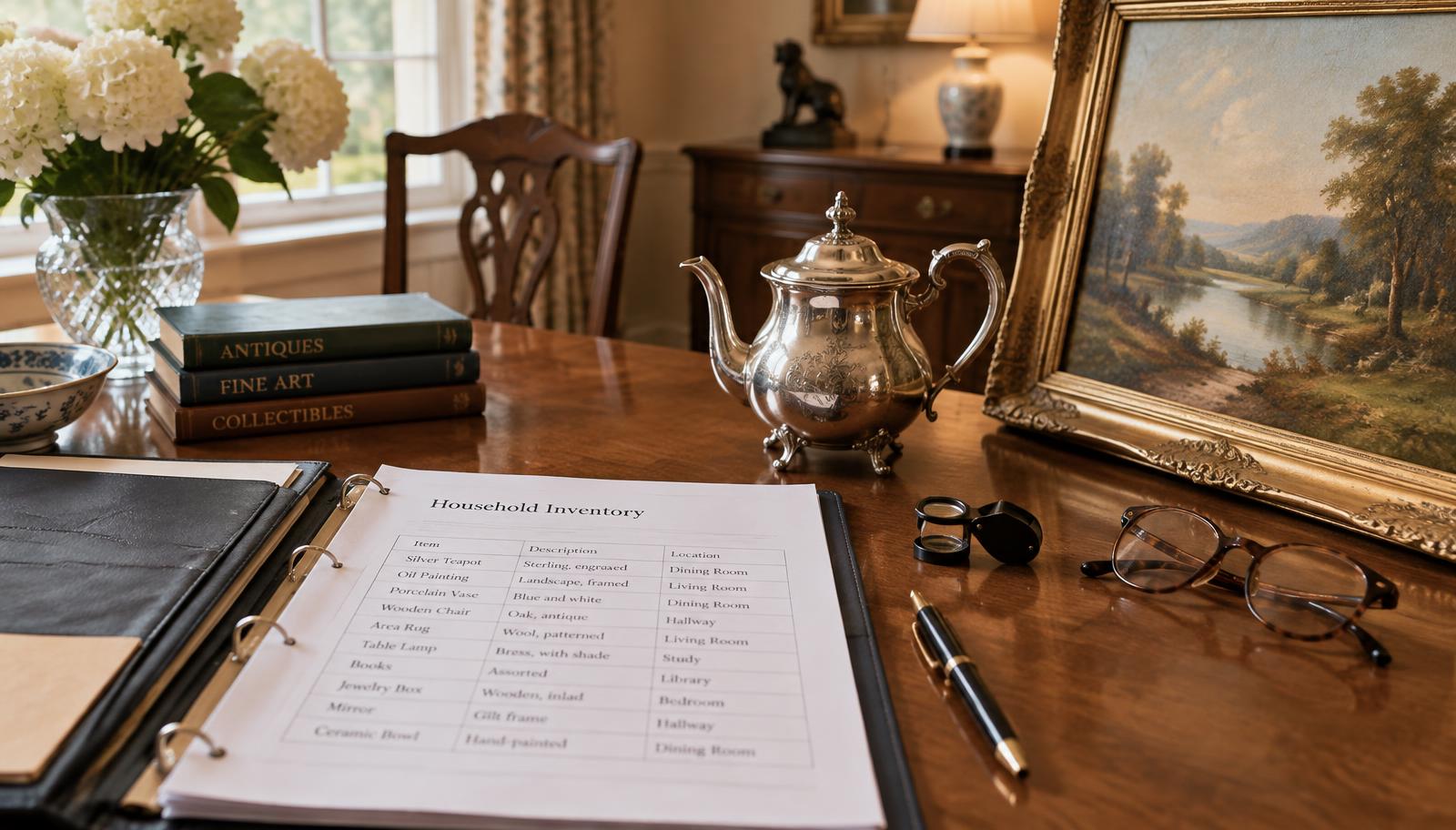
Take a photo of each gun and its serial number. Keep the list somewhere private. It's useful for the probate court, for heirs, for an appraiser, and for insurance. Our free Ai Appraiser can help you name an unfamiliar maker or model from a photo, but treat what it says as a starting point, not a final value.

Printable firearm inventory checklist
Copy this into a notebook or spreadsheet:
| # | Make | Model | Serial | Type | Location found | Paperwork? | Plan (heir / dealer / sell) |
|---|---|---|---|---|---|---|---|
| 1 | |||||||
| 2 | |||||||
| 3 |
Sort them into three groups
Almost every gun in an estate falls into one of these:
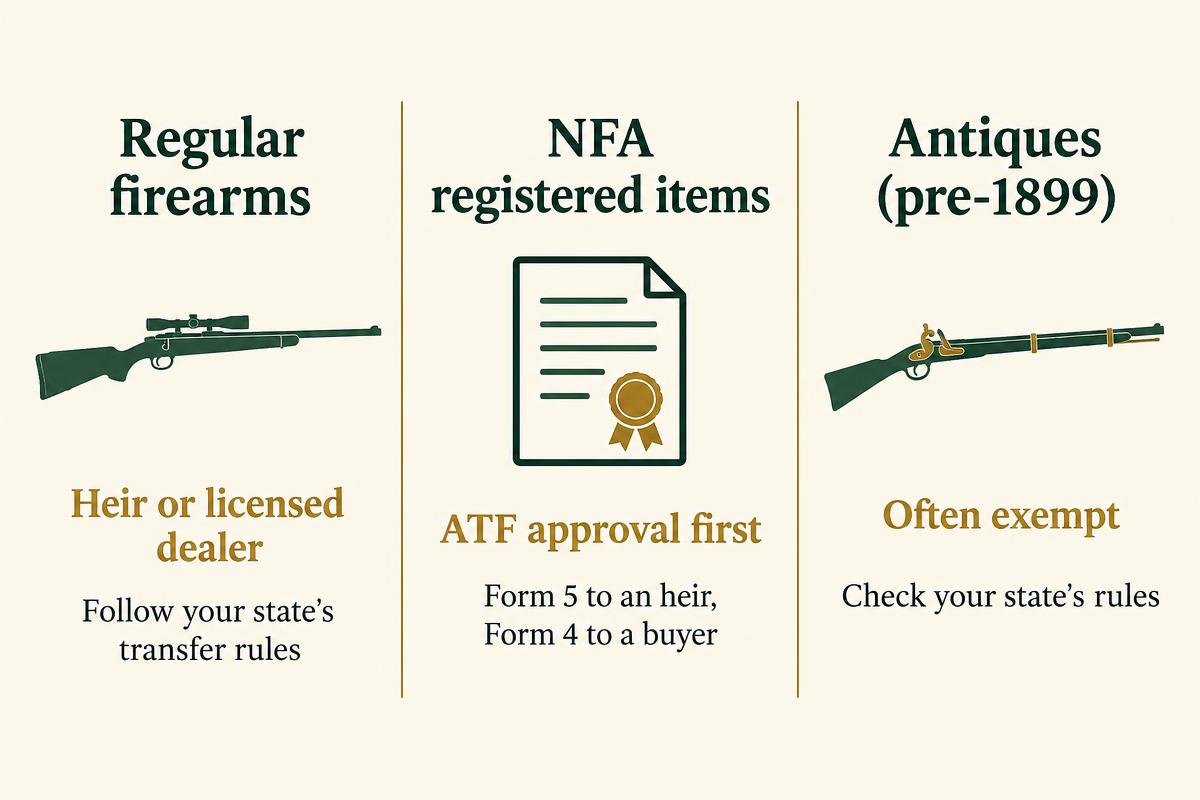
1. Regular firearms
Most hunting rifles, shotguns and handguns. They can usually go to an heir or be sold, following your state's transfer rules.
2. Federally registered (NFA) items
Machine guns, silencers (suppressors), short-barreled rifles and shotguns, and a few others are registered with the ATF under the National Firearms Act. These have stricter rules, covered in the next section. If you aren't sure whether something counts, don't guess. Ask a licensed dealer.
3. Antiques
Under federal law, firearms made in or before 1898, and certain replicas, are generally treated as "antique firearms" and aren't regulated the same way. Your state may still have its own rules, and old guns can be valuable, so get them looked at before selling.
The special rules for NFA items
The federal rule for estates is in 27 CFR 479.90a. In plain English:
- The executor can hold a registered item during probate without it counting as a transfer.
- No later than the close of probate, the executor has to apply to transfer it.
- To a beneficiary (heir): the executor files ATF Form 5, the tax-exempt transfer form, listing the estate as the transferor.
- To someone outside the estate (a buyer): the transfer generally goes on ATF Form 4, and the transfer tax applies.
- Nothing gets handed over until ATF approves.
ATF has also said that it can share registration details with an executor who shows proof of appointment, that unregistered NFA items in an estate are contraband and can't be registered by the estate (call your local ATF office), and that registered items can't be passed to a dealer for consignment or safekeeping while the transfer is pending (ATF guidance on NFA firearms in decedents' estates). That last point surprises a lot of families, so it's worth a call to the ATF NFA Division before you move anything.
Heirs in the same state vs. out of state
Same state
many states let you transfer to a family member directly, and some require the transfer go through a dealer with a background check. Check your state before you hand anything over.
Out of state
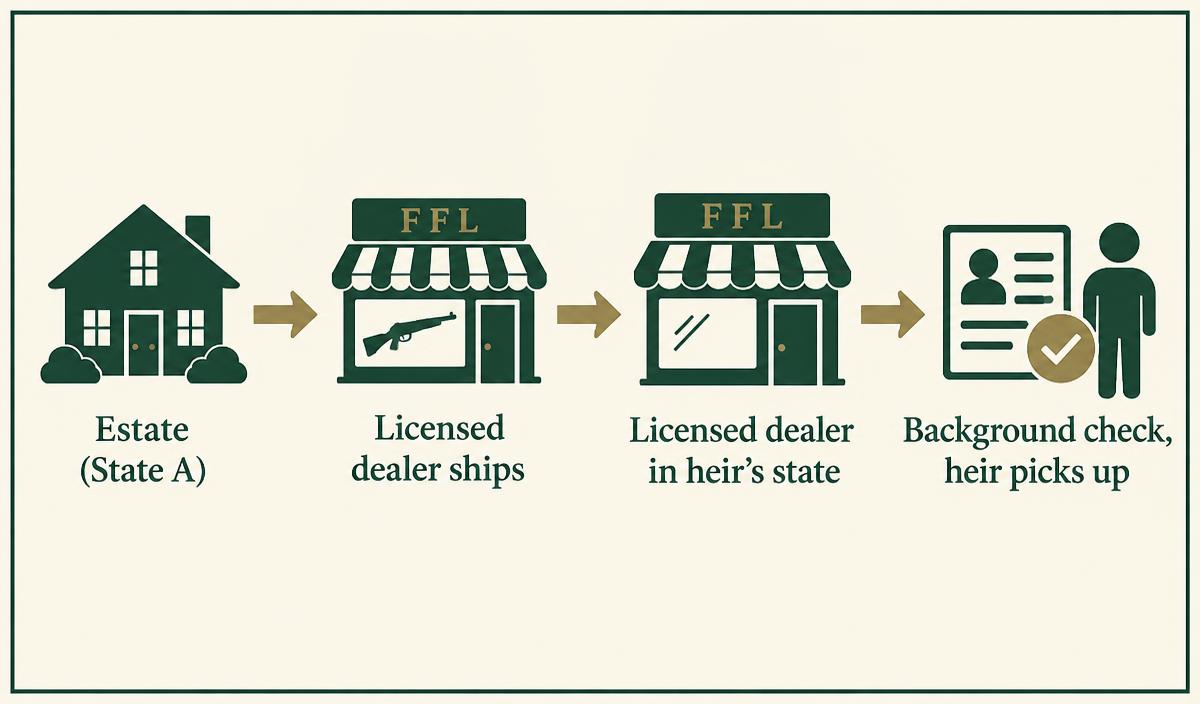
federal law has an exception for guns received by inheritance, but the heir still has to be legally allowed to own that gun in their state. The simplest, safest path is to have a licensed dealer near the estate ship it to a licensed dealer near the heir, who then runs the background check and hands it over.
Ways to sell inherited guns
- Sell or consign to a local licensed dealer. Fast and simple. You'll get less than retail, but the paperwork is handled.
- A licensed firearms auction house. Better for collections, rare pieces and antiques. Ask about the seller's commission and how they ship.
- A private sale, only where your state allows it and only to someone who can legally buy. Many states require private sales to go through a dealer anyway.
Can an estate sale company sell guns?
Some can. Most estate sale companies aren't licensed to sell firearms, so they'll ask you to remove guns before the sale. Some hold a license or bring in a licensed partner for the weekend. Our article on what can't be sold at an estate sale covers this and other restricted items. When you hire an estate sale company, ask on the first call: "Do you handle firearms, and how?"

How state laws vary (a few examples)
Rules change, so always check your state's official site before acting:
- California: most transfers, including many family transfers, run through a licensed dealer; some heirs report the gun to the state instead. See the California DOJ Bureau of Firearms.
- New York: handguns need a license, and the estate has a short window to deal with them. See New York State Police firearms.
- Illinois: the person receiving a gun generally needs a FOID card. See Illinois State Police FOID.
- Pennsylvania: many handgun transfers go through a dealer or county sheriff, with some family exceptions. See Pennsylvania State Police firearms.
- Florida and Texas: private transfers between residents are generally allowed without a dealer, but the buyer still has to be legally allowed to own a gun.
What not to do
- Don't hand a gun to anyone you aren't sure can legally own it.
- Don't mail or ship a gun yourself across state lines.
- Don't post guns on general marketplace sites; most ban them.
- Don't move, sell or give away an NFA item before ATF approves.
- Don't throw guns away. If nobody wants them, call your local police about a surrender.
Ammo, safes and accessories
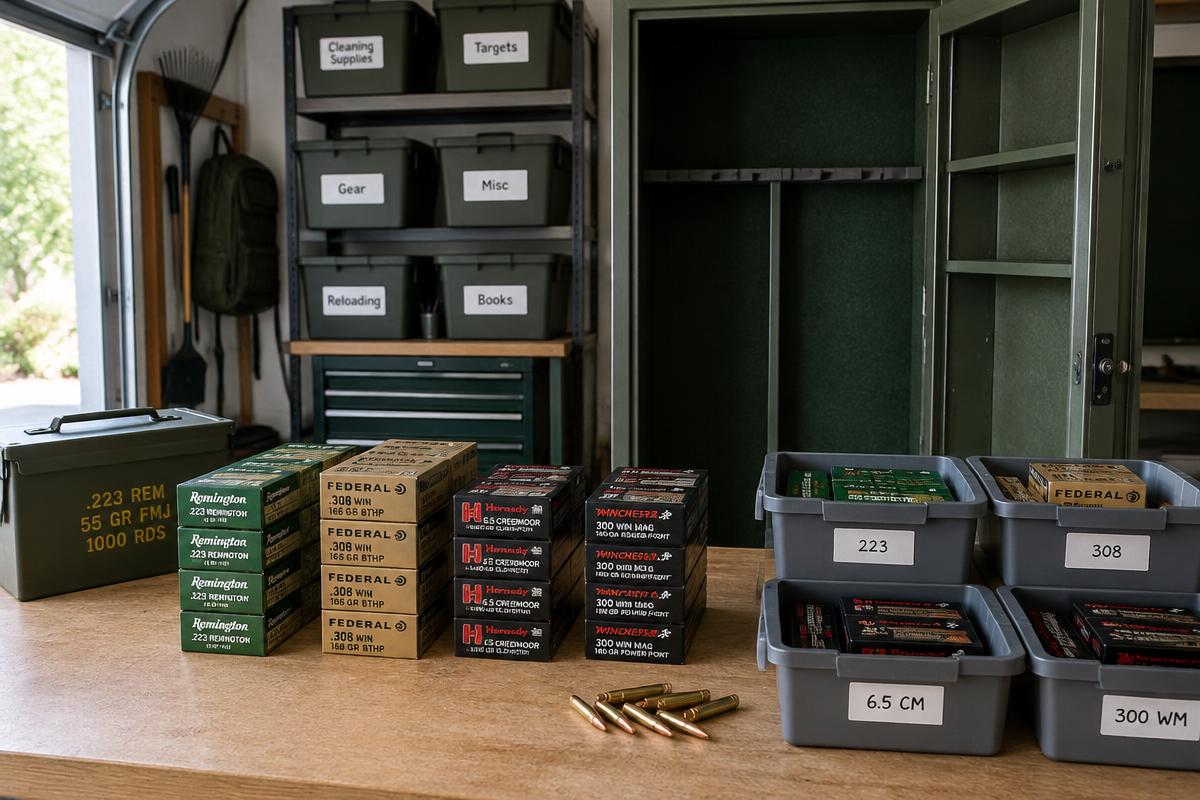
Ammunition has its own rules in some states, and it can't be shipped like normal packages. Local dealers and ranges sometimes buy it. A safe is often worth real money and is easy to sell, and scopes, cases and reloading gear can usually be sold at a regular estate sale.
Getting an appraisal
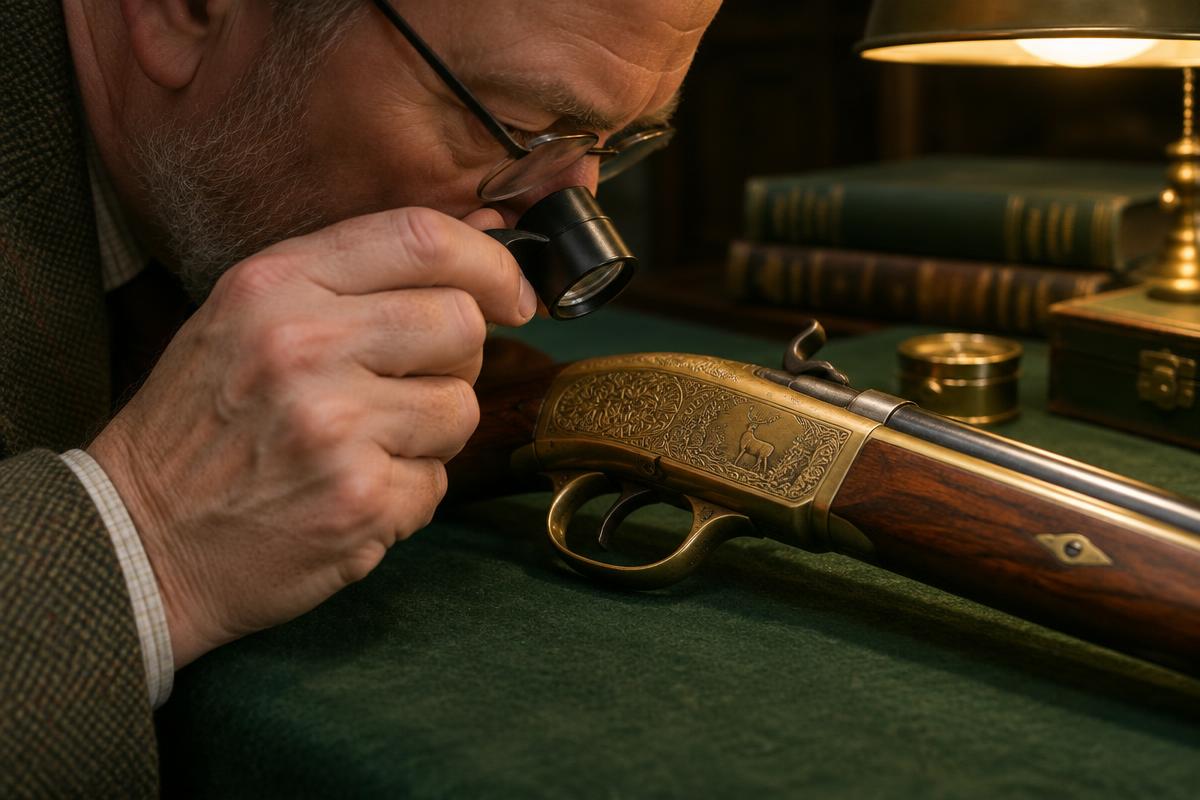
Get a value before you divide guns among heirs or sell them. A collection with old, engraved, military or unusual pieces is worth taking to a specialist auction house or a firearms appraiser. Our guide on whether you need an appraisal before an estate sale explains when it's worth paying.
Quick answers
Can I just keep my dad's guns?
Often, yes, if you can legally own them in your state and you follow its transfer rules. Registered NFA items need an approved ATF Form 5 first.
Can you inherit a firearm from another state?
Yes, in most cases, but the gun has to be legal where you live. Have a dealer ship it to a dealer near you.
Do I need probate to transfer guns?
For NFA items, the executor handles the transfer before probate closes. For regular guns, it depends on your state and the will. Our guide on having an estate sale during probate covers how the court timeline works.
What if I find a gun nobody knew about?
Lock it up, add it to the list, and call a licensed dealer to identify it. If it might be an unregistered NFA item, call ATF before doing anything else.
The bottom line
Lock them up, write them down, sort them into three groups, and pick the legal path for each one. Nothing about inherited guns has to happen fast except keeping them safe. When the guns are handled, an estate sale company near you can take care of the rest of the house, and our guide to what happens to everything after someone dies covers the next steps.
Sources:
Sources checked October 30, 2026. General information, not legal advice. Check your state's rules and talk with a probate attorney or licensed dealer about your situation.
Keep exploring
Ready to start your own treasure hunt?
Discover estate sales near you and find incredible deals.
Explore Sales Near Me
About the author
Andy
Founder, EstateSaleFinder.net
Hi, I'm Andy — a retired commercial photographer turned developer with a five-year (and counting) obsession with estate sales. I started EstateSaleFinder.net because I knew there had to be an easier, smarter way to find and list estate sales. Now I get to chase treasure and build the tool I always wished existed.