

Can You Have an Estate Sale During Probate? An Honest, Compassionate Guide
You're grieving, the house is full, the court is slow, and everyone has an opinion. Here's a compassionate, plain-English guide to whether — and when — you can have an estate sale during probate, what Letters Testamentary actually do, and how to move forward without stepping on a legal landmine.
This is a general guide, not legal advice. Probate rules vary by state and by county — please talk to a probate attorney in your area before you sell anything of real value. What follows is what we've learned from years of working alongside families and estate sale professionals through this exact moment.
If you're reading this, I'm sorry. Almost nobody Googles "can you have an estate sale during probate" for fun. Someone you loved has died, the house is full of a whole life, the calendar is starting to feel like an enemy, and now there's a legal process on top of everything else called probate that nobody warned you would move this slowly.
Take a breath. You are not behind. You are not doing anything wrong. And the answer to your question is almost always yes — you can have an estate sale during probate. You just can't quite do it today, and you can't do it alone. There's an order of operations, and once you understand it, most of the fear falls out of it.
Let's walk through it gently.
The short, honest answer
In most U.S. states, an estate sale of the deceased person's personal property (furniture, dishes, tools, clothing, collectibles — everything inside the house) can happen during probate, but usually not before the court has officially appointed a personal representative (an "executor" if there's a will, an "administrator" if there isn't). Once the court issues that appointment — the piece of paper is called Letters Testamentary (or Letters of Administration) — the person named on it has the legal authority to sell the contents of the estate, subject to a few conditions we'll cover (North Carolina Judicial Branch — Estates overview; Morgan Legal Group — Letters Testamentary in New York).
Two things families are often surprised by:
- Nobody — not the surviving spouse, not the oldest child, not the person named in the will — has legal power to sell estate property until those Letters are issued. Being named executor in a will is not the same as being appointed executor by the court. Until the judge signs, you're just a person with strong feelings and a house key.
- You can absolutely start preparing today. Interviewing estate sale companies, letting them do a walkthrough, taking photos, protecting the home — none of that requires court authority. Waiting until Letters arrive to start the conversation is what turns a smooth process into a scramble.
Now here's the good news that nobody tells grieving families: from the moment Letters are issued in most states, an estate sale of household goods can typically happen quickly — often within a few weeks — because personal property is treated very differently from real estate under probate law.
What "during probate" actually means
Probate is the court process of proving a will (if there is one), appointing someone to manage the estate, paying the deceased's debts, and eventually distributing what's left. It usually takes six months to two years, sometimes longer, depending on the state, the estate, and whether anyone contests anything.
Almost no family can — or should — leave a house full of belongings sitting untouched for that long. Insurance policies lapse. Pipes freeze. Homes get broken into. Property taxes and utility bills keep coming. Grief that could be processed while a home is thoughtfully emptied instead gets prolonged and layered with resentment. This is why every state's probate code has built-in mechanisms for selling personal property well before the whole estate closes (Ohio Revised Code § 2113.40; Florida Statutes § 733.612; Texas Estates Code Ch. 356).
The mechanism is almost always the same in spirit: once the personal representative is appointed, they have the authority (and the fiduciary duty) to preserve and, where appropriate, sell estate property. Selling clothing, furniture, dishes, and household items is one of the most routine acts an executor performs.
The one piece of paper that changes everything
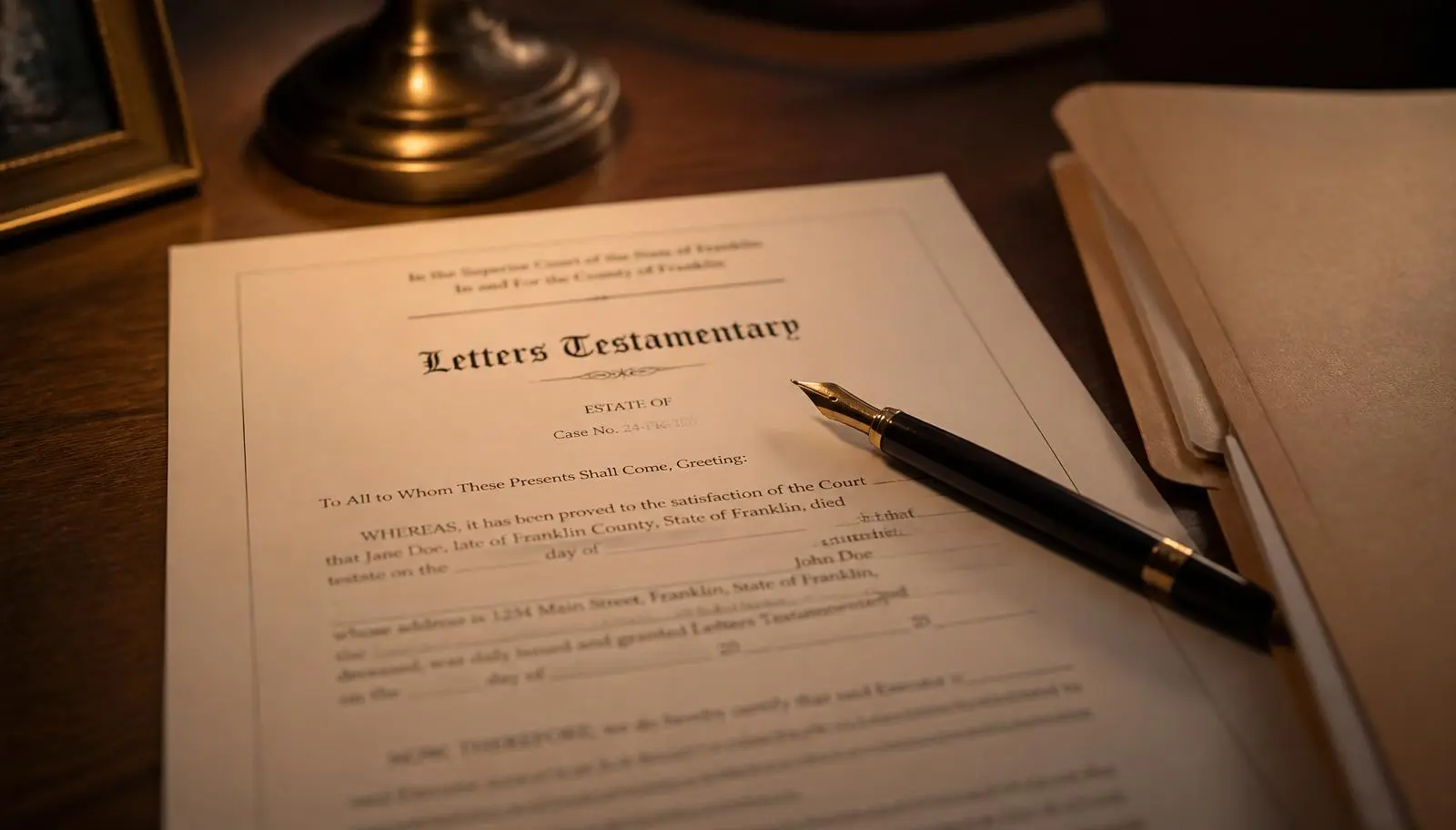
Letters Testamentary (with a will) or Letters of Administration (without one) is a short, formal document issued by the probate court that names you as the personal representative and tells the outside world you are legally authorized to act for the estate.
You will hand a copy of this document to:
- Banks, so they'll let you open an estate account.
- The DMV, so you can transfer titles.
- The IRS, so you can file the final tax return.
- The estate sale company, so they'll sign a contract with you.
No reputable estate sale company in the country will sign a contract to liquidate a deceased person's belongings without seeing Letters. It's not them being difficult — it's them protecting you and themselves from a claim by another heir or creditor later. If a company is willing to skip this step, that alone is a red flag (North Carolina — Letters Testamentary Q&A; South Carolina — Letters Testamentary explained).
Timing to expect: in most states, filing to open probate takes a few weeks to a couple of months to result in Letters being issued — assuming the will is uncontested and the paperwork is clean. Some states allow emergency or special administrations for time-sensitive situations (perishable property, a home in foreclosure, imminent closing dates). Ask your probate attorney whether that applies to you.
Independent vs. supervised administration — why it matters for an estate sale
Here's the piece most articles skip, and it's genuinely important.
Not all probates are equally hands-on. Most states offer some version of two tracks:
- Independent (or "informal") administration. Once the executor is appointed, they can sell personal property, pay bills, and generally manage the estate without asking the court's permission for every step. The court is a referee, not a boss. In Texas, for example, roughly 80% of estates use this track (Settled Estate — Texas Independent Administration).
- Supervised (or "dependent" / "formal") administration. The court has to approve major actions — sometimes including the sale of personal property above a certain value. This is more common when there's family conflict, minor beneficiaries, an insolvent estate, or no will and no consent among heirs (LegalClarity — Supervised vs. Independent Estate Administration Explained).
For an estate sale, this matters because:
- Under independent administration, the executor can usually schedule an estate sale as soon as Letters are in hand.
- Under supervised administration, the executor may need to file a notice or petition with the court before the sale — sometimes even before signing the contract. The rules vary widely: California requires Notice of Proposed Action under certain circumstances (California Probate Code § 10580 et seq.); Nevada has a similar structure (NRS 143.535); Ohio spells out the personal-property sale authority in ORC § 2113.40.
The one-sentence takeaway: which track you're on determines whether the sale needs additional court paperwork, so this is one of the first questions to ask your probate attorney. The estate sale itself is usually straightforward; the paperwork around it is where families sometimes stumble.
What the executor is actually responsible for during the sale
If you're the executor, please hear this: your job is not to price the salt-and-pepper shakers. Your job is to make sure the sale is honest, documented, and fair to the heirs and creditors the court has entrusted to your care. That's a fiduciary duty, which is a fancy legal way of saying "act like you're spending someone else's money — because you are."
Practically, that looks like:
- Inventory before you sell. Most states require some form of estate inventory. Do a walkthrough with the estate sale company and photograph everything before pricing begins. That protects you if an heir later says "but Grandma's diamond ring was in the top drawer."
- Pull out anything specifically bequeathed. If the will says "my pearl necklace goes to Anna," pull the pearl necklace out of the sale. This is the #1 source of family lawsuits in estate sales — and it's 100% preventable.
- Get written appraisals for high-value items. Jewelry, art, coins, firearms, silver, and instruments should be independently appraised before they're priced for a sale. If an heir later challenges the price, the appraisal is your armor.
- Use a reputable, bonded, insured estate sale company. Not a friend. Not a cousin's neighbor. A company with references, a written contract, and both liability insurance and a surety bond. This is not the moment to save 5% on commission.
- Keep every receipt. Deposit sale proceeds into the estate bank account — never a personal account. Every dollar in and out needs to be traceable when you file the final accounting with the court.
Executors who follow these five rules almost never get sued. Executors who skip them sometimes do — and it's heartbreaking, because they usually meant well (Tax Shark — Can Estate Executor Sell Property?).
What you can safely start before Letters arrive

Waiting on the court is the hardest part. It feels passive and slow at exactly the moment you want the world to move. Here's what you can do right now, before Letters are issued, that will make everything faster once they are.
- Secure the home. Change the locks, forward mail, cancel newspaper delivery, adjust the thermostat, alert a trusted neighbor. This is preservation of estate property — it's part of the informal role you're already playing.
- Notify the insurance carrier. Most homeowner policies limit or void coverage after 30 days of vacancy. Ask the carrier to switch to a vacant home policy immediately. This is probably the most-forgotten step in probate and it can cost families five figures when something goes wrong.
- Interview estate sale companies. Reputable companies do walkthroughs and provide written proposals for free, with no obligation. Doing this before Letters arrive means you can sign a contract the same week you're appointed.
- Take photos and videos of every room. Not for pricing — for documentation. This protects you against heir disputes later ("but Grandpa's coin collection was on the desk!") and helps the estate sale company plan.
- Let heirs walk through and mark keepsakes. Some families do "colored dot" walkthroughs: each heir gets a color of dot stickers and takes turns marking items they want to keep. Anything with a dot comes out of the sale. This is not required by any court — it's just how kind families avoid resentment.
- Locate the will and start the probate filing. The clock doesn't move until someone files. Every day you wait to file is a day added to the end.
None of the above requires court authority. None of it commits you to anything. All of it moves the ball forward.
What you should absolutely not do before Letters
- Do not sell anything valuable. Not the ring to a cousin, not the car on Craigslist, not the collection to a dealer. Sales made before you have legal authority can be voidable and can expose you to personal liability.
- Do not throw things away. Layperson "junk" is where estate sale professionals find $500 items every week. Cast iron, first editions, sterling, Depression glass, mid-century small appliances. Wait for the walkthrough.
- Do not clean out the house with a dumpster. Same reason. A 40-yard dumpster full of "clutter" is often thousands of dollars of recoverable estate value going to the landfill. This is the #1 preventable financial loss in probate estates.
- Do not distribute keepsakes formally. Informal keepsake selection is fine as long as everything is documented and no one objects. Formal distribution — signing over the piano to a nephew, transferring the car — has to wait.
- Do not commingle funds. Anything sold, anything reimbursed, anything deposited goes into the estate account, not yours.
The realistic timeline for an estate sale in probate
Every state and county differs, but here's a rough map most families can plan around:
| Milestone | Typical Time from Death |
|---|---|
| Contact a probate attorney; secure the home | Week 1–2 |
| File the will and petition to open probate | Week 2–4 |
| Notice period; hearing scheduled | Week 4–8 |
| Letters Testamentary issued | Week 4–12 |
| Contract signed with estate sale company | Week 4–12 (day Letters arrive) |
| Sorting, pricing, staging, marketing | 3–6 weeks after contract |
| Estate sale weekend | ~2–4 months after death |
| Cleanout / donation / disposal | Within 1 week of sale |
| House ready to list or transfer | 3–4 months after death, in the average case |
Complex estates, contested wills, or supervised administrations can easily push this out to 6–12 months. That's not a failure — that's the process working correctly.
The empathetic part

I want to say a few things that don't fit in a checklist.
The house is not the person. The most tender thing a family faces during probate is the feeling that letting go of the stuff is letting go of the person. It isn't. The person is safe in your memory. The stuff is just stuff, and stuff wants to go be useful somewhere else. A well-run estate sale sends your grandmother's Pyrex to a young couple who will use it for Sunday breakfast for the next thirty years. Her books go to a schoolteacher. Her rocker to someone's front porch. That is a good thing.
Grief and paperwork don't share a schedule. You will have days when you can look at legal documents for six hours and days when you can't answer an email. Both are fine. Estate sale professionals who work in probate understand this and are not going to rush you. If one does, hire a different one.
You don't have to do it alone. A probate attorney, an experienced estate sale company, and — if the situation calls for it — a grief counselor or a hospice social worker are all resources that exist for this exact moment. Using them is not weakness. It's what they're there for.
You are allowed to keep the ugly lamp. If there's one piece in the house that means everything, keep it. It doesn't have to make sense to anyone else. That's not a loophole in probate law — that's just being human.
How EstateSaleFinder can help right now
We built EstateSaleFinder to make the actual finding of a trustworthy estate sale company as easy as possible — no cold calls, no guesswork, no wondering whether the person you're about to hire actually knows how to handle a probate estate.
- Start with our Find a Vetted Estate Sale Company directory to see companies near you with verified reviews, insurance and bond confirmation, and past sales you can actually look at.
- Read our full guide to hiring an estate sale company for what to ask on the first phone call.
- If you're not sure yet whether an estate sale is right for your situation, Cleaning Out a Parent's House After Death walks through the emotional and practical steps with more room to breathe.
- If cost is a concern, What Estate Sale Companies Actually Charge breaks down commissions, fees, and what's fair to expect.
You don't need to make any decisions today. Just start the conversation. A good company will meet you where you are.
Questions & answers
Frequently asked questions
Can I have an estate sale before probate is finished?
Yes. In most states, an estate sale of personal property (furniture, dishes, clothes, collectibles) happens during probate — long before the estate itself is closed. What you can't do is sell estate property before the court has appointed you as personal representative and issued Letters Testamentary or Letters of Administration.
Do I need a lawyer to have an estate sale during probate?
You don't strictly need a lawyer to hire an estate sale company, but you almost certainly need a probate attorney to become the legal executor in the first place. That's the step that unlocks your authority to sign the sale contract. In independent-administration states, most of the rest of the process moves without heavy court involvement.
What if there's no will?
The court will appoint an administrator instead of an executor — usually the surviving spouse or an adult child — and issue Letters of Administration. Once those are in hand, the administrator has essentially the same authority to hold an estate sale as an executor would. The path is a little slower because there's no will to prove, but it works.
Can the executor be sued for holding an estate sale?
Only if the executor breaches their fiduciary duty — for example, by selling items to themselves at below-market prices, by ignoring specific bequests in the will, or by failing to account for the money. Executors who use a reputable, bonded, insured estate sale company; pull specifically bequeathed items out of the sale; get appraisals for valuables; and keep clean records almost never face problems.
What about the house itself?
Real estate is a different process. Selling the house during probate usually requires either broad authority in the will, all heirs' consent, or specific court approval, and it has its own timeline. This guide is about the contents of the house — furniture, personal property, collectibles — which is a much more routine part of any probate.
How long does it take to get Letters Testamentary?
Most states issue Letters within 4–12 weeks of filing, assuming an uncontested will and complete paperwork. Some states offer expedited or emergency appointments when there's a genuine time-sensitive issue (like a house closing or perishable property). Ask your probate attorney.
Can heirs override the executor and hold a sale themselves?
No. Until the executor is discharged or removed by the court, they are the only person with legal authority to sell estate property. Heirs can object to a proposed sale (and in supervised administrations, that objection can go to the judge), but they can't run a parallel sale.
Can the estate sale company help with a probate estate specifically?
Reputable companies handle probate estates constantly — it's one of the most common situations they work in. When you interview companies, ask directly: "How many probate estates have you handled in the last year, and can I speak to two of those executors as references?" A confident answer to that question is a very good sign.
One last thing. If you're stuck at the beginning of this — you have the will, or you don't, and you're not sure what to do next — the single best move is to make two phone calls this week: one to a probate attorney in your county, and one to an estate sale company in your area for a walkthrough. Neither call obligates you to anything. Both will make the whole road ahead feel a lot less lonely.
Keep exploring
Ready to start your own treasure hunt?
Discover estate sales near you and find incredible deals.
Explore Sales Near Me
About the author
Andy
Founder, EstateSaleFinder.net
Hi, I'm Andy — a retired commercial photographer turned developer with a five-year (and counting) obsession with estate sales. I started EstateSaleFinder.net because I knew there had to be an easier, smarter way to find and list estate sales. Now I get to chase treasure and build the tool I always wished existed.