

Estate Sale Etiquette: The Unwritten Rules Buyers and Sellers Both Wish Everyone Knew
Estate sales are half retail, half stepping into someone's private life. There is a real code of conduct regulars follow — and the people who break it are the ones asked to leave. Here are 45 rules, from both sides of the sale.
Estate sale etiquette comes down to one idea: you are a guest in someone's home, not a customer in a store. Honor the line, stay out of taped-off rooms and marked drawers, don't hoard or hide items, hold price negotiation until the discount days, pay promptly, and haul out what you buy by the posted deadline. Break those and you don't just have a bad morning — good companies keep lists, and being blacklisted costs you every sale they run afterward.
Estate sales are a strange hybrid: half retail, half stepping into someone's private life. The family may be in the next room. Their belongings, their memories, and their privacy are all on display. Below are 45 rules experienced buyers and sellers follow — most of which nobody ever puts on a sign.
Why etiquette matters more at estate sales than anywhere else
An estate sale is usually triggered by a death, a move to assisted living, a downsize, or a divorce. That is the emotional weight most first-time buyers don't feel until they're standing in a stranger's kitchen holding her wedding china.
The unwritten rules exist for three practical reasons:
- They protect a grieving or stressed family from being treated like a clearance rack.
- They keep the sale physically safe in a house with narrow hallways and fragile inventory.
- They separate serious buyers from the handful of people who ruin sales for everyone else.
The rules are not gatekeeping. They are what makes the whole thing work well enough to keep happening every weekend.
Part 1: Etiquette for buyers
Before you arrive
1. Read the listing carefully. Every company runs sales slightly differently: numbers versus first-come, bag policies, negotiation windows, load-out times, payment methods. The fastest way to look inexperienced is to arrive and ask what the listing already answered.
2. Confirm payment methods first. Some sales are cash only. Some take cards but not Venmo or Zelle. Some take everything. Showing up with the wrong payment and expecting flexibility is a rookie move.
3. Bring supplies. Cash in small bills, a tape measure, a small flashlight, reusable bags, packing paper or towels for glass, and — if furniture is on your list — a vehicle that can actually haul it. Load-out is your job, not the staff's.
4. Calibrate your expectations. Estate sales are not garage sales. Inventory is usually priced by people who know what they have. Real bargains exist and appear constantly, but they reward knowledge, not entitlement. If you want to know which items get mispriced most often, the overlooked expensive items and brands guide is the field manual.
In the line
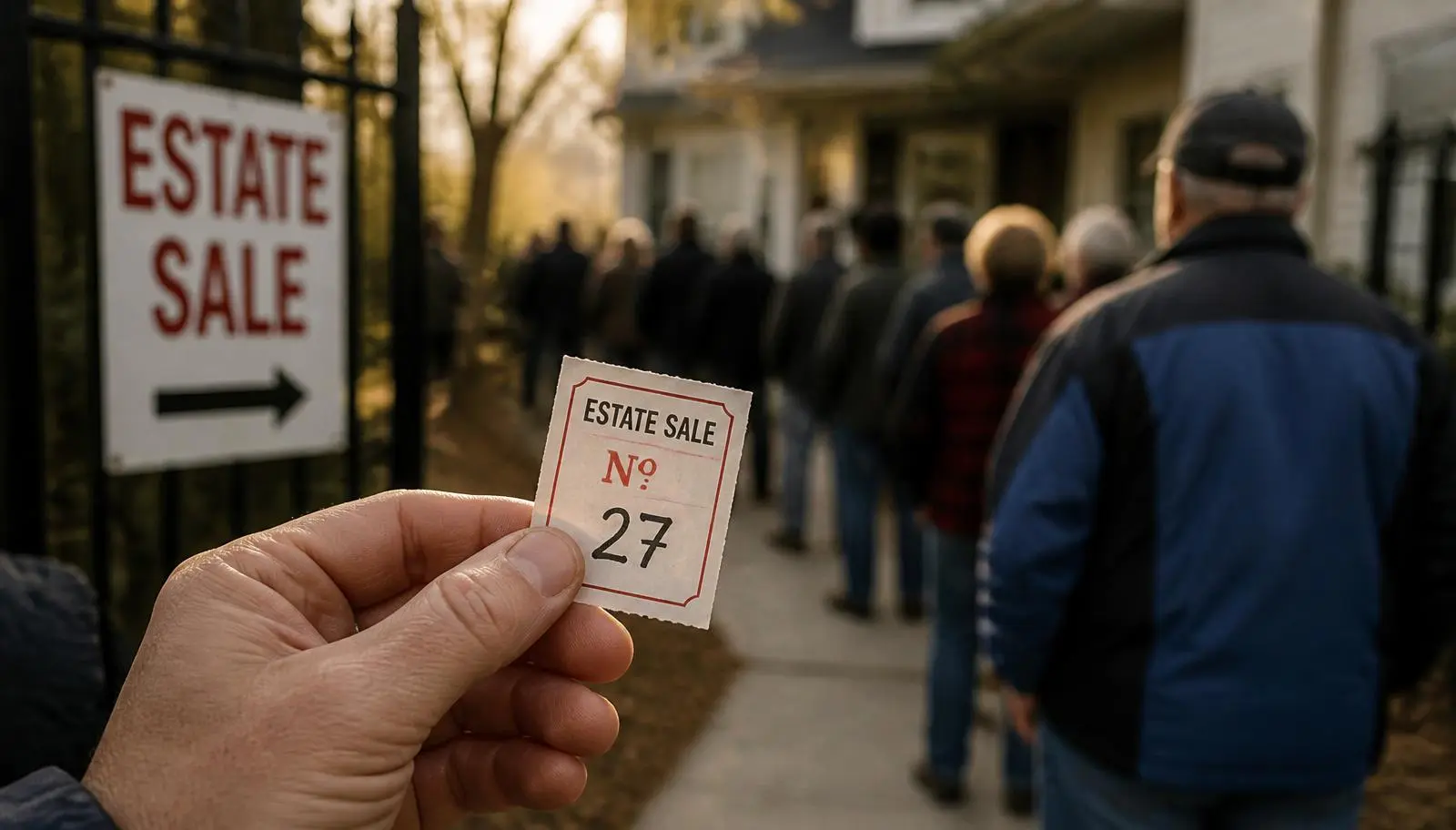
5. Respect the line — no exceptions. At popular sales, people queue up to an hour early. Many companies hand out numbered tickets to lock in order. Do not cut. Do not hold spots for five friends who show up at opening.
6. Hold your place with your body, not your car. Sitting in a warm vehicle does not reserve position unless the company explicitly runs a sign-in sheet. If you want to be first through the door, stand there.
7. Don't rush the door. Walk in. Running, shoving past staff, or blocking the entry is how a company decides you're not welcome back.
8. Don't cluster in the entryway. Once inside, keep moving. Long conversations and phone-checking in a doorway back up twenty people behind you.
Inside the home

9. This is somebody's home — act like it. Someone lived here. Sometimes someone died here. No jokes about the deceased, no remarks about the family's taste, no loud commentary about how "cheap" the belongings are. Family members are often inside, pricing in the next room, listening.
10. Respect off-limits areas. Taped doorways, cabinets marked not for sale, closed closets with signs — those are boundaries, not challenges. Getting caught pushing past one is the single fastest route to being asked to leave.

11. Don't open marked drawers or containers. A for-sale dresser can still hold family photos, medical records, or documents the sale hasn't cleared. Taped or labeled means hands off.
12. Handle items carefully. "You break it, you buy it" is real. Don't stack pieces to see underneath, and don't use a fragile table as a staging surface for everything you're considering.
13. Don't block the traffic flow. Hallways in most homes fit one person. Step into a corner or outside to make decisions or take calls.
14. Follow staff instructions immediately. If someone asks you to put an item down, move, or step outside, do it. Arguing is the second fastest way out the door.
The buying process
15. Don't hoard items you may not buy. This is the number one complaint companies have: a shopper piles forty items in a corner, then buys three. Many sales now require a "sold" tag with your name — and tagging it means you're committed. If you're unsure, don't tag it.
16. Don't hide items to buy later. Stashing pieces behind a couch or in a closet to come back for is universally despised. Staff notice, and other buyers notice.
17. Never move or swap a price tag. That is theft. It results in permanent bans, and some companies pursue charges.
On haggling — where most people get it wrong

18. Day one is not for haggling. Professional sales hold firm prices on opening day. Asking for a discount at 8:15 AM marks you instantly as an amateur. Love it, buy it — or come back later and risk losing it.
19. Day two is when negotiation opens. Most multi-day sales publish a discount schedule that looks like this:
| Day | Typical pricing | Negotiation room |
|---|---|---|
| Day 1 | Full price | None — firm |
| Day 2 | ~25% off | Some, especially on bundles |
| Day 3 / final hours | ~50% off or more | Greatest flexibility |
Always check the listing — plenty of companies run two-day sales, and some go deeper than 50% in the last hour to avoid hauling inventory away.
20. Ask politely, not aggressively. The phrasing that works: "Is there any flexibility on this price?" or "Would you consider a discount if I take all three?" The phrasing that fails: "Would you take $10?" on a $200 item on opening morning.
21. Bundle for the real discount. Offering one price for several items is the single most effective move at an estate sale, because it moves volume in a business where unsold inventory is a cost.
22. Accept no gracefully. If staff says no, that's the answer. Don't argue, don't shop for a softer second opinion from another staff member, and don't explain what the item "should" be worth.
After you buy
23. Pay promptly. Once you've decided, go to checkout. Don't wander the house for another 40 minutes holding items other people want.
24. Load out on time. Large furniture typically must be gone by a posted deadline, often early afternoon on the final day. If you buy the couch, you move the couch. Bring a truck, bring help, or don't buy it.

25. Don't damage the home. Protect doorframes, walls, and floors on the way out. Companies are responsible to the family for the condition of the property — and they remember exactly who gouged the stairwell.
New to all of this? What to expect at your first estate sale walks through the full buyer experience start to finish.
Part 2: Etiquette for sellers

Before the sale
26. Decide honestly between DIY and hiring a professional. Companies typically take 30–40% of gross. That buys objectivity, pricing expertise, staffing, and a buffer between you and 200 strangers. Above roughly $5,000–$10,000 in sellable goods, a professional usually nets more and costs less stress. The breakdown of what estate sale companies actually charge runs the math.
27. Make every keep-or-sell decision before pricing. Pulling priced items mid-sale undermines your own company, frustrates buyers, and can breach your contract.
28. Put the rules in the listing. Opening time, parking, payment methods, whether numbers are handed out, bag policy, pets and strollers, negotiation windows, and load-out deadlines. Buyers who know the rules follow them.
29. Secure valuables before doors open. Fine jewelry, sterling, coins, and small collectibles belong in a locked case or at the checkout table — never scattered on a table in a back bedroom.
30. Physically remove sentimental items. "Not for sale" tags get argued over, ignored, or accidentally sold. Anything the family keeps leaves the house before pricing.
During the sale
31. Don't hover. The number one DIY mistake. Buyers need room to inspect, discuss, and decide. Follow them around and they leave empty-handed.
32. Let people touch things. This is used merchandise and buyers will not spend real money without handling it. The exception is small high-value pieces, which live at the checkout table for supervised viewing.
33. Don't overcrowd displays. Stacked, piled inventory hides your best pieces and overwhelms shoppers. Spread out across tables, shelving, and racks.
34. Run one clear checkout. Clear signage, multiple payment methods, someone who can wrap fragile items fast, and a running sold list so nothing gets double-promised.
35. Enforce your own rules consistently. If the listing says no negotiation on day one, hold that line. Buyers talk, and sellers who bend for the pushiest shopper get pushed at every future sale.
Communicating with buyers
36. Be transparent about condition. Chips, cracks, missing pieces, prior repairs — say so. Buyers who feel deceived write reviews that outlive the sale.
37. Don't inflate provenance. "It might be antique" and "it was my grandmother's" add no value without evidence, and overclaiming costs credibility with the buyers who spend the most.
38. If you don't know, say so. "I'm not sure what this is — feel free to make an offer" is a respected answer. A confident wrong guess is not.
Operationally, how to run a successful estate sale covers staging, staffing, and pricing in depth.
Part 3: The unwritten rules nobody talks about
39. Regulars get remembered. Show up month after month, follow the rules, pay promptly, treat staff like people — some companies start offering preview access, holds, and heads-ups on incoming sales. That relationship is worth more than any single deal.
40. The parking lot is part of the sale. Don't block driveways, park on neighbors' lawns, or idle in fire lanes. Neighbor complaints are how companies lose the ability to run sales in a neighborhood at all.
41. Think hard before bringing young kids. Fragile inventory, narrow walkways, and competitive crowds make a busy sale a poor environment for small children. If they come, they stay with you.
42. Pets stay home or in the vehicle. Even the friendliest dog is a liability in a house full of glass and strangers.
43. Don't speculate about the family. "Bet somebody died," "must be a divorce" — it gets overheard, every time. Keep it to yourself.
44. Take photos discreetly, if at all. Assume photography is not allowed unless posted. Never photograph the family, and never shoot broad interiors of the home — just the item you're considering.
45. If a family member is present, thank them. "I'm sorry for your loss" or "thank you for letting us come through" costs nothing and means an enormous amount to someone clearing out a parent's house. If they offer the story behind an item, listen.
What actually gets buyers banned
Companies keep lists, and in mid-size markets they compare notes. The behaviors that end access:
| Behavior | Why companies ban for it |
|---|---|
| Cutting the line or door-rushing | Safety risk and it enrages paying regulars |
| Hiding items to buy later | Steals inventory from other buyers |
| Opening taped rooms, closets, or drawers | Violates the family's privacy and the contract |
| Swapping or removing tags | It is theft, full stop |
| Aggressive day-one haggling | Slows checkout and pressures staff |
| Damaging items or the home | The company is liable to the homeowner |
| Arguing with staff | Makes the sale unmanageable |
| Bringing pets inside | Breakage and liability |
| Photographing the family or interiors | Privacy and security risk |
| Ignoring load-out deadlines | Blows the company's cleanout schedule |
Being blacklisted means missing every future sale that company runs — often the majority of the good sales in your area.
Etiquette in difficult situations
When a family member is grieving in the next room
Speak quietly. No jokes. If you love something, buy it — families overwhelmingly want their parents' belongings going to people who value them. If someone offers the story behind a piece, listen genuinely; it matters far more to them than the price.
When the sale follows a divorce
You may sense tension, or watch items get pulled abruptly. Don't comment, don't ask why. Buy what you want and move on.
When you think an item is badly underpriced
You have no obligation to say anything; this is a market transaction. But if you shop a company regularly, quietly mentioning "I think this may be worth more than the tag" builds the kind of trust that turns into preview invitations later. Plenty of regulars got their access exactly that way.
Questions & answers
Frequently asked questions
Is haggling allowed at estate sales?
Yes, but timing decides everything. Day one is typically firm full price. Day two usually opens to about 25% off with light negotiation, and the final day commonly runs 50% off with the most flexibility. Ask politely, bundle items, and never lowball on opening morning.
How early should I arrive at an estate sale?
For a competitive sale in a major metro, 30–60 minutes before opening. For a weekday or smaller sale, 15–30 minutes is plenty. Bring a folding chair if you expect a long wait, and check whether the company hands out numbered tickets.
Can I bring bags into an estate sale?
It varies by company. Many sales prohibit large bags and backpacks to reduce theft. Check the listing; when in doubt, carry a small crossbody bag and leave the rest in your car.
Should I bring my kids to an estate sale?
Not to a large, busy sale with fragile inventory and narrow walkways. At a smaller, calmer sale it's usually fine as long as children stay with you the entire time and don't handle glassware.
What if I break something at an estate sale?
Most sales operate on "you break it, you buy it." Tell staff immediately and ask how they'd like to handle it. In practice, honesty is very often met with grace — especially on low-value pieces.
Can I ask about specific items before the sale?
Yes, by phone or message ahead of the sale — not on opening morning. Staff running an active sale cannot stop to research a specific piece for you.
Do estate sale companies remember rude buyers?
Yes. Most keep notes, many share them with other companies in their region, and repeat offenders get barred from future sales. Reputation compounds in both directions.
Do I have to take the furniture the same day?
Yes, unless the company explicitly agrees otherwise in writing. Load-out deadlines are usually early afternoon on the final day, and staff will not help carry items to your vehicle.
The short version
Buyers respect the home. Sellers respect the buyers. Staff get to run a sale instead of managing conflict. That is the entire code, and it is why the good sales stay good.
Ready to put it to work? Browse upcoming estate sales near you and find a verified estate sale company on EstateSaleFinder.
Keep exploring
Ready to start your own treasure hunt?
Discover estate sales near you and find incredible deals.
Explore Sales Near Me
About the author
Andy
Founder, EstateSaleFinder.net
Hi, I'm Andy — a retired commercial photographer turned developer with a five-year (and counting) obsession with estate sales. I started EstateSaleFinder.net because I knew there had to be an easier, smarter way to find and list estate sales. Now I get to chase treasure and build the tool I always wished existed.