

Can You Sell a House With Furniture Still in It? What Executors and Realtors Should Do With the Contents First
You can sell a house with furniture in it, but the deed doesn't transfer the contents and "as-is" means condition, not belongings. The three options compared, an executor's checklist, the best timeline, and a section for realtors.
Yes, you can sell a house with furniture still in it. But the deed transfers the house, not the belongings. Furniture and other contents go to the buyer only if the purchase contract, an addendum or a separate bill of sale lists them. "As-is" describes the condition of the house, not what's inside. For an estate, the contents usually have to be inventoried and handled first.
That's the short answer. The longer one matters if you're an executor, a family member or a realtor staring at a full house: what each option really costs, what the law expects of an executor, and the order that usually gets the most money with the least stress.
Quick summary for skimmers:
- The house and the contents are two different kinds of property. Real property (house, land, fixtures) goes with the deed. Personal property (furniture, dishes, art) doesn't, unless the paperwork says so.
- You have three main options: sell the contents first in an estate sale, sell the house furnished, or take a cash offer for the house with everything in it.
- Executors have duties. List, photograph, secure and account for the contents before anything is removed, sold or thrown out.
- The usual order: inventory, family picks, estate sale, list the house with a few staging pieces, remove those before closing.
- Realtors: an empty, clean house usually photographs and shows better. An estate sale can clear it and pay the family at the same time.
Can you sell a house with furniture still in it?
Yes. Nothing stops you from listing or closing on a house that still has things in it. What you need to understand is who owns those things after closing.
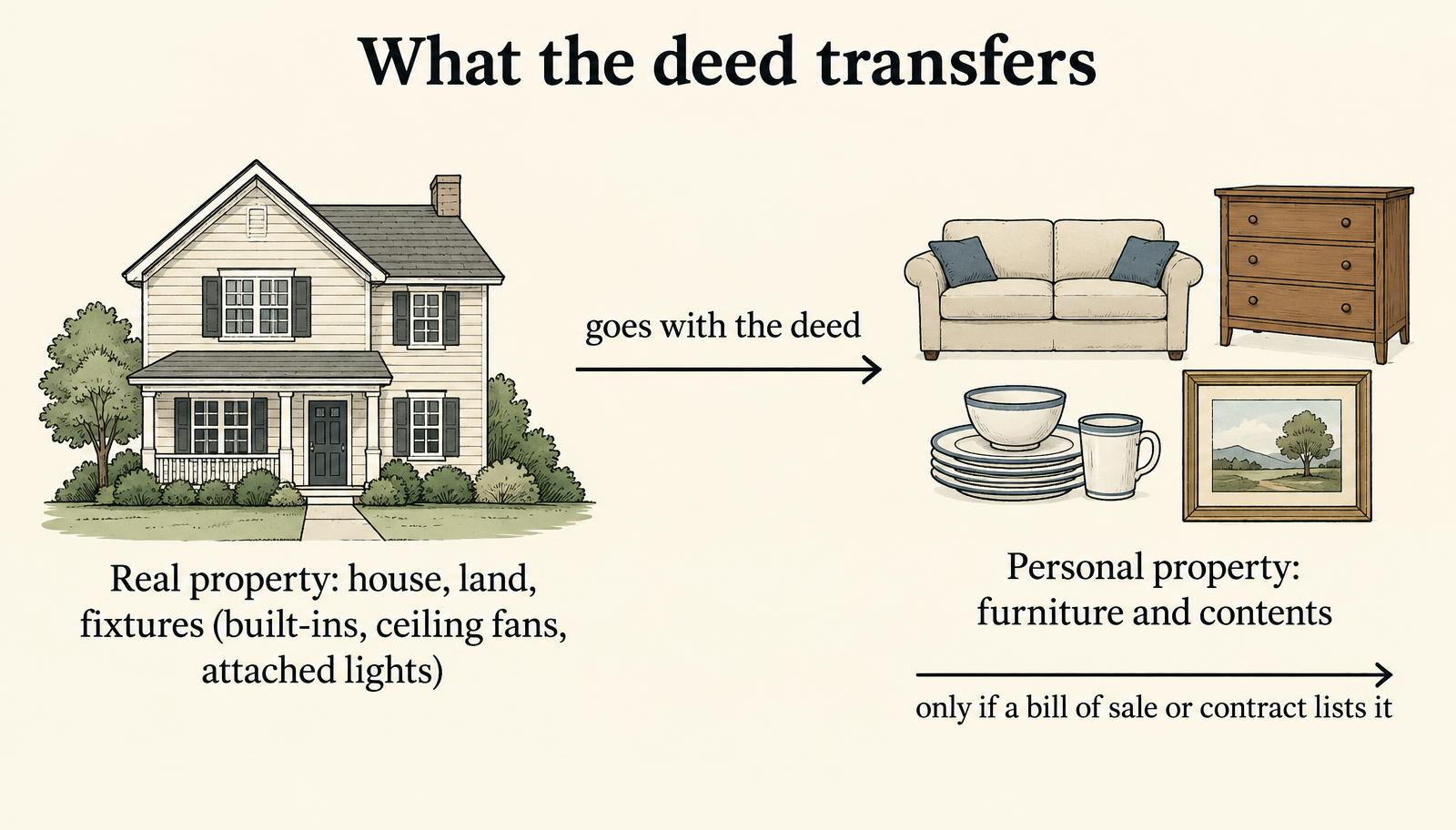
Pierce Law Group, a North Carolina probate firm, puts it plainly: buying an estate house "does not automatically give the buyer the personal property inside the home." Furniture, clothing, tools, photos, vehicles and jewelry "remain estate personal property unless the deed, purchase contract, court order, or family settlement agreement clearly transfers those items" (Pierce Law Group).
The North Carolina REALTORS' guide to the standard purchase contract says the same from the agent's side: fixtures are included unless excluded, but personal property "is not included as a part of the sale unless specifically included," and an item listed in the MLS but not named in the contract "is not a part of the contract" (NC REALTORS).
North Carolina is the example here, but most states draw the same line between real and personal property. Ask your attorney or agent how your state's standard contract handles it.
What does "as-is with contents" actually mean?
"As-is" means the buyer accepts the condition of the house without asking for repairs. It doesn't, by itself, say anything about the couch. If you want the buyer to take the contents, the contract or a bill of sale should say "all contents remaining at closing," or list the items, and state who handles anything left over.
What happens if you leave stuff behind when you sell your house?
It depends on the contract. Many standard contracts expect the house delivered free of the seller's belongings and debris. Leftovers can delay the walkthrough, lead to a holdback from your proceeds or a cleanup bill, or create a dispute. In an estate, items left behind may also still legally belong to the estate, which is a problem for the executor.
Three ways to handle a full house, and what each costs
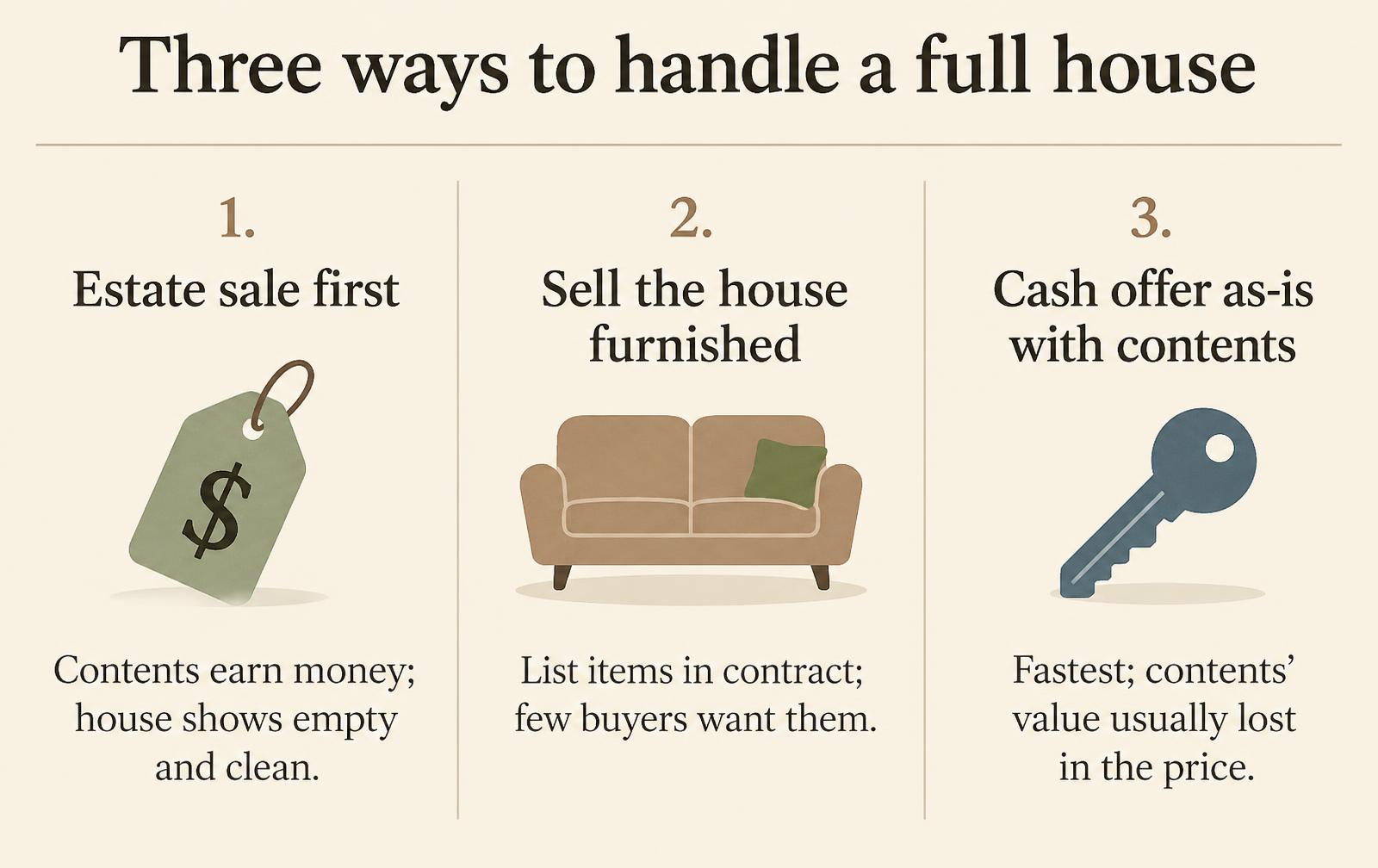
| Estate sale first | Sell the house furnished | Cash offer with contents | |
|---|---|---|---|
| Who gets paid for the contents | The estate or family, after the company's commission | The buyer, only if they agree to pay | Usually no one; it's folded into a lower price |
| How the house shows | Empty and clean, or lightly staged | As lived in | Not marketed |
| Time | Often about 3 to 6 weeks for the sale process | Normal listing time | Fastest |
| Main risk | Needs a company and a few weeks | Most buyers don't want someone else's furniture | Leaving money on the table |
| Best when | There's anything of value inside | Vacation or turnkey rentals where buyers want it furnished | Severe condition, hoarding, or no time at all |
Option 1: Estate sale first
An estate sale company sorts, prices and sells the contents, then often arranges donation, buyout or hauling for what's left. You're paid a share of sales. See our timeline of how long an estate sale takes for the week-by-week detail, and estate cleanout or estate sale if you're weighing a cleanout instead.
Option 2: Sell the house furnished
This works when buyers actually want the furniture, such as furnished vacation homes or rentals. For a typical family home, most buyers don't. If you do include items, list them in the contract and decide whether they add to the price or are included at no charge.
Option 3: Take a cash offer for the house with everything in it
Some investors will buy as-is and handle the contents. It's fast. The trade-off is that the value of the contents and the cost of clearing them are reflected in a lower offer. In a widely read January 2026 post in Reddit's r/AgingParents, a Tampa adult child funding a parent's memory care described exactly this choice: a realtor said the house needed to be empty to list, and a cash buyer offered to take it "as-is" with the contents inside. The most-upvoted reply was simply: "You can split the difference" (Reddit r/AgingParents). That's one family's story, not data, but it's the decision many families face.
Splitting the difference often means holding an estate sale for the contents first, then selling the house either on the market or to a cash buyer. You keep the money from the contents either way.
What an executor must do with the contents first

If someone has died and the estate is in probate, the executor (also called the personal representative) is responsible for the estate's property, including what's in the house. Pierce Law Group says the personal representative "should inventory, secure, value, divide, sell, or distribute the contents before or as part of the closing," and notes that in North Carolina the Clerk of Superior Court oversees inventories and accountings (Pierce Law Group).
A practical checklist:
- Change or control the keys. Know who can get in.
- Photograph every room before anyone removes anything, including closets, garage and attic.
- Make an inventory. Note anything of obvious value: jewelry, silver, art, guns, coins, vehicles, collections.
- Check the will for specific gifts before letting family take items.
- Ask the attorney whether you need court permission or heir agreement before selling contents. Our guide to estate sales during probate covers the usual questions.
- Keep records of everything sold, donated or thrown out, with amounts. You'll need them for the accounting.
- Value before you give away. Read valuing inherited items before giving away a fortune before calling a junk hauler.
This is general information, not legal advice. Rules vary by state; follow your attorney and the probate court.
The timeline that usually works best
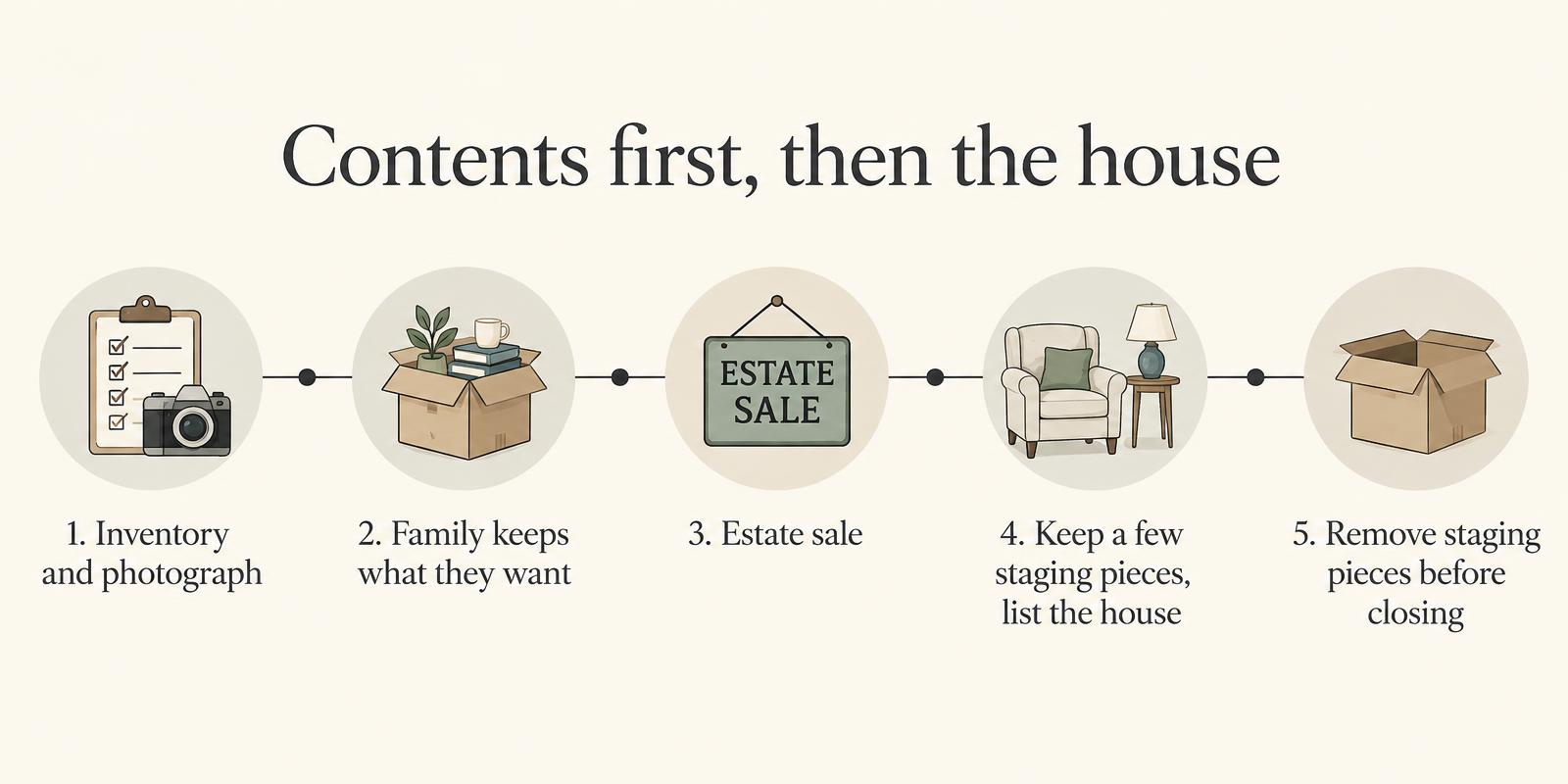
- Inventory and photograph everything.
- Family takes what they're keeping, in line with the will and any agreement.
- Hold the estate sale. Tell the company up front which pieces aren't for sale.
- Keep a few staging pieces (a sofa, a table, lamps) if your agent wants them, then list the house.
- Remove the staging pieces before the final walkthrough, unless the contract says they stay.
Plan backward from any closing date. If a closing is already set, tell estate sale companies on the first call so they can say whether they can fit it in.
For realtors: why an empty, clean house sells better

Listing photos of a full house show the stuff, not the space. A cleared, cleaned house photographs brighter, shows room sizes honestly and lets buyers picture their own life there. It also removes a common source of last-minute closing friction: belongings nobody agreed to.
For your seller, an estate sale does something a cleanout can't: it turns the contents into money instead of a bill. That's an easy win to offer an executor or adult child who's overwhelmed.
How to find a company:
- Search the estate sale company directory on EstateSaleFinder by city or state.
- Look at each company's current and past sales to see the kind of homes they handle.
- Call two or three, ask about timing, commission, cleanout and payout, and get it in writing. Our guide to finding an estate sale company lists 15 questions to ask.
- Read our realtor's guide to estate sales for how to fit a sale into a listing schedule.
Questions & answers
Frequently asked questions
Is it better to sell a house with furniture in it or not?
For most family homes, it's better to remove the contents first. An empty, clean house usually shows better, and selling the contents separately keeps their value for the family or estate. Furnished sales make most sense for vacation or rental homes where buyers want the furniture.
Can you leave furniture in your house when you sell it?
Only if the buyer agrees in writing. List the items in the contract or a bill of sale. Otherwise, plan to remove them before the final walkthrough.
Is it better to remove furniture before selling a house?
Usually, yes, though a few well-chosen staging pieces can help. Ask your agent which pieces to keep until closing.
What stops a house from selling?
Common reasons include price, condition, poor photos and a cluttered or hard-to-picture space. A house full of belongings can hurt the last two.
What happens if you leave stuff behind when you sell your house?
It depends on the contract. It can delay closing, trigger a cleanup charge or holdback, or cause a dispute. In an estate, those items may still belong to the estate.
What is included when you sell a house furnished?
Only what the contract or bill of sale lists. Name the specific items, and if there's any doubt about whether something is a fixture or personal property, list it.
Does "as-is" include the contents?
No. "As-is" describes the condition of the house. Contents transfer only if the paperwork says they do.
Are there tax implications of selling a house furnished?
Possibly. Personal property sold with a house may need to be valued separately, and estates have their own tax rules. Ask a tax professional.
Sources
Related reading:
Sources checked October 27, 2026. General information, not legal or tax advice.
Keep exploring
Ready to start your own treasure hunt?
Discover estate sales near you and find incredible deals.
Explore Sales Near Me
About the author
Andy
Founder, EstateSaleFinder.net
Hi, I'm Andy — a retired commercial photographer turned developer with a five-year (and counting) obsession with estate sales. I started EstateSaleFinder.net because I knew there had to be an easier, smarter way to find and list estate sales. Now I get to chase treasure and build the tool I always wished existed.