


How Long Does an Estate Sale Take? The Seller's Week-by-Week Timeline From First Call to Final Check
The sale itself lasts 1 to 3 days, but the whole process usually takes 3 to 6 weeks. A week-by-week seller's timeline, when you get paid, what to put in the contract, and how to plan around a closing date.
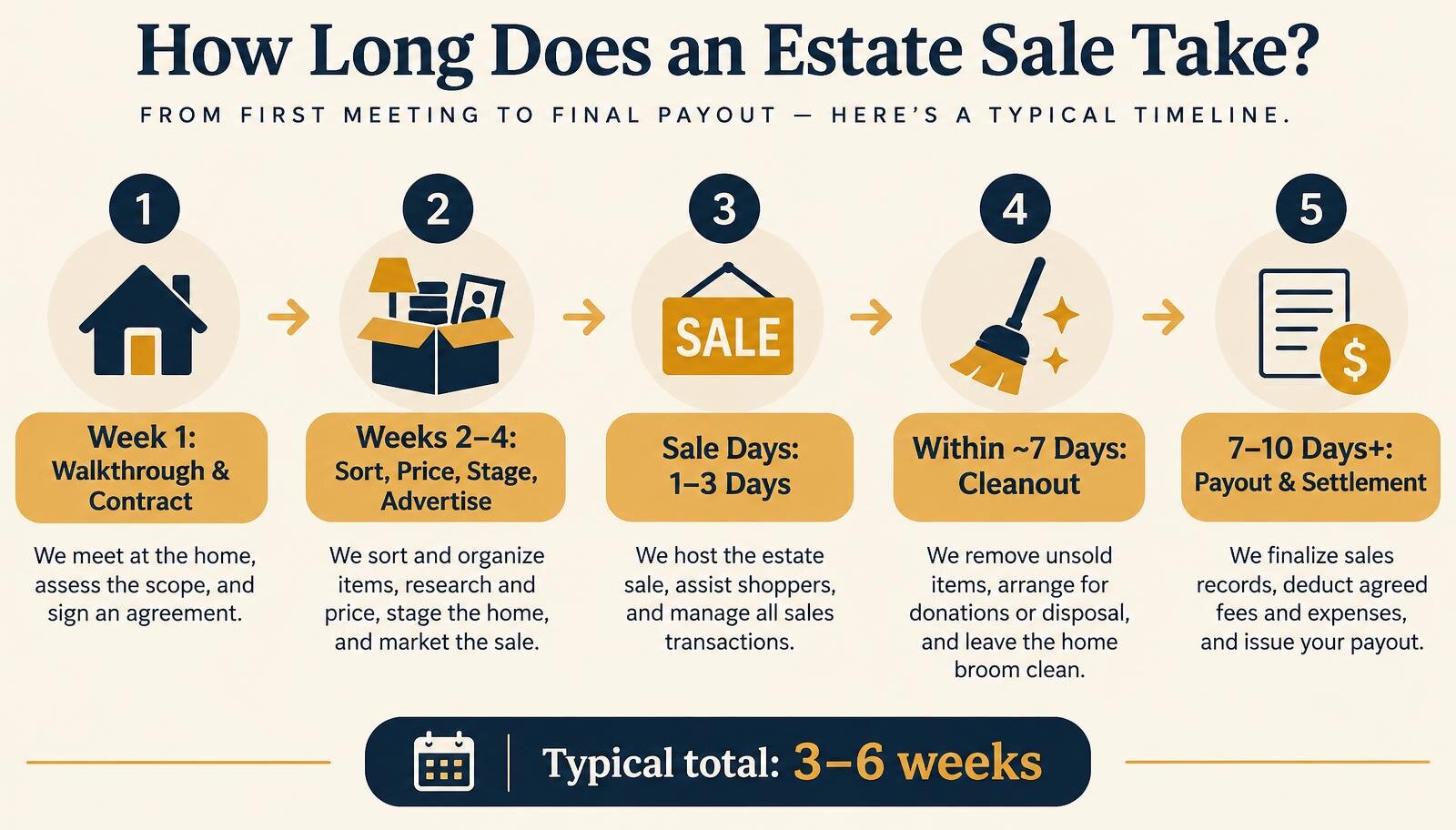
How long does an estate sale take? The public sale itself usually runs 1 to 3 days, but the whole process, from the first walkthrough to the day you're paid, typically takes about 3 to 6 weeks. Allow more time if the house is very full, the company is booked out, or a probate court or closing date sets the pace.
That's the short answer. The longer one is what helps you plan: what happens each week, who does the work, where delays usually come from, and what to put in writing so the money arrives when you expect it.
Quick summary for skimmers:
- Week 1: call companies, schedule walkthroughs, compare proposals and sign a contract.
- Weeks 2 to 4: the company sorts, researches, prices, stages and photographs the home, then advertises the sale.
- Sale days: most sales run 2 or 3 days, often with lower prices on the last day.
- After the sale: leftover items are donated, bought out or hauled away, often within about a week.
- Payout: many companies pay within one to two weeks after the sale. Get the exact deadline in your contract.
The estate sale timeline at a glance
| Phase | Typical length | Who does the work | What you should have at the end |
|---|---|---|---|
| Interviews and contract | About 1 week | You and 2 to 3 companies | A signed contract with fees, sale dates and payout deadline |
| Prep: sort, price, stage | About 1 to 3 weeks | The estate sale company | A priced, staged house and online photos |
| Advertising | Starts during prep | The company | Listings live several days before the sale |
| Sale days | 1 to 3 days (often 2 to 3) | The company's staff | Daily sales totals |
| Cleanout | Often within about a week | The company or a cleanout crew | An empty or broom-clean house |
| Settlement and payout | Often 1 to 2 weeks | The company | A check or transfer plus an itemized sales report |
These ranges are typical, not promises. The best number is the one a company writes into your contract.
Week 1: The walkthrough and the contract
The clock starts when you call. Good companies often book weeks ahead, so call early, especially if you have a deadline.
During the walkthrough, a company looks at what's in the house, how full it is, and whether there's enough to sell. Many companies have a minimum. Consumers' Checkbook notes that a home with roughly $3,000 or more in furnishings and household goods generally merits an estate sale, and that most events run two or three days (Consumers' Checkbook).
Before the walkthrough, don't throw anything away. EstateSales.NET's own advice to families is blunt: "don't throw anything away until you have an expert look at it" (EstateSales.NET).
Interview at least two or three companies. Our guide How to Find an Estate Sale Company has the questions to ask, and How Do Estate Sale Companies Work? explains what you're paying for.
What to get in writing
The Minnesota Attorney General's Office warns families about companies that delay payment and provide "only minimal paperwork regarding what items were sold and for how much" (Minnesota Attorney General). Protect yourself by putting these in the contract:
- Commission and any extra fees (cleanout, advertising, minimums).
- Sale dates and how many days the sale will run.
- When the company needs access to the house, and when it must be cleared.
- A payout deadline, such as "within X days after the last sale day."
- An itemized or daily sales report showing what sold and for how much.
- What happens to unsold items.
Weeks 2 to 4: Sorting, pricing, staging and advertising
This is the longest part of the process, and it's mostly invisible to the family. The company:
- Sorts every room, drawer, closet, garage and attic.
- Researches and prices items, checking sold comparisons for anything valuable or unusual.
- Stages the house so shoppers can see everything, often moving items into the main rooms.
- Photographs highlights for the online listing.
- Advertises the sale on listing sites, email lists and social media.
How long prep takes depends on the house. A tidy two-bedroom condo may take a few days. A packed house with a full basement, a collection, or decades of paperwork can take weeks. Many companies ask for access to the house at least a week or two before the sale, so plan family visits and keepsake removal before that window opens.
Take your keepers out first. Anything the family is keeping should be removed, or locked in one clearly marked room, before the company starts pricing. Our guide How to Prepare Your Home for an Estate Sale Company walks through this step by step.
Should you get an appraisal?
For most household contents, the company prices items as part of the job. A formal appraisal is a separate service, usually needed for court, insurance, tax or family-division reasons. See Do You Need an Appraisal Before an Estate Sale?. For a quick look at what a single item might be worth, EstateSaleFinder's Ai Appraiser gives an Ai price suggestion from photos. It's a starting point, not a formal appraisal.
Sale days: 1 to 3 days
Most estate sales run two or three days, usually over a weekend or ending on one. A common pattern:
- Day 1: full price. The most serious buyers line up early.
- Day 2: some companies discount, often around 25%.
- Last day: deeper discounts, often around 50%, plus bids or box lots.
Every company sets its own schedule. Our guide to estate sale discount days explains how discounts and offers usually work, from the shopper's side.
As the seller, you usually don't need to be there. In fact, many companies prefer the family stay away during the sale. Ask for daily sales totals so you know how it went.
After the sale: unsold items and cleanout
Very few sales sell everything. What's left usually goes one of these ways:
- Donated to charity, sometimes with a receipt for the estate's records.
- Bought out by the company or a dealer for a lump sum.
- Sold online or consigned, which can extend the timeline.
- Hauled away by a cleanout crew.
Many contracts set a short window for clearing the house, often about a week after the sale. If you're closing on the house, make that date firm. Our guide Estate Cleanout or Estate Sale: How to Decide compares the options.
When does the seller get paid?
Many companies pay within one to two weeks after the last sale day, after deducting their commission and any agreed fees. Items that go to consignment or online auction can take a month or more, because the company has to wait for those to sell and for buyers to pay.
There is no single industry rule, which is exactly why the deadline belongs in your contract. If a company won't commit to a payout date in writing, treat that as a warning sign (Minnesota Attorney General).
Your settlement should include:
- Gross sales by day.
- The commission and each fee, listed separately.
- Sales tax collected, if the company handles it.
- What happened to unsold items.
- The net amount paid to you.
Fitting an estate sale around a closing or probate deadline
Work backward from the date that can't move.
Example: house closing on the 30th.
| Date | Milestone |
|---|---|
| Day 1 | Call 3 companies; schedule walkthroughs |
| Day 5 | Sign contract with sale dates and a clear-out deadline |
| Days 6 to 10 | Family removes keepers |
| Days 10 to 21 | Company sorts, prices, stages and advertises |
| Days 22 to 24 | Sale |
| Days 25 to 28 | Cleanout; house broom-clean |
| Day 30 | Closing |
| About 1 to 2 weeks later | Payout and final report |
If you're under a probate deadline or need court approval to sell estate property, ask the estate's attorney before you sign. This is general information, not legal advice. Always verify with your attorney or the court.
Realtors and probate attorneys: if you refer families regularly, our Hire an Estate Sale Company tool lets a family describe the job once and hear from a local company, which can save a week of phone calls.
What slows an estate sale down?
- Companies booked out. Busy seasons can push sale dates out by weeks.
- Family disagreements about who keeps what.
- Keepers not removed before pricing starts.
- A very full house, or a hoard, which can need a cleanout before a sale.
- Large collections that need research, or items better sold at auction.
- Probate or court approval for selling estate property.
Questions & answers
Frequently asked questions
How long after death is an estate sale?
There's no set waiting period. Many families hold the sale a few weeks to a few months after a death, once keepsakes are divided and the executor has authority to sell. If the estate is in probate, check with the attorney before selling anything.
What percentage do estate sales usually take?
Commission rates vary by company, region and the size of the sale. Consumers' Checkbook says 30 to 50 percent is typical (Consumers' Checkbook). Compare written proposals, not just percentages.
What happens to stuff not sold at estate sales?
It's usually donated, bought out by the company or a dealer, sold online or consigned, or hauled away. Your contract should say which, and who pays for it.
What items do not sell well at estate sales?
Large dark-wood furniture, older electronics, worn upholstered furniture, used mattresses, and common china or glassware often sell slowly or at low prices. Demand varies by area.
What are the disadvantages of estate sales?
You pay a commission, strangers walk through the house, and leftovers still need a plan. The process also takes several weeks, which can be tight before a closing.
What are common mistakes to avoid at an estate sale?
Throwing things away before a company sees them, signing without a payout deadline, not removing keepers first, and hiring the first company without comparing.
Find a company and get started
- Hire an Estate Sale Company: describe the job once and hear from a local company.
- Estate sale company directory: browse companies by state, with past sales and reviews.
- Ai Appraiser: a quick Ai price suggestion for a single item.
- Estate sale companies: list your company to reach families planning a sale.
Sources
Related reading:
Sources checked October 26, 2026. Timelines and payout windows are typical ranges, not guarantees; your contract controls.
Listing the house with contents inside? See Can you sell a house with furniture still in it?
Keep exploring
Ready to start your own treasure hunt?
Discover estate sales near you and find incredible deals.
Explore Sales Near Me
About the author
Andy
Founder, EstateSaleFinder.net
Hi, I'm Andy — a retired commercial photographer turned developer with a five-year (and counting) obsession with estate sales. I started EstateSaleFinder.net because I knew there had to be an easier, smarter way to find and list estate sales. Now I get to chase treasure and build the tool I always wished existed.