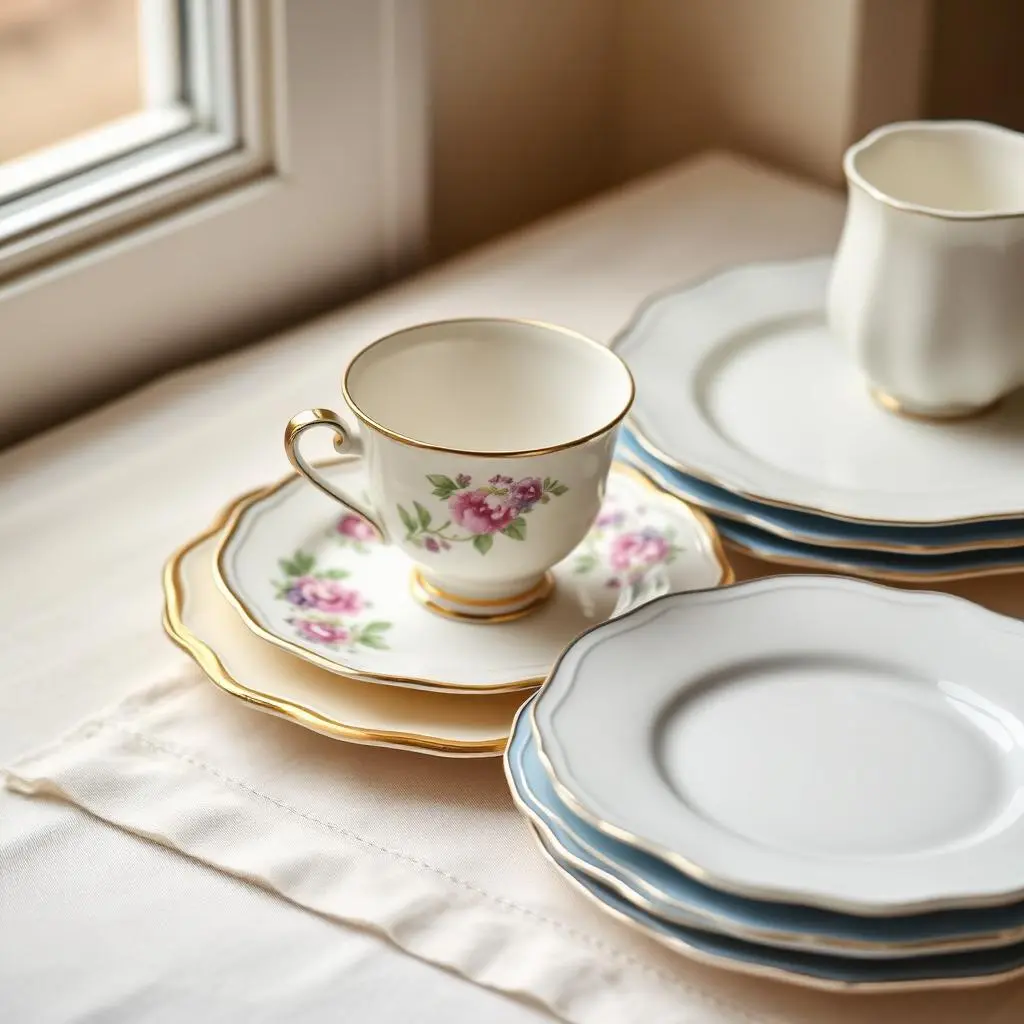
Identifying & Valuing Vintage China at Estate Sales: The Complete Guide
The complete estate-sale playbook for vintage china — how to flip a plate, read the backstamp, tell bone china from porcelain, know what patterns actually sell, and use the Ai Appraiser to price a full set before someone else grabs it.
You walk into an estate sale, spot a china cabinet packed floor to ceiling, and freeze. Is it worth anything? Is any of it worth anything? Is that Noritake real Noritake or the '70s reissue? Is the pink-rose pattern a $600 Royal Albert Old Country Roses set or a $30 knockoff from a discount department store?
This is the guide I wish I'd had when I started. It's built for people shopping estate sales — not museum curators — so everything here is field-usable in the 30 seconds you have before someone else grabs the piece.
The 4 questions every china piece must answer
Before anything else — before you flip the plate, before you look up marks — ask these four questions. If you can answer all four you can appraise almost anything.
- What is it made of? Bone china, hard-paste porcelain, ironstone, or earthenware.
- Who made it? The backstamp tells you.
- When was it made? The mark's style dates it, not just the company name.
- Is the pattern collected? Some patterns are $2 a plate forever. Others jumped 400% in the last decade.
Step 1 — The 5-second material test
Pick up the plate. You're doing three things simultaneously:
Weight & translucency. Hold it up to a window with your hand behind it. Real bone china is thin and light passes through — you'll see the shadow of your fingers. Porcelain is denser, whiter, and less translucent. Ironstone is opaque and noticeably heavy for its size. Earthenware is chunky and dead-opaque.
The tap test. Flick the rim gently with a fingernail. Bone china rings — a clear, sustained bell tone. Porcelain gives a shorter, higher ping. Ironstone thuds. Earthenware thuds duller. If a plate that looks like bone china thuds when you tap it, it's cracked (even hairline) — don't buy it at a china price.
The rim. Fine bone china rims are almost sharp when you run a finger across them. Cheap earthenware rims are rolled and rounded. Handpainted enamel that stands proud of the surface is a strong sign of pre-1950s work.
Step 2 — Flip the plate: reading the backstamp
The backstamp is the DNA of the piece. Nine times out of ten it will tell you the maker, the country, and — with a little decoding — the decade.
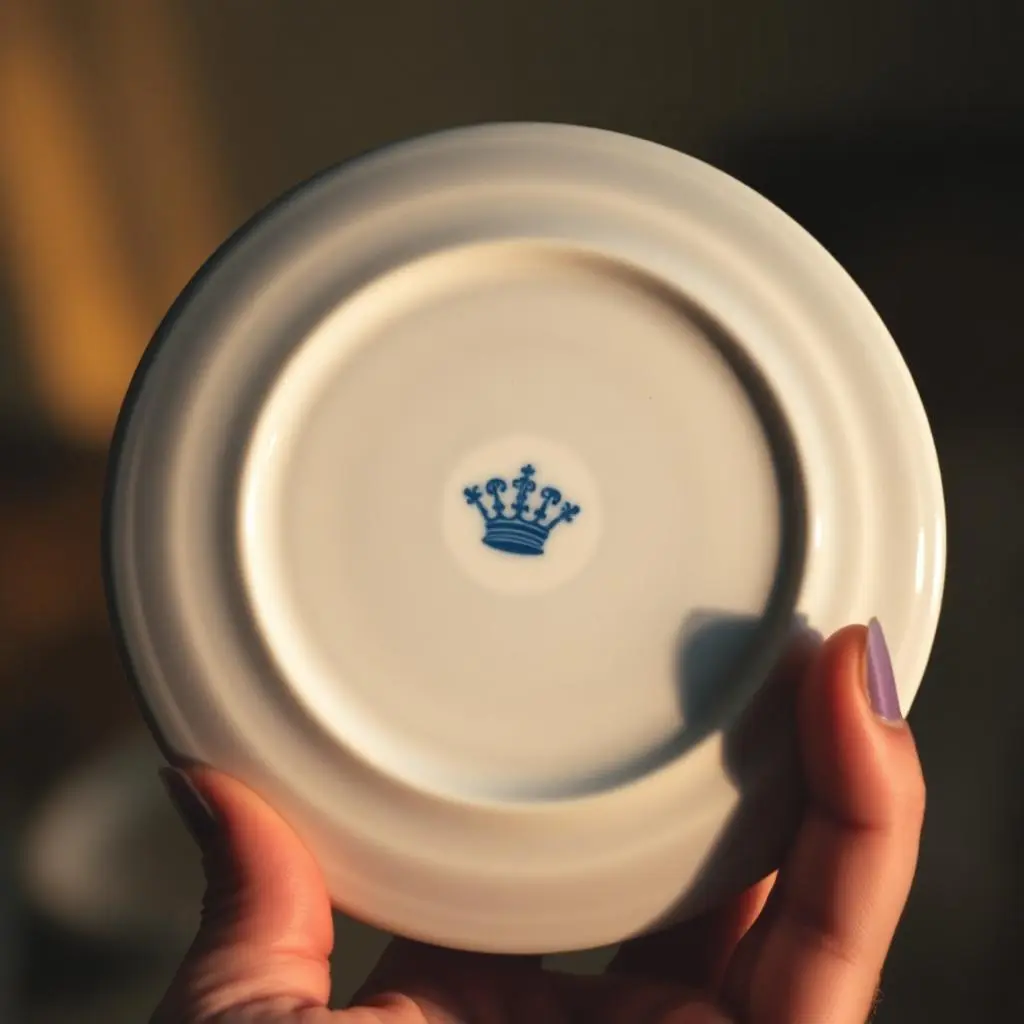
Here's the field cheat sheet:
- "Bone China" printed on the mark → post-1920s (the phrase wasn't used on marks before then).
- "Made in England" / "Made in Germany" / "Made in Japan" → post-1891 (the McKinley Tariff Act required country of origin on all imports to the US).
- "Made in Occupied Japan" → 1945–1952 only. A four-word phrase that dates the piece to a seven-year window.
- "Nippon" → 1891–1921 (Japan called itself Nippon on export marks until the US ruled it wasn't an acceptable country name).
- No country of origin at all → almost certainly pre-1891.
- A pattern number or "Rd No." (Registered Number) on English china → look it up; Rd No. 1 was 1884 and the numbers climb chronologically.
Famous makers you'll see over and over at estate sales:
- Noritake (Japan, 1904–present) — the "M in wreath" mark = pre-1953; the "N in wreath" = post-1953. Hand-painted Nippon-era pieces are the valuable ones; 1960s–80s dinnerware sets are usually $50–$200 for a full 8-place setting.
- Lenox (USA, 1889–present) — green wreath mark 1906–1953, gold wreath post-1953. Lenox is quality bone china but very common; most patterns retail for $10–$30 per piece.
- Wedgwood (England, 1759–present) — impressed "WEDGWOOD" (no ampersand) on jasperware, printed marks with a "Portland vase" logo on dinnerware. Fine early jasperware, Fairyland Lustre, and Queensware are the crown jewels.
- Royal Albert (England, 1904–present) — Old Country Roses (introduced 1962) is the best-selling bone china pattern in history. Full 6-place settings in excellent condition still fetch $250–$600.
- Spode / Copeland Spode (England, 1770–present) — Blue Italian (1816) and Christmas Tree (1938) are the patterns to know. Early Copeland transferware can be strong money.
- Haviland (Limoges, France, 1842–present) — hand-painted French hard-paste porcelain. Green "H&Co" marks are 1876–1930. Pattern-matched sets (verified via Schleiger numbers) command real premiums.
- Meissen (Germany, 1710–present) — crossed blue swords under the glaze. Genuine Meissen is museum-tier; also the most-faked mark in the world, so verify carefully.
- Royal Copenhagen (Denmark, 1775–present) — three wavy blue lines (the three Danish waterways) under the glaze. Flora Danica is the grail pattern.
- Lefton, Napco, Lipper & Mann (Japanese-import labels, 1940s–70s) — decorative, charming, cheap. Not fine china; think $10–$40 per piece at most.
Step 3 — Does the pattern actually sell?
Maker matters, but pattern is what sets the price. Two Noritake plates with identical backstamps can be $4 and $80 depending on the pattern's collector demand.
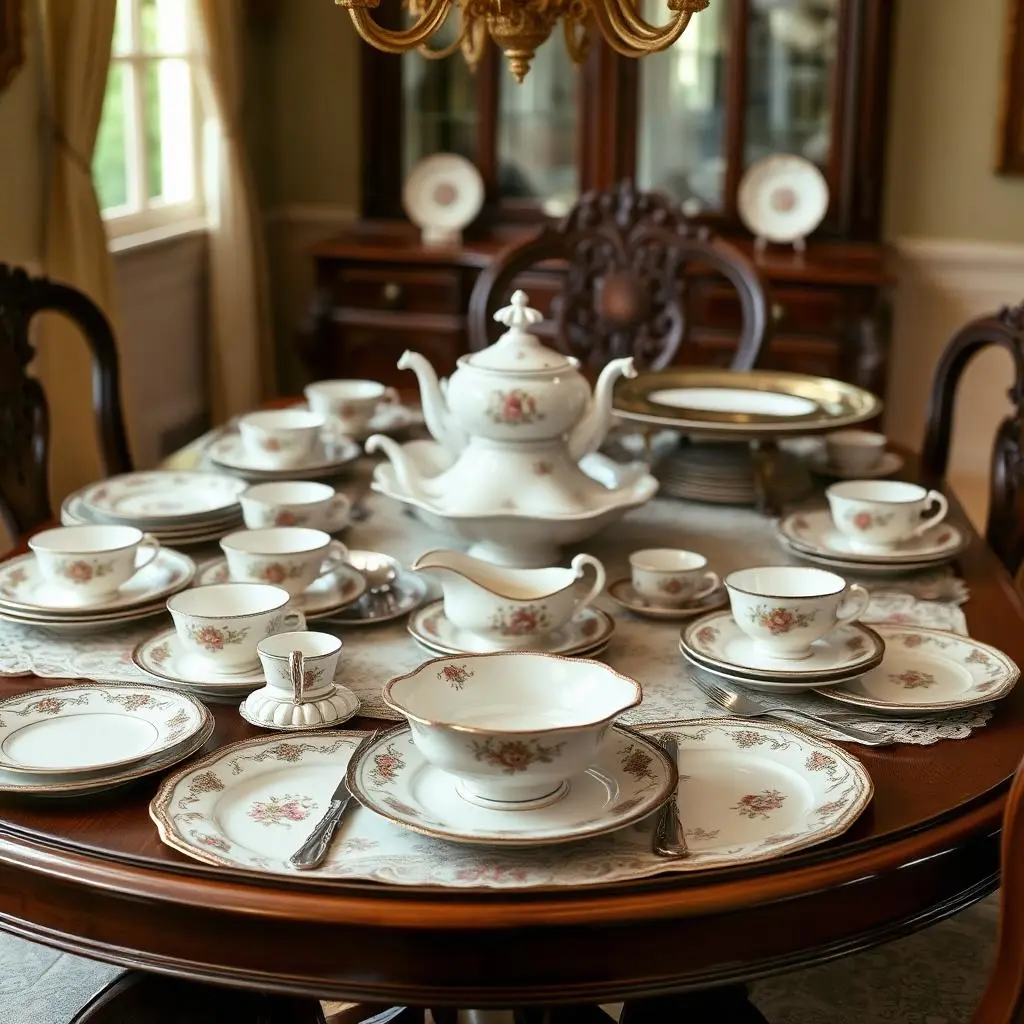
Patterns to grab on sight:
- Royal Albert Old Country Roses, Lady Carlyle, Petit Point
- Spode Christmas Tree (green trim), Blue Italian, Woodland
- Lenox Holiday (holly), Autumn, Eternal
- Noritake Shenandoah, Rothschild, hand-painted Nippon
- Wedgwood Jasperware (any color), Fairyland Lustre, Florentine
- Haviland Limoges hand-painted sets with matching serving pieces
- Any Flow Blue transferware pre-1900
- Meissen Blue Onion (verify the mark — heavily reproduced)
- Royal Doulton character jugs and figurines (D-numbers matter)
Patterns that rarely move:
- Generic 1970s–80s "wedding china" — beige with a thin gold band
- Mikasa, Mikasa "Bone China," Pfaltzgraff — mass-market, low resale
- Fine china marked "Fine China of Japan" with no maker name
- Anything with fluorescent-orange fruit patterns (mid-70s trend)
- Salton, Sango, Sanyei — often mistaken for premium; usually $2/plate
Step 4 — The completeness premium
A full 8-place service with matching serving pieces (platter, gravy boat, sugar & creamer, teapot, vegetable bowls) is worth 3–5x what the same number of loose pieces would fetch. Estate sales are one of the last places to find complete sets — that's your edge.
Before you buy a "complete" set, do a five-second count:
- 8 dinner plates, 8 salad plates, 8 bread plates
- 8 cups, 8 saucers (they should match — mismatched saucers = "married" set = worth less)
- Platter, vegetable bowl, gravy boat, creamer, sugar
- Bonus points: teapot, coffee pot, covered casserole
Flip every single piece and confirm the pattern name/number is identical. Estate sales frequently have two similar Noritake patterns mixed together — buyers who don't check get burned.
Step 5 — Condition kills value fast
- Crazing (fine web of surface cracks in the glaze) — acceptable on early transferware, kills value on 20th-century bone china.
- Gold-band wear — a set with worn gold rims drops 50–70% in value. Check every cup handle and plate rim.
- Utensil scratches in the center of dinner plates — very common, discounts value 20–40%.
- Chips, cracks, hairlines — run a fingernail around every rim. If your nail catches, it's a crack.
- Repair with adhesive — usually visible under UV light as a glow along the seam.
Using the Ai Appraiser on the sale floor
This is the tool I built EstateSaleFinder around. In the china aisle you'll use it three ways:
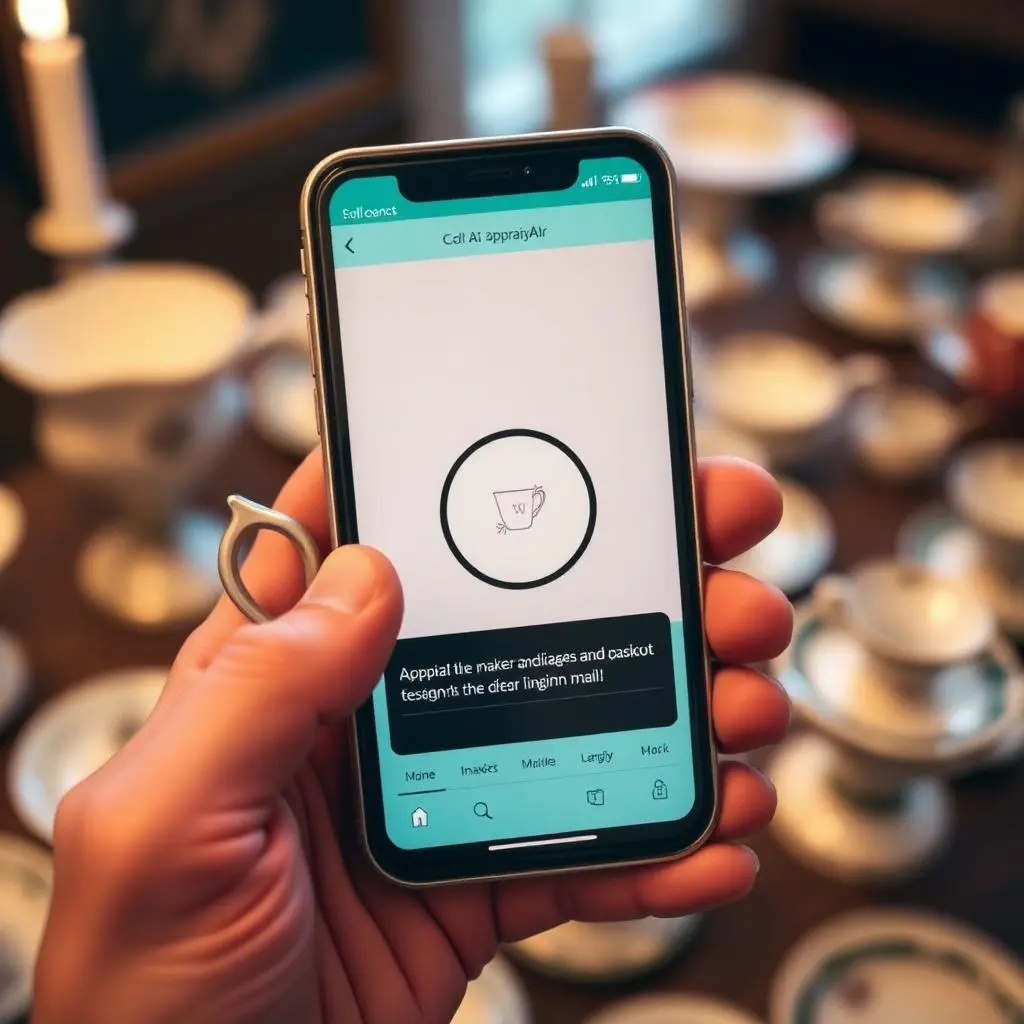
- Snap the backstamp. Flip a plate, photograph the mark, and the Ai Appraiser reads it — identifying the maker, dating the mark style, and pulling the pattern name when it's visible.
- Photograph the pattern. Take a top-down shot of a plate. The appraiser matches the border, floral motif, and color palette against known patterns and returns comparable sold prices from live secondary-market data.
- Value the full set. Include a serving piece in the frame so the appraiser knows you have a complete service — a set premium can be the difference between $80 and $400.
You get roughly 30 seconds per piece before someone else picks it up. The Ai Appraiser reduces that to about 8 seconds and gives you a live comparable price to negotiate with.
The five estate-sale scenarios you'll actually see
"Grandmother's china cabinet, everything for $400." Photograph three or four backstamps first. If any are Royal Albert Old Country Roses, Spode Christmas Tree, Noritake hand-painted Nippon, or Wedgwood jasperware, buy it before you finish the sentence. If it's generic 80s wedding china — walk.
"Loose plates on a folding table, $2 each." This is where you win. Sellers who've priced a whole cabinet at $2/plate haven't looked at the backstamps. Flip every plate. A single Haviland Limoges hand-painted charger at $2 is a $60–$150 flip.
"Big set, three plates chipped." Ask if they'll knock $30 off. Chipped pieces still sell — replacement services (Replacements Ltd. is the giant) buy individual pieces from anyone.
"Fenton, Fostoria, Depression glass mixed in." That's glassware, not china — different guide, different market. Both can be strong.
"Estate sale company running a China Day markdown." Day 2 or Day 3 markdowns on china sets are the biggest discounts of any category. Estate sale companies know china doesn't move fast at retail — they discount 50% to move it.
Fast pricing benchmarks (2026 secondary market)
| Type | Typical estate-sale ask | Realistic resale |
|---|---|---|
| Royal Albert Old Country Roses, 6-place set | $150–$300 | $300–$600 |
| Noritake hand-painted Nippon, single piece | $10–$40 | $40–$180 |
| Wedgwood jasperware, small piece | $15–$60 | $50–$250 |
| Meissen Blue Onion (verified), plate | $40–$100 | $150–$500+ |
| Flow Blue transferware, pre-1900 plate | $15–$60 | $80–$300 |
| Haviland Limoges hand-painted service | $200–$500 | $500–$1,500 |
| Generic 1980s wedding china, 8-place set | $50–$150 | $50–$150 |
| Lenox modern dinnerware, place setting | $20–$60 | $30–$80 |
Numbers vary by region and pattern popularity — treat these as anchors, not gospel.
How to source vintage china faster
EstateSaleFinder's search lets you filter estate sales that mention china, porcelain, Noritake, Lenox, Wedgwood, Limoges, or any pattern name — and our wishlist alerts email or text you the moment a sale in your area lists a matching keyword. Set one for "china cabinet" and one for the specific pattern you collect, and you'll be first in line more often than not.
Browse estate sales near you → Set up a china wishlist alert →
The bottom line
Vintage china is one of the most consistently underpriced categories at estate sales because most sellers can't tell a $30 plate from a $300 plate — and most shoppers can't either. The people who can tell (or who carry the Ai Appraiser in their pocket) buy the same china cabinet everyone else walked past.
Flip the plate. Read the mark. Verify the pattern. Check condition. Ask about the set. That's the whole game.
Happy hunting.
Keep exploring
Ready to start your own treasure hunt?
Discover estate sales near you and find incredible deals.
Explore Sales Near Me
About the author
Andy
Founder, EstateSaleFinder.net
Hi, I'm Andy — a retired commercial photographer turned developer with a five-year (and counting) obsession with estate sales. I started EstateSaleFinder.net because I knew there had to be an easier, smarter way to find and list estate sales. Now I get to chase treasure and build the tool I always wished existed.