
Why Estate Sale Companies Should Accept Early Offers
Furniture and high-end collectibles are the hardest items to sell at full price — and the first to get slashed on the last day. Here's the honest case for why estate sale companies have always resisted pre-selling, why a transparent early-offer system fixes every one of those concerns, and exactly how the Accepting Offers feature on EstateSaleFinder works.
Walk through any estate sale on the final afternoon and you'll see the same thing in every house: the big stuff is still there. The solid-wood dining set. The china hutch. The mid-century credenza. The case of collectibles nobody quite knew how to price. By Sunday the tags read 50% off, then 75% off, and the company is quietly hoping a picker or a liquidator hauls it away before the family's deadline to clear the house.
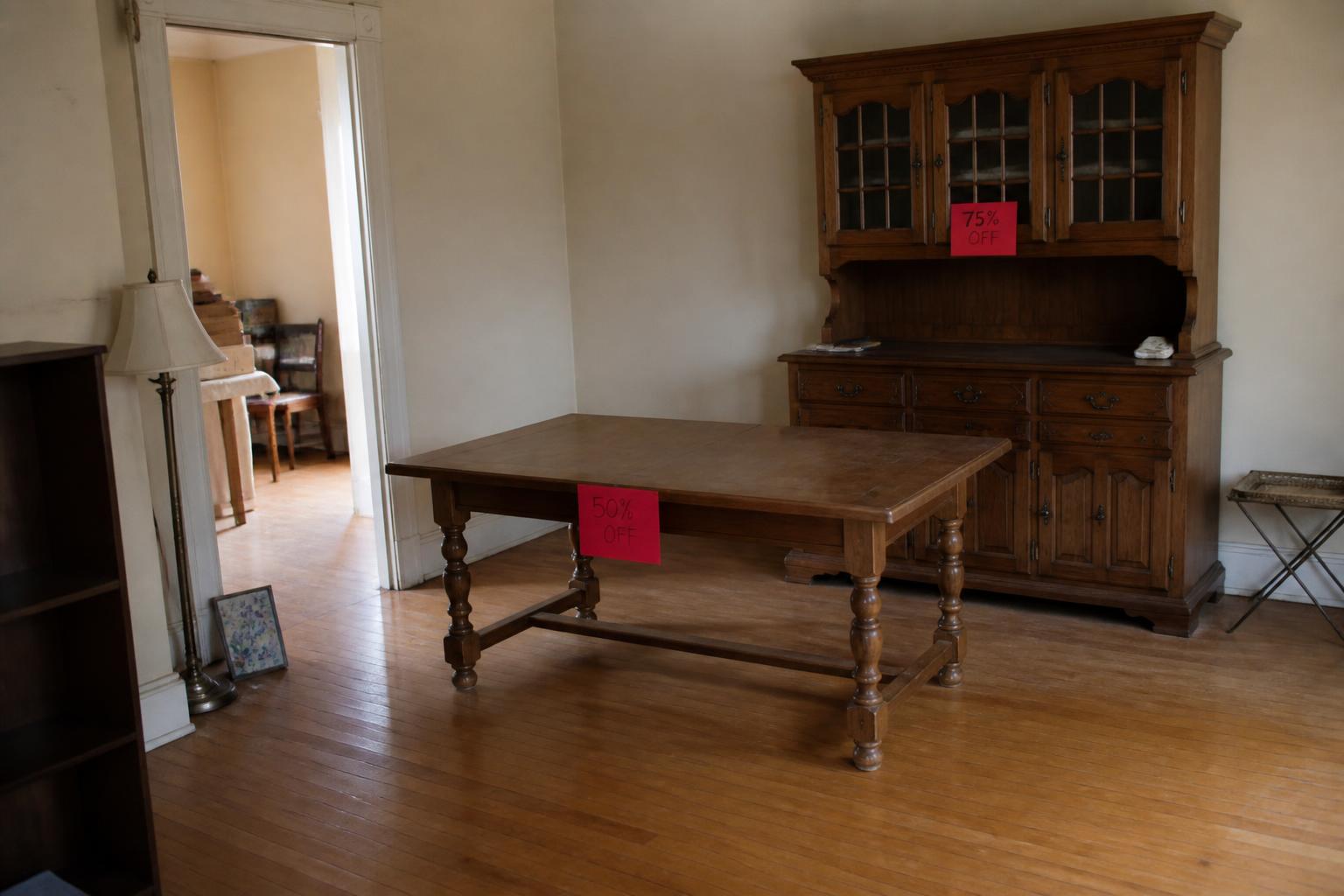
It's the oldest problem in the business. The items with the most value — furniture, fine collectibles, art, jewelry, anything over a couple hundred dollars — are also the hardest to sell in a one-weekend, in-person window. They're heavy, they're niche, and the one buyer who'd happily pay top dollar usually doesn't live close enough to show up at 8 a.m. on a Saturday.
So here's the question this article exists to answer: if early, motivated buyers are willing to pay strong money for those exact pieces before the sale, why has the industry spent decades refusing to sell to them? And what changes when you can do it the right way?
First, let's be honest about why companies hate pre-selling
This isn't a strawman. The reasons estate sale professionals avoid selling before the doors open are real, and most of them are good instincts:
- Fairness and reputation. Nothing torches a company's name faster than "the good stuff was gone before the sale even started." Buyers talk. When regulars suspect items were quietly sold to a dealer friend on Thursday, they stop showing up — and they post about it.
- Pricing risk. Prices aren't truly final until the house is staged and researched. Sell a "sleeper" on day one and you might learn it was worth five times what you let it go for. That's a fiduciary failure to the family.
- Client trust. You were hired to maximize the estate's return, transparently. Off-the-books early sales — cash in a pocket, no paper trail — look exactly like the thing families are terrified of.
- Logistics and staging. Items walking out early wreck your inventory counts and gut the "full house" look that drives opening-day momentum.
- Crowd and theft control. Uncontrolled early access is a security nightmare. You can't run a sale and field a stream of "can I come by early?" texts at the same time.
Read that list again, though, and notice what every single objection has in common: *they're all problems with secret, uncontrolled, unstructured pre-selling.* A handshake deal in the driveway. A DM you can't track. A price you set on the spot with no record.
None of them are arguments against selling early. They're arguments against selling early badly.
The complaint buyers actually have
Talk to estate sale shoppers and you'll hear the flip side of the same coin. The number-one frustration isn't that companies sell early — it's that they sell early and nobody else got a chance.
I drove forty minutes and the piece I came for had already been sold to someone the company knew. Why even list it?
That resentment is the reputational damage every pro is rightly afraid of. But the cause isn't earliness — it's exclusivity. When one insider gets first dibs in private, everyone else feels cheated. When everyone can see the item and everyone can make an offer, early selling stops being favoritism and becomes just… a marketplace. Fair, open, and on the record.
That's the entire idea behind how the Accepting Offers system on EstateSaleFinder is built.
The fix: transparent, on-the-record early offers
Instead of a private side channel, you turn early interest into a public, structured queue attached to the listing itself. Every shopper browsing the sale sees the same thing: this item is open to offers, here's the photo, here's the button. Anyone can submit. You see every offer in one place and decide — accept, decline, or ignore — entirely at your discretion.
That one change neutralizes the whole objection list:
| The old worry | Why transparent offers solve it |
|---|---|
| "It looks like favoritism" | Every buyer sees the item and can offer. No insider channel. |
| "I might underprice a sleeper" | You set a minimum offer and you approve every sale — nothing moves without your yes. |
| "It's off the books" | Every offer is logged with the buyer's name and contact. Full paper trail for the family. |
| "It disrupts staging" | The item stays listed and in place until you accept and arrange pickup. |
| "Early access is chaos" | No one shows up early. Offers come to your dashboard, not your driveway. |
You keep total control. You just stop leaving money on the table for the pieces that were going to get marked down to nothing anyway.
How it actually works — the whole process
Here's exactly what it looks like, start to finish. No mock-ups — these are the real screens.
Step 1 — Flip on offers for the items you choose
When you build your sale, each item has an Accept Offers toggle. Turn it on for the pieces where early interest helps you most: the furniture, the high-ticket collectibles, the anything-that-tends-to-linger. Leave it off for the $2 kitchen items. You can also set a minimum offer so nothing comes in insultingly low. The sale's item view marks the whole sale as "Accepting Early Offers," and every eligible piece gets a green "Open to Offers" badge.
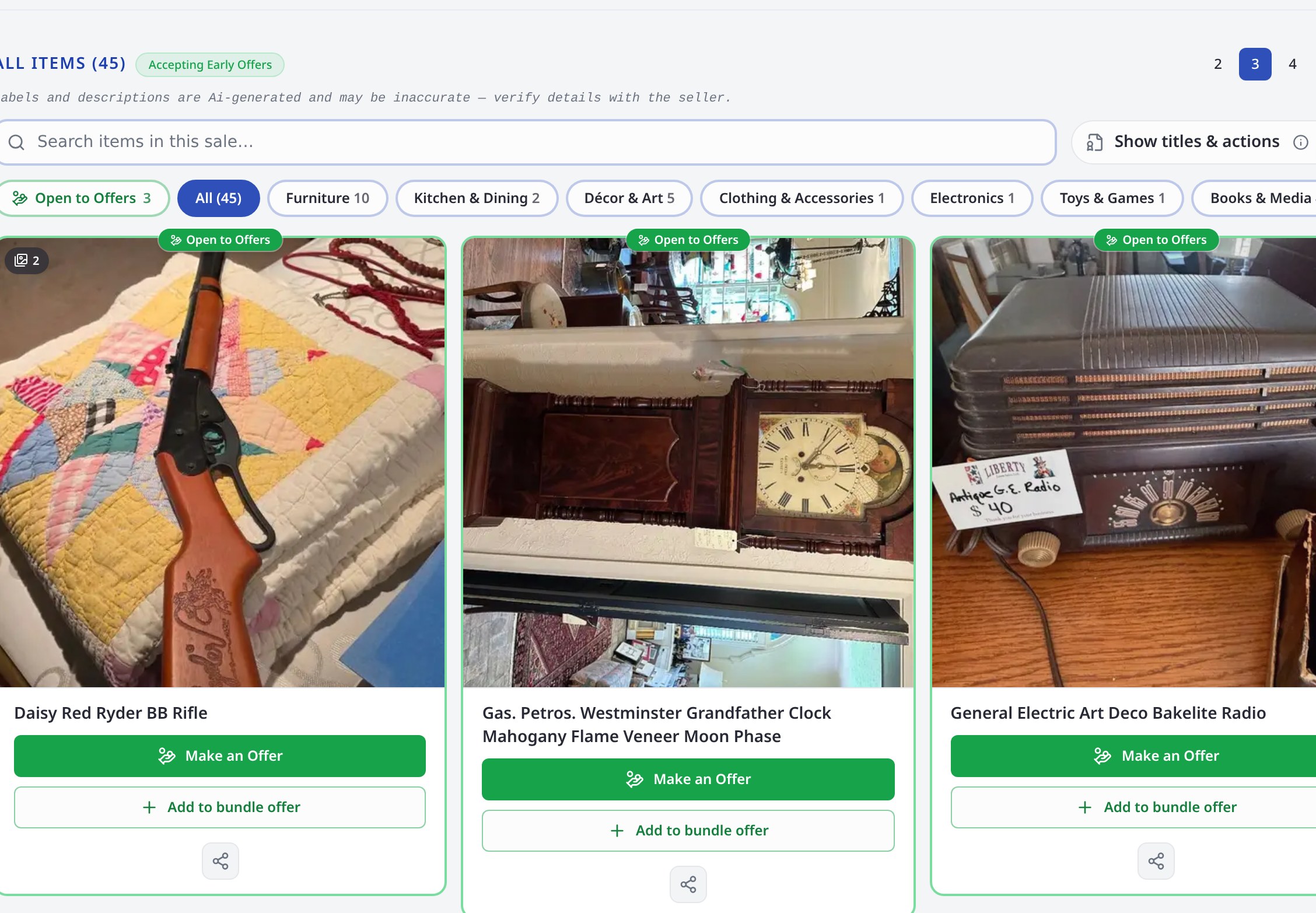
Notice the "Open to Offers" filter at the top — buyers can tap it to instantly see only the items you've opened up. That's the high-intent shopper self-selecting straight to your best pieces.
Step 2 — Buyers make a clean, on-the-record offer
A shopper taps Make an Offer, enters their number, and can add a short message about why they want it. The form is explicit that this is an offer (not a binding sale) and that their name and contact info will be shared with you. No haggling in your inbox, no anonymous lowballs — just a structured offer with a real person attached.
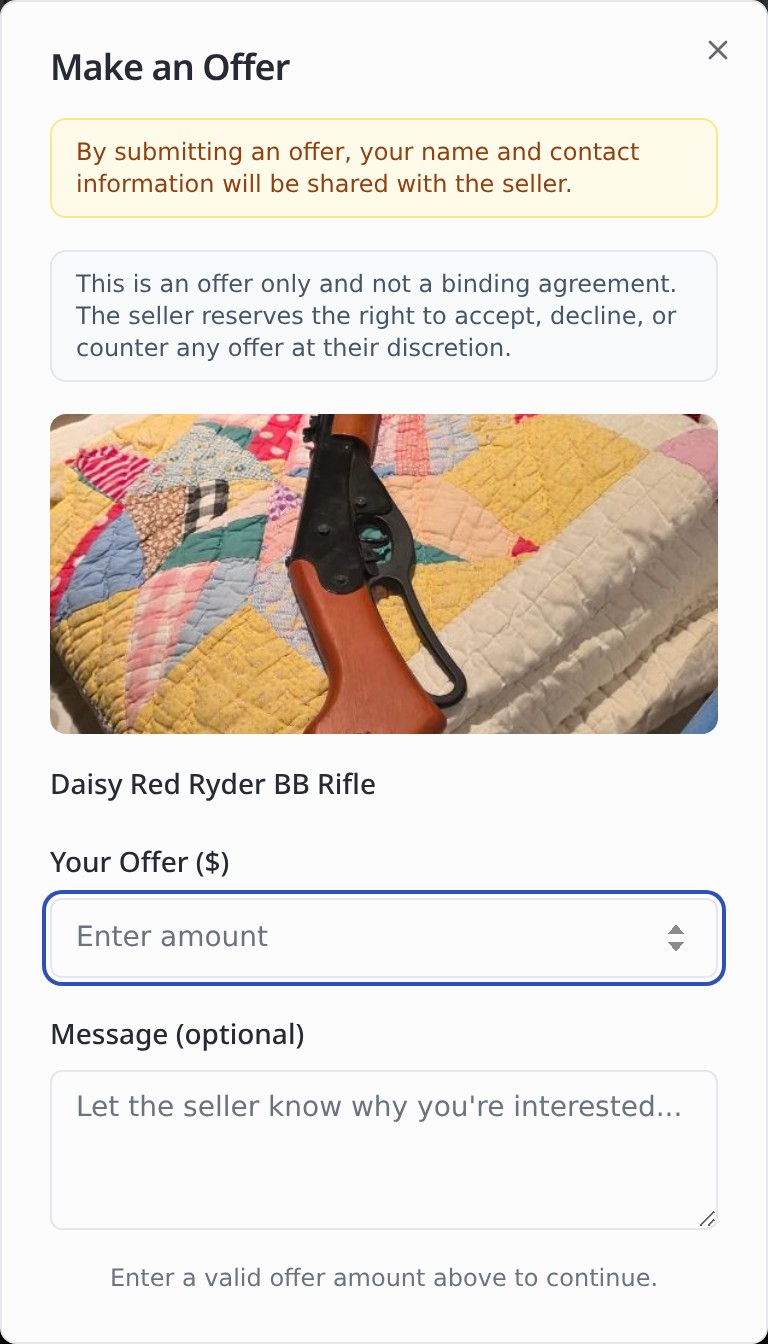
Buyers can even bundle multiple items into one offer — perfect for a designer who wants the credenza, the lamps, and the mirror in a single deal.
Step 3 — You review and decide
Every offer lands in your dashboard. You see the item, the amount, the buyer, and their message in one place. Accept the ones that work, decline the rest, and arrange pickup on your schedule. The item only leaves the sale when you say so — and the family gets a clean record of exactly what sold and for how much.
That's the whole loop. It takes minutes to set up and it runs itself.
Why this reaches better buyers, not just earlier ones
Here's the part most companies miss. Accepting early offers isn't only about timing — it's about who you reach. And on EstateSaleFinder, two features quietly change the entire pool of people who will ever see your furniture and collectibles.
Keyword search puts your items in front of people who weren't coming to your sale
On the legacy directories, you advertise a sale — an address and a date — to the same finite crowd of weekend regulars every company in town is already fighting over. On EstateSaleFinder, your individual items are searchable. When a collector types "Steinway," a designer searches "marble console," or a dealer hunts "Roseville pottery," your piece shows up — even if they'd never heard of your company and weren't planning to attend a single sale that weekend. Browse the live estate sale feed and you'll see how items surface on their own.
Pair that with early offers and the math is obvious: the buyer most likely to pay full price for your credenza is the one who was searching for a credenza — and now they can act the moment they find yours, instead of hoping they happen to be free Saturday morning.
Wishlist alerts turn high-value buyers into standing orders
The wishlist solves the harder problem — the buyer who wants something that isn't listed yet. A collector saves "Herman Miller," "Limoges," "antique tools," sets a travel radius, and goes back to their life. The instant any company lists a match nearby, EstateSaleFinder alerts them.
When you flip on early offers for a wishlisted item, you're not hoping the right person wanders in. You're notifying someone who already told us, in their own words, that they want exactly this — and giving them a way to claim it before the crowd. That's not foot traffic. That's intent.
This is the real shift: instead of hoping the right customer shows up for your hardest-to-move pieces, you're targeting the customer who was already looking for them — and removing every reason they used to skip estate sales.
The bottom line for your business
- Your hardest-to-sell, highest-value items get sold to motivated buyers instead of marked down 75% on the last day.
- Early selling becomes fair and public — protecting the one thing you can't afford to lose, your reputation.
- The family gets a transparent, on-the-record result, with you approving every single sale.
- You reach a bigger, higher-spending audience through keyword search and wishlist alerts — buyers the old model never put in front of you.
Pre-selling was never the problem. Secret pre-selling was. Do it in the open, on the record, with the right buyers — and the items that used to haunt your last-day clearance pile become some of your best sales of the week.
Ready to try it? List your sale on EstateSaleFinder and turn on Accepting Offers for the pieces that matter most.
Related reading: Stop turning down estate sales — the jobs early offers unlock.
Keep exploring
Ready to start your own treasure hunt?
Discover estate sales near you and find incredible deals.
Explore Sales Near Me
About the author
Andy
Founder, EstateSaleFinder.net
Hi, I'm Andy — a retired commercial photographer turned developer with a five-year (and counting) obsession with estate sales. I started EstateSaleFinder.net because I knew there had to be an easier, smarter way to find and list estate sales. Now I get to chase treasure and build the tool I always wished existed.