
You Shouldn't Have to Put Your Whole Life on Hold to Run an Estate Sale
Being an estate sale operator can be all-consuming — and the pricing table is usually where your personal life goes to die. Jenna Pecor said it better than I could, so we're saying it together: the Institute for Estate Sale Professionals and EstateSaleFinder are working on the same problem from two directions. Better ways to operate, and better tools to do it with.
If you run estate sales, the hardest part usually isn't the sale — it's everything the sale takes from the rest of your life. The pricing never ends, the tagging never ends, and the people who love you get whatever is left at 11:40 at night. That's not a character flaw or a time-management problem. It's a systems problem, and it's fixable from two directions: better ways to operate, and better tools to operate with.
That's exactly why we're working with the Institute for Estate Sale Professionals.

The part of this job nobody warns you about
You already know the moment. The family left hours ago. The house is quiet in that particular way an empty house gets. You've got four rooms staged, two garages untouched, a client texting about the driveway, and a folding table covered in things you still have to research, price, and tag before Thursday.
So you stay. You always stay. And the birthday dinner, the doctor's appointment you keep pushing, the kid's game, the weekend that was supposed to be yours — those go to the back burner, because the pricing is a wall and the wall doesn't move unless you move it.
Here's what I want you to hear first, before any talk about tools: that exhaustion is not evidence that you're bad at this. It's usually evidence that you're carrying a decade-old workflow — legal pads, handwritten stickers, a mental inventory only you can read — through a job that has gotten much bigger than that workflow was ever built for.
Jenna said it better than I could
Jenna Pecor has run her own estate sale company for over a decade, and she built the Institute for Estate Sale Professionals because she got tired of watching capable operators burn out in private. She put it this way when we were talking about all of this:
Being an estate sale operator can be all consuming and at times, you can feel like everything else in your life gets put on the back burner for tasks like finishing pricing a never-ending amount of items in a house. The Institute isn't just a place for education, it's also a think tank for better ways to operate an estate sale business that gives operators a better quality of life and work.
Read that second sentence again, because it's the important one. A think tank — not just a classroom. Training teaches you how the job is done. A think tank asks whether the job has to be done that way at all.
What "quality of life" actually means for an operator
It isn't a spa day. For the people I talk to every week, it looks embarrassingly specific:
- Leaving the house at a normal hour on setup week instead of 1 a.m.
- Pricing an item once, not writing it on a sticker, then a legal pad, then a spreadsheet, then an invoice.
- Not being the only person on earth who knows what's in the back bedroom.
- Knowing what a sale actually made without a Sunday-night reconciliation session.
- Being able to say yes to something in your own life during a sale week.
Every one of those is a workflow you can change. None of them require you to care less about your clients.
Two halves of the same fix
Here's how Jenna and I think about the partnership, plainly:
- The Institute handles the thinking. Structured courses, real systems, and the Certified Estate Sale Fiduciary™ (CESF) credential — so you're running a business with a playbook instead of reinventing one house at a time. It's also where operators compare notes on what's actually working, which is how an industry gets better instead of just older.
- We handle the software. Our job is to delete hours. Not "streamline." Delete. If a task can be done once instead of four times, or by a phone instead of by your memory, we want to build that so you can go home.

We're not competing for your attention. We're aiming at the same thing from opposite ends: make this industry more professional, and make the operator's day physically shorter.
The two features built specifically to give you your evenings back
Tag as you go, from your phone
Pricing used to mean two passes: decide the price, write the sticker, then later re-enter everything into whatever system you use. Item Label Manager collapses that into one pass. You price an item on your phone standing right in front of it, and it prints a clean tag — title and a scannable QR or barcode, no price printed on the label if you don't want one there. Buyers scan the tag to see the price on a page branded to your company; you can change a price without reprinting a thing.

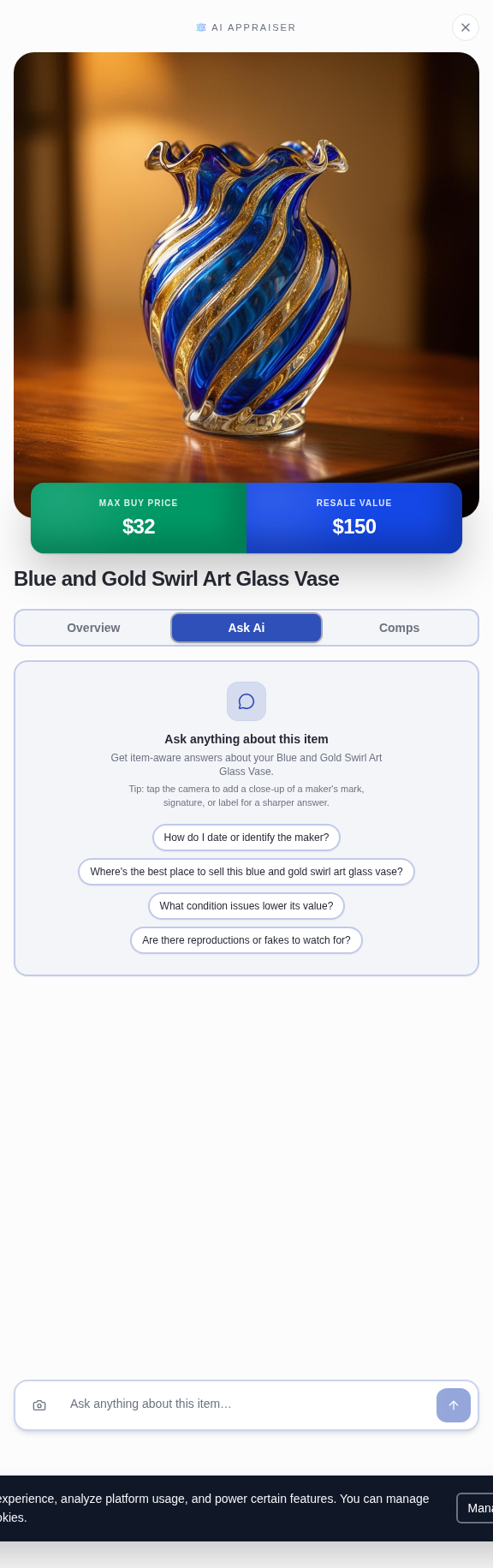
Our Ai will suggest a price and write the title for you if you want the help — and it's a suggestion, always. You're the appraiser. It's just there so you're not starting from a blank line six hundred times in one house.
A register that closes the loop
Sale day is the other place hours disappear. The Register turns checkout into a scan: scan the tag, the item's in the cart, take cash, card, or any of the other payment methods your buyers actually use, apply a discount or tax if you need to — and the item marks sold on your listing while your ledger and analytics update themselves.

That last part is the one operators tell me they feel the most. No Sunday reconciliation. No wondering what the sale really netted. It's already added up.
Try the tools that shorten your setup week
Labels, register, ledger, and analytics are included with the seller plans built for estate sale companies.
Take an Institute course, get 3 months of Pro Plus free
This is the part we made sure to build together. When you buy a course from the Institute for Estate Sale Professionals, you get 3 months of Estate Sale Pro Plus on EstateSaleFinder — free. Labels, register, ledger, analytics, the whole professional toolkit, for the exact stretch of time when you're putting the training into practice on real houses.
It's the same idea from both sides: learn the better way to operate, and have the tools in your hands while you're learning it.
- Browse courses and certification at the Institute — start with the training.
- Create your EstateSaleFinder account — then your 3 months of Pro Plus gets applied.
One more thing, operator to operator
You got into this because you're good with people at the worst moment of their year, and because you can look at a whole house and see order in it. That's rare. It shouldn't cost you your own life to keep doing it.

Jenna and I are both working on the same bet: that the operators who last another twenty years will be the ones who stopped doing everything by hand. Not because they cared less — because someone finally built them a better way to work.
If tonight you're still at the folding table, take this as your sign to look at the workflow instead of just working harder. We'll keep building. She'll keep teaching. You go home at a decent hour.
Questions & answers
Frequently asked questions
What is the Institute for Estate Sale Professionals?
The Institute for Estate Sale Professionals (IESP) is an education and certification organization for estate sale operators, founded by Jenna Pecor, who has run her own estate sale company for over a decade. It offers structured courses covering how to run an estate sale business — from the first client call to the final payout — plus the Certified Estate Sale Fiduciary™ (CESF) credential, which signals to families that their home, heirlooms, and money will be handled with integrity. Jenna also describes the Institute as a think tank: a place where operators work out better ways to run the business, not just how to run it the way it has always been run.
How does the 3 months of Pro Plus offer work?
Buy a course from the Institute for Estate Sale Professionals and you receive 3 months of Estate Sale Pro Plus on EstateSaleFinder at no cost. Enroll through the Institute, then create your EstateSaleFinder account and the trial is applied to your company account. It includes the professional seller toolkit — Item Label Manager, the Register, ledger, and analytics — so you can put the coursework into practice on live sales.
How do labels and a register actually reduce pricing time?
The time sink in most estate sale companies isn't deciding prices — it's entering the same information multiple times. Tagging from your phone as you price the room means each item is handled once: price it, print a title-only tag with a scannable code, move on. On sale day, scanning that tag at checkout marks the item sold and updates your ledger and analytics without a separate reconciliation pass. The same data serves pricing, checkout, and reporting instead of being retyped for each.
Do the printed tags show the price?
They don't have to. You can print labels with just the item title and a QR or barcode, and buyers scan to see the price on a page branded to your company. Because the price lives in your system rather than on the sticker, markdowns and adjustments don't require reprinting anything.
Keep exploring
Ready to start your own treasure hunt?
Discover estate sales near you and find incredible deals.
Explore Sales Near Me
About the author
Andy
Founder, EstateSaleFinder.net
Hi, I'm Andy — a retired commercial photographer turned developer with a five-year (and counting) obsession with estate sales. I started EstateSaleFinder.net because I knew there had to be an easier, smarter way to find and list estate sales. Now I get to chase treasure and build the tool I always wished existed.