
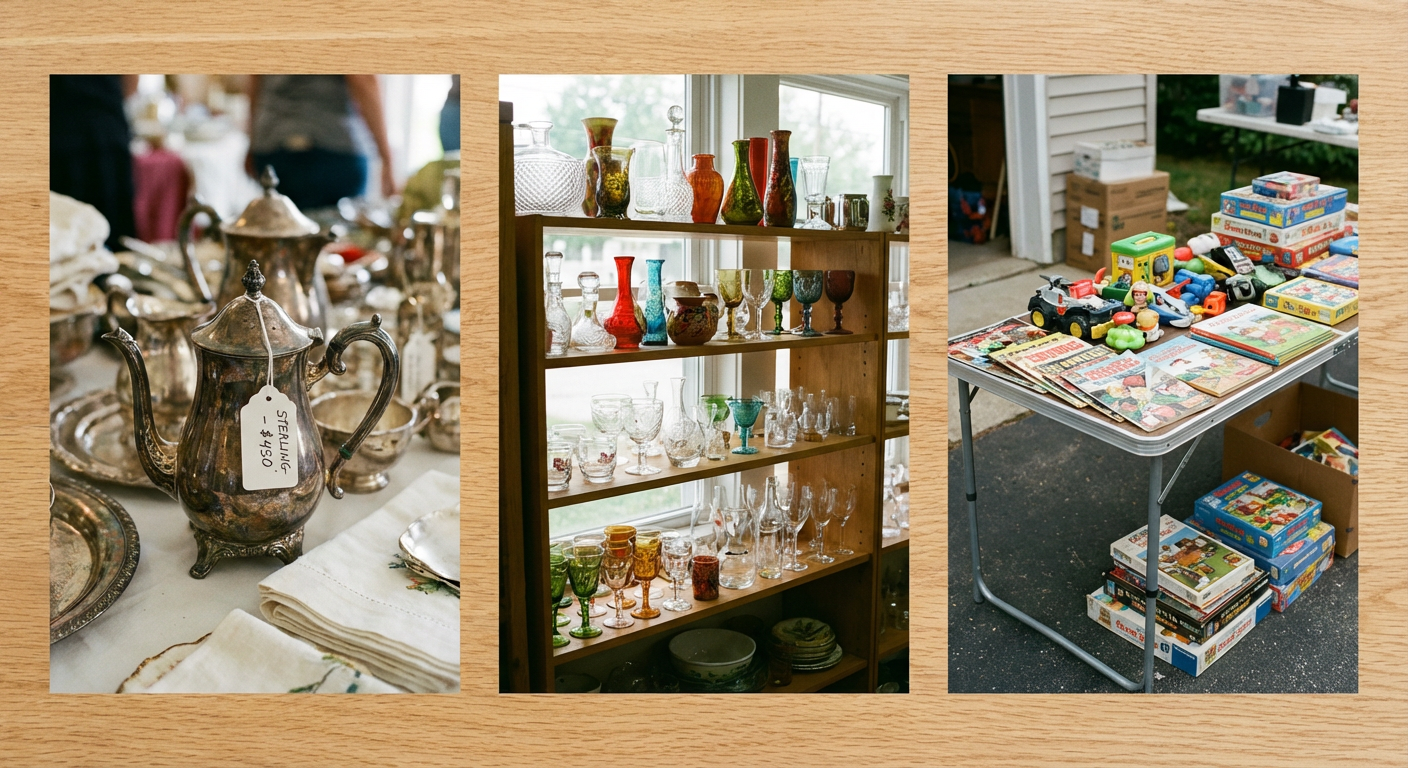
Estate Sale vs. Garage Sale vs. Thrift Store: Where Should Resellers Source Inventory?
I tracked every dollar, hour, and item across all three sourcing channels for six months. The winner wasn't even close — but the runner-up surprised me.
I'm going to settle the question every new reseller asks in the Facebook groups: Where should I actually be sourcing?
I tracked every purchase across estate sales, garage sales, and thrift stores for six months. Hours invested, money spent, items resold, profit per hour. Here's what the data said.
The Three Channels in Plain English
Estate sales are organized whole-household liquidations, usually professionally run, usually because of a death, downsize, or move.
Garage sales are casual driveway sales by individual families, usually to declutter, usually one-day, usually unprofessional pricing.
Thrift stores are continuous-inventory donation-based retail run by Goodwill, Salvation Army, Habitat ReStore, and local nonprofits.
Each one has a personality. Each one has a math problem.
Estate Sales — The Volume Champion
Time investment: 4–6 hours per Saturday morning hits 4–7 sales. Money invested per trip: $80–$300 average. Items returned: 8–25 per trip. Average margin per item: $30–$80. Profit per hour: My six-month average was $78/hour.
Why estate sales win: deep inventory of old, untouched stuff. The categories that resell best — sterling, vintage electronics, art pottery, mid-century furniture, vintage clothing — live in estate sales. They're rare at thrifts and garage sales.
The downside: you're competing with other resellers from minute one. The crowd is sharp. You need to be sharp too.
Garage Sales — The Sleeper Pick
Time investment: 3–5 hours per Saturday morning hits 5–10 sales. Money invested per trip: $30–$120 average. Items returned: 5–15. Average margin per item: $20–$200 (huge variance). Profit per hour: My six-month average was $54/hour, but with much higher variance — some Saturdays were $0, some were $400.
Why garage sales surprised me: pricing is wildly inconsistent. A family clearing out grandma's house has no idea what anything is worth. I once paid $4 for a piece of art pottery that sold for $340. That kind of swing doesn't happen at estate sales.
The downside: you have to find them, you have to drive farther per sale, and 60% of them are honestly junk.
Thrift Stores — The Consistent Bottom
Time investment: 1–2 hours per visit, 3–4 visits per week. Money invested per trip: $20–$60. Items returned: 2–5. Average margin per item: $15–$45. Profit per hour: My six-month average was $22/hour.
Why thrift stores trail: employees pre-shop. Resellers shop them daily. Inventory is thin — the good stuff is gone within hours of being put out. The categories that survive on the floor are the ones nobody recognized as valuable, which means you have to recognize them. The bar is high and the ceiling is low.
The upside: it's open all week, it's a constant low-grade hunt, and it pairs nicely with weekend sales.
The Real Comparison Table
| Channel | Profit/Hour | Variance | Skill Required | Volume |
|---|---|---|---|---|
| Estate Sales | $78 | Medium | Medium | High |
| Garage Sales | $54 | Very High | Low–Medium | Medium |
| Thrift Stores | $22 | Low | High | Low |
What This Means for Your Strategy
If you can only source one day a week: estate sales. The hourly is the highest, the volume is the highest, and the categories that print money are the most concentrated there.
If you have flexible weekday time: pair estate sales (Saturday morning) with thrift store stops (Tuesday/Thursday lunch breaks).
If you live in a rural area without many estate sales: garage sales become your main lane, with the understanding that you need to drive more and tolerate more dud stops to find the gold.
The Tooling That Changes Everything
The reason estate sales used to be intimidating was that they were hard to find and hard to scout. That's gone. With listings now showing 50+ photos and Ai-detected items, you can build your Saturday route Friday night from your couch.
Browse this weekend's sales near you and you'll see the difference instantly. Filter by category, see what's in each sale before driving, and stop wasting Saturdays on duds.
For the on-the-floor moment when you're staring at something and need to know if it's valuable, the Ai Photo Appraiser will give you a comp range in 5 seconds.
My Honest Recommendation
Estate sales should be 70% of your sourcing. Garage sales 20%. Thrift stores 10%, and only at specific stores you've identified as productive in your area.
The data is clear. Your weekends are valuable. Spend them where the dollars are.
Keep going: find sales near you this weekend and bookmark the reseller's complete guide for the full system.
Keep exploring
Ready to start your own treasure hunt?
Discover estate sales near you and find incredible deals.
Explore Sales Near Me
About the author
Andy
Founder, EstateSaleFinder.net
Hi, I'm Andy — a retired commercial photographer turned developer with a five-year (and counting) obsession with estate sales. I started EstateSaleFinder.net because I knew there had to be an easier, smarter way to find and list estate sales. Now I get to chase treasure and build the tool I always wished existed.