How to Turn Your Estate Sale Finds Into a Real Income with a Collective Booth
Buy it Saturday morning, list it Saturday afternoon. How serious resellers use the Ai appraiser, route planner, and Collective booth as a complete sourcing-to-selling system.
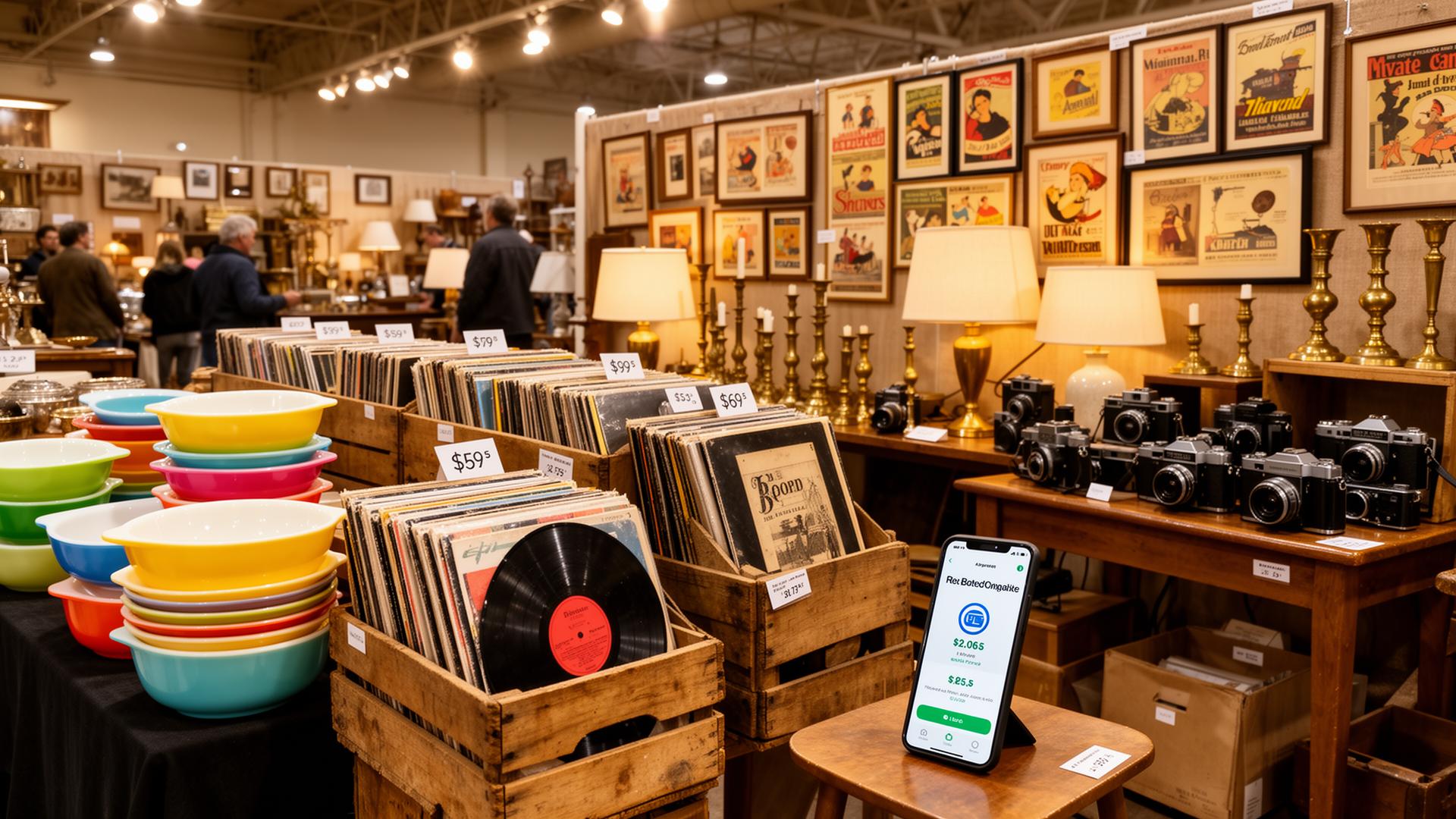
If you've sold a few things on eBay, Poshmark, or Facebook Marketplace and wondered whether estate sale flipping could be a real income, the answer is yes — but only if you treat it like a system. The resellers making real money from estate sales aren't shopping by feel. They're running a sourcing-to-sale loop with specific tools at every step.
Here's the loop that works.
The Full Reseller Loop
Every successful reseller runs the same five steps:
- Find the sales worth attending (wishlist alerts + browse)
- Identify items on-site (Ai appraiser)
- Buy with confidence in your margin (eBay sold comps)
- List quickly with great descriptions (Ai-generated listings)
- Sell to buyers who already want what you have (wishlist-matched buyers)
The resellers who do all five well make consistent money. The resellers who skip steps lose money on items they shouldn't have bought, list slowly with weak descriptions, and never reach the buyers who would have bought their inventory.
Step 1 — Wishlist Alerts as Your Sourcing Filter
Most resellers waste their first hour every Saturday driving to sales that turn out to be empty or full of stuff they don't deal in. Wishlist alerts solve this. Set keywords for the categories you specialize in — "McCoy pottery," "Levi's Big E," "Blue Note first pressing," "vintage Pyrex" — and only get alerts for sales that actually have your inventory.
By Friday night, you have a list of 4–6 sales worth attending. The route planner orders them efficiently. You're done sourcing by noon, every Saturday.
Step 2 — The Ai Appraiser Changes Margin Math On-Site
Before the Ai appraiser, identifying an item took experience plus a phone with bad signal in someone's basement. Now it takes 10 seconds.
Photograph the item. Get back: maker, era, pattern name (where applicable), and — critically — real eBay sold comps for the same item in the last 90 days. Not asking prices. What real buyers actually paid.
This changes the buying decision completely. A vase priced at $25 with sold comps of $180–$240 is a buy. A vase priced at $25 with sold comps of $30–$45 is a pass. You make the call in seconds, move on to the next item, and never second-guess.
Step 3 — Buying With Confidence
The single biggest difference between profitable and unprofitable reselling is confidence at the buying decision. Hesitation costs you good buys. Overconfidence costs you on bad ones. The Ai appraiser eliminates both. You know your margin before you pick up the item.
Rule of thumb: aim for at least a 3x markup on what you pay vs. expected sale price. So an item with $90 in sold comps is a buy at $30 or less, a maybe at $30–$50, and a pass above $50. Adjust based on category and how fast that category turns.
Step 4 — Ai-Generated Listings (Saturday Afternoon)
The reason most reseller side hustles stall isn't sourcing — it's listing. Writing 20 good item descriptions with proper keywords is a 4-hour job. Most people get to listing 3 and quit.
Upload a photo to the Collective. The Ai generates a full listing: title, condition note, era, materials, suggested keywords, and a clean description. Edit it in 30 seconds, hit publish. A 20-item listing session takes 25 minutes instead of 4 hours.
Step 5 — Wishlist-Matched Buyers
Here's the part that makes The Collective different from eBay or Facebook Marketplace. The buyers on this platform have set wishlist alerts for specific categories. When you list a McCoy Lily Bud planter, the system automatically notifies every buyer with "McCoy" or "McCoy Lily Bud" in their wishlist within your shipping range.
The sale often happens within hours, not weeks. That changes the entire economics of reselling — your inventory turns faster, your cash flow is healthier, and you spend less time managing stale listings.
The Economics vs. Other Platforms
The fee comparison everyone wants to see:
- eBay: 12.9% final value fee + payment processing (often $14–$17 per $100 sale)
- Poshmark: 20% on sales over $15
- Mercari: 10% selling fee + payment processing
- Facebook Marketplace: free, but no buyer base for serious vintage
- The Collective: flat monthly fee, zero commission
For a reseller selling $1,000/month, eBay takes $130–$170. Poshmark takes $200. The Collective takes a flat fee regardless of volume. The math gets better the more you sell.
A Real Example
A reseller in Austin sources every Saturday morning using wishlist alerts and the route planner. Hits 4–5 sales by noon. Lists everything by 4pm using Ai-generated descriptions. Average week: 18 items listed, $640 in sales by the following Wednesday. Net of booth fee: ~$590. Annualized (with two weeks off): about $30,000 in side income.
That's the loop. Nothing magical, no complicated tricks — just the right tools at each step.
Keep going: open your free booth or read more about The Collective.