The $77,000 Toy Train: Lionel, and Why the Attic Collection Could Be a Windfall
A black locomotive in Grandpa's attic might be a common postwar runner, a four-figure first-year Berkshire, or one of the rarest Lionel trains ever made. Here is how to tell the difference without cleaning away the evidence, mixing up the boxes, or trusting a price copied around the internet.
Old Lionel trains can be worth anything from a few dollars to tens of thousands, but the name on the locomotive is only the beginning. The documented high-water story is a 1937 brass 700E scale Hudson prototype that sold for $77,000 at Stout Auctions in December 2004. Most attic trains will not approach that result. The pieces that do best combine rarity, original paint, completeness, strong condition, matching boxes and a history a buyer can verify.
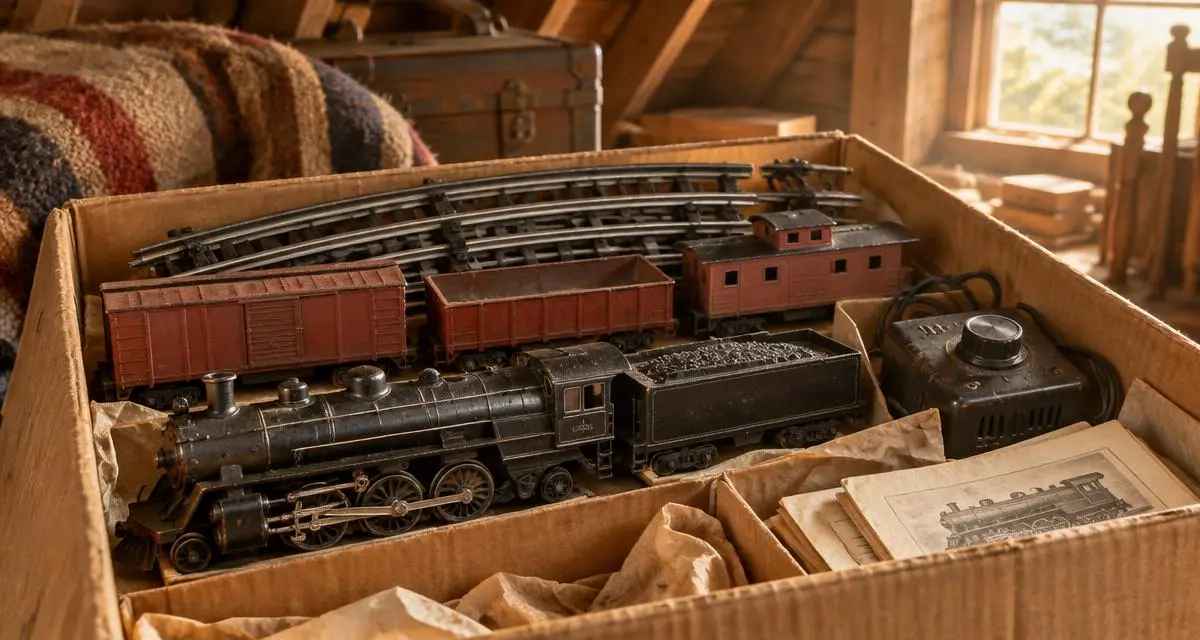
This is the good kind of attic mystery: a box heavy enough to need both hands, curved track hooked through the handles, a transformer underneath, and a black locomotive wrapped in newspaper dated sometime around the moon landing. The temptation is to plug it in, polish it until it shines and search the first number you see.
Please don't. Not yet.
The $77,000 locomotive was real
On December 10 and 11, 2004, collectors converged on Williamsport, Indiana, for a Stout Auctions sale. The star was a 1937 brass 700E scale Hudson prototype with provenance reaching back to its beginning. It sold for $77,000, which contemporary trade coverage called a new auction record for a Lionel toy train. The same sale included a rare 6464-100 orange-and-blue boxcar at $74,250 and a 400E steam engine and tender at $2,970—an excellent lesson in how one unusual variation can run miles ahead of a familiar model. Read the contemporary sale report in *The Newtown Bee*.
The production 700E was already extraordinary. Introduced in 1937, it was a highly detailed 1:48-scale model of the New York Central J-1e 4-6-4 Hudson, built for O-gauge track. Classic Toy Trains describes the 700E's scale detail and history, while PBS Antiques Roadshow's 700E appraisal shows why collectors inspect the model, tender and condition together.
The important word in the $77,000 result is prototype. It was not an ordinary production locomotive that happened to survive in a closet. It was exceptionally rare, documented and desirable before the bidding started.
About that $250,000 Lionel story
You may have seen articles claiming that a 1935 Lionel Standard Gauge set sold for $250,000. We went looking for the auction house, catalog, lot number and sale date. We could not find them.
The number has been copied across collector listicles, but a repeated claim is not an auction record. By comparison, a documented Bonhams listing for a prewar 400E Blue Comet locomotive and train set carried a $3,000–$5,000 estimate in September 2025. See the exact Bonhams 400E lot and photographs.
Could a unique variation with impeccable provenance bring dramatically more? Of course. But until a verifiable result appears, $250,000 belongs in the rumor cabinet—not in your insurance schedule.
Four Lionel eras, four very different markets
| Era | What you are likely to see | Why collectors care |
|---|---|---|
| Standard Gauge, early 1900s–1939 | Large locomotives and cars on 2 1/8-inch three-rail track; bright enamel and nickel trim | Size, color variations, scarcity and spectacular complete sets |
| Prewar O gauge, 1915–1942 | Smaller three-rail trains, tinplate cars and scale models such as the 700E | Important engineering, Art Deco design and rare character tie-ins |
| Postwar, 1945–1969 | 726 Berkshires, F3 diesels, operating cars, accessories and familiar orange-blue boxes | The great nostalgia market—and the era most likely to fill an attic |
| Modern, 1970–present | MPC, later Lionel and limited-run trains with newer electronics | Some scarce releases matter, but age alone does not make them valuable |
Lionel introduced O gauge in 1915, and the smaller format eventually displaced Standard Gauge. Invaluable's illustrated Lionel history and auction archive is a useful orientation, but even its examples prove there is no single “Lionel value.” A common car with play wear and a rare locomotive in untouched paint are different markets wearing the same name.
The attic triage table
These are documented examples and useful search ranges, not appraisals. Auction estimates are not sale prices, an online asking price is not a sale, and condition can move a result enormously.
| Train or set | First clues | Documented market evidence | What changes the number |
|---|---|---|---|
| 1937 brass 700E Hudson prototype | Fine brass construction, 4-6-4 wheel arrangement, extraordinary scale detail and documented history | $77,000 sold, Stout Auctions, December 2004 | Prototype status and continuous provenance—not merely “700E” on a listing |
| 400E Blue Comet | Large Standard Gauge locomotive; blue passenger consist with bright trim | A Bonhams 2025 set was estimated at $3,000–$5,000; Invaluable records a gray 400E locomotive and tender at $12,810 in 2016 | Factory color, matching cars, original paint, completeness, boxes and condition |
| 1935 Mickey Mouse Circus | Windup lithographed train, Mickey figure and fragile cardboard circus pieces | A complete original example sold for $6,995 online in October 2024; another highly complete boxed example sold for CA$3,300 at Miller & Miller | Missing figures, tent pieces, tabs and box damage matter enormously |
| Postwar 726 Berkshire | Black 2-8-4 locomotive, commonly paired with a 2426W whistle tender | Recent evidence ranges from a $600–$1,200 auction estimate to a reported $1,799.99 sale for a desirable 1946 Type I example | Production year, smoke mechanism, tender, operation, box and originality |
For the Mickey set, compare the Miller & Miller lot description and CA$3,300 result with the $6,995 October 2024 sale record. For the 726, compare the $600–$1,200 auction estimate with the reported $1,799.99 Type I sale. These are snapshots, not a promise that the train in your hands will match them.
What makes one Lionel train outrun another
Original paint beats fresh paint
Collectors want to see what left the factory. Chips and honest play wear can be preferable to a glossy repaint that hides repairs or turns a rare color variation into a guess. Do not touch up a stripe, replace a decal or scrub a shell before someone knowledgeable examines it.
Completeness is a scavenger hunt
A locomotive may need its correct tender. A passenger set may need the right cars. The Mickey Mouse Circus needs small figures and delicate cardboard parts that disappeared first. Search the entire room before separating anything: drawers, cigar boxes and coffee cans are exactly where couplers, bulbs, track clips and tiny figures migrate.
The box is part of the collection
A correct numbered box with inserts and intact flaps can establish identity and protect value. Never flatten it, tape it or throw it away because it looks shabby. Keep every box beside the item you found in it until the pairing is confirmed.
Provenance turns a story into evidence
“Grandpa said it was special” is charming. A receipt, collector-club letter, inventory notebook or old auction catalog is evidence. Photograph papers where they sit, keep names with the collection and resist reorganizing before you understand the system.
Rarity matters more than the logo
Large collections can reach $50,000, $200,000 or beyond when they contain rare, high-grade, documented material. That is not the normal attic. Common postwar trains can be wonderful, runnable and modestly priced. The market is uneven: elite rarities and scarce variations can climb while abundant pieces stay flat or soften. We found no defensible market index supporting the often-repeated claim that Lionel trains as a group appreciated 30–50 percent in five years.
Your five-minute, do-no-harm inspection
- Photograph the collection exactly where it sits. Include boxes, paper, track and accessories before moving anything.
- Record every visible number. Check cab sides, frames, car sides, tender undersides and box end labels. Photograph instead of rubbing grime away.
- Count wheels correctly. A 4-6-4 Hudson has four leading wheels, six drivers and four trailing wheels; a 2-8-4 Berkshire has two, eight and four. Count both sides as axle-wheel totals, not only what faces you.
- Keep sets and boxes together. Use removable paper notes outside the packaging; never write on an original box.
- Stop before power. Brittle wiring, old insulation and dried lubricant can turn “let's see if it runs” into an electrical or mechanical problem.
The Train Collectors Association condition and grading standards give collectors a common C-1 through C-10 language. Read the definitions before calling anything “mint.” In collector grading, enthusiasm is not a condition grade.
Repaints, reproductions and assembled sets
Old trains have been restored, reproduced and assembled from mismatched parts for decades. None of that makes a train worthless. It does mean you must describe it correctly.
Look for paint inside screw holes, soft or incorrect lettering, hardware that ages differently from the body, Phillips screws where slotted screws belong, modern wire, inconsistent wheel wear and box labels that do not match the train. A suspiciously flawless ninety-year-old piece deserves more inspection, not more excitement.
The Train Collectors Association publishes a detailed Postwar Lionel Reproduction Handbook covering repaints, restorations and fakes. Use it as a warning system, not a substitute for hands-on authentication of a possible five-figure piece.
What to do when the attic holds a railroad
First, make an inventory. Give each locomotive, tender, car, accessory, box and paper item its own line and photographs. Then research completed sales for the exact number and variation—not active listings with wishful prices. Note whether a result includes the tender, box, buyer's premium or a whole set.
For a collection that appears rare, boxed or unusually complete, contact a toy-train specialist or established auction house before dividing it. One locomotive may explain which cars and papers belong together. Selling the obvious star first can make the remaining set harder to identify and less desirable.
If you are pricing a household professionally, the same discipline applies across categories: start with the estate-sale pricing guide, then compare the train against the broader list of overlooked brands and valuable estate-sale finds. Ai pricing can be a useful suggestion, but a prototype, undocumented repaint or rare variation still requires expert judgment.
How to find the next collection before Saturday morning
Toy trains often appear in basement photos as a transformer, a loop of track or the corner of an orange box—not as a beautifully cataloged “rare Lionel collection.” Search the objects, not only the sale title.
- Browse estate sales near you and search for Lionel, toy train, O gauge, Standard Gauge, Hudson and Berkshire.
- Save those terms to your wishlist so newly photographed matches can find you.
- Follow companies that regularly list collections, then add promising stops to your sale route.
- Read the broader vintage toy field guide and the honest lesson from collectibles whose hype outran their scarcity.
- If you resell, use the complete estate-sale sourcing guide to calculate the time, testing, fees and shipping risk—not just the headline sale price.
The fun is not believing every dusty box contains $77,000. The fun is knowing enough to recognize when one deserves a second look.
Quick answers before you touch the train
Are all old Lionel trains valuable? No. Common, incomplete or heavily worn trains may sell for modest amounts. Exact model, variation, condition, originality and completeness matter more than age alone.
Should I clean a dirty Lionel train? Dust it only with great caution and avoid polish, solvents, oil and paint. Original finishes and decals can be fragile, and cleaning can erase the evidence a specialist needs.
Does an original box really add value? Often, yes—especially when the number matches and the inserts and flaps survive. It also helps establish that the pieces belong together.
Should I plug in the transformer? Not until an experienced repairer checks the cord, insulation and transformer. Old electrical equipment can be unsafe even when it looks intact.
Where can I get a serious collection appraised? Start with a recognized toy-train auction specialist, an experienced dealer or a collector organization such as the Train Collectors Association. For an exceptional item, seek more than one opinion and ask how comparable sales were selected.
What is the fastest way to identify a locomotive? Photograph every number and marking, then match the wheel arrangement, tender, gauge, color and construction details—not just one number from a box that may have been swapped.
Sources and further reading
- The Newtown Bee — “Record Prices for Lionel Toy Trains”, December 22, 2004: contemporary report of the Stout sale and $77,000 brass 700E prototype.
- Classic Toy Trains — “The Lionel 700E Hudson steam engine”, updated September 22, 2023: model history and technical context.
- Bonhams — prewar 400E Blue Comet lot 352, September 20, 2025: exact lot photographs and $3,000–$5,000 estimate.
- Invaluable — Lionel history and auction archive, updated March 13, 2019: era overview and documented auction examples.
- Train Collectors Association — grading standards and reproduction handbook: condition language and authentication warnings.
- Miller & Miller — Mickey Mouse Circus set: exact condition description and CA$3,300 result.
Values are snapshots from specific sales and estimates, not guarantees. Buy the train because it makes the room come alive; research it carefully because, once in a great while, the attic really did keep the best secret in the house.
Keep exploring
Ready to start your own treasure hunt?
Discover estate sales near you and find incredible deals.
Explore Sales Near Me
About the author
Andy
Founder, EstateSaleFinder.net
Hi, I'm Andy — a retired commercial photographer turned developer with a five-year (and counting) obsession with estate sales. I started EstateSaleFinder.net because I knew there had to be an easier, smarter way to find and list estate sales. Now I get to chase treasure and build the tool I always wished existed.