Vinyl Record Collectors: Estate Sales Are Where Rare Records Still Hide
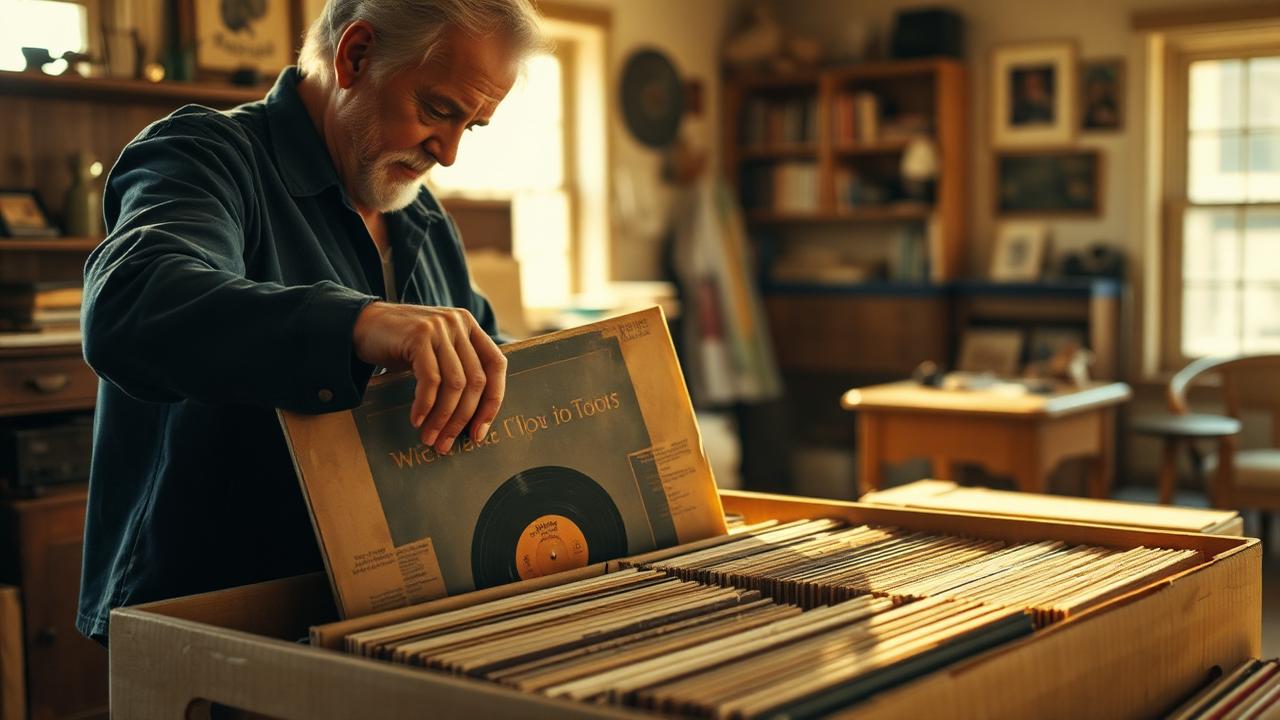
A 75-cent record from a stoop sale turned out to be a one-of-a-kind acetate worth a fortune. That kind of score still happens — at estate sales, where records are priced by someone clearing a house, not a collector who knows a first-pressing Blue Note from a reissue. Here's what separates a $2 record from a $2,000 one, plus how EstateSaleFinder's keyword search, 24/7 wishlist alerts, and an AI that reads pressings like a 30-year dealer get you to the good crates first.
In 2002 a DJ named Warren Hill flipped through a cardboard box on a New York City stoop and pulled out a scuffed, hand-labeled acetate. The seller wanted 75 cents. He paid it.
That disc turned out to be a one-of-a-kind 1966 demo acetate of The Velvet Underground & Nico — a version of the album that existed nowhere else on earth. When he later put it up for sale, the bidding spiraled into the tens of thousands of dollars. Seventy-five cents to a small fortune, because a stranger clearing out records had no idea what was in the box.
Here's the part most people never internalize: that exact scenario is still happening every weekend — and the place it happens most is an estate sale.
Why estate sales are the last place records are still priced wrong
Think about who prices the records at each stop along the way.
- Estate sale: a family member or sale company clearing a house. They see "a box of old records." Maybe $2 each, or $20 for the crate.
- Record store: a buyer who knows exactly what's in that crate. The Coltrane gets pulled, graded, and shelved at $120.
- Discogs / eBay: photographed, matrix-checked, graded VG+, shipped worldwide. $200+.
Same record. Same pressing. The only thing that changed is who priced it. At every step after the estate sale, someone who knows records set the number. At the estate sale, the person pricing it almost never does.
That's the entire edge. You can search estate sales near you for records right now — but first, let's make sure you know what you're looking at.
What separates a $2 record from a $2,000 record
This is the stuff that makes collectors lean in — and the stuff a house-clearer will never check. Most of the value lives in details you can't see from across the room.
The dead wax tells the truth. The smooth band between the last groove and the label is the dead wax (or runout). Etched into it are the matrix and stamper numbers. Hand-etched, slightly irregular lettering usually means an original pressing; clean machine-stamped numbers usually mean a later reissue. Two copies of the same album that look identical can be worth $15 and $1,500 — and the only difference is in that one-inch strip of vinyl.
Label variations date a pressing precisely. Collectors memorize tiny label changes because they pin down the year. The classic example: an original Blue Note jazz LP with the "767 Lexington Ave., NYC" address on the label is a pre-1955 deep-groove pressing — the most valuable kind. A later "Liberty" or "United Artists" reissue of the same title is worth a fraction.
Mono vs. stereo matters — and not how you'd guess. For a lot of 1950s–60s jazz and rock, the original mono pressing is the prized one, often worth far more than the stereo version that looks newer and "better."
Promos and white labels. A white-label promo (a pre-release copy sent to radio stations) is frequently rarer than the commercial release. A John Coltrane A Love Supreme white-label promo sold for $2,275 in late 2025.
Weight and audiophile reissues. A heavy 180g pressing is usually a modern audiophile reissue — nice to listen to, but not the holy grail. Thin, light vinyl can be a budget reissue. Original-era pressings vary, which is exactly why the dead wax matters more than the heft.
Condition is graded, and the floor is higher than you think. Collectors use a standard scale — M (Mint), VG+ (Very Good Plus), VG, G+. As a rule of thumb, VG+ is the minimum grade where a record holds real value. A rare title in beat-up shape can be nearly worthless; a common title in Mint can still surprise you.
None of this is checked at the average estate sale. Which is precisely why the records are still in the box.
The finds that started at a sale
The 75-cent Velvet Underground acetate isn't a fluke. Estate sales and house clearances keep producing music history:
- In 2022 a buyer hauled away 15 U-Haul boxes of reel-to-reel tapes from a Montgomery County estate sale — they turned out to contain never-before-heard David Bowie recordings from his Philadelphia era.
- A producer found a forgotten 1970s recording at a Bridgeport estate sale, tracked down equipment to play it, and finally released the lost song decades later.
- Auction-grade rarities still surface from old collections constantly: a first-state Beatles "Yesterday and Today" Butcher Cover has sold for up to $125,000; rare Northern Soul promo 45s routinely clear $1,000–$1,300.
The records are out there. The hard part was never the records. The hard part was finding the sale that had them — before someone else did.
The catch: you can't dig through every crate in your county
For twenty years, hunting records at estate sales meant the same grind: scan a directory of addresses, guess which sales might have music, drive across town on a Saturday morning, and dig — hoping the one sale with the jazz crate wasn't the one you skipped.
There was no way to ask the simple question every collector actually has: "Who near me is selling records this weekend?"
Now there is.
Feature #1 — Search estate sales for records by name
On EstateSaleFinder, the items inside the sale are searchable — not just the address. Type "vinyl records," "jazz LPs," "Blue Note," "45s," or "record collection," and you'll see matching items at real estate sales near you, with photos, prices, and how far away they are.
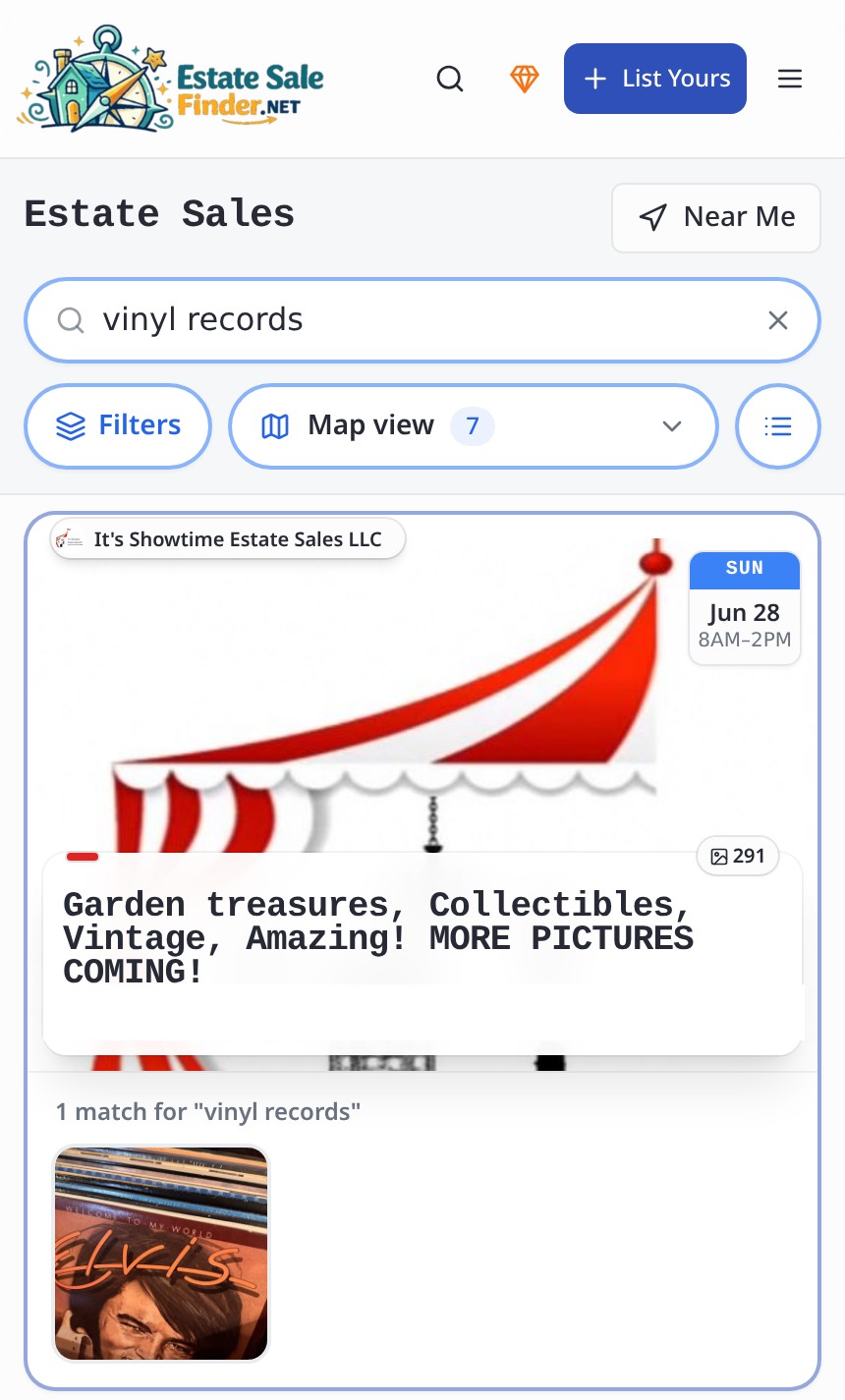
No legacy estate-sale directory does this. They list sales; we make the contents findable. For a record hunter, that's the difference between driving to nine sales and coming home empty — and driving straight to the one with the crate. Start searching here.
Feature #2 — A wishlist that hunts crates while you sleep
You can't refresh a directory all day. So don't. Save your wants to a wishlist — "vinyl records," "Blue Note," "Northern Soul," a specific artist — set your radius, and EstateSaleFinder watches for you 24/7. The moment a matching item lists at a sale nearby, you get pinged.
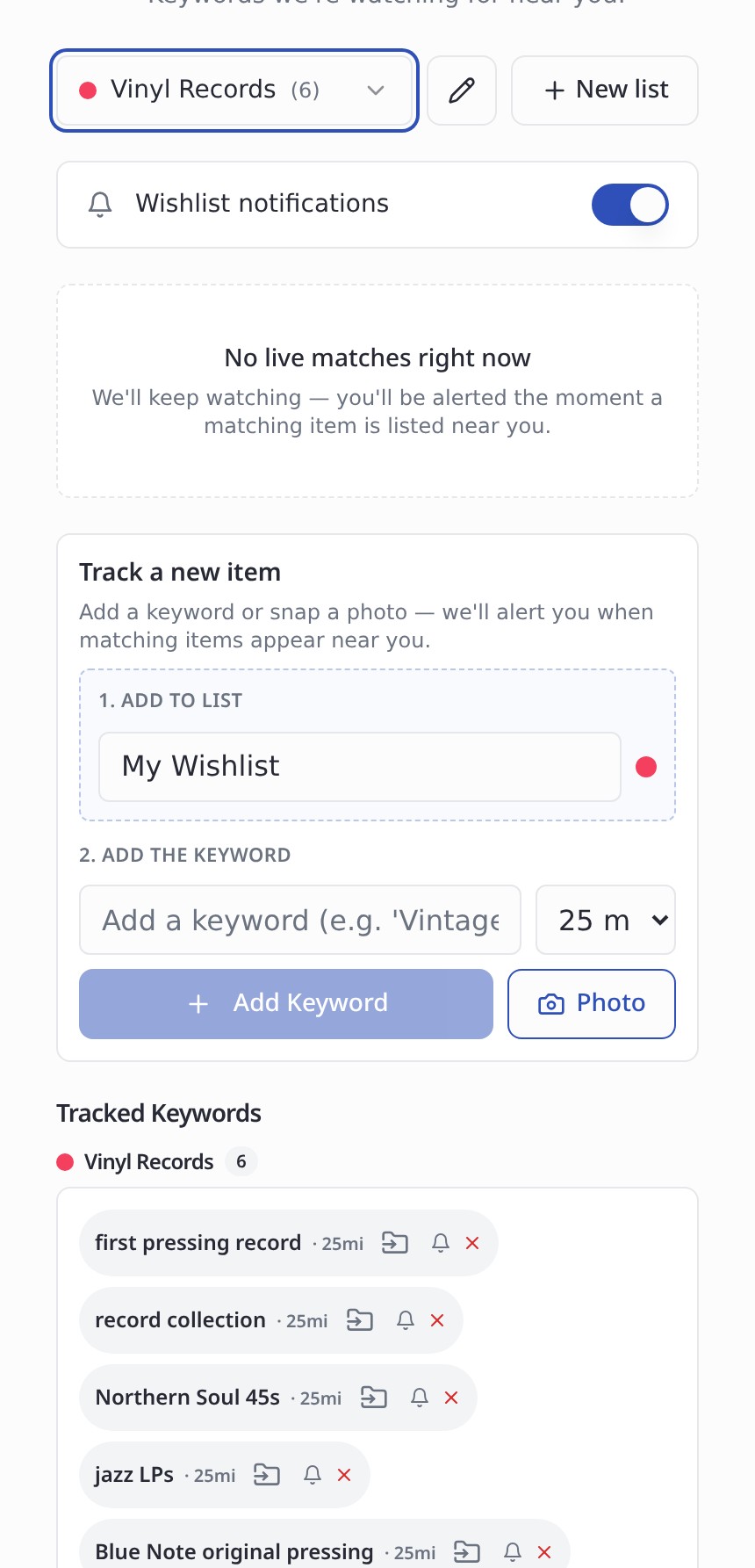
This is how you stop being the collector who hears about the great record sale on Monday. You hear about it the second it posts.
Feature #3 — An AI that reads a record like a 30-year dealer
This is the one that makes people say "wait, it does what?" The AI Analyzer on EstateSaleFinder is a genuine vinyl expert. Snap a photo of a record or its label and it will:
- Identify the pressing and flag original vs. reissue — the single most value-defining question.
- Read the format — LP, 45, or 78 — and adjust expectations accordingly.
- Explain exactly where to look for the matrix number in the dead wax and what hand-etched vs. machine-stamped means for your copy.
- Decode label variations — like that pre-1955 Blue Note "767 Lexington Ave" tell — and call out famous high-value labels.
- Surface a value range and link you straight to Discogs to confirm against real sold data.
In other words, the knowledge from the section above — the stuff that takes collectors years to learn — is in your pocket, standing right there at the sale, before you decide whether that $2 record is actually a $2 record. Try the analyzer.
The collector math
Put the three together and the edge is almost unfair:
- Keyword search gets you to the sale with the records.
- Wishlist alerts make sure you hear about it first.
- The AI Analyzer tells you, on the spot, whether you're holding a reissue or a grail.
First dibs + the lowest price anyone will ever pay + instant expert verification. That's not luck anymore. That's a system.
Start your record hunt
The 75-cent acetate, the Bowie tapes, the Coltrane promo — every one of them sat in a box because the right collector hadn't walked in yet. EstateSaleFinder makes sure the right collector is you, and that you get there first.
Create a free account, save your first record wishlist, and scan your next find with the AI Analyzer. The next crate is out there. Now you can actually find it — and know exactly what's in it.
If you collect more than records, you'll want our full collector toolkit too.
Keep exploring
Ready to start your own treasure hunt?
Discover estate sales near you and find incredible deals.
Explore Sales Near Me
About the author
Andy
Founder, EstateSaleFinder.net
Hi, I'm Andy — a retired commercial photographer turned developer with a five-year (and counting) obsession with estate sales. I started EstateSaleFinder.net because I knew there had to be an easier, smarter way to find and list estate sales. Now I get to chase treasure and build the tool I always wished existed.