Uranium Glass: The Salad Bowl That Glows
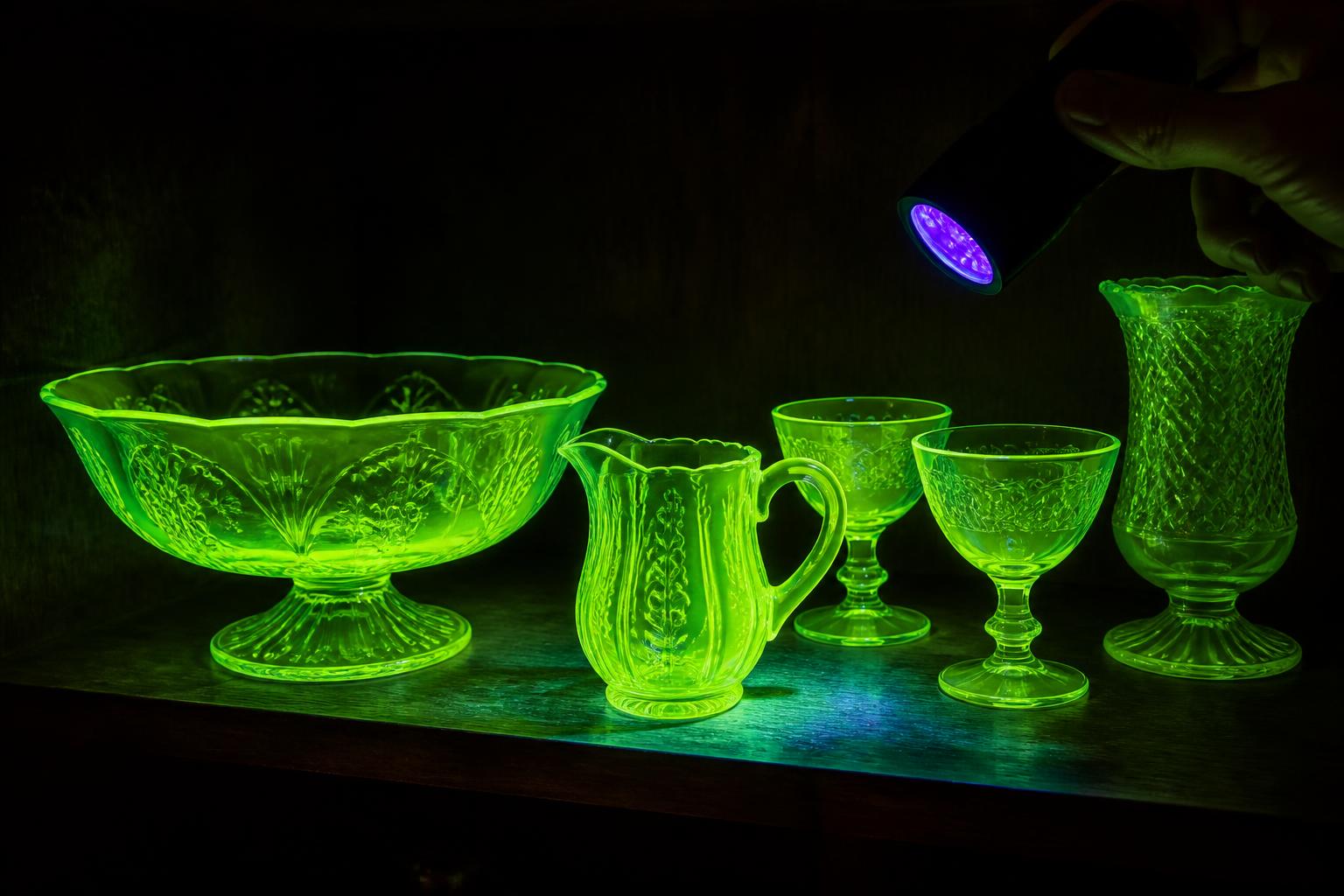
There is a bowl in somebody's china cabinet right now that looks like weak lemonade in daylight and blazes electric green under a $12 flashlight, because it was made with uranium. Here's the true story of Vaseline glass — why it stopped in 1943 and restarted in 1959, what it honestly sells for, whether it's safe (mostly yes, with one rule), and how to find it across a dim estate sale in four seconds.
Quick answer
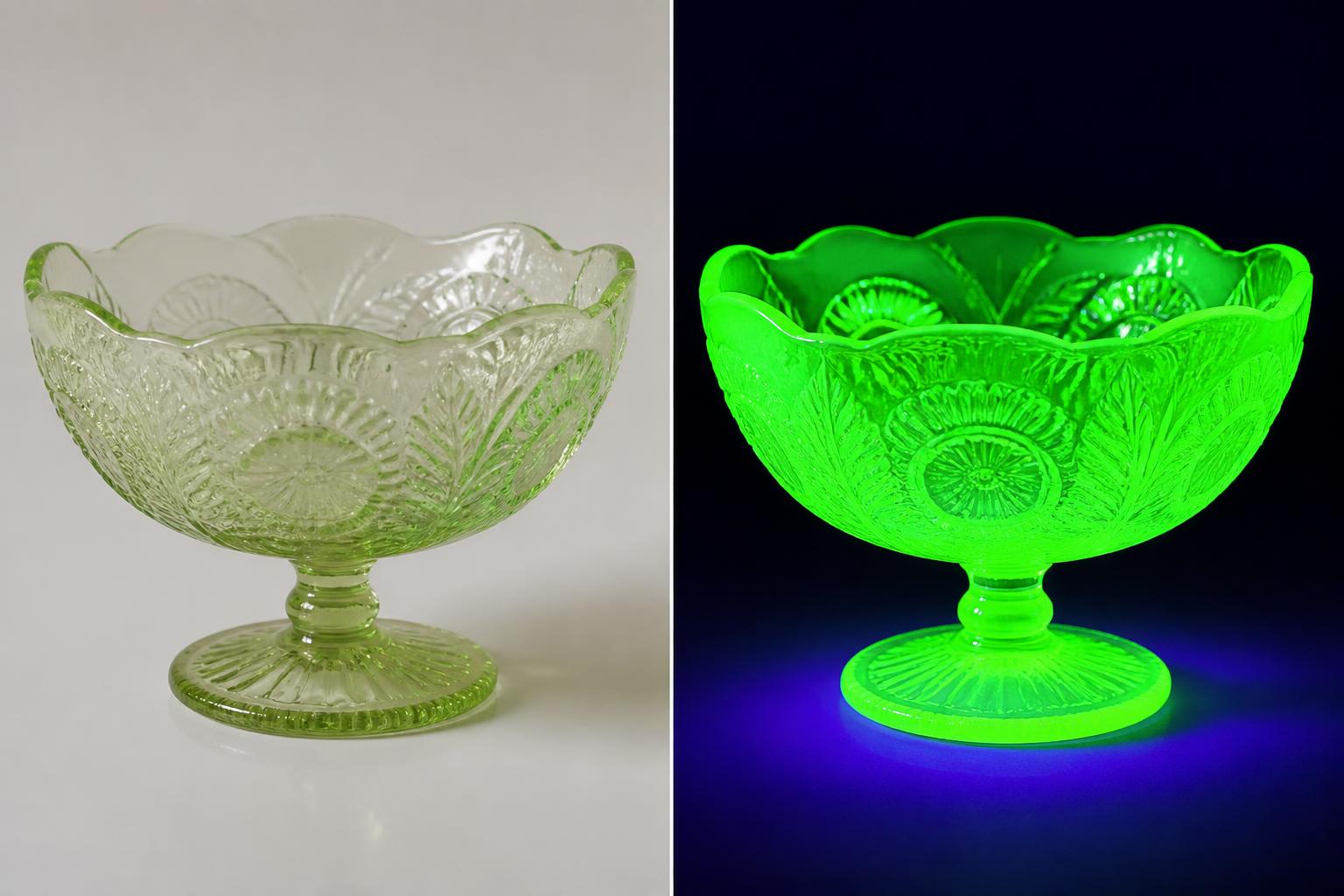
Uranium glass — usually called Vaseline glass in the U.S. — is antique glassware colored with a small amount of uranium dioxide, typically around 0.1% to 2% by weight. In daylight it looks pale yellow or yellow-green. Under a 365 nm UV flashlight it fluoresces intense neon green, which is the standard, non-destructive way to identify it. It was made from about 1840 until roughly 1943, when the U.S. government took control of uranium supplies during the war; the ban lifted in November 1958 and production resumed in 1959 using less-radioactive depleted uranium (Vaseline Glass Collectors, Inc.). It is radioactive, but barely: the federal exposure assessment cited by Oak Ridge Associated Universities found the most exposed group — people who trucked crates of it around — received 1 to 2% of an average American's annual radiation dose. Common pieces sell for about $10 to $50; large, rare or signed pieces run into the hundreds and occasionally into the low thousands. Display it, don't dine on it.
Somewhere in your town, tonight, there is a woman named Carol who has had the same yellow-green footed bowl on the third shelf of her china cabinet since 1974. She got it from her mother. Her mother got it from a neighbor. Carol has served exactly one salad in it — Thanksgiving 1988 — and has referred to it, for fifty-one years, as "that ugly green bowl."
Carol's ugly green bowl is radioactive.
Not Chernobyl radioactive. Not don't-open-the-cabinet radioactive. But genuinely, measurably, hold-a-Geiger-counter-to-it-and-it-clicks radioactive, and if you take it into a dark room and hit it with a twelve-dollar flashlight from the internet, it does something that no other object in Carol's house does.
It turns the color of a highlighter having a religious experience.
What is uranium glass?
Uranium glass is ordinary glass — sand, soda ash, limestone — with a pinch of uranium dioxide stirred into the batch as a colorant. That's it. That's the whole trick. Uranium is a spectacular pigment: a fraction of a percent turns the entire melt a luminous yellow-green that no other additive quite matches, and it gives the glass a strange internal depth, like it's lit slightly from the inside even in a dim room.
How much uranium? Less than people assume. Vaseline Glass Collectors, Inc. defines the American category as glass made with as little as 0.1% to 0.2% uranium dioxide. Reference sources put the broader historical range from trace amounts up to about 2%, with a handful of unusual twentieth-century pieces reported far higher — up to roughly 25% — which is the outlier, not the recipe. If you have heard "grandma's vase is a quarter uranium," that is the extreme end of a very long tail.
The reason it matters at an estate sale is the party trick. Uranium in glass sits there as the uranyl ion, and uranyl absorbs ultraviolet light and spits it back out as visible green. That is fluorescence, not radioactivity — as ORAU's retired health physicist Paul Frame puts it, the glow is "a visual effect resulting from the interaction of UV light with the uranium in the glass." The glass is not glowing because it's dangerous. It's glowing because chemistry is showing off.
A Bohemian glassmaker named his uranium after his wife
The story starts in the 1830s in what is now the Czech Republic, in the glassmaking valleys of the Jizera Mountains.
A glassmaker named Josef Riedel began producing uranium-colored glass commercially and named the two shades after his wife, Anna: Annagelb for the yellow and Annagrun for the green. Anna yellow. Anna green. The Corning Museum of Glass still lists Annagelb in its glass dictionary, and the Victoria & Albert Museum holds a Riedel goblet from around 1840 in the collection.
Take a second with that. In the 1830s, uranium was an obscure mineral curiosity. Radioactivity would not be discovered for another sixty years. Marie Curie was not born yet. Nobody on Earth knew what an atom was doing. A man looked at a heavy grey oxide, thought that would look lovely in a punch bowl, and named the color after his wife.
By the Victorian era it was everywhere. Vaseline Glass Collectors puts the heyday at the 1880s through the 1920s — the era of the ruffled compote, the ornate epergne, the tiny thumbprint toothpick holder that every dealer in America still has a box of. Britain called their opalescent version Pearline. Germany called all of it uranglas. Americans looked at the yellow stuff, thought about petroleum jelly, and named it Vaseline glass, which is either charmingly literal or the least glamorous name ever given to a luxury good.
Why it stopped, and why it came back
Here is the part that makes people sit up.
In the early 1940s the United States government developed a sudden, pressing, top-secret interest in uranium. Every gram of it. The Manhattan Project did not care about compotes.
Per Vaseline Glass Collectors, Inc., the government confiscated uranium supplies and production of Vaseline glass halted from approximately 1943 until the restriction was finally lifted in November 1958. Glass companies were permitted to resume only after regulators worked through the testing, and production restarted in 1959 — this time using depleted uranium, the leftover material after the fissile isotope has been removed, which is less radioactive than the natural uranium used before the war.
So there is a genuine, physical dividing line running through this category: pieces made before about 1943 used natural uranium, and pieces made after 1959 used depleted uranium. ORAU describes the gap the same way — production halted for the war effort, then resumed after a 15-year hiatus with depleted material.
Today only a handful of makers still produce it, in small batches, for collectors — and not as dinnerware. Uranium dioxide is tightly regulated and expensive, which is exactly why the surviving old pieces hold their value the way they do.
That is the sentence to remember when you're standing in a garage in July holding a bowl: the reason your grandmother's punch set exists and mine doesn't is that a factory in Ohio ran out of uranium because of the atomic bomb.
Is uranium glass safe? The honest answer
Short version: yes to owning, displaying, dusting, handling, and inheriting it. No to using it as everyday dinnerware.
Long version, with the actual numbers:
The U.S. government's Systematic Radiological Assessment of Exemptions for Source and Byproduct Materials looked at exposure from uranium glass products. As ORAU summarizes it, the highest doses did not go to collectors — they went to the people who transported crates of the stuff from manufacturers to distribution centers, and even for them the maximum estimated dose came out at 1 to 2% of the average American's annual radiation exposure. You get more radiation from a cross-country flight, a granite countertop, or the potassium in a banana-heavy week.
The EPA states the general rule plainly: antiques containing radioactive materials "are usually not a health risk if they are in good condition," and notes that the low-level emissions from Vaseline glass can register on a handheld Geiger counter if you get close enough. Which is the entire reason a small but committed slice of the hobby owns a Geiger counter, and the entire reason those people are so much fun at parties.
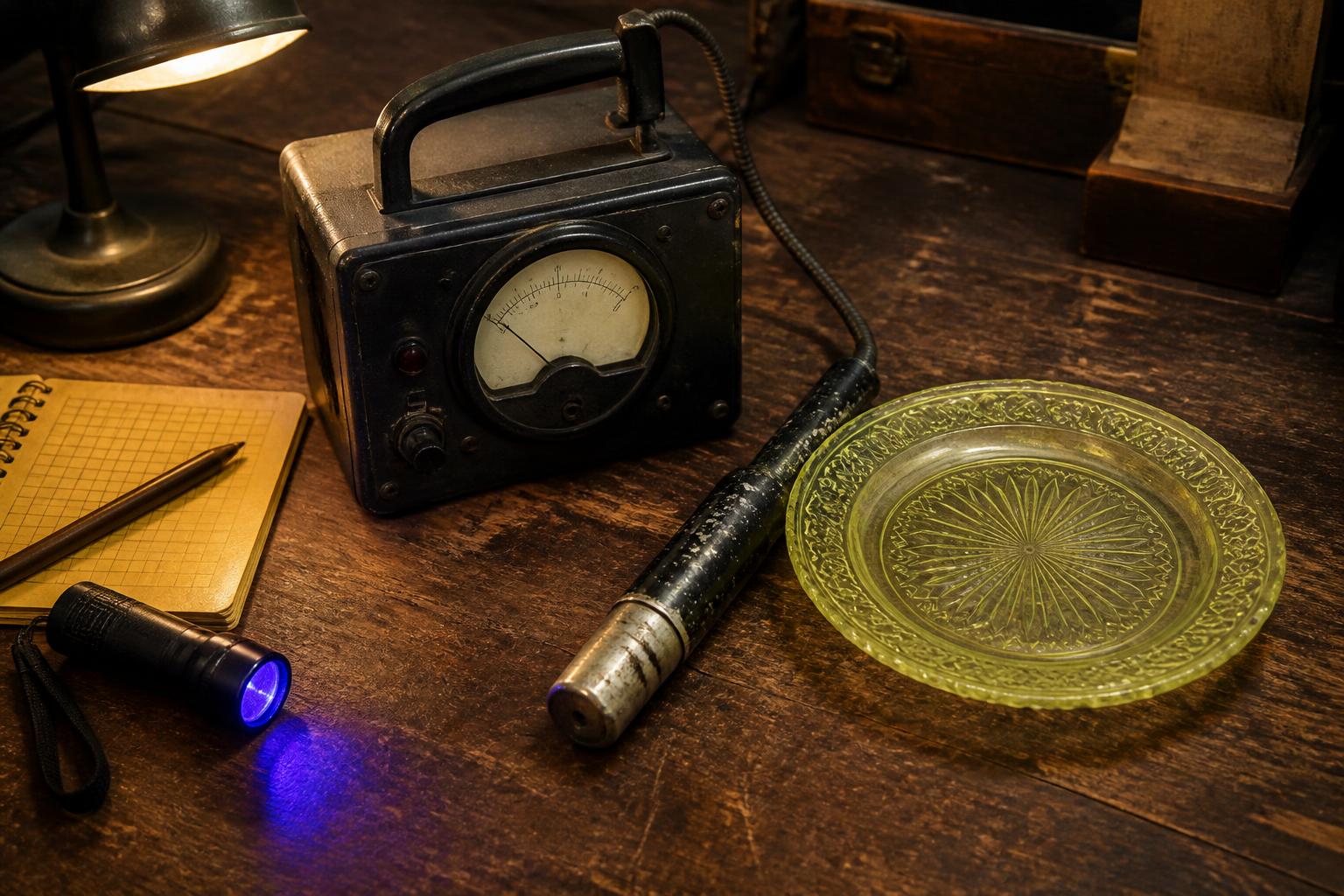
So where's the catch? It's about ingestion, not exposure. The concern was never the glass sitting on a shelf beaming at you; it's uranium physically getting into you. That means:
- Don't use it as daily dinnerware or drinkware. ORAU's guidance is explicitly to handle it with care and not use uranium glass for food or drink. Acidic foods and liquids sitting in it for long periods are the specific scenario nobody wants to test.
- Damaged pieces are the real caution. Chipped rims, cracked edges, and anything that produces glass dust. Do not grind, sand, cut, or drill it — that turns a stable solid into inhalable particles.
- Wash your hands after handling a lot of it, the same as you would after an afternoon of sorting anything old and dusty.
- Display it, don't dose it. Backlit on a shelf it's gorgeous. Under a UV strip in a cabinet it is the single most impressive object most guests have ever seen in a dining room.
One more clarification, because pop culture blends these together constantly: uranium glass is not the Radium Girls story. That was radium paint, applied by hand, by workers who were told to point their brushes with their lips, and it was a genuine industrial tragedy. If you want that history done properly — and it is a gut-punch — we wrote it up in The Radium Girls and the clocks that glow. Different element, different dose, wildly different story. A salad bowl is not a watch dial.
Vaseline, canary, custard, Burmese: the glowing family
"Uranium glass" is the chemistry. The names on the price tags are describing color and finish, and knowing the difference is worth real money at a sale.
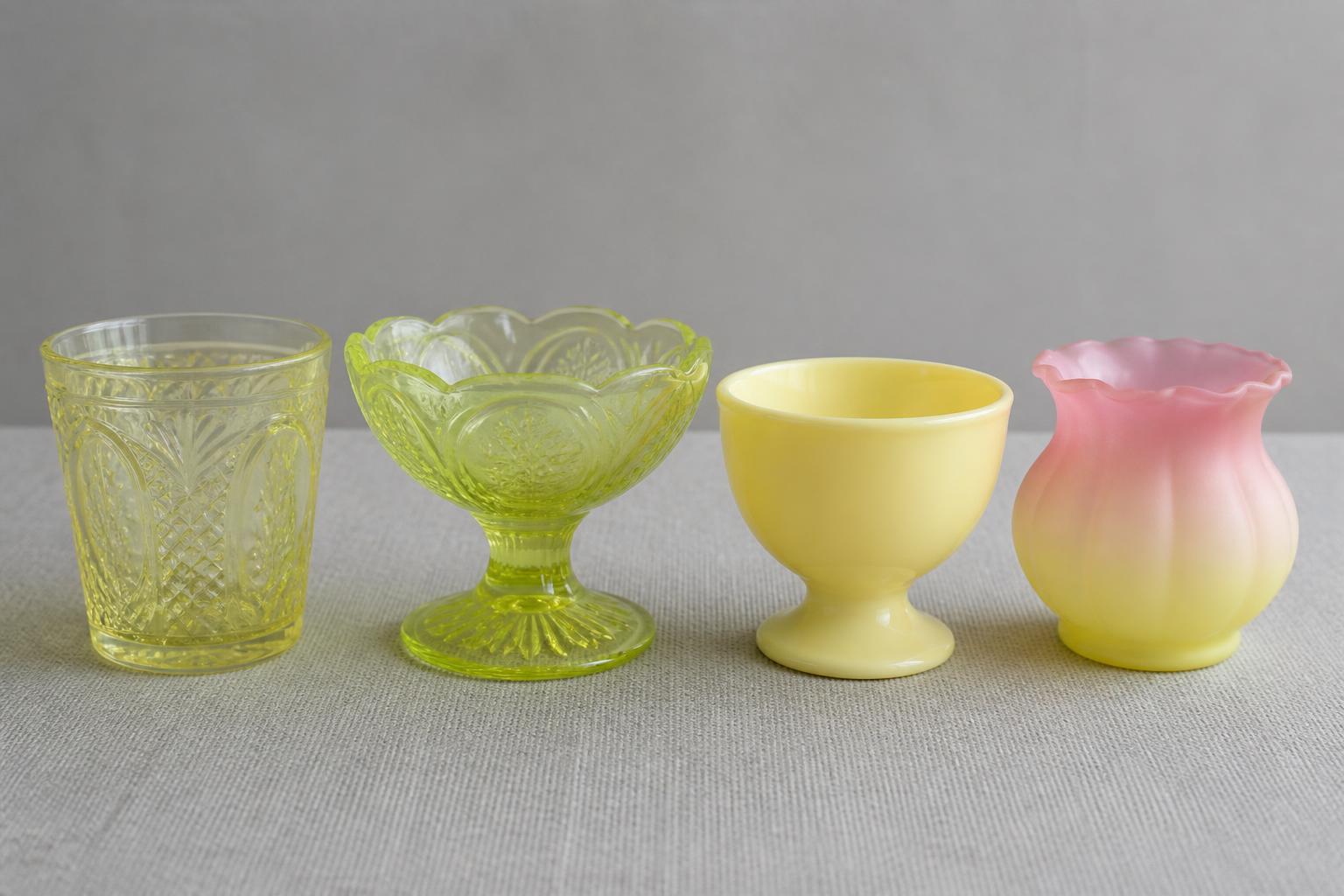
| Type | What it looks like in daylight | Under UV | Notes |
|---|---|---|---|
| Vaseline glass | Transparent yellow to yellow-green, like petroleum jelly | Bright, clean green | The American definition; VGCI's rule is "if it doesn't glow green, it's not Vaseline" |
| Canary / citron | Transparent clear yellow | Bright green | Older and regional terms for much the same thing |
| Custard glass | Opaque, creamy pale yellow, like set custard | Softer, milkier green | Popular around 1900; opacity mutes the glow |
| Burmese glass | Satin, shading pink at the top to yellow at the base | Green at the yellow end | Uranium supplies the yellow; the pink is heat-struck gold |
| Green Depression glass | Transparent bottle green | Often glows green | Uranium plus iron oxide — a different formula, and not Vaseline glass |
| Jadeite, milk glass, most green glass | Opaque or green | No green glow | No uranium. Very common false alarm |
That Depression glass row is where nine out of ten arguments in this hobby start. Green Depression glass frequently glows, because manufacturers kept the uranium and added iron oxide to push the color green when the yellow-green shade stopped selling. Purists don't count it as Vaseline glass. Your blacklight doesn't care, and neither do most buyers. We broke that whole category down separately in Free With Oatmeal: how Depression glass ended up in every grandma's cupboard.
And if the glowing piece in front of you is a small domed shade sitting in a matching cup, you may be holding something considerably better than a bowl — see our complete guide to fairy lamps.
How to test a piece in four seconds
This is the most satisfying skill in all of estate sale shopping, and the entire barrel of equipment costs about the price of lunch.
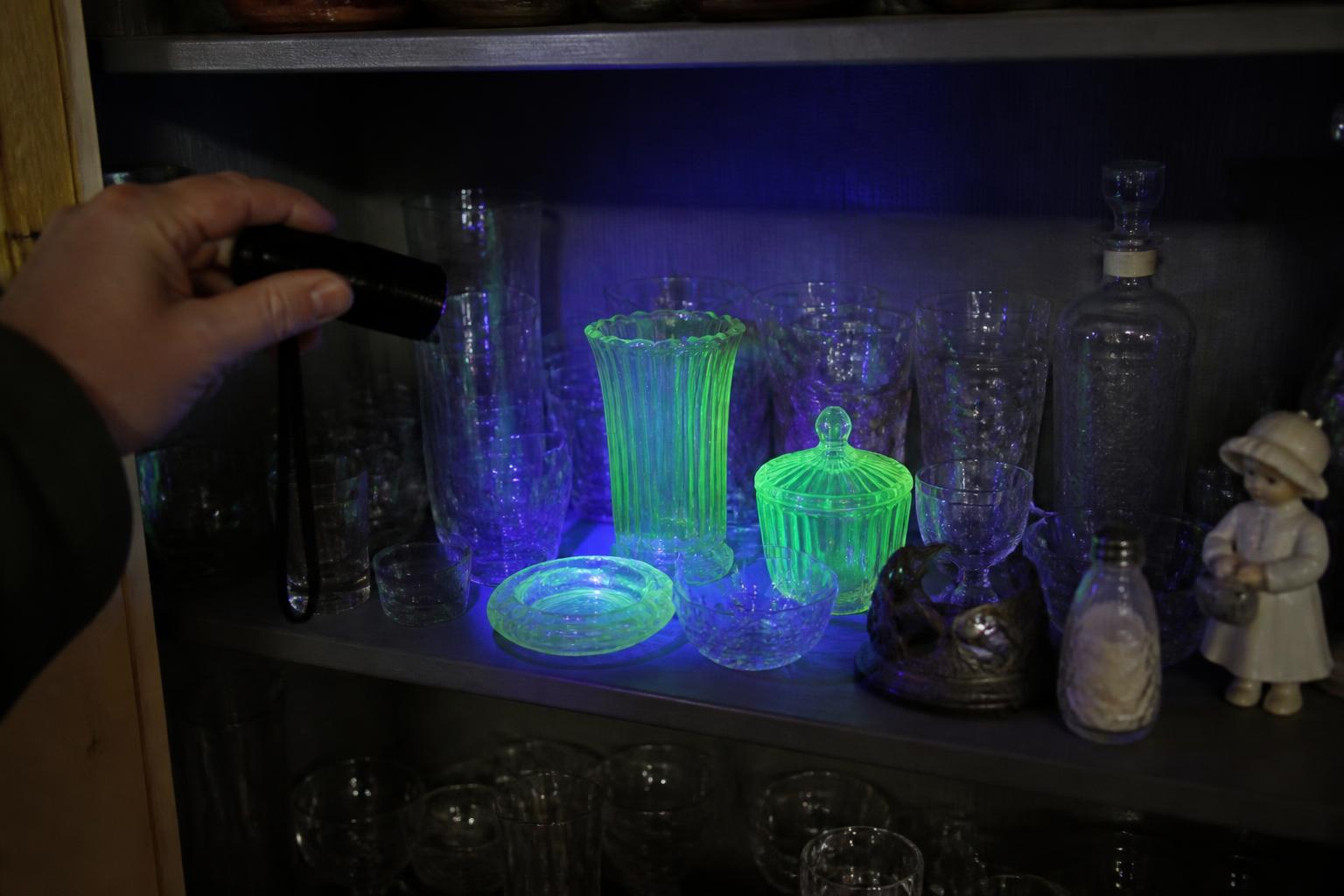
Buy a 365 nm UV flashlight. Not 395 nm. The cheap violet ones sold as "blacklights" are 395 nm and they work, technically, but they flood everything in purple haze and make weak fluorescence hard to read. A 365 nm light throws almost no visible purple, so the green pops out of the darkness like a special effect. They run roughly $10 to $25.
Then:
- Cup your hand or use a shadowed corner. Under a shelf, behind a curtain, inside a cabinet. You don't need full darkness, just less light.
- Hit the piece for a second. Real uranium glass responds instantly and unmistakably. There is no squinting and asking a friend "does that look green to you?" If you have to ask, it's a no.
- Watch the color. Vivid apple-to-lime green means uranium. Bluish-white usually means modern glass or an optical brightener. Yellowish or peach can mean manganese, used to decolorize old clear glass — interesting, old, not uranium.
- Check the whole piece. On Burmese and on some multi-part pieces, only the yellow section glows. On a lamp, test the shade and the base separately; mismatched marriages are extremely common.
- Then look at it in daylight. UV tells you the chemistry. Only your eyes and hands tell you the age, the maker, the condition and the form — which is where all the money actually is.
Two rules that save people money: glow proves uranium, not age — modern makers still produce it, and reproductions glow just as brightly as 1890 pieces. And no glow means no uranium, full stop, no matter what the tag says.
Standing there unsure what maker or form you're holding? Photograph it and run it through our Ai Appraiser before you commit — it will identify the type and give you a realistic range while you're still in the room, which is a much better plan than looking it up in the car after you've already paid.
What is uranium glass actually worth?
Time for the honest part, because this category attracts a lot of internet hype. The glow is thrilling. The glow is not, by itself, valuable. Uranium glass was made in enormous quantities for ninety years, and the world is full of small yellow-green pressed dishes.
ORAU's own summary of the market: common items run roughly $10 to $50, while large vases, intricate figural pieces, and work from renowned manufacturers can command several hundred to a few thousand dollars.
Recent dated results give a realistic picture of the middle of the market rather than the fantasy top:
| Piece | Result | When / where |
|---|---|---|
| Fostoria Vaseline five-piece epergne | $350 sold | July 2024, eBay (collector price archive) |
| Two opalescent Vaseline glass epergne centerpieces | $100–$300 estimate | Austin Auction Gallery, Nov 2023 |
| Victorian cranberry and Vaseline glass epergne | $300–$500 estimate | Austin Auction Gallery, Nov 2023 |
| Common toothpick holders, small dishes, salts | $10–$40 typical | Ongoing retail range |
Estimates are auction pre-sale estimates, not hammer prices; the Fostoria figure is a completed sale. Confirm current comparables for your exact form before buying or pricing.
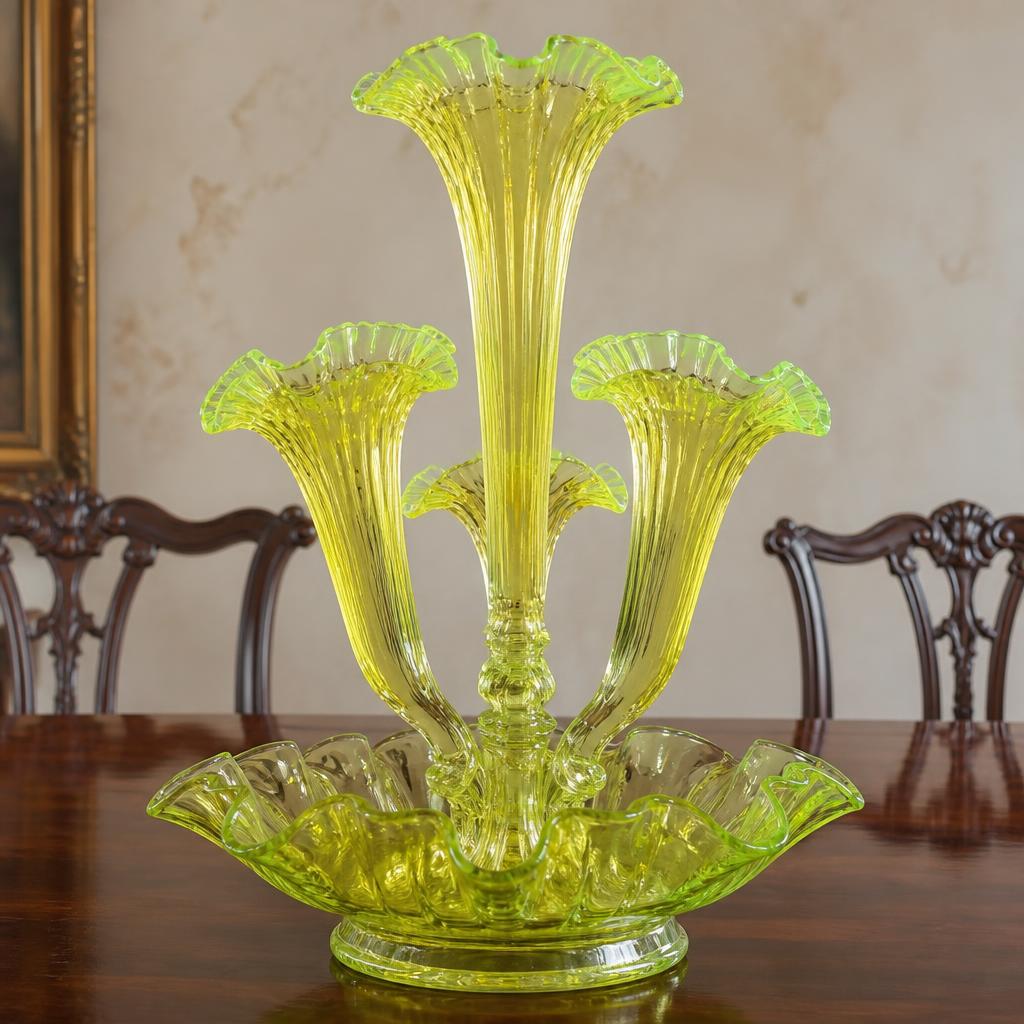
Notice what the four-figure claims floating around the internet usually leave out: they belong to exceptional objects — signed art glass, complete Victorian epergnes in perfect condition, rare colors and rare forms — not to the compote on the folding table. A standard Vaseline glass epergne is a $100 to $500 object in today's market, not a $3,000 one.
What actually moves the price
- Form beats color. Epergnes, cruets, water pitchers, complete lamps, figural pieces and covered forms. Flat plates and small dishes were made forever.
- Condition is brutal here. Ruffled and crimped rims chip. Run a fingernail all the way around every edge — you will feel damage you cannot see, and a chip can take half the value.
- Completeness. An epergne missing one trumpet, or a lamp with a married shade, drops hard.
- Maker. Fenton, Northwood, Davidson, Sowerby, Mosser and Boyd all have followings; the Vaseline Glass Collectors manufacturers gallery is the best free reference for sorting out who made what.
- Scarcity of the recipe today. Regulation and cost mean very little new uranium glass gets made, and the collector base knows it.
If you resell, the practical play is The Collective, where the buyers already know what a Northwood opalescent Vaseline basket is. If you buy, set a wishlist alert on uranium glass, vaseline glass, custard glass and canary glass, and we'll email you when a listed sale posts a matching item instead of you refreshing listings at midnight.
The people who collect this stuff
Every collecting category has a subculture. This one has a subculture that carries flashlights.
Uranium glass collectors are, in the nicest possible sense, a crossover crowd: half antiques people, half science people, and completely unable to walk past a dark cabinet without reaching for a pocket light. Vaseline Glass Collectors, Inc. is the American nonprofit at the center of it, maintaining the definitions, the manufacturer galleries and the reference book lists, and there's an active club in Japan too. Collectors Weekly ran a wonderful long feature on the community under the extremely fair headline "These People Love to Collect Radioactive Glass. Are They Nuts?"
And there's a hard number that tells you how magnetic this stuff is: ORAU says uranium glass is the most-viewed item in its entire online Museum of Radiation and Radioactivity. Not the bomb-era instruments. Not the medical devices. The salad bowl.
Finding it at estate sales
A short field routine that works:
- Sweep the dim rooms first. Basements, back bedrooms, the inside of closed china cabinets. Uranium glass is easiest to find where the light is worst, which is the exact opposite of every other category.
- Go where the glass congregates. One glowing piece in a house almost always means five. Collectors collected.
- Test the lamps. Shades, fonts, and prisms glow independently. A glowing shade on a non-glowing base means a marriage — negotiate accordingly.
- Check the drab stuff. Custard glass looks like beige nothing on a shelf and is easy to leave behind. Hit it with the light.
- Ask about "the green dishes." Say it exactly that way to the family. Half the time it produces a box from a closet.
- Buy on form and condition, not on wattage. A blindingly bright common dish is still a common dish.
More broadly, the skill of spotting the one good thing in a room full of ordinary things is the whole game — we cover the general version in how to spot valuable items at estate sales and the pricing side in how to appraise estate sale items. And if it turns out you just like beautiful old glass on open shelving, welcome — that's grandmacore, and you're going to be great at it.
Ready to hunt? Browse estate sales near you and bring the flashlight.
Questions & answers
Frequently asked questions
Is uranium glass dangerous to own?
No, not under normal ownership. The federal exposure assessment cited by Oak Ridge Associated Universities found that even the most exposed group — workers transporting crates of uranium glassware — received an estimated maximum of 1 to 2% of the average American's annual radiation dose. The EPA states that radioactive antiques "are usually not a health risk if they are in good condition." The realistic cautions are about ingestion rather than exposure: don't use it as everyday dinnerware, don't store acidic food or drink in it, don't grind, cut or sand it, and treat chipped or cracked pieces as display-only. Intact glass on a shelf is fine, and a whole hobby has proved it for a century and a half.
Can you eat or drink from uranium glass?
You can, and generations did, but current guidance says don't make a habit of it. ORAU's advice is explicit: handle uranium glass with care and don't use it as dinnerware or drinkware. The concern is uranium leaching into food or drink over time, which is most plausible with acidic contents left standing, and any risk from surface damage on a chipped or worn piece. Use it for display, for photographs, and for the moment at a dinner party when you turn out the lights and switch on a blacklight. Use something else for the vinaigrette.
How can I tell if glass is uranium glass?
Shine a 365 nm ultraviolet flashlight on it in a shaded spot. Uranium glass fluoresces an immediate, vivid, unmistakable green — there is no ambiguity and no squinting. Cheaper 395 nm lights work but flood the piece with purple, making faint reactions harder to read. A bluish-white glow usually indicates modern glass or optical brighteners; a yellow or peachy glow often points to manganese in old clear glass rather than uranium. Vaseline Glass Collectors, Inc. reduce it to one sentence: if it doesn't glow green, it isn't Vaseline glass. Remember that the glow proves chemistry, not age — modern reproductions glow just as brightly as Victorian pieces.
Why is it called Vaseline glass?
Because the transparent yellow-green color looks like petroleum jelly in the jar. The name is American and it caught on in the mid-twentieth century. Elsewhere, the vocabulary differs: Germany calls all of it uranglas, British collectors apply "Vaseline" to certain opalescent treatments, and Australians use it for opalescent-rimmed glass generally. The earliest trade names came from Bohemia, where Josef Riedel called his yellow Annagelb and his green Annagrun in the 1830s, after his wife Anna.
Why did they stop making uranium glass?
The war took the uranium. According to Vaseline Glass Collectors, Inc., the U.S. government confiscated uranium supplies and production halted from approximately 1943 until the restriction was lifted in November 1958, with manufacturing resuming in 1959 — at that point using depleted uranium, which is less radioactive than the natural uranium used earlier. ORAU describes the same gap as a roughly 15-year hiatus after World War II. Today only a small number of makers produce it at all, in limited quantities for collectors, because uranium dioxide is both tightly regulated and expensive.
How much is uranium glass worth?
Most of it is affordable. ORAU puts common items at roughly $10 to $50, with large vases, intricate figural pieces and work from well-known makers reaching several hundred to a few thousand dollars. Real recent results bear that out: a Fostoria Vaseline five-piece epergne sold for $350 in July 2024, and a pair of opalescent Vaseline epergne centerpieces carried a $100–$300 estimate at auction in November 2023. Value concentrates in scarce forms — epergnes, cruets, complete lamps, figurals, covered pieces — in perfect condition with no chips to the crimped rims.
Does all green glass glow under a blacklight?
No, and this is the most common mistake. Jadeite, milk glass and most modern green glass contain no uranium and stay dark. Much green Depression glass does glow, because manufacturers kept uranium in the batch and added iron oxide to shift the color, though strict collectors don't classify that as Vaseline glass. Conversely, some old clear glass fluoresces a yellowish tone from manganese rather than uranium. Only a vivid green response indicates uranium.
If you run estate sales
Uranium glass is one of the most under-marketed things you will ever put on a table, and it is nearly free to fix.
Photograph it twice. One clean daylight shot so buyers can read the color, form and condition, and one dark shot with a UV light on it. That second photo stops thumbs. Nothing else at a typical sale performs like a glow shot, and it is the single easiest post the Social Media Studio will ever have to work with.
Then name it correctly in the listing. "Green glass bowl" gets browsed past. "Vaseline glass footed compote, glows under UV" gets found by the person who has a saved search for exactly that phrase and who will drive an hour for it. Use the Ai Appraiser to pin the type and form, and put those words in the title.
Collectors of this stuff are organized, they are online, and they show up early. Give them something to find.
Sources and further reading
- Vaseline Glass Collectors, Inc. — What Is Vaseline Glass? — uranium percentages, the 1943 halt and 1958/1959 resumption, and the American definition
- Vaseline Glass Collectors, Inc. — Glass Manufacturers Gallery — maker-by-maker reference
- ORAU — A "glowing" review of uranium glass — dose assessment, depleted uranium, market ranges
- ORAU Museum of Radiation and Radioactivity — Vaseline / Uranium Glass — the collection entry itself
- EPA RadTown — Radioactivity in Antiques — federal guidance on radioactive antiques
- Corning Museum of Glass — Annagelb — Riedel and the original trade names
- Victoria & Albert Museum — Riedel goblet, ca. 1840 — a dated museum example
- Watson & Hughes, *Journal of Radiological Protection* (2010) — Radiological implications of the use of uranium in Vaseline glass — the peer-reviewed dose study
- Collectors Weekly — These People Love to Collect Radioactive Glass. Are They Nuts? — the collector subculture
Related reading:
This article is general collecting and safety information, not radiological, medical or appraisal advice. Values are reported ranges and dated results as of 2026 — confirm recent completed sales for your exact maker, form and condition. Photographs illustrating this article are original illustrative images, not photographs of the specific pieces whose prices are cited.
Keep exploring
Ready to start your own treasure hunt?
Discover estate sales near you and find incredible deals.
Explore Sales Near Me
About the author
Andy
Founder, EstateSaleFinder.net
Hi, I'm Andy — a retired commercial photographer turned developer with a five-year (and counting) obsession with estate sales. I started EstateSaleFinder.net because I knew there had to be an easier, smarter way to find and list estate sales. Now I get to chase treasure and build the tool I always wished existed.