Free With Oatmeal: How Depression Glass Ended Up in Every Grandma’s Cupboard
It was free with a box of oats, free at the movies, free in a sack of flour — and somehow it survived a century of dishwashers and moves to sit in almost every grandmother’s cupboard in America. Here’s the real story of Depression glass, how to identify the patterns and colors that matter, what it honestly sells for in 2026, and the tells that separate a 1932 plate from a 1978 copy.
Quick answer
Depression glass is thin, machine-pressed, transparent colored glassware made in the U.S. from about 1929 to the early 1940s and given away free — packed inside oatmeal and flour, handed out at gas stations, and passed across the counter at movie theaters on "Dish Night." That is exactly why it is in every grandmother’s cupboard: almost nobody bought it. Most pieces are still cheap today — common plates, cups and tumblers run about $5 to $35 — but the money lives in rare combinations of color, pattern and form. Documented sales include a pink Jeannette Adam covered butter dish at just under $1,250, a pink American Sweetheart water pitcher at $895, and six blue Mayfair footed tumblers at just under $720, per LoveToKnow’s roundup of valuable patterns. Cobalt blue and ruby red carry the biggest premiums; green and amber the smallest.
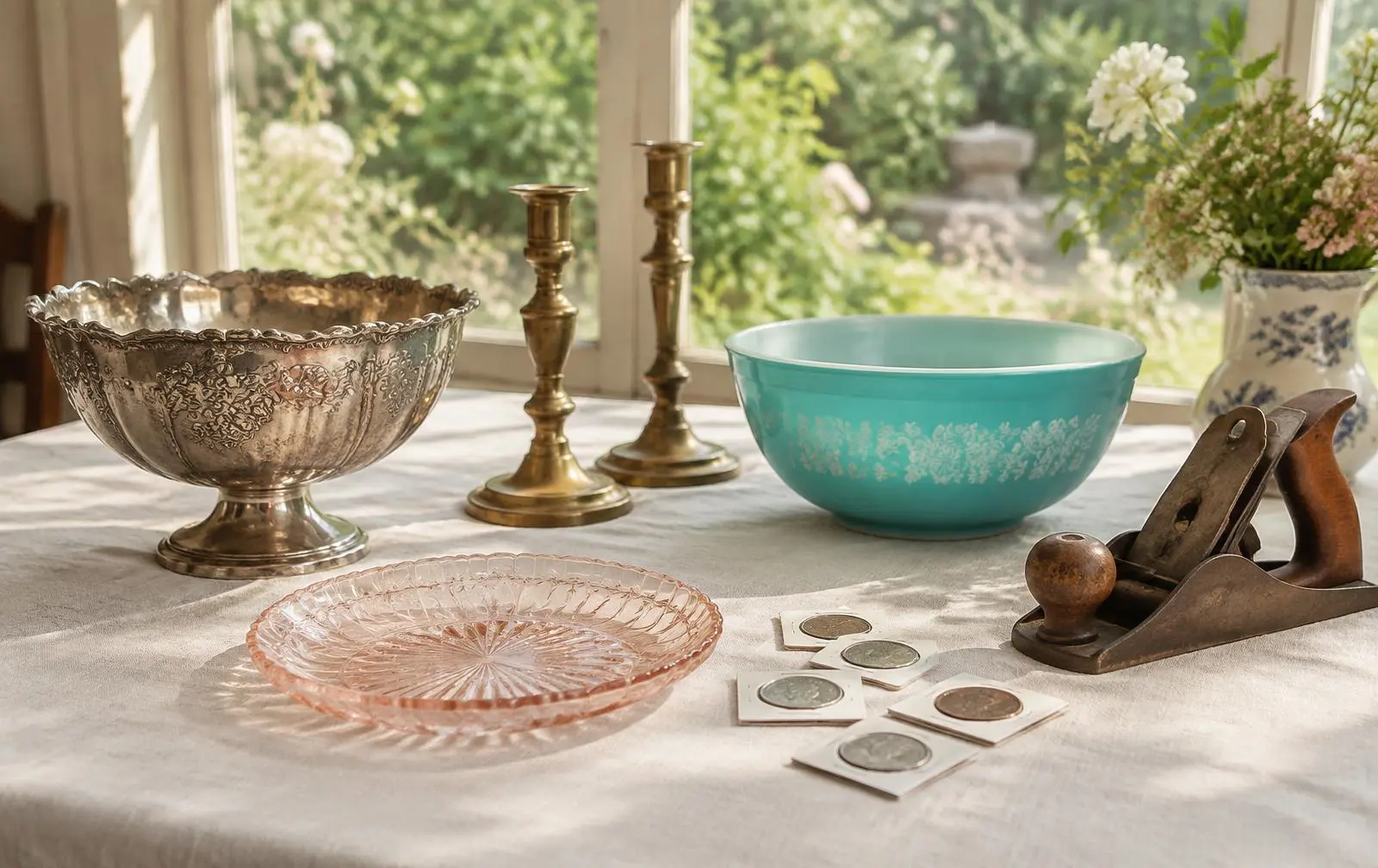
Open almost any cupboard in a house built before 1960 and there it is. A pink plate with roses pressed into the rim. A green bowl that catches the window light like bottle glass. A tumbler with a scalloped foot that somebody’s grandmother used for orange juice every morning for fifty years and never once thought of as a collectible.
Nobody in that house ever went to a store and bought it.
That is the strange, wonderful fact at the center of Depression glass: it was one of the largest free-sample campaigns in American history, and it worked so well that the evidence is still sitting in kitchens ninety years later.
What is Depression glass?
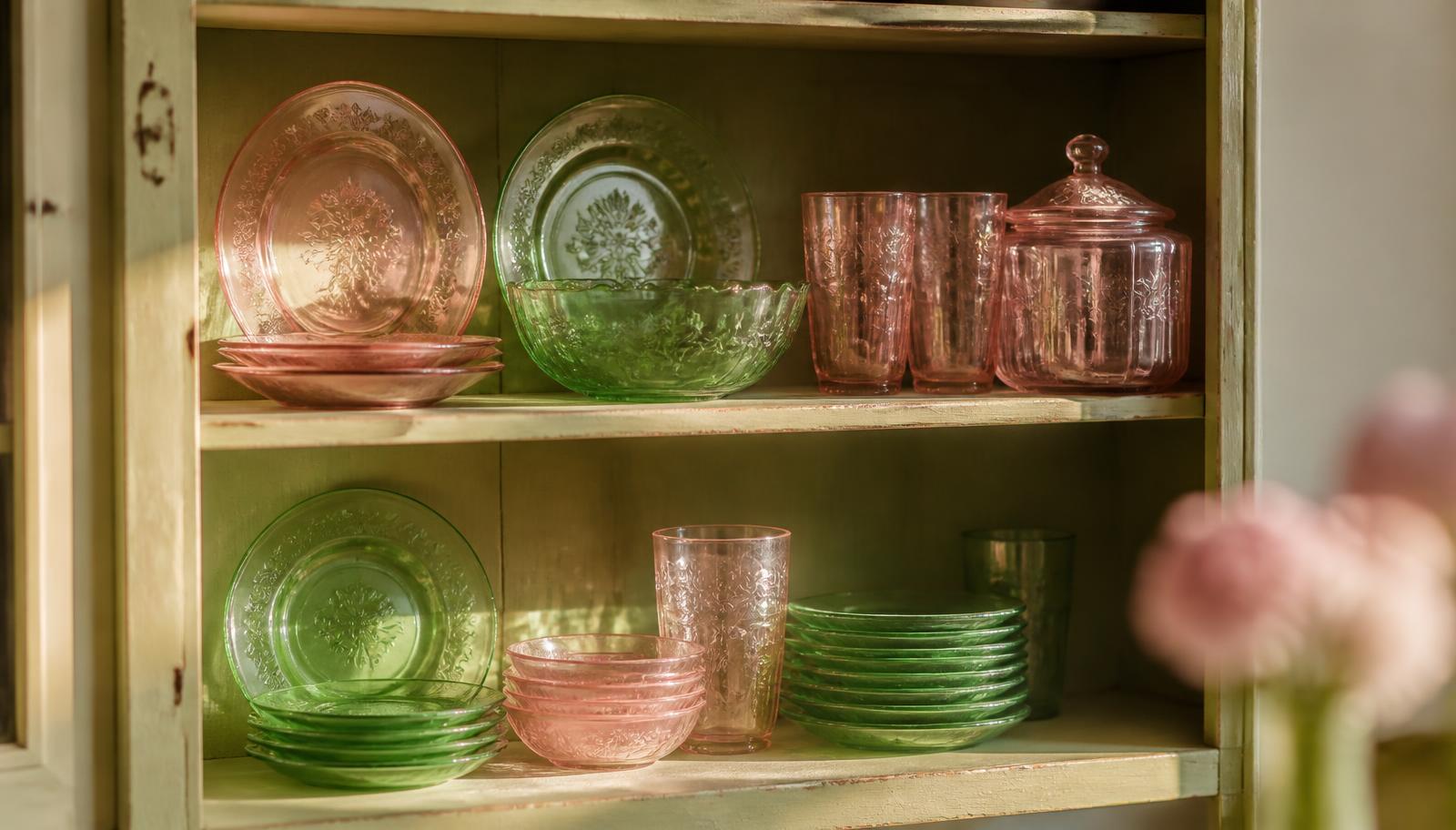
Depression glass is inexpensive, mold-pressed, transparent colored glassware mass-produced in the United States from roughly 1929 through the early 1940s by companies including Hocking (later Anchor Hocking), Jeannette, Federal, Hazel-Atlas, Indiana, MacBeth-Evans and U.S. Glass. It was made by machine, in enormous volume, in pink, green, amber, cobalt blue, ruby red, delphite, ultramarine and clear crystal.
Genuine pieces share a family resemblance: thin and light in the hand, faint vertical mold seams, small bubbles and straw marks in the glass, pattern detail that is crisp in some spots and soft in others, and often a slightly uneven rim. It was never meant to be fine glass. It was meant to be a reason to buy your flour from one company instead of another.
Because it was cheap to make and impossible to sell at a profit in 1932, manufacturers did something counterintuitive: they gave it away.
The giveaway economy
Between 1929 and 1933, American consumer spending collapsed. Nobody was buying dish sets. Glass factories in Ohio, Pennsylvania, West Virginia and Indiana were sitting on furnaces they could not afford to shut down and could not afford to run.
The way out was the premium — free merchandise packed with, or given alongside, an ordinary purchase. A pressed glass sherbet cost a manufacturer pennies. To a family choosing between two identical five-cent boxes of oats, a free dish was the whole decision.
So the glass went everywhere:
- Inside oatmeal and flour — a piece packed right in the box or sack, so you learned which pattern you were collecting only after you opened it
- At the gas station — fill the tank, take a tumbler
- At the grocery counter — a plate with a minimum purchase
- In laundry soap and coffee — the same trick, different aisle
- At the movies — the biggest program of them all
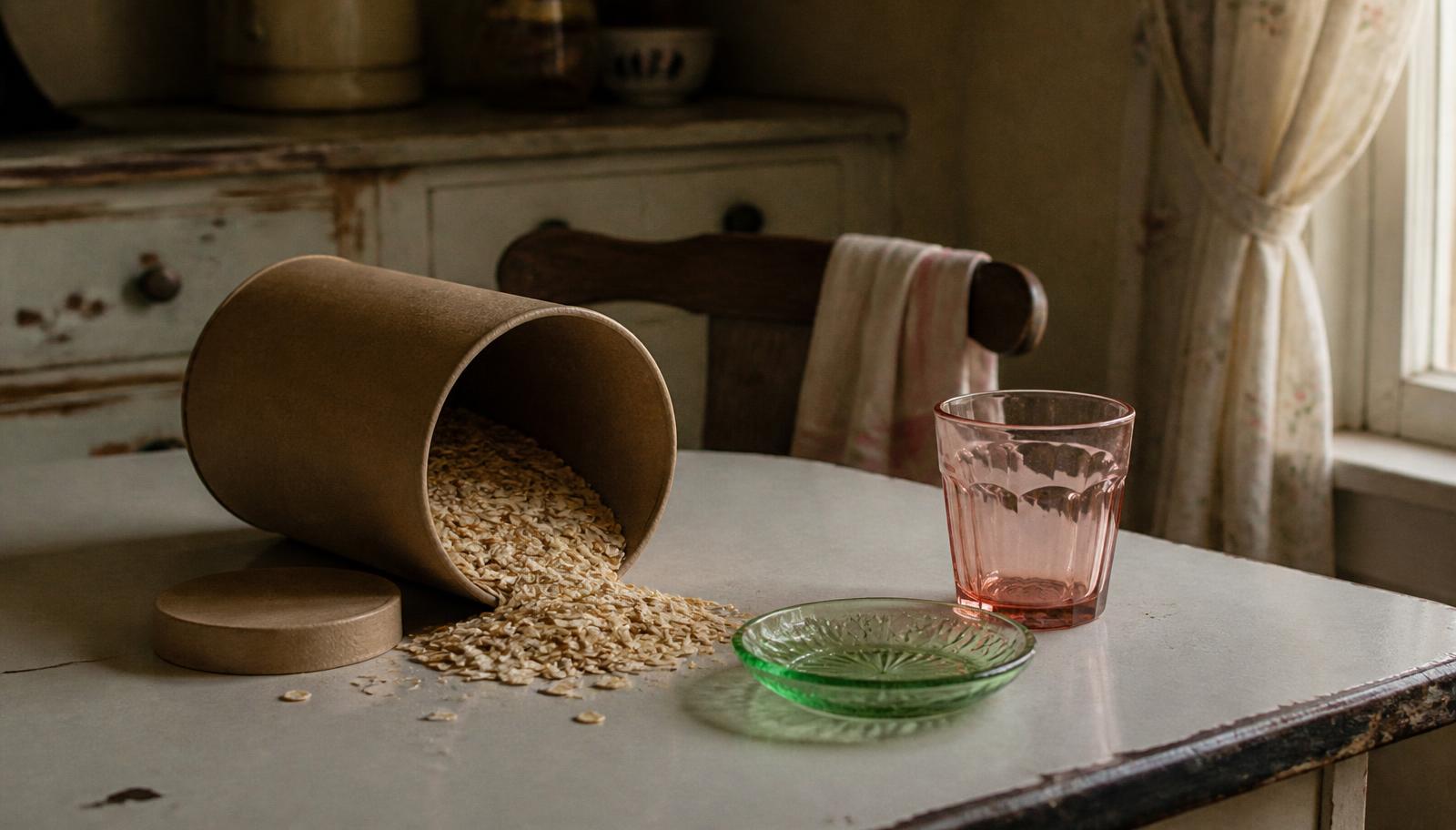
Quaker Oats is the giveaway story most often told, and for good reason: an oatmeal company’s premium orders were large enough to keep glass furnaces lit through the worst years of the Depression. The National Depression Glass Association — the hobby’s main nonprofit body — remains the best starting point for the manufacturer histories behind those contracts.
Dish Night at the movies
The most charming version of the premium was Dish Night.
Theaters were fighting the same collapse everyone else was. Tuesday, Wednesday and Thursday houses were empty. So a theater manager would buy a few crates of pressed glass and announce that every ticket holder on Dish Night went home with a piece.
The economics were almost comically good. Glass bought in bulk cost the theater a few cents per piece; a full house of a couple hundred patrons paying admission turned a small crate into a very good night, and the Museum of Dinnerware Design has documented the exhibitions and ephemera from this era of theater premiums.
But the real genius was the serialization. You did not get a set. You got one piece. A cup this week, a saucer next week, a luncheon plate the week after. Completing a service for eight could take the better part of a year of Tuesdays.
It was a subscription service disguised as a night out — and it built a habit. Families went to the movies on a slow weeknight not because of the picture but because grandmother was four plates short. Theaters advertised the pattern on the marquee. Neighbors traded duplicates.
That is why so much surviving Depression glass shows up in near-complete sets from a single pattern. Somebody sat through a year of B-pictures to finish it.
Which colors and patterns are actually worth something?
Here is the honest version, because the internet is full of hype on this one: most Depression glass is still inexpensive. It was made by the millions, and the collector base that drove prices in the 1990s and early 2000s has aged. Common plates and cups in common colors trade for single digits.
Value comes from color × pattern × form, and all three have to line up.
The color ladder
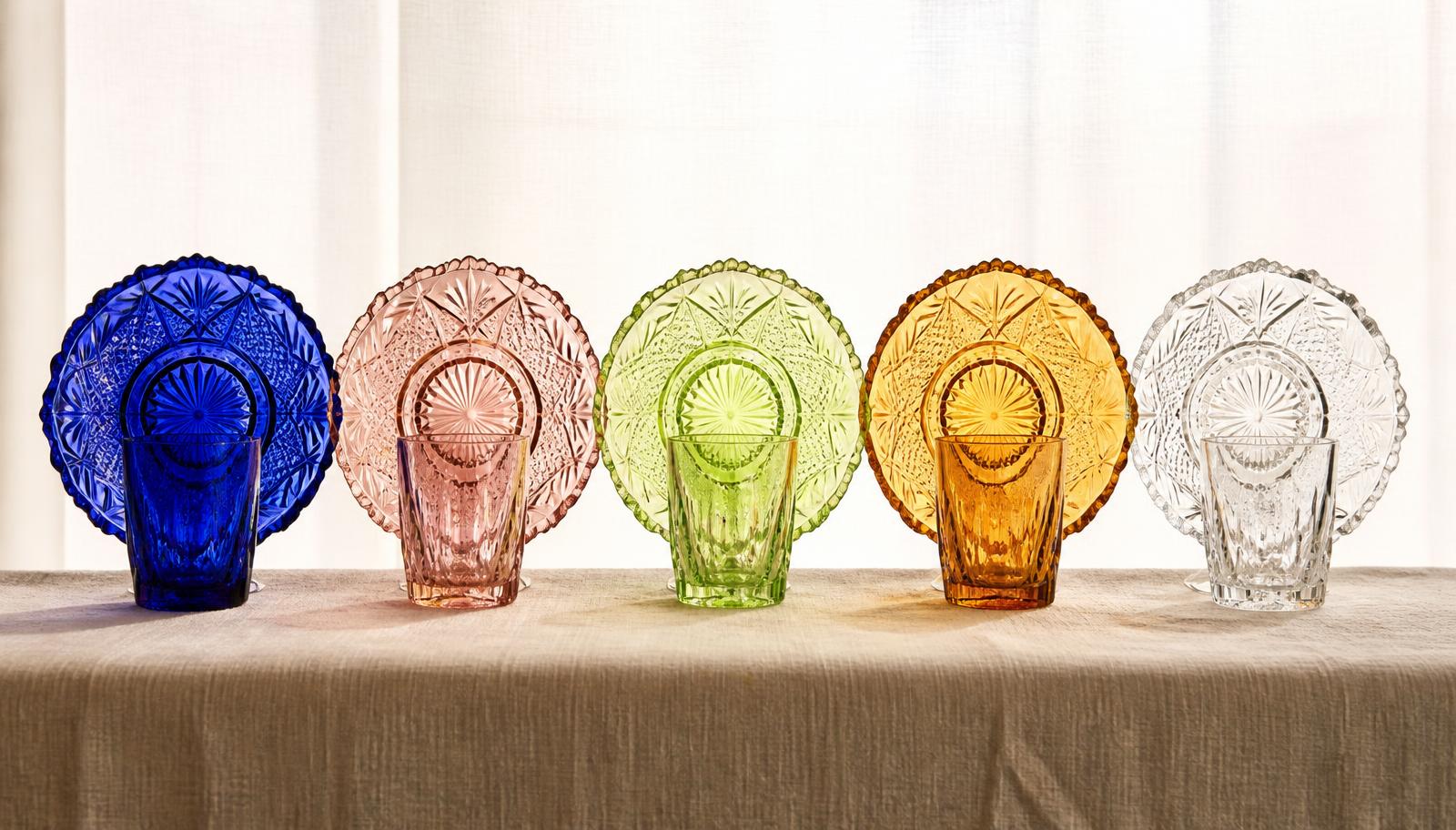
| Color | Scarcity | What it means for price |
|---|---|---|
| Cobalt blue ("Ritz Blue") | Rarest of the mainstream colors | The single biggest multiplier in the category |
| Ruby red | Very scarce | Close behind cobalt on most patterns |
| Delphite / ultramarine (opaque blues) | Scarce, pattern-specific | Strong premiums in Jeannette patterns |
| Yellow / topaz | Uncommon | Modest premium in patterns like Cameo |
| Pink | Common but the most wanted common color | Steady demand, strong on rare forms |
| Green | Very common | Low unless the form is rare |
| Amber & crystal | Most common | Usually the cheapest of all |
Patterns with documented high sales
These are reported sold results, not asking prices, and they represent the top of the market — not what a loose plate brings.
| Pattern & maker | Documented sale | Years made |
|---|---|---|
| Adam, Jeannette — pink covered butter dish | Just under $1,250 | 1932–1934 |
| American Sweetheart, MacBeth-Evans — pink water pitcher | $895 | 1930–1936 |
| Mayfair (Open Rose), Hocking — six blue footed tumblers | Just under $720 | 1931–1937 |
| Petalware, MacBeth-Evans — eight pastel cups & saucers | $770 | 1930–1940 |
| Royal Lace, Hazel-Atlas — six cobalt tumblers | $285 | 1934–1941 |
| Parrot (Sylvan), Federal — green sugar & creamer | $280 | 1931–1932 |
| Doric and Pansy, Jeannette — ultramarine salt & pepper | $150 | 1937–1938 |
| Cameo (Ballerina), Hocking — pink sandwich plate | $100+ | 1930–1934 |
Sales figures above are reported results compiled by LoveToKnow; production years follow standard collector references.
Notice the pattern behind the pattern. Every single one of those is either a scarce color, a short production run, or a hollowware form — pitchers, covered butters, cookie jars, footed tumblers, salt and peppers. Those are the pieces that broke, that got used hardest, that nobody bothered to save. Flat plates survived by the crate.
If you remember one rule: lids and handles are where the money is.
Depression glass vs. elegant glass
People mix these up constantly at estate sales, and the difference is worth real money in both directions.
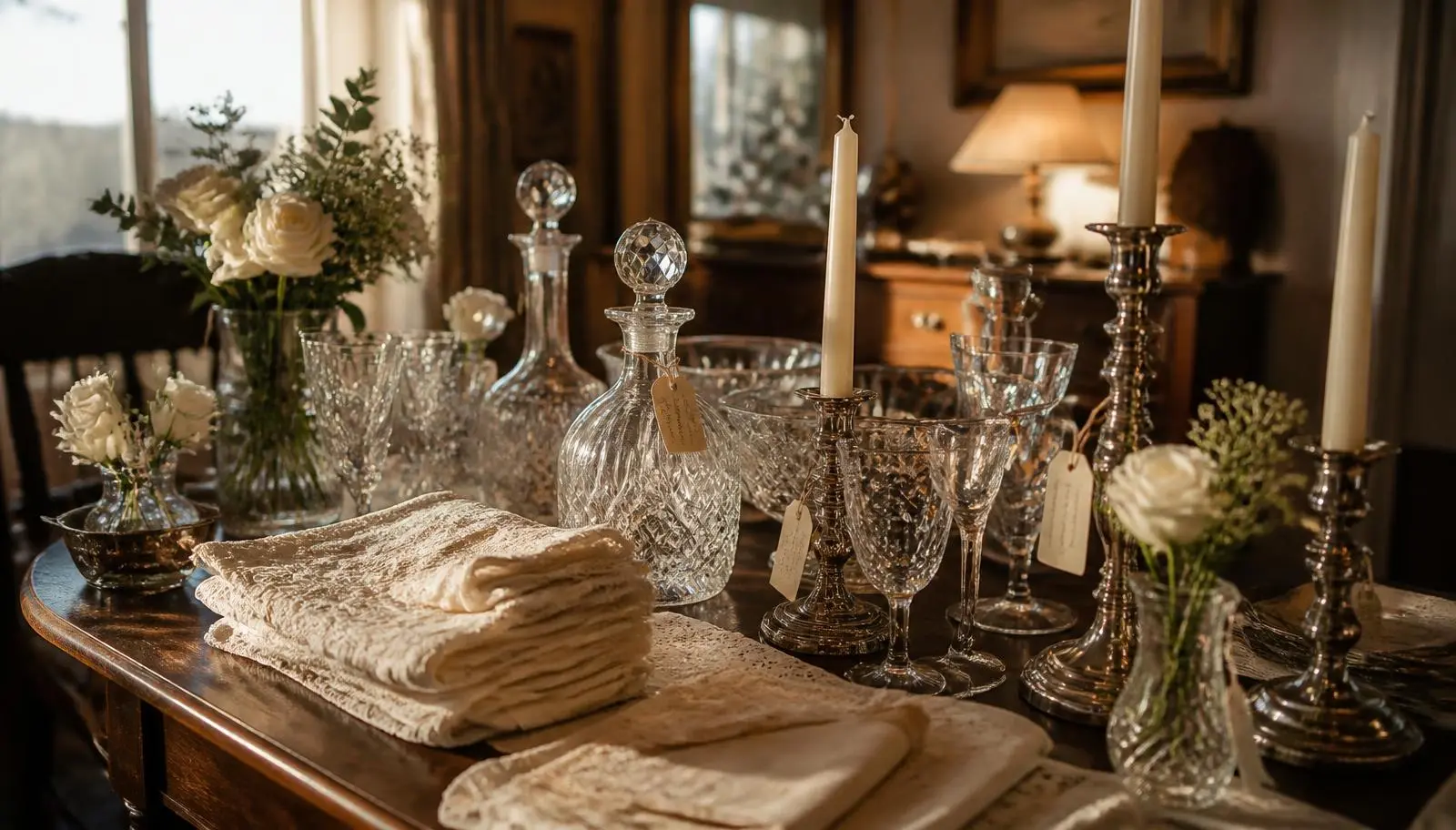
Depression glass is machine-pressed, thin, lightweight, seamed, slightly imperfect, and was free or nearly free. Elegant glass — Fostoria, Cambridge, Heisey, Duncan & Miller, Tiffin — was made in the same years but hand-finished: seams ground away, edges fire-polished, glass clearer and heavier, often etched rather than molded. It sold in department stores and jewelry stores to people who still had money.
Run your finger around the rim. If it is smooth, weighty and seam-free with a crisp etched design, you are probably holding elegant glass, and it may be worth more than the pink plate next to it. If it is thin, light, and you can feel a faint vertical line up the side, that is Depression glass.
Both are worth learning. Neither is worth guessing at — if you are standing in a sale trying to decide, our Ai Appraiser will read a photo of the pattern and give you a realistic range before you commit.
Condition is the quiet value killer
Depression glass has one specific enemy, and it is not chips.
It is sick glass — the permanent cloudy or oil-slick haze that forms inside pitchers, tumblers and bowls after decades of hard water, mineral deposits and dishwasher detergent. It looks like film. It is not film. It is etched into the glass surface and it does not come out with any amount of vinegar, denture tablets, or hope. Sick glass takes 60–90% off a piece’s value, and on a common piece it takes off all of it.
Beyond that, run the standard checks:
- Chips — run a fingernail around every rim, foot and handle; you will feel what you cannot see
- Cracks — hold it to a window and rotate slowly; hairlines catch the light
- Bell test — a light flick should ring, not thud; a thud usually means a crack
- Heat damage — warped or slumped rims from a dishwasher’s heating element
- Wear scratches — acceptable on the base, value-killing across the face of a plate
None of this is a defect in the sense of a fake. Depression glass was made with bubbles, straw marks, uneven rims and off-register patterns from the day it left the factory. Manufacturing flaws are age evidence. Use damage is not.
How to spot a reproduction
This is the part that matters, because Depression glass has been reproduced heavily since the 1970s — and the most-copied patterns are exactly the ones people get excited about: Cherry Blossom, Mayfair, Madrid, Sharon, Avocado and Miss America.
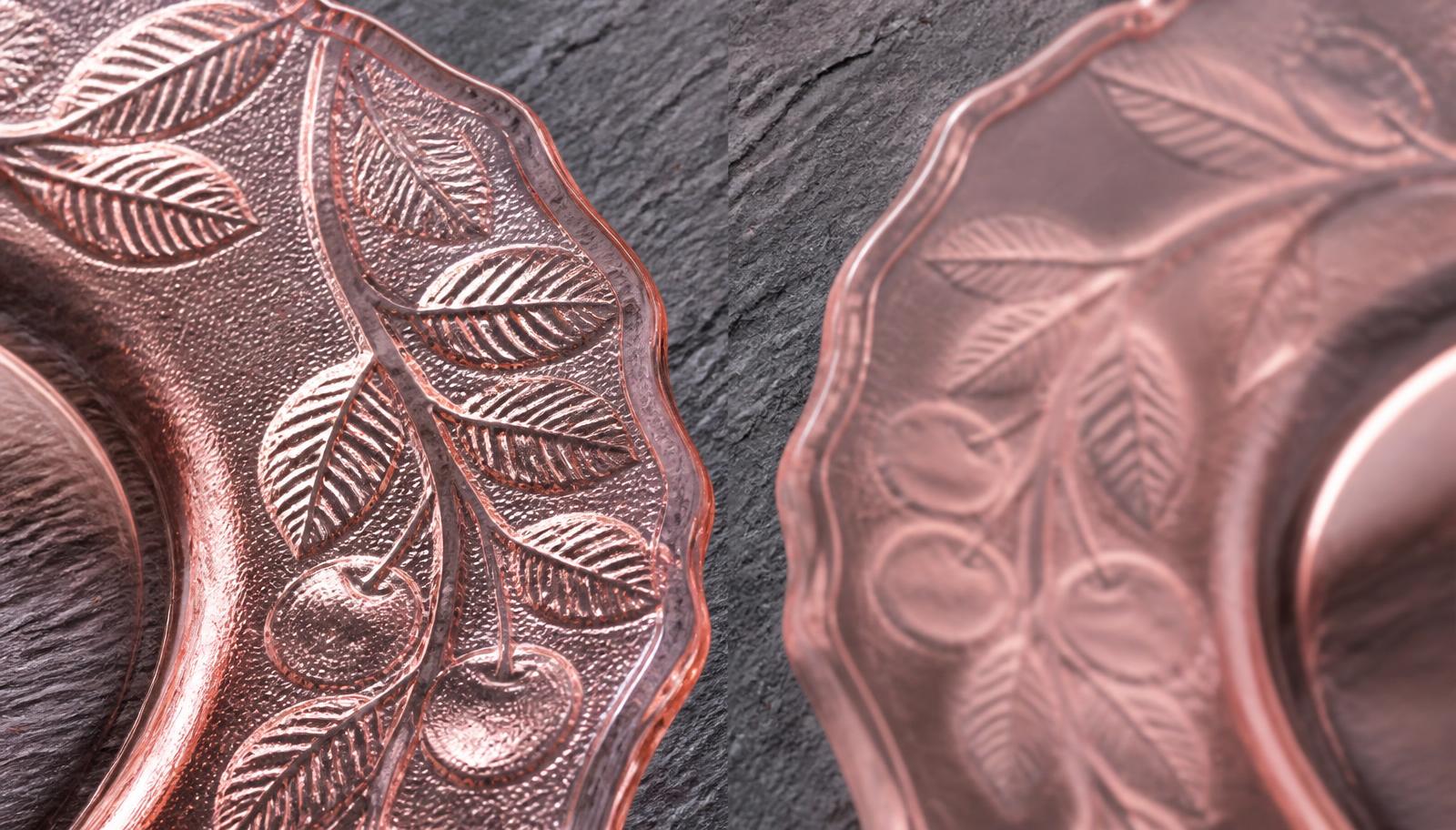
The single most useful principle: a reproduction is a copy of a copy. New molds were taken from finished pieces rather than original factory molds, so every generation loses detail. Real pattern relief is sharp-edged and deep. Reproduction relief is soft, rounded and shallow, like a photocopy of a photocopy.
Specific tells collectors and the National Depression Glass Association’s reproduction resources rely on:
- Leaf and vein detail. On Cherry Blossom, genuine leaves have fine, distinct veins running to the edges. Repro leaves have vague, smeared veining or veins that stop short.
- Mold seams in the wrong place. Look at where the seam crosses the rim. Repros often show seams that are heavier, sharper, or offset from where the original mold parted.
- Weight. Reproductions are frequently noticeably heavier and thicker than the originals, which were made deliberately thin to save glass.
- Colors that never existed. If a pattern appears in a color the factory never produced — iridescent, bright cobalt, opaque light blue on Cherry Blossom, for instance — it is modern. This is the fastest disqualifier in the whole hobby.
- Forms that never existed. Some reproduction lines invented pieces the original maker never offered. If a "rare" form does not appear in the standard pattern references, be very suspicious.
- Too perfect. No bubbles, no straw marks, dead-even rim, flawless glass. Original Depression glass is charmingly imperfect; a spotless example of a "rare" piece deserves scrutiny.
If you are looking at something in the hundreds of dollars, verify the exact form against a pattern reference before you buy — not after.
The blacklight test: what it does and doesn’t prove
Bring a small UV flashlight to a sale and a lot of green Depression glass will light up an electric, unmistakable green. That glow means the glass was colored with uranium salts, which was completely routine in this era.
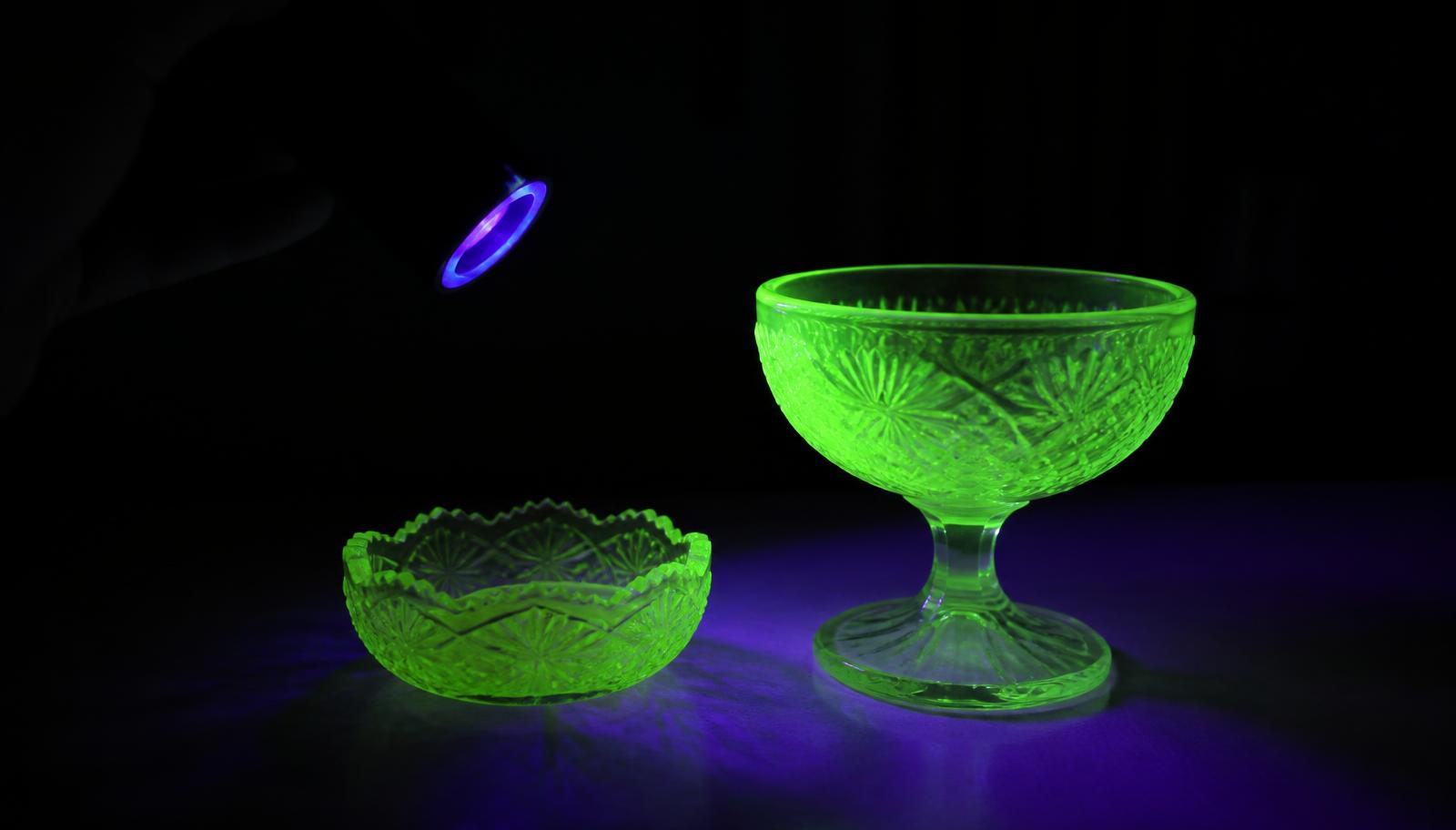
It is a fun, genuinely useful sorting tool. It is not an authenticity test. As dealers who work the category point out plainly, most Depression-era green glass will glow — but so will plenty of later glass, including reproductions, and some very old glass does not glow at all. Uranium coloring was used in glassmaking from the 1830s and returned after 1959 using depleted uranium, per the Oak Ridge Associated Universities health physics collection.
Use UV to find glass across a dim room. Use pattern, seam, weight and detail to authenticate it.
And no, a glowing sherbet is not a hazard sitting on a shelf. If radioactive antiques are a rabbit hole you want to fall down properly, we went deep on the real risks and the real history in The Radium Girls & the clocks that glow, and on uranium-colored Vaseline glass in our complete guide to fairy lamps.
Why it is having a moment again
Two forces are working on this market at once, and they pull in opposite directions.
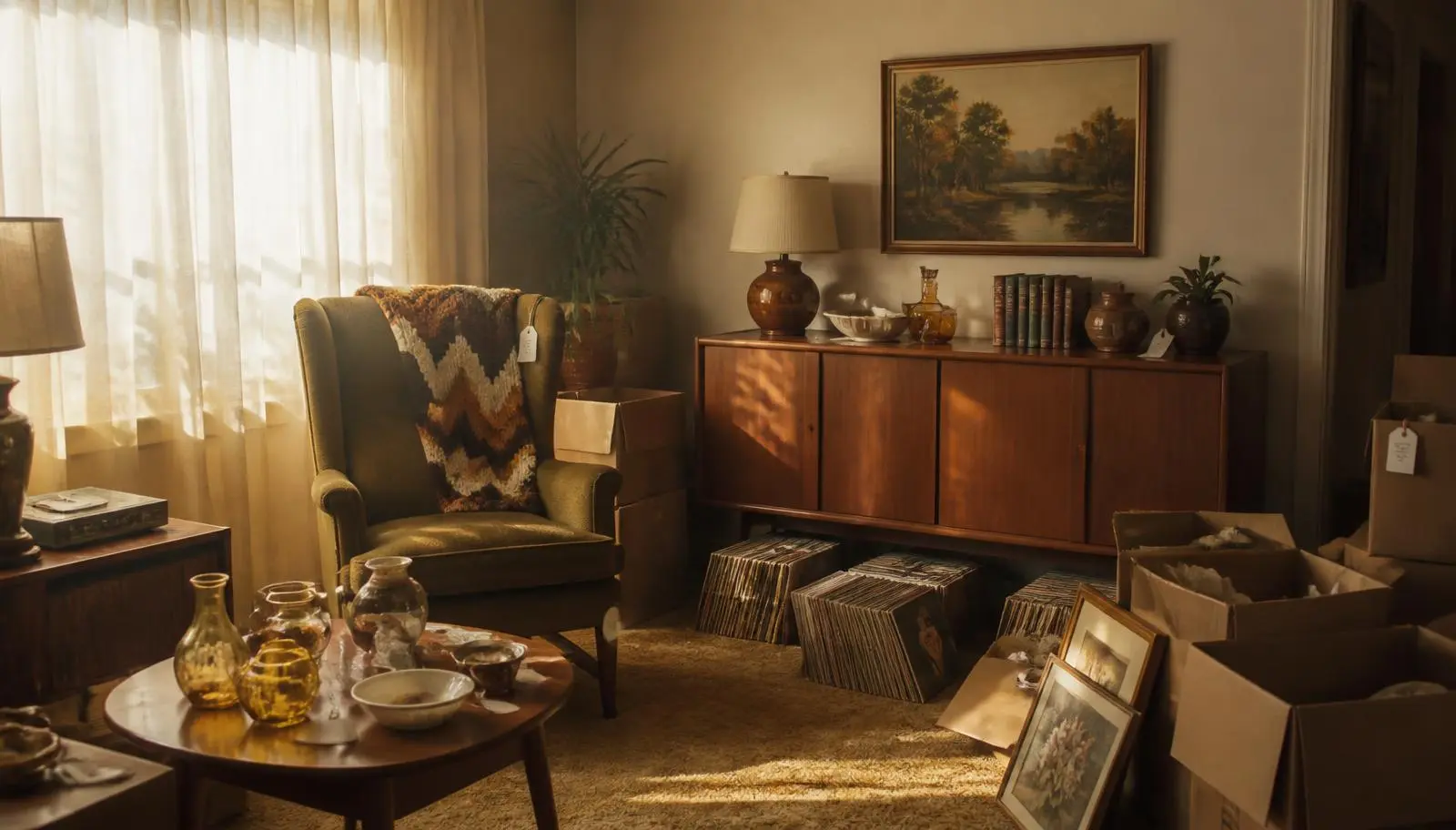
The traditional collector base — people who assembled complete services in the 1980s and 1990s — is downsizing. That has pushed common pieces down. A full set of green luncheon plates that brought real money twenty years ago is a bargain today.
At the same time, a completely different buyer showed up: young people furnishing first apartments who do not care about completing a service and do care that a pink glass tumbler photographs beautifully. Depression glass is one of the purest grandmacore objects there is — cheap, colorful, tactile, and impossible to buy new. Mixed-pattern, mixed-color tables are now the look, which is very good news, because mixed lots are exactly what estate sales produce.
If that is your aesthetic, our grandmacore shopping list and our guide to cottagecore, grandmacore and dark academia at estate sales map the rest of the category.
How to buy it well at an estate sale
A short, practical field routine:
- Go for hollowware first. Skip the stack of plates. Find the pitchers, cookie jars, covered butters, salt and peppers, footed tumblers.
- Check the lid separately. A lid alone can be worth more than the base. Mismatched lids are extremely common in a cupboard that has been used for ninety years.
- Take the piece to a window. Sick glass and hairlines only show in real light.
- Buy the color, not the pattern. Cobalt and ruby are worth a second look in any pattern; green amber crystal need a rare form to matter.
- Buy sets whole. A complete, undamaged service in one pattern is worth meaningfully more than the sum of its pieces, and estate sales are one of the last places you find them intact.
- Set a wishlist alert. If you are hunting a specific pattern, add keywords like Depression glass, Royal Lace, cobalt or Mayfair to your wishlist and we will email you when a listed sale posts a matching item, instead of you refreshing listings all week.
Questions & answers
Frequently asked questions
Is Depression glass worth anything?
Most of it is worth a little; a small slice of it is worth a lot. Common plates, cups, saucers and tumblers in green, amber or crystal generally sell for $5 to $35 each. Value concentrates in scarce colors (cobalt blue, ruby red, delphite, ultramarine), short-run patterns, and hollowware forms — pitchers, covered butter dishes, cookie jars, footed tumblers and complete matched sets. Reported sales at the top of the market include a pink Adam covered butter dish just under $1,250 and a pink American Sweetheart water pitcher at $895. Condition is decisive: chips, cracks, and the permanent cloudiness known as sick glass can erase nearly all of a piece’s value regardless of pattern.
How can I tell if my Depression glass is real or a reproduction?
Look for the imperfections of mass production — small bubbles, straw marks, faint soft mold seams, slightly uneven rims, and crisp deep pattern relief. Reproductions, taken from molds made off finished pieces, typically show shallow, soft, blurry detail, heavier glass, sharper or misplaced mold seams, and sometimes colors or forms the original factory never made. Cherry Blossom, Mayfair, Madrid, Sharon, Avocado and Miss America are the most heavily reproduced patterns and deserve the closest inspection.
What is the most valuable Depression glass pattern?
There is no single answer, because value follows a specific piece in a specific color rather than a pattern overall. That said, Hocking’s Mayfair (Open Rose), Hazel-Atlas’s Royal Lace in cobalt, MacBeth-Evans’s American Sweetheart, Jeannette’s Adam and Hocking’s Cameo (Ballerina) in pink or yellow consistently produce the highest reported results.
Why was Depression glass given away free?
Because in 1930 almost nobody would buy it. Glass factories had furnaces they could neither shut down nor profitably run, and manufacturers of everyday goods needed a reason for shoppers to choose their box over an identical one. A pressed glass dish cost pennies to make and worked as an advertising expense, so it was packed into oatmeal and flour, handed out at gas stations, and given away at movie theaters on Dish Night.
Is Depression glass safe to eat and drink from?
Generally yes for intact, undamaged pieces used occasionally, and that is how most of it has been used for ninety years. Two sensible cautions: uranium-colored (glowing) glass is best kept for display rather than daily acidic food or drink, and no Depression glass should go in a dishwasher — heat and detergent cause the permanent haze that ruins it. Hand wash in lukewarm water, and never put a piece with a hairline crack into hot water.
Does all green Depression glass glow under a blacklight?
No. Much of it does, because uranium salts were a routine green colorant in the period, but plenty does not — and later glass, including modern reproductions, can glow just as brightly. The blacklight is a great tool for spotting uranium glass across a dim room and a poor tool for proving age.
If you run estate sales
Depression glass is one of the most under-photographed categories at a typical sale, and it is one of the easiest to sell well when it is presented properly.
Two things move it. Photograph it backlit — against a window or a light panel, so the color reads instead of going gray. And name the pattern in the listing. "Pink Depression glass" gets browsed; "Hocking Mayfair Open Rose pink footed tumblers, set of 6" gets found by the person who has been hunting that exact form for two years. Our Ai Appraiser will help you name it, and the Social Media Studio will turn the good pieces into posts that pull collectors to your sale before the doors open.
If you resell rather than run sales, The Collective is where those pieces find the buyers who already know what a cobalt Royal Lace butter dish is worth.
Sources and further reading
- National Depression Glass Association — the hobby’s nonprofit body; pattern research and reproduction resources
- LoveToKnow — Rare & Valuable Depression Glass Patterns — the reported sale figures cited above
- Museum of Dinnerware Design — exhibitions and ephemera covering Depression-era premium glass
- Oak Ridge Associated Universities — Vaseline / Uranium Glass — uranium coloring history and radiological context
- Depression & Elegant Glass — All That Glows Is Not Vaseline Glass — why the blacklight is not an authenticity test
- Glass Bottle Marks — What Is Depression Glass? — manufacturer overview and identification basics
Related reading:
Values here are reported market results and general ranges as of 2026, not appraisals — confirm against recent completed sales for your exact pattern, color and form. Photographs illustrating this article are original illustrative images, not photographs of the specific pieces whose sale prices are cited.
Keep exploring
Ready to start your own treasure hunt?
Discover estate sales near you and find incredible deals.
Explore Sales Near Me
About the author
Andy
Founder, EstateSaleFinder.net
Hi, I'm Andy — a retired commercial photographer turned developer with a five-year (and counting) obsession with estate sales. I started EstateSaleFinder.net because I knew there had to be an easier, smarter way to find and list estate sales. Now I get to chase treasure and build the tool I always wished existed.