Fairy Lamps: The Complete Buyer's & Seller's Guide (Every Type, History & Real Prices)
Everything you need to buy, sell, identify, and value fairy lamps — Clarke's Cricklite to Webb Burmese to Fenton hobnail — with real, verified auction prices and how our wishlist alerts ping you the moment one is posted.
Short answer
A fairy lamp is a small Victorian candle lamp — a domed glass shade on a matching cup and base — patented by Samuel Clarke of London in 1857 and made by the finest art-glass houses of the 1880s–1890s (Webb, Stuart, Mt. Washington, Baccarat, Val St. Lambert). Common Victorian examples run $60–$300; signed Burmese and Nailsea pieces routinely bring $250–$1,100; and complete Webb Burmese epergnes sell in the $700–$2,500 range. Mid-century Fenton fairy lamps — the ones most people actually inherit — average $50–$150 with rare colors reaching $500+.
This is the guide we wish existed when we started chasing these little glass domes at estate sales. Every major type, real history, honest identification tips, and verified sold-comp price ranges from Jeffrey S. Evans, LiveAuctioneers, Hindman, Bidsquare, Kovels, and eBay — updated for 2026. Prices verified July 2026.
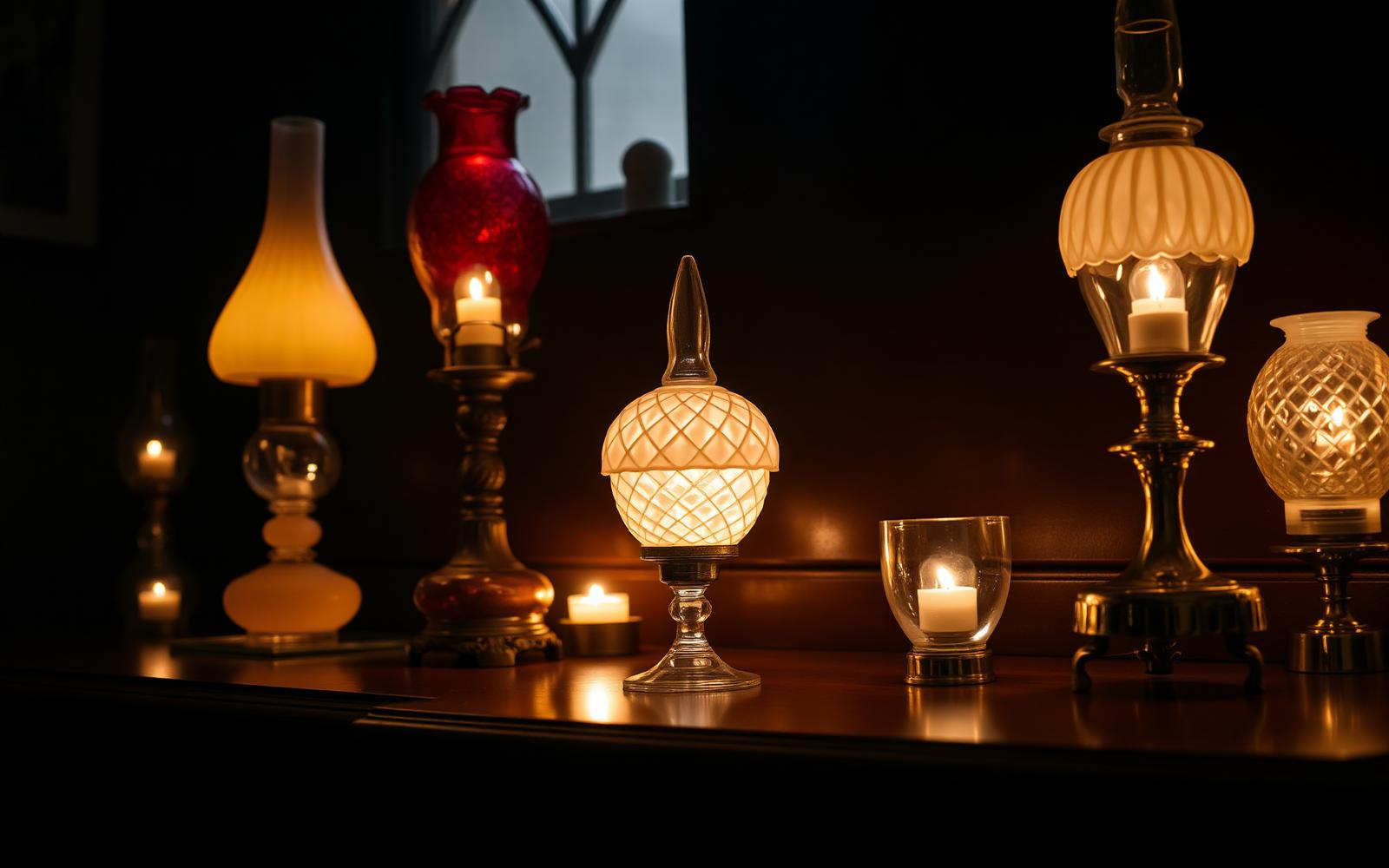
A quick note on the photos: every image below is either a real antique from Wikimedia Commons (credited in the caption) or a photorealistic illustration of the type being described. Auction-house condition photos of real sold lots are linked inline throughout.
What is a fairy lamp?
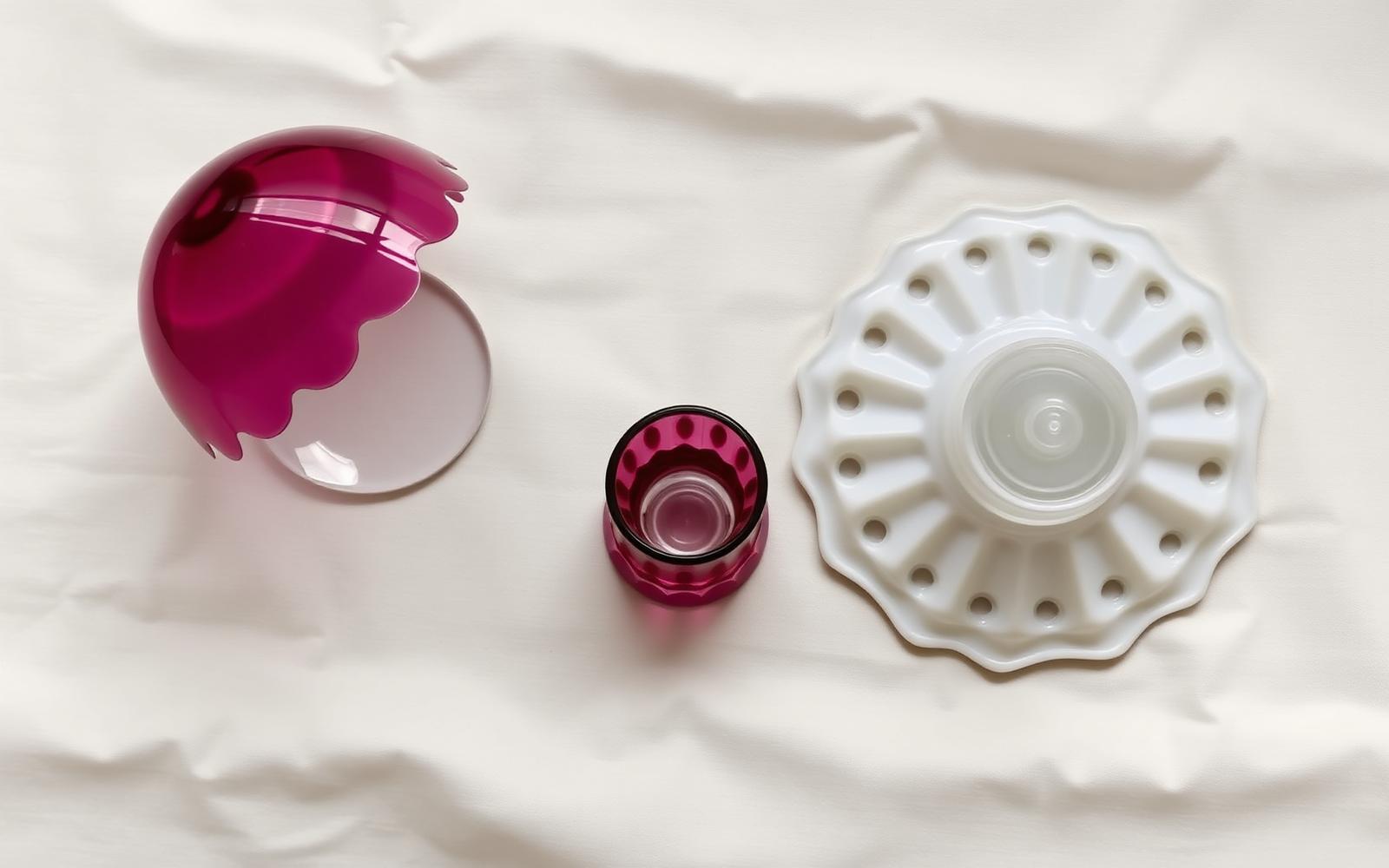
A fairy lamp is a small candle lamp usually built from two or three pieces:
- The shade — a dome (or beehive, or pyramid) of colored, satin, or cut glass, open at the bottom.
- The cup — a short glass cup that holds a stubby "fairy candle," which the shade sits directly on.
- The base or saucer (three-piece lamps) — a matching decorative stand.
Clarke sold them in three sizes: Wee Fairy (about 2 inches tall), Fairy (about 3 inches), and Pyramid (about 4 inches with a pointed top). They were sold as safety candlelamps for Victorian nurseries, sickrooms, and dinner tables — a candle you couldn't easily knock over or blow onto the drapes.
A short history
Samuel Clarke, a London candle maker, patented the first "Fairy" candle in 1857 and the matching lamp system through the 1880s. He didn't make glass himself — he licensed the design to the great houses of the age:
- Thomas Webb & Sons (Stourbridge, England) — Burmese, Peachblow, cameo
- Stuart & Sons (Stourbridge)
- W.H.B. & J. Richardson, Stevens & Williams
- Baccarat and Cristallerie de Pantin (France)
- Val St. Lambert (Belgium)
- Mt. Washington Glass Co. and New England Glass Co. (USA) — Burmese, Peachblow, satin
The lamps hit their peak in the 1880s and 1890s. Electrification killed the market by around 1910. Then in 1953, Fenton Art Glass revived the form for the American gift-shop era and ran with it until 2002 — which is why 95% of the "fairy lamps" you'll find at estate sales today are actually Fenton, not Victorian.
How to identify a real Victorian fairy lamp
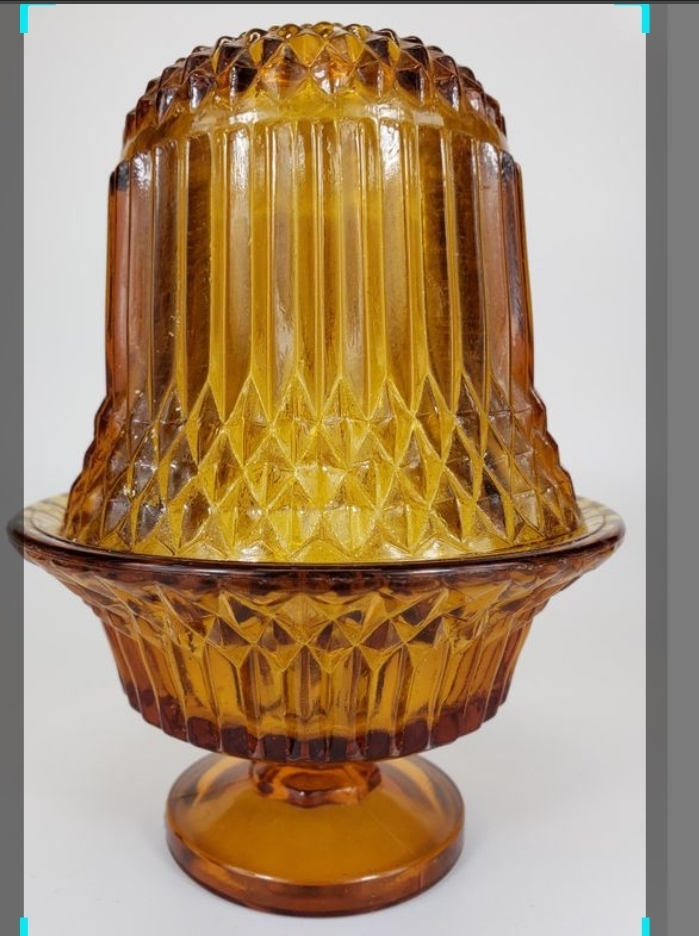
Above: a real Clarke's Patent antique fairy lamp, listed via OfferUp by willshouseofglass — Wikimedia Commons, CC BY-SA 2.5.
Look for these tells:
- Marks on the candle cup. Most Clarke's lamps carry an impressed fairy figure and one of these marks on the clear glass insert: "S. Clarke's Patent Trade Mark Fairy", "S. Clarke's Patent Fairy Pyramid", "Clarke's 'Cricklite' Trade Mark" (post-1885), or "Clarke's Pat. Wee Fairy" (miniature size).
- Hand-finished pontil or ground rim on the base.
- Shade fits the cup exactly — Victorian shades were made in matched pairs. A shade that rattles or sits crooked is a red flag for a married pair.
- Weight and quality of glass. Victorian glass has a "wet" clarity you can feel; modern reproductions look thick and dull.
- Wear pattern on the base underside consistent with 130+ years of use.
Every major type of fairy lamp
Here's the whole family, in the order collectors actually rank them, with verified sold prices from major auction houses.
Clarke's Cricklite
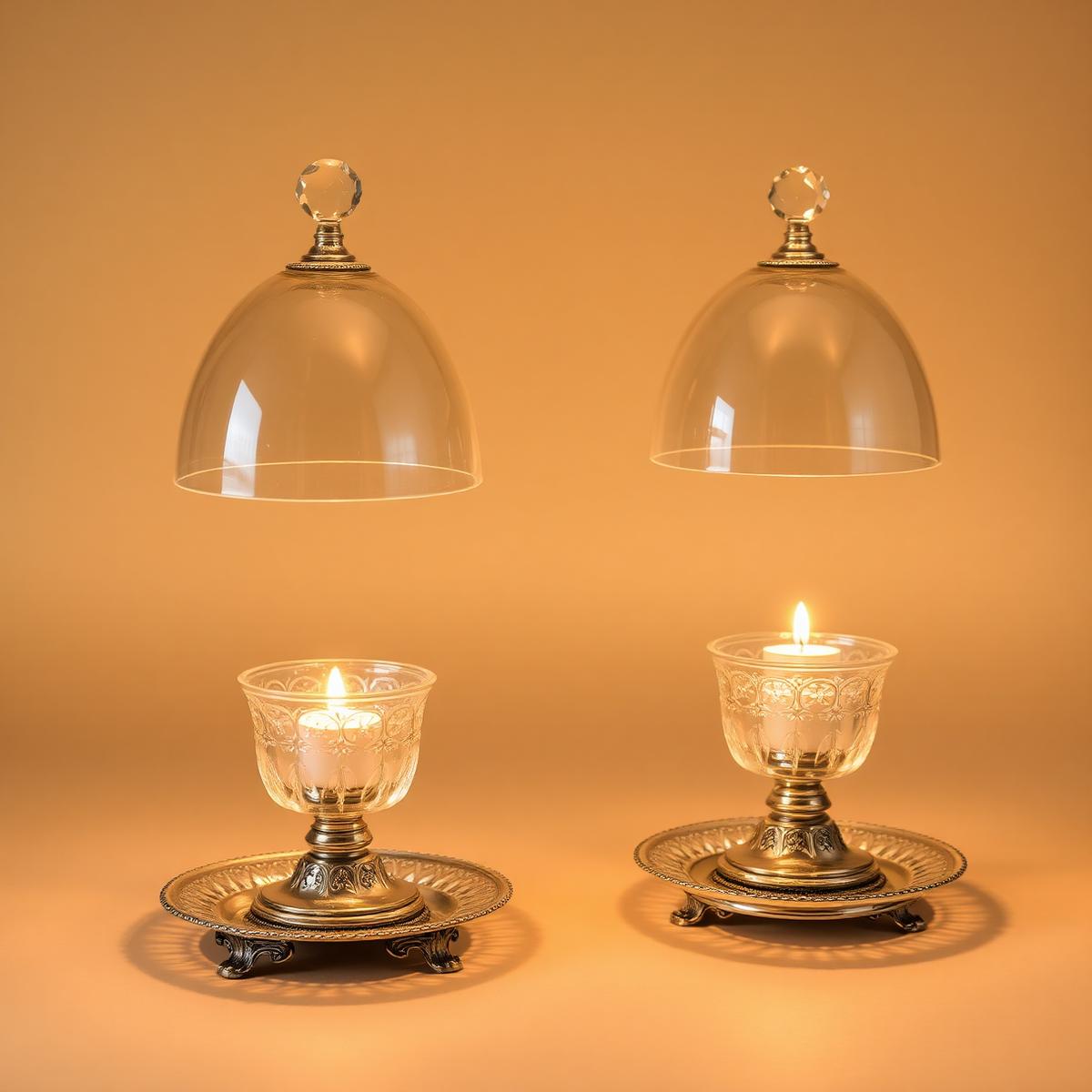
The upgraded Clarke system launched in the mid-1880s. Classic Cricklite is a clear cut-crystal dome over a signed clear glass cup, mounted on ornate silverplate stands — often by F. & C. Osler or Elkington. Sold as centerpieces and mantel pairs.
Verified sold prices:
- Single clear Cricklite lamp, complete: $75–$250 (eBay, 2024–2026)
- Pair of assembled Cricklite lamps on cut-glass Osler stands — New Orleans Auction Galleries
- Colored Cricklite (rare cranberry, cobalt): $300–$700 the pair
Burmese fairy lamps (Webb & Mt. Washington)
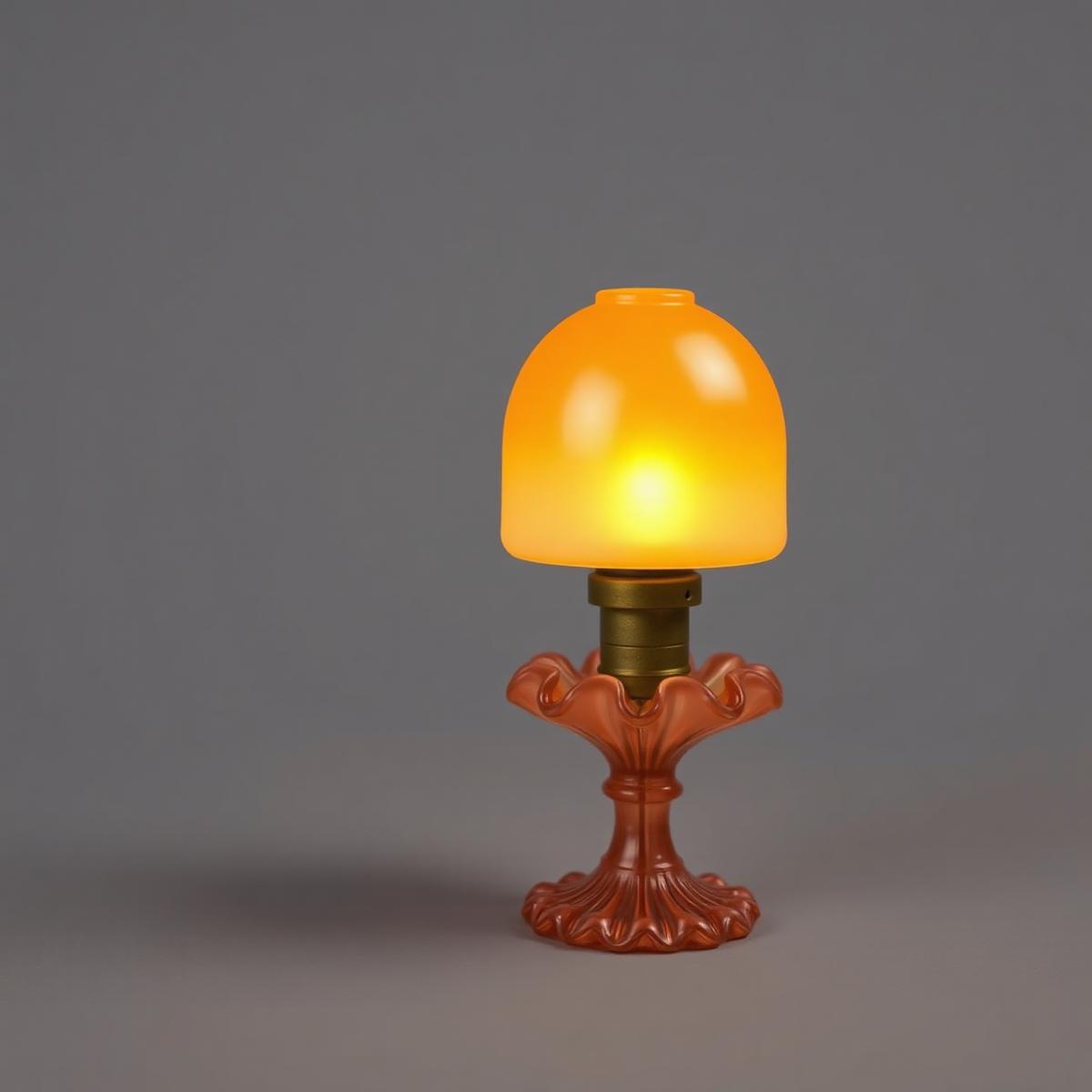
The most iconic type. Burmese glass was patented by Mt. Washington in 1885 and immediately licensed to Thomas Webb & Sons in England, who applied the "Queen's Burmese Ware" mark. The heat-sensitive glass shades from butter yellow at the base to soft salmon pink at the top, glowing gold when lit.
Verified sold prices:
- Burmese Wee-size fairy lamp — Jeffrey S. Evans, April 2024 — sold for $1,080 (est. $80–$120)
- Webb Burmese fairy lamp — James D. Julia — $402.50
- Typical Webb Burmese single lamp with matching base: $225–$550
- Plush-finish (unglazed) Burmese: adds 20–40%
Nailsea (looped and festooned)
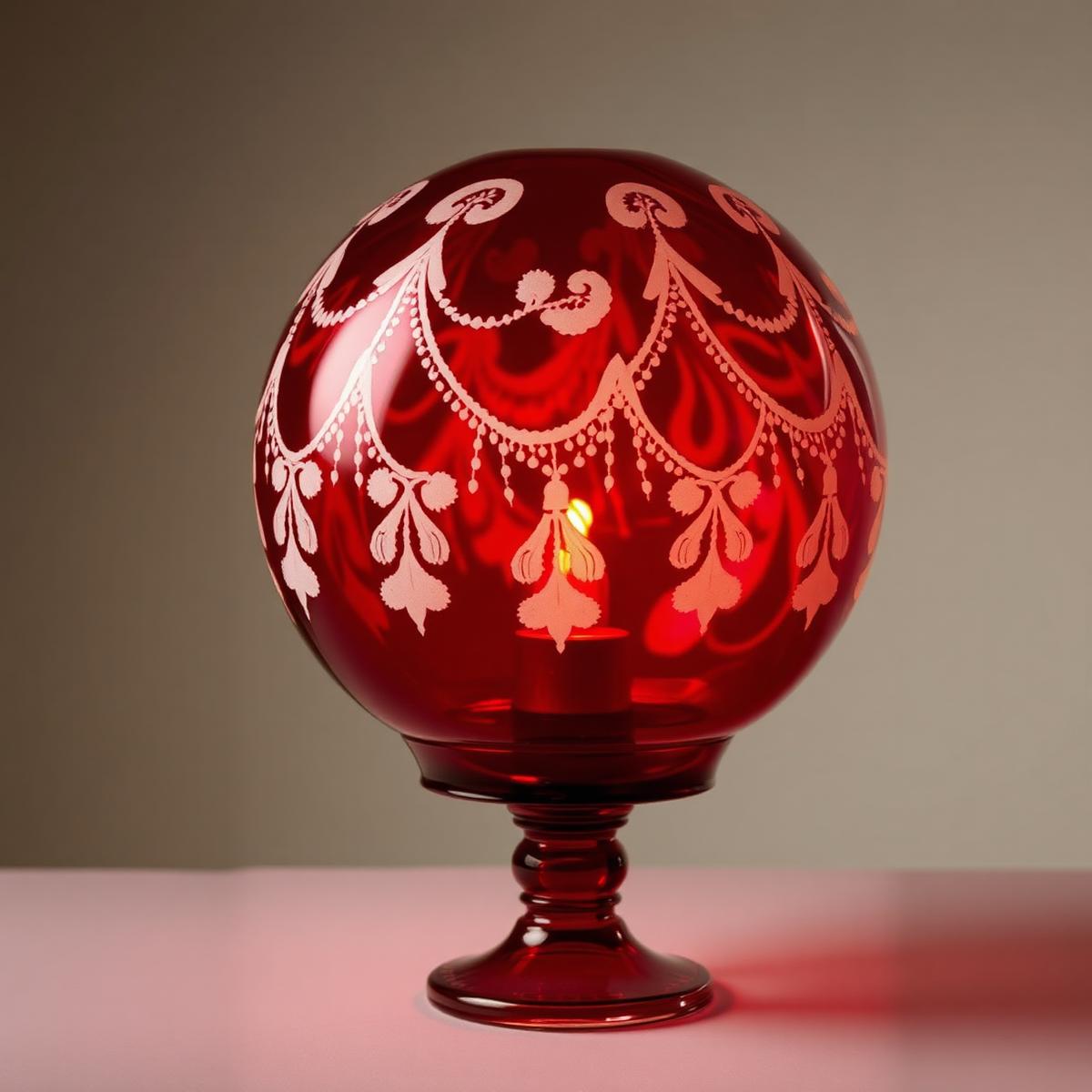
Nailsea refers to the technique — white or contrasting glass threads pulled into loops and festoons across a colored ground. Made across Europe and America, not just at the Nailsea works. Cranberry and cobalt Nailsea fairy lamps are the trophies.
Verified sold prices:
- Nailsea / Venetian Thread fairy lamp — Jeffrey S. Evans, Oct 2024 — sold for $400 (est. $100–$200)
- Nailsea / Venetian Thread fairy lamp — Jeffrey S. Evans, July 2025 — $237.50
- Typical single Nailsea fairy lamp: $150–$450
- Rare colors (cobalt, amethyst): $400–$900
Cranberry & ruby glass
Deep gold-ruby glass — colored with actual gold chloride — was the Victorian status symbol. Cranberry fairy lamps come in plain, cut, enameled, and Nailsea variants.
Verified sold prices:
- Plain cranberry single lamp: $90–$220
- Cranberry with white enameled florals: $175–$375
- Cranberry Nailsea: see Nailsea range above
Vaseline / uranium glass
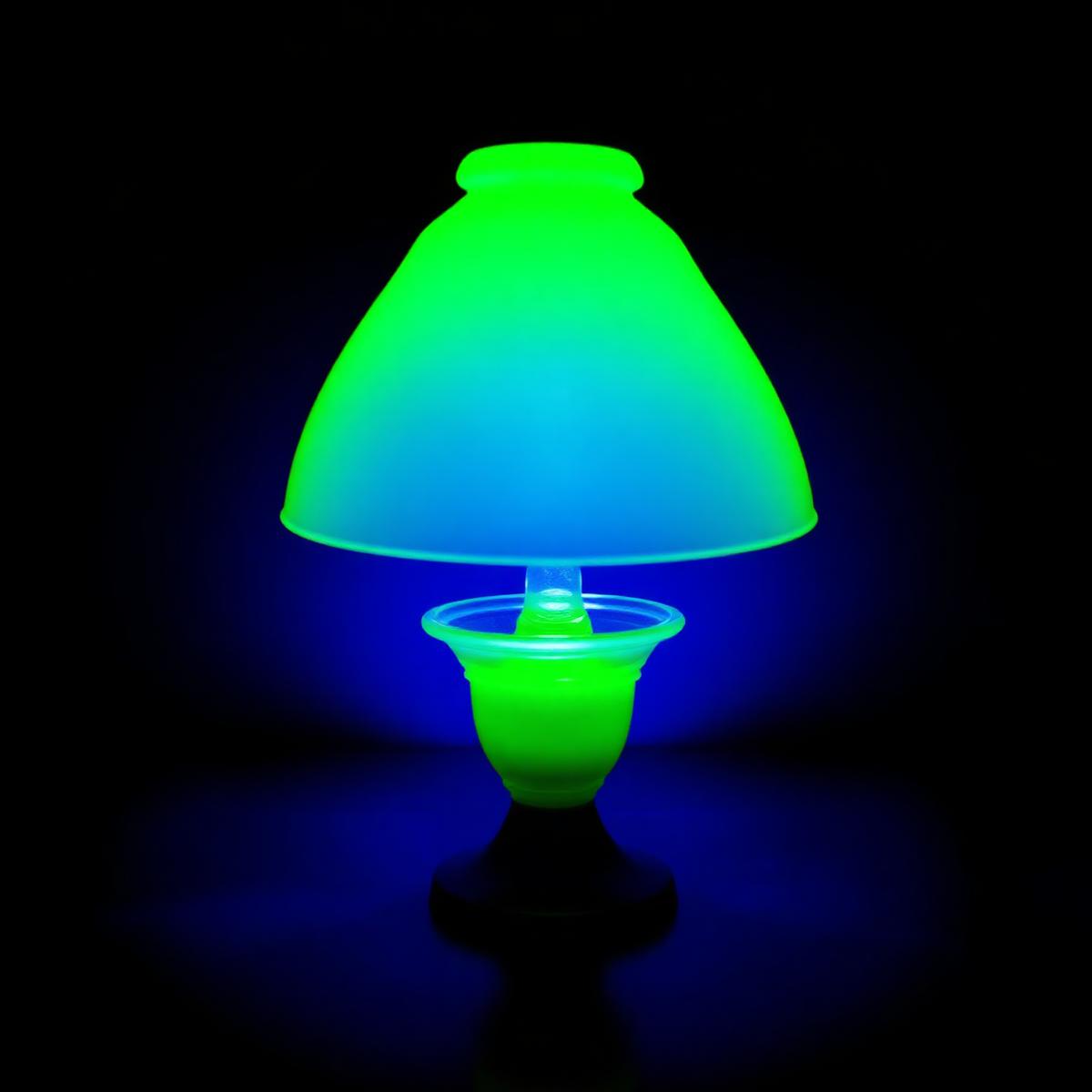
Vaseline glass contains ~2% uranium oxide, which makes it fluoresce electric green under a UV blacklight. In daylight it reads pale yellow-green. Perfectly safe to own — the radiation is trivially low.
Verified sold prices:
- Single Victorian Vaseline fairy lamp: $85–$250
- Fenton reissue vaseline: $40–$110
- Custard-glass (opaque vaseline) rare pieces: $150–$400
Satin glass mother-of-pearl (MOP)
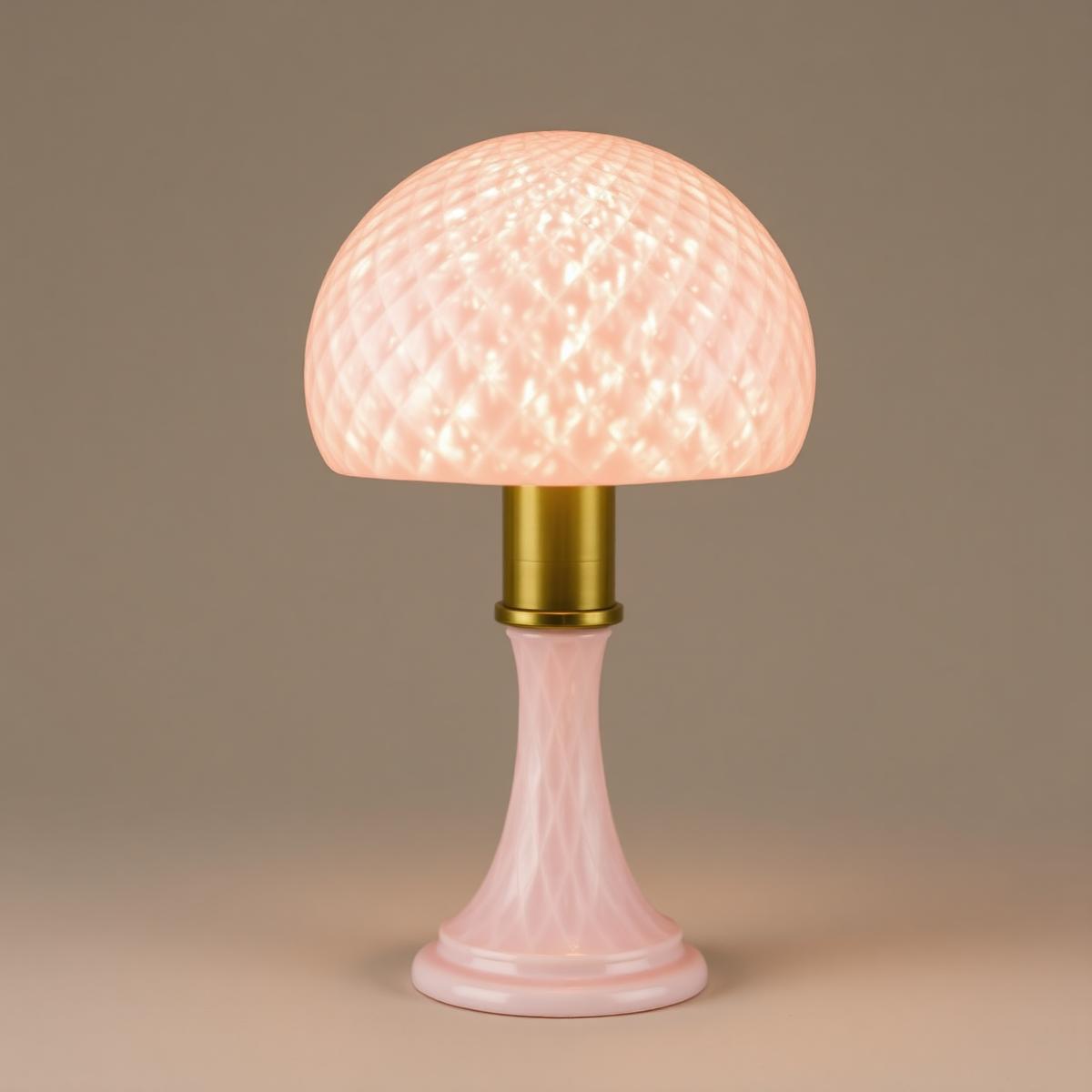
Cased satin glass with internal air pockets forming patterns like diamond quilted (DQMOP), herringbone, swirl, or raindrop. The finish is soft, matte, and pearlescent. Made by Webb, Stevens & Williams, and American houses.
Verified sold prices:
- Rose satin DQMOP fairy lamp, single: $150–$400
- Blue or yellow MOP: $125–$325
- Rainbow MOP (multi-color): $400–$900
- Herringbone or raindrop MOP: $200–$500
Peachblow
Peachblow shades from creamy white to peach or rose pink. Made by Mt. Washington, Wheeling, and New England. Any signed Peachblow fairy lamp is a serious find.
Verified sold prices:
- Wheeling Peachblow fairy lamp: $400–$1,200
- New England Peachblow: $300–$800
- Mt. Washington Peachblow: $350–$900
Milk glass & opalescent
Opaque white or opalescent shaded pieces — everything from plain Victorian milk glass to elaborate figural pieces. The workhorse of Victorian fairy lamps.
Verified sold prices:
- Plain Victorian milk glass single: $25–$85
- Opalescent hobnail Victorian: $75–$180
- Figural (owl, cat face, moon): $125–$400
End-of-Day / spatter / spangle
Made from leftover colored glass rods at the end of the workday — random splashes of multicolor over a white or clear ground. Spangle glass adds flakes of mica for sparkle.
Verified sold prices:
- Spatter / End-of-Day: $95–$275
- Spangle: $125–$350
Figural fairy lamps
Owls, cat faces, moon faces, Christmas trees, Santa figures. The Victorian figurals are folk-art rare and pricey; the Fenton reissues are affordable.
Verified sold prices:
- Victorian owl-face figural: $275–$700
- Victorian moon-face: $400–$1,100
- Fenton hand-painted Santa fairy lamp — sold on eBay Nov 2021, $71
Epergne & multi-lamp centerpieces (the trophies)
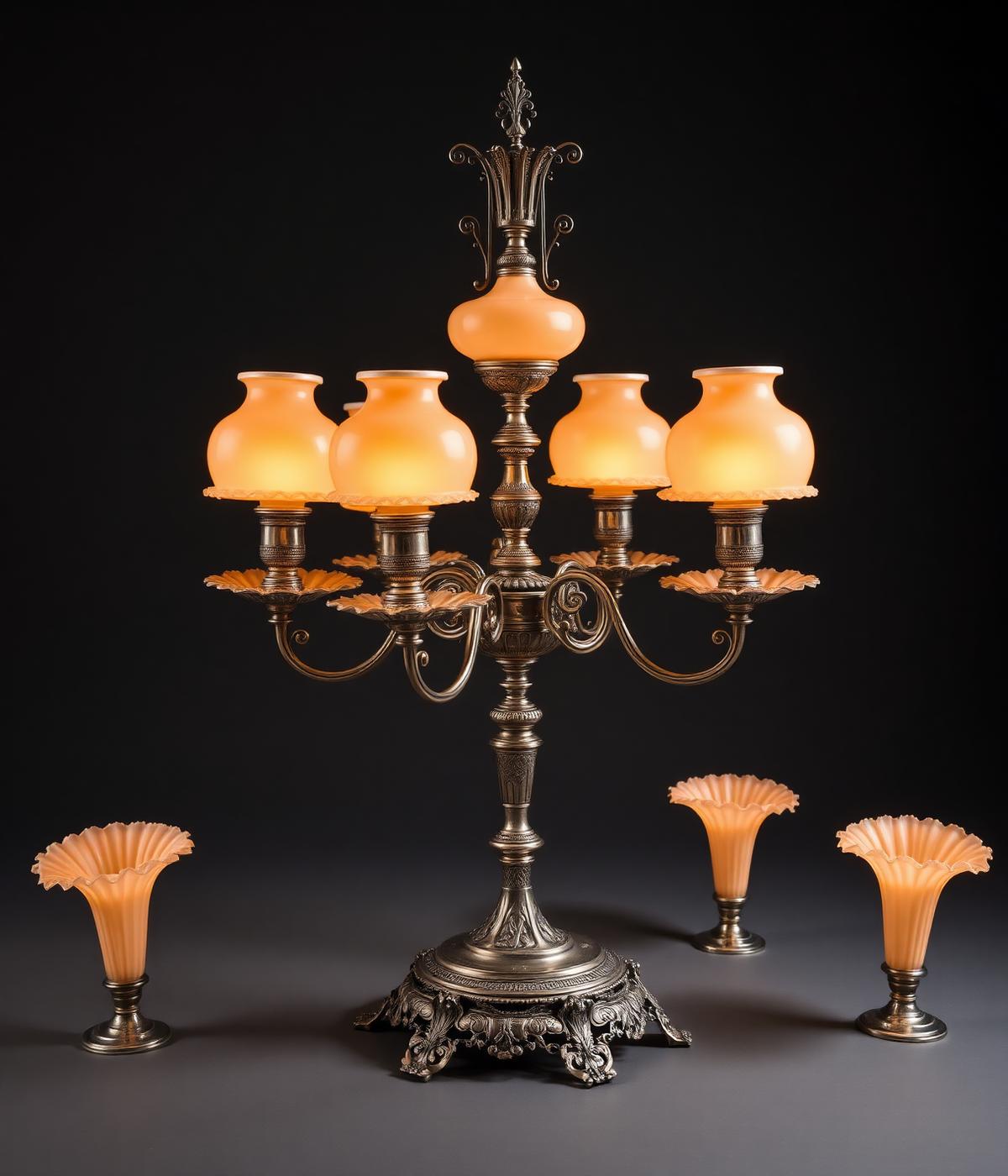
The epergne is the top of the market. A tall silverplate frame holds 3–7 fairy lamp shades and matching trumpet vases. Complete Webb Burmese epergnes with all original glass are among the most valuable Victorian lighting pieces you'll ever see.
Verified sold prices:
- Webb Burmese Epergne — Hindman, May 2023 — $882 (est. $800–$1,200)
- Thomas Webb Burmese Epergne — Jeffrey S. Evans, Oct 2025 — $715 (est. $400–$600)
- Webb Burmese Epergne, plush finish — Jeffrey S. Evans, 2019 — $2,106
- Typical complete Webb Burmese epergne: $700–$2,500
- Cranberry Nailsea epergne: $800–$2,000
Fenton fairy lamps (1953–2002)
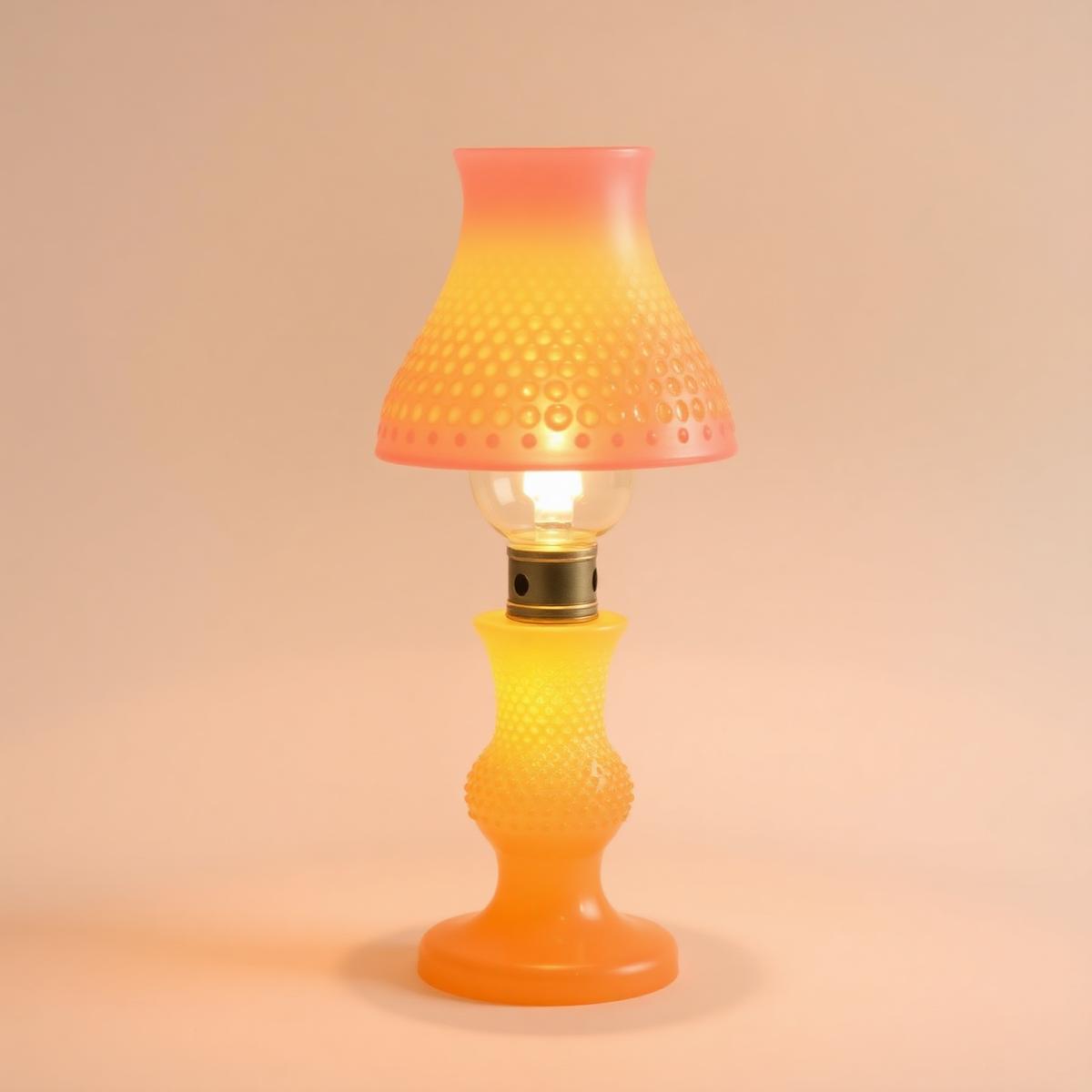
Fenton Art Glass revived fairy lamps in 1953 with their Hobnail line and expanded through the 1970s–2000s in every color and pattern they made. These are the most common "fairy lamps" you'll actually see at estate sales.
Fenton fairy lamps are typically 3 pieces (shade, candle cup, base foot), have the acid-etched Fenton oval logo on the base, and were sold with Fenton labels through gift shops.
Verified sold prices (from Fenton Art Glass Collectors Guide sold-comp database):
- Average vintage Fenton fairy lamp: $50–$95 (avg $52.56 across 84,806 comps)
- Plain hobnail milk glass: $25–$70
- Rare colors (Burmese, Rosalene, Rose Magnolia): $110–$300
- 95th Anniversary Burmese Hobnail: $150–$400
- One-of-a-kind and rare pieces: high of $1,100 documented
Fenton Burmese pieces made before 1985 are unmarked and often confused with Webb Burmese — Fenton's Burmese has a slightly cooler pink and doesn't glow as strongly under UV. See the comparison shot below.
Other 20th-century "fairy lamps"
Companies like Homco, Viking, Indiana Glass, Westmoreland, and L.E. Smith made candle lamps sometimes marketed as fairy lamps. These are decorative — not collectible in the Victorian sense — and typically sell for $10–$40.
Victorian vs. Fenton — how to tell them apart
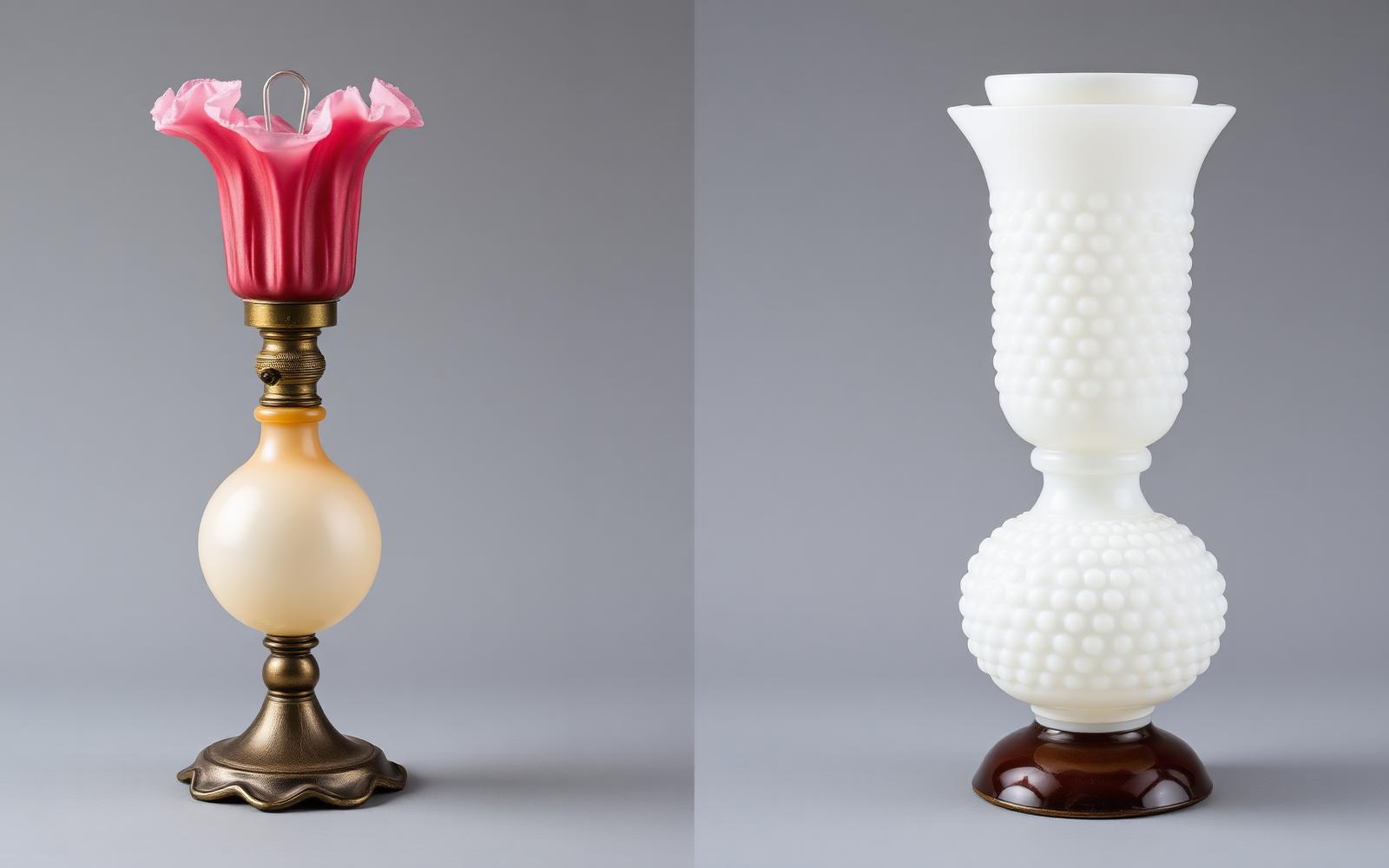
| Feature | Victorian (1857–1900) | Fenton (1953–2002) |
|---|---|---|
| Pieces | 2 (shade + cup) or 3 (+ base) | Almost always 3 (shade + cup + base foot) |
| Base marks | Clarke's Patent trade mark, impressed fairy figure | Fenton oval acid stamp |
| Shade fit | Snug, matched, hand-finished rim | Slightly loose, molded rim |
| Glass quality | "Wet" clarity, hand-finished pontils | Uniformly molded, smooth base |
| Weight | Substantial for size | Lighter for size |
| Typical price | $60–$1,200+ | $25–$150 |
What fairy lamps really sell for right now
The full sold-comp market as of July 2026:
| Type | Typical | Trophy pieces |
|---|---|---|
| Plain milk glass Victorian | $25–$85 | $150 (unusual form) |
| Fenton hobnail (any color) | $25–$95 | $200–$400 (rare colors) |
| Cranberry Victorian single | $90–$220 | $400+ (Nailsea) |
| Vaseline / uranium Victorian | $85–$250 | $400 (custard rare) |
| Satin MOP (DQ, herringbone) | $150–$400 | $900 (rainbow MOP) |
| Clarke's Cricklite pair | $200–$500 | $700+ (colored) |
| Nailsea | $150–$450 | $900 (cobalt/amethyst) |
| Webb Burmese single | $225–$550 | $1,080 (recent JSE result) |
| Peachblow (Wheeling/Mt.W.) | $400–$1,200 | $1,500+ (signed) |
| Figural (Victorian) | $275–$700 | $1,100 (moon-face) |
| Webb Burmese epergne | $700–$2,500 | $2,100+ (plush finish) |
Sources: Jeffrey S. Evans & Associates, LiveAuctioneers, Hindman, Bidsquare, Kovels, and eBay sold-comps aggregated through the Fenton Art Glass Collectors Guide and Relic value databases. Prices verified July 2026. Include buyer's premium.
Where to buy fairy lamps
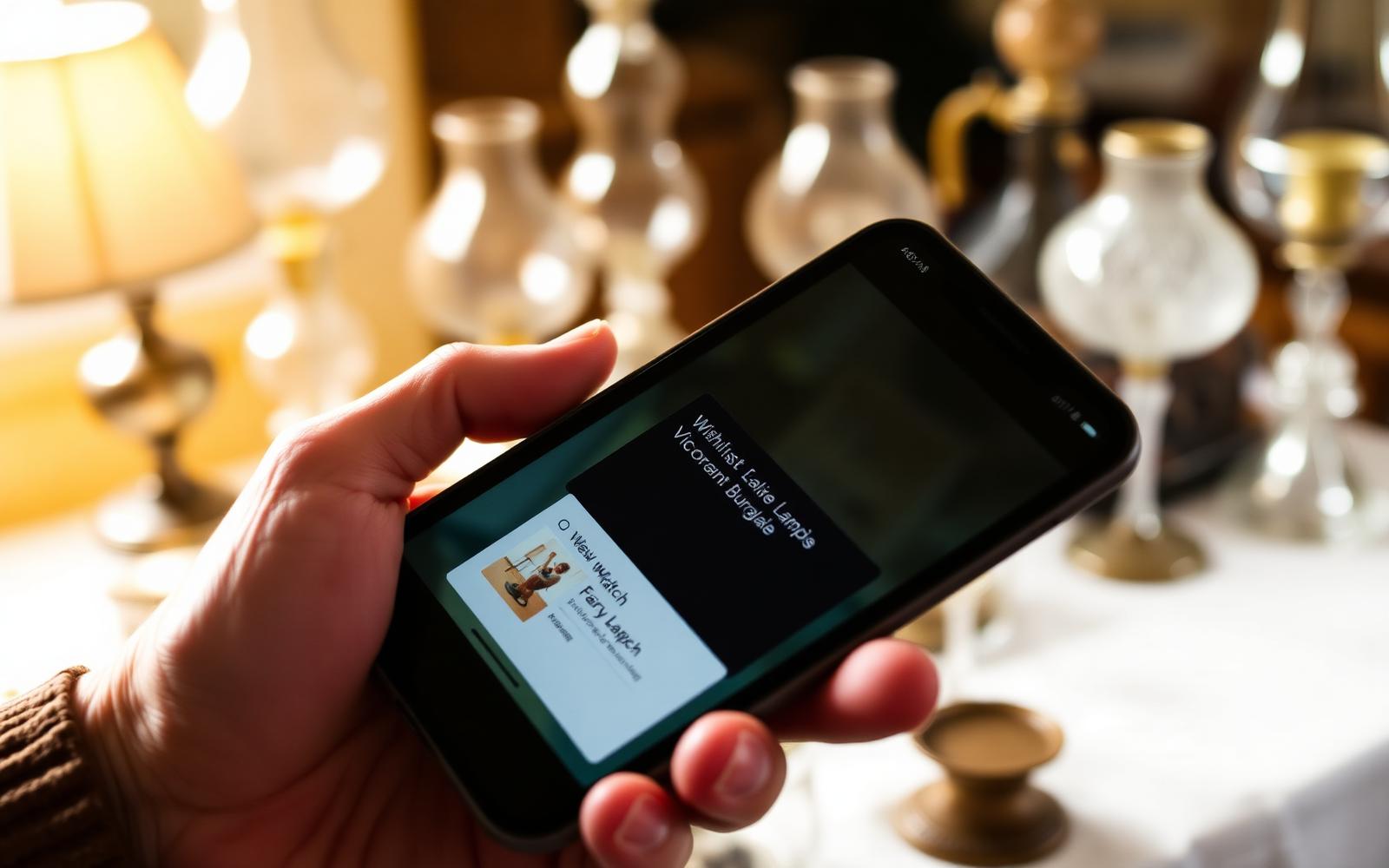
The cheapest fairy lamps show up at estate sales — often mispriced by families who don't know what they have. That's why we built EstateSaleFinder around a simple idea: tell us what you're hunting and we'll ping you when it appears.
- EstateSaleFinder Wishlist Alerts — Add "fairy lamp" plus any type you collect (Burmese, Nailsea, Vaseline, satin MOP, Webb, Cricklite) and we'll notify you the moment a matching item is posted at any estate sale on the platform. Free. This is the single fastest way to build a collection at estate-sale prices instead of auction-house prices.
- Browse estate sales near you — filter by lighting/glassware and see what's on this weekend.
- Ai Appraiser — point your phone at any lamp in a booth and get a real-time value read before you buy.
- Live auctions — Jeffrey S. Evans (Harrisonburg, VA) runs the country's premier lighting sales twice a year. Hindman, LiveAuctioneers, and Bidsquare are the online pipelines.
- eBay sold listings — set saved searches on "Webb Burmese fairy lamp," "Nailsea fairy lamp," and "Clarke's Cricklite" filtered to Sold to see real market pace.
- Ruby Lane and specialist dealers — priced above auction but pre-vetted for authenticity.
How to sell fairy lamps for top dollar
- Photograph lit and unlit. Buyers pay a premium when they can see the glow. Shoot on a dark background with a warm tealight inside, and again on white in daylight so color is accurate.
- Photograph the base mark. Any Clarke's, Webb, or Fenton stamp doubles buyer confidence.
- Sell pairs as pairs. A matched Cricklite or Burmese pair sells for 2.5–3× the single price — never break a pair.
- Grade condition honestly. Check the shade rim under raking light for hairlines. Mention any ground rims, chips, or repairs.
- Match the platform to the price tier (see chart below).
- Include provenance. Any old family photo, receipt, or note bumps final price 15–25%.
Where to list, by price tier:
- Under $75 → eBay auction, local estate sale
- $75–$400 → eBay Buy It Now, Etsy
- $400+ → Ruby Lane, Jeffrey S. Evans consignment, LiveAuctioneers house
- $1,000+ → Hindman, Skinner, or Webb specialists
Selling estate-sale inventory? Our reseller playbook and antique dealer's grab list walk through the whole workflow.
Red flags: marriages, repros, and fakes
- Married pairs — shade and base don't originally belong together. Check the fit (should be snug), the tone (should match exactly under warm light), and the finish (both should have identical satin/glossy texture). Marriages sell for 40–60% less.
- Aftermarket bases — reproduction silverplate stands are still being made in India. A too-shiny, too-crisp stand under a genuinely old shade is a giveaway.
- Reproduction Cricklite shades — clear cut-crystal domes are still being made. Real Cricklite shades have a Clarke's mark on the cup, not the shade.
- "Fenton style" — Chinese-made hobnail lamps are showing up labeled "Fenton style." Real Fenton has the acid-etched oval mark.
- Painted-over damage — hand-painted florals sometimes hide hairline cracks. Backlight the shade with a phone flashlight to check.
Care & display
- Never use a full-size taper candle — the heat cracks the glass. Use a short "fairy" candle or, safer still, a battery LED tealight.
- Clean satin glass with warm water and a drop of dish soap, never abrasive cleaner (it dulls the finish permanently).
- Keep out of direct sunlight — cranberry and Peachblow can fade over years.
- Store shades and bases together, wrapped separately in acid-free tissue.
- Never soak signed cups — some Clarke's marks are surface-etched and can wear.
FAQ
What is a fairy lamp?
A fairy lamp is a small Victorian candle lamp made of a glass dome shade seated on a matching glass cup that holds a stubby "fairy" candle. Patented by Samuel Clarke of London in 1857 and popularized in the 1880s–1890s, they were sold as safe nursery and dining-table candlelights by makers like Webb, Stuart, Baccarat, and Mt. Washington.
How much are fairy lamps worth?
Most Victorian fairy lamps sell for $60–$300. Signed Burmese, Nailsea, and satin mother-of-pearl pieces bring $250–$1,100. Complete Webb Burmese epergne centerpieces routinely sell for $700–$2,500, with plush-finish and rare-color examples reaching over $2,000. Mid-century Fenton fairy lamps average $50–$95, with rare colors like Rosalene and 95th Anniversary Burmese reaching $200–$400.
Are Fenton fairy lamps valuable?
Vintage Fenton fairy lamps (1953–2002) are collectible but not rare. Common hobnail milk glass pieces sell for $25–$70. Rare colors — Rosalene, Rose Magnolia, Burmese, 95th Anniversary pieces, and hand-painted limited editions — reach $150–$400, with documented one-of-a-kind Fenton fairy lamps selling as high as $1,100 on eBay.
How do I know if my fairy lamp is real Webb Burmese?
Real Webb Burmese has a satin finish, shades from butter yellow at the base to salmon pink at the top, and the cup often carries a "Clarke's Patent Fairy Trade Mark" impressed with a small fairy figure. Under UV blacklight, genuine Webb Burmese glows a soft green (the uranium content). Fenton Burmese, by comparison, is slightly cooler-toned and glows less strongly. Any documented Thomas Webb mark ("Queen's Burmese Ware," "Thos. Webb & Sons") is proof.
Where can I sell fairy lamps for the best price?
Under $75, use eBay or a local estate sale. $75–$400 does best on eBay Buy It Now or Etsy. Above $400, consign to a specialist like Jeffrey S. Evans & Associates or list on LiveAuctioneers. For epergnes and top-shelf Webb pieces ($1,000+), send them to Hindman, Skinner, or a Webb specialist. Selling requires good lit-and-unlit photos, close-ups of any marks, and honest condition grading.
What does "Cricklite" mean?
"Cricklite" is the trade name Samuel Clarke gave his upgraded fairy lamp system in the mid-1880s — typically a clear cut-crystal dome over a signed clear glass cup, mounted on ornate silverplate stands with matching flower trumpet vases (often by F. & C. Osler). The Cricklite mark appears on the glass cup, not the dome.
Are Vaseline glass fairy lamps safe to own?
Yes, completely safe. Vaseline glass contains about 2% uranium oxide, which produces a bright fluorescent green glow under UV blacklight but negligible actual radiation — less than a granite countertop or a banana. It's safe to display, handle, and store on open shelving.
Can I still use a candle in an antique fairy lamp?
Only if you use an actual short "fairy" candle designed for the form — never a full-size taper. Full-size candle heat can crack 130-year-old glass. The safest option is a battery LED tealight; it gives an identical warm glow without any risk of heat damage, wax mess, or fire.
The bottom line
Fairy lamps are the perfect Victorian collectible: small enough to display anywhere, cheap enough to start collecting for $25, deep enough that you can spend the rest of your life learning them. Start with a Fenton to learn the form, add a Cricklite for the marks, and hunt patiently for a Webb Burmese to make the shelf sing.
Then let us do the hunting: set a wishlist alert for "fairy lamp" and we'll ping you the moment one lands on any estate sale we index. Free, forever. Happy hunting.
Keep exploring
Ready to start your own treasure hunt?
Discover estate sales near you and find incredible deals.
Explore Sales Near Me
About the author
Andy
Founder, EstateSaleFinder.net
Hi, I'm Andy — a retired commercial photographer turned developer with a five-year (and counting) obsession with estate sales. I started EstateSaleFinder.net because I knew there had to be an easier, smarter way to find and list estate sales. Now I get to chase treasure and build the tool I always wished existed.