The Vintage Camera Hunter's Guide to Estate Sales
Gen Z brought film photography back and estate sales are the last honest market for it. Canon AE-1, Pentax K1000, Minolta SRT, Olympus OM-1 — they still turn up in kitchen drawers and closet shelves marked $10. Here's how to spot them, test them, and know exactly what they're worth in 2026.
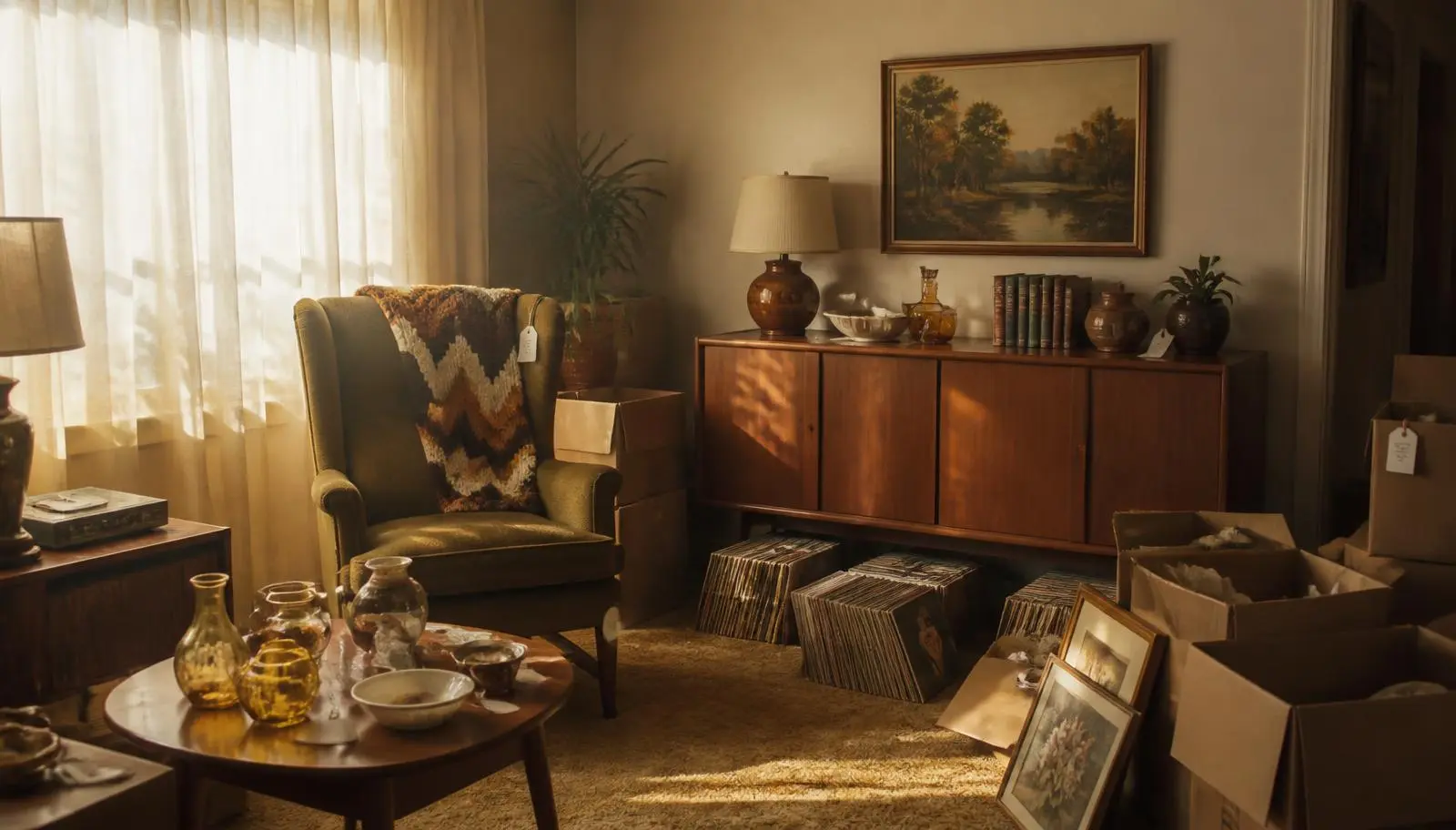
There is a very specific moment every estate-sale regular knows. You're in the back bedroom, the light is bad, and there — on a closet shelf, next to a stack of National Geographics — is a leather case with a strap. You pop it open. A chrome-and-black Canon AE-1 looks up at you. The tag on the strap says $25. Somewhere in the country right this second, a 22-year-old is on eBay paying $180 for the same camera.
This is the whole opportunity in one paragraph.
Film photography is not a passing thing anymore. Kodak's film business grew 127% between 2020 and 2025 — a resurgence driven almost entirely by Gen Z. The Phoblographer has a running series on the best cameras for first-time film shooters. TikTok is full of "35mm point-and-shoot haul" videos. And the supply of vintage film cameras is fixed forever — Canon stopped making the AE-1 in 1984. Pentax retired the K1000 in 1997. The only place new supply comes from now is estates.
This is the honest, dealer-grade field guide to hunting vintage cameras at estate sales in 2026: which models actually move, how to test one at the table in 60 seconds, what they're really worth (from real eBay sold comps, not fantasy asking prices), and how to walk out of a kitchen with a camera worth ten times what you paid for it.
Why estate sales are the last honest market for film cameras
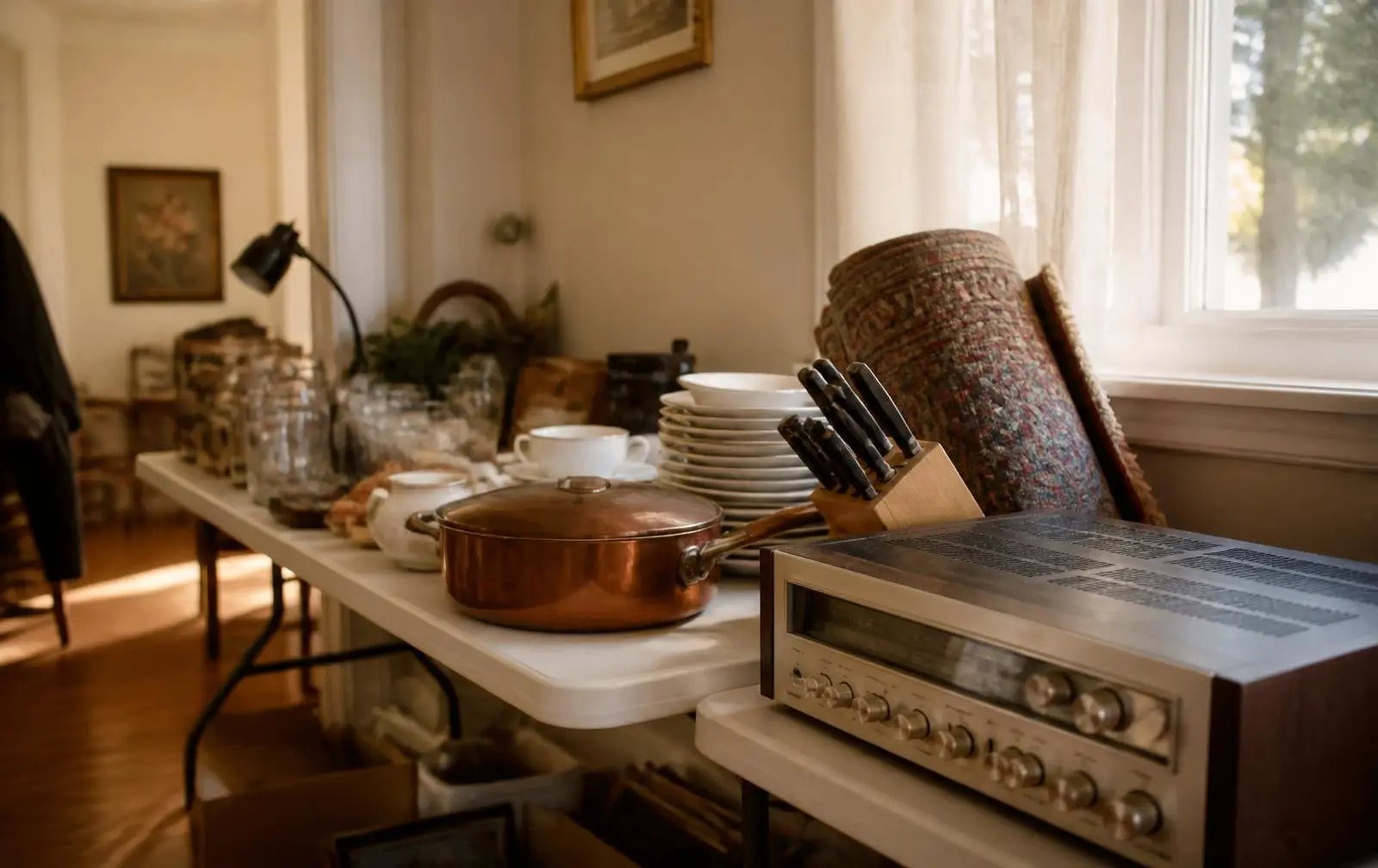
Every other channel has been picked over. Camera shops know exactly what a Canon AE-1 costs and price to the tenth. Facebook Marketplace is full of resellers. eBay is efficient. Estate sales are the exception because the person setting up the sale is almost never a camera person — they're a family member or an estate liquidator with fifty categories to price in three days. Cameras get lumped in with electronics, priced by the case (not the body), and stashed in closets nobody photographs for the listing.
That means the cameras that sell for $150–$400 in every other market routinely surface at estate sales for $15–$50. Not sometimes. Constantly. Anyone who has browsed estate sales near them for a year has bought at least three of them.
The five film cameras every estate-sale hunter memorizes
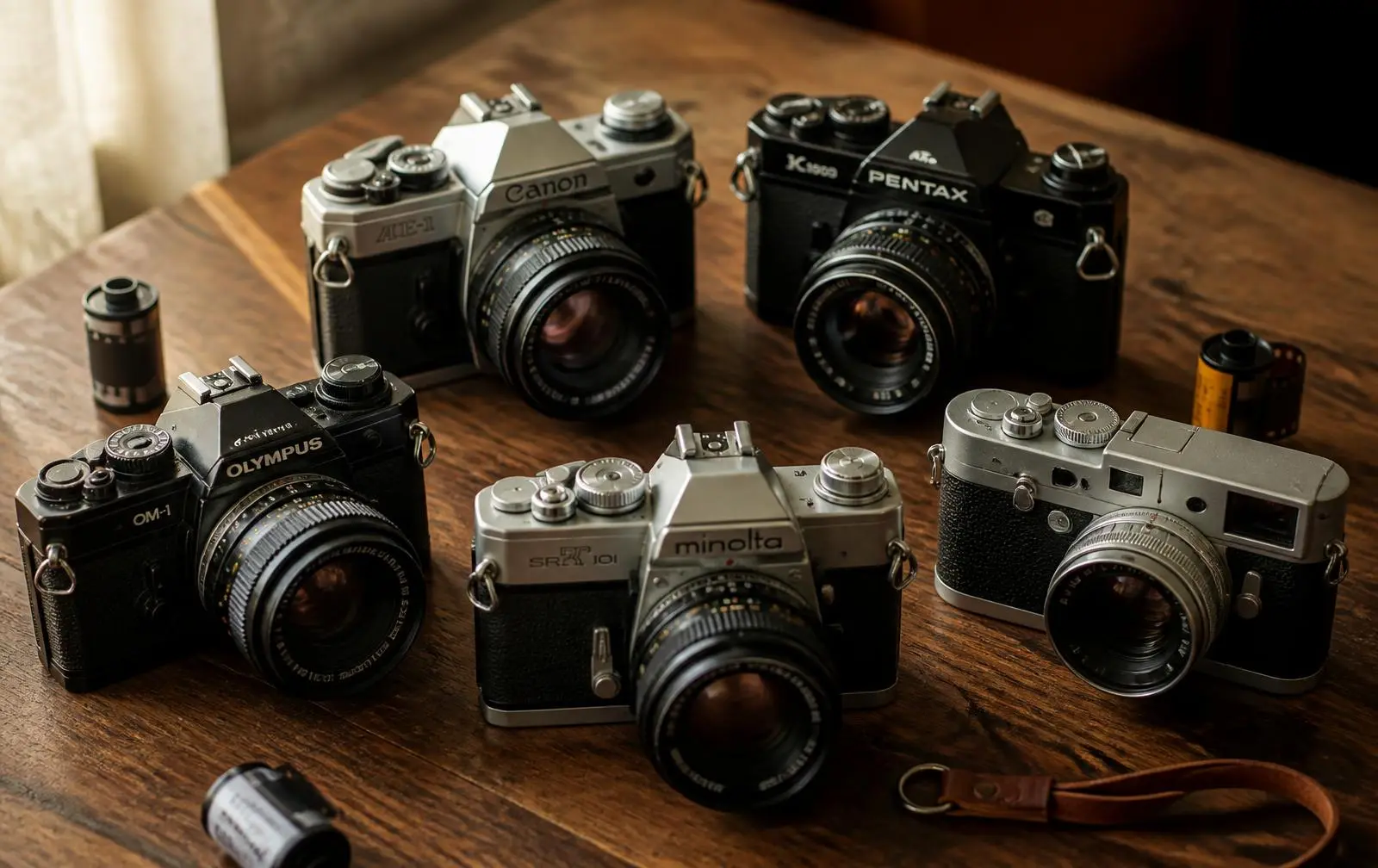
You do not need to know every camera ever made. You need to know these five bodies cold — they're the ones you will actually see, and the ones with the strongest, most-informed collector demand right now.
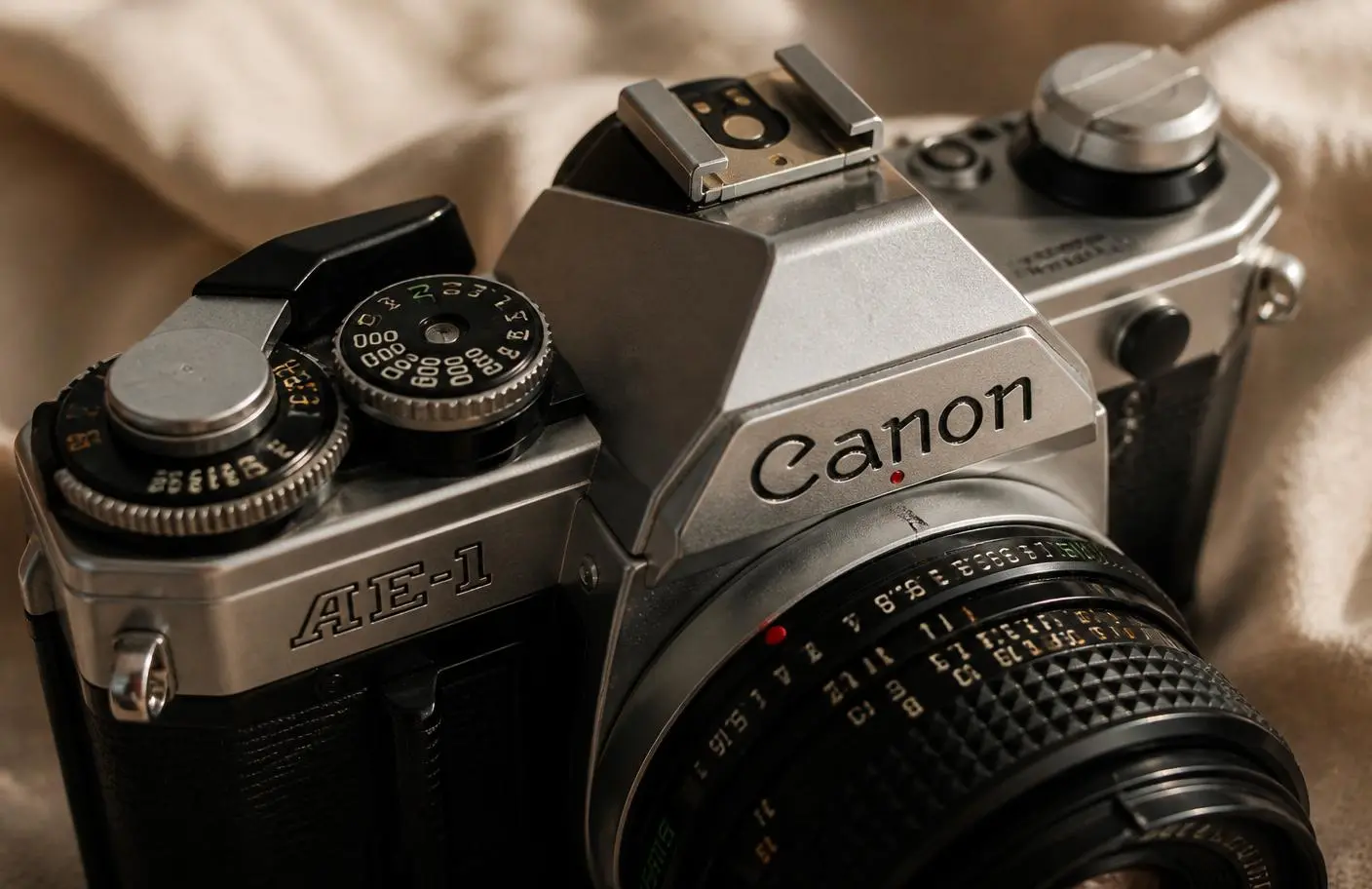
1. Canon AE-1 & AE-1 Program (1976–1984) — the crown jewel of the resurgence
If you learn one camera, learn this one. The Canon AE-1 was the best-selling 35mm SLR of its era and became the face of the Gen Z film revival. It's the camera every TikTok film account seems to shoot. It's also famous for one specific noise — the "Canon cough," a squeaky mirror slap caused by dried grease — that is a $75 CLA fix, not a dealbreaker.
- How to spot it: Chrome or black top plate, "Canon" and "AE-1" engraved on the front pentaprism hump. A round shutter-speed dial on the left, a film advance lever on the right. Almost always comes with a 50mm f/1.8 FD lens.
- What it's worth in 2026: Median $135 on eBay, ranging $77–$190 for a working body with lens. Over 3,700 recent completed eBay sales — this is a very liquid market. Black-paint bodies push the top of the range.
- Buy at: anything under $60. Walk-away at $100+ untested.
2. Pentax K1000 (1976–1997) — the student camera every photo teacher recommended
The Pentax K1000 is the fully mechanical, no-battery-needed SLR that a generation of college photo programs standardized on. That means two things: they were built in massive numbers (a big supply at estate sales) and every second-year photo student in America knows exactly what one is (huge, informed demand).
- How to spot it: All-manual SLR, no automation, just a needle meter on the right side of the viewfinder. "PENTAX K1000" on the pentaprism. Japan-made bodies (pre-1978) command a premium; later Hong Kong and China builds are still fine but worth less.
- What it's worth in 2026: Median $100 on eBay, ranging $65–$160 for a body with the standard 50mm f/2 SMC lens. The rare black-body "K1000 SE" runs $180+.
- Buy at: anything under $50. Add another $30 for a Japan-made body.
3. Olympus OM-1 (1972–1979) — the compact one photographers obsess over
Designed by Yoshihisa Maitani to be dramatically smaller and lighter than every other pro SLR of its era. The Olympus OM-1 has a cult following among travel and street photographers, and its Zuiko lenses are legitimately great. One catch: the original meter runs on a mercury battery that hasn't been legal since 1996 — modern owners use an adapter or shoot "sunny 16."
- How to spot it: Very small, silver top plate, "OLYMPUS OM-1" on the pentaprism. Distinctive shutter-speed ring around the lens mount, not on top of the body.
- What it's worth in 2026: Median $138 on eBay, ranging $59 to $290+ — 792 recent sales. Cameras noted as CLA'd or with fresh light seals sell at the top end.
- Buy at: under $50 for a body, under $85 with a 50mm Zuiko attached.
4. Minolta SRT-101 / SRT-201 (1966–1981) — the sleeper deal
Minolta doesn't have the loud community that Canon and Pentax have, which is exactly why the SRT series is the sleeper play at estate sales. It's a well-built, all-mechanical, match-needle SLR with a Rokkor lens system that's genuinely underrated. Prices are low right now because the demand hasn't fully arrived yet.
- How to spot it: Chrome or black body, "minolta" in lowercase script on the front. "SRT 101" or "SRT 201" on the pentaprism. Match-needle meter (two needles in the viewfinder that you align).
- What it's worth in 2026: A working SRT-101 with a 50mm Rokkor typically sells $45–$130 on eBay. Not a headline camera, but a reliable $15-in / $90-out flip. The Rokkor lenses on their own often sell for $40–$80.
- Buy at: under $30. All day.
5. Nikon FM2 / FM2n (1982–2001) — the professional's backup
The Nikon FM2 is the one you don't see as often, because photographers who owned them didn't retire them — they kept them as backups until the day they died. When one turns up at an estate sale, it usually came from a working photographer. It shoots 1/4000s, needs no battery for the shutter, and takes every manual Nikkor lens ever made.
- How to spot it: All-metal SLR (chrome or black), "Nikon" logo on the pentaprism, "FM2" on the front. The "FM2n" (the later version with better flash sync) is worth slightly more.
- What it's worth in 2026: Median $390 on eBay, ranging $90 to $546. The titanium FM2/T is a several-thousand-dollar camera and does turn up.
- Buy at: anything under $150. Do not hesitate.
Honorable mentions worth grabbing
You'll also run into these. Not the headline five, but never leave them behind at a good price:
- Canon A-1 — the AE-1's fancier sibling. $150–$275 working.
- Pentax ME Super — compact, aperture-priority. $80–$180.
- Nikon FE / FE2 — the FM2's aperture-priority sibling. $150–$300.
- Olympus OM-2 / OM-2n — OM-1 with metering. $120–$220.
- Canon P / Canon 7 rangefinders — the Leica-alternative rangefinders. $300–$800.
- Any Leica M-series body — M3, M4, M6 — these start at $1,200 and go up. Never guess on a Leica; check it on the spot.
- Hasselblad 500-series medium format — instantly recognizable modular body. $800–$3,000+.
- Polaroid SX-70 — folding, iconic, back in a big way with the Impossible/Polaroid Originals film revival. $120–$280.
The 60-second table test: how to check a film camera without opening it
You are standing at a table with a camera in your hand and someone waiting behind you. Here's the exact sequence.
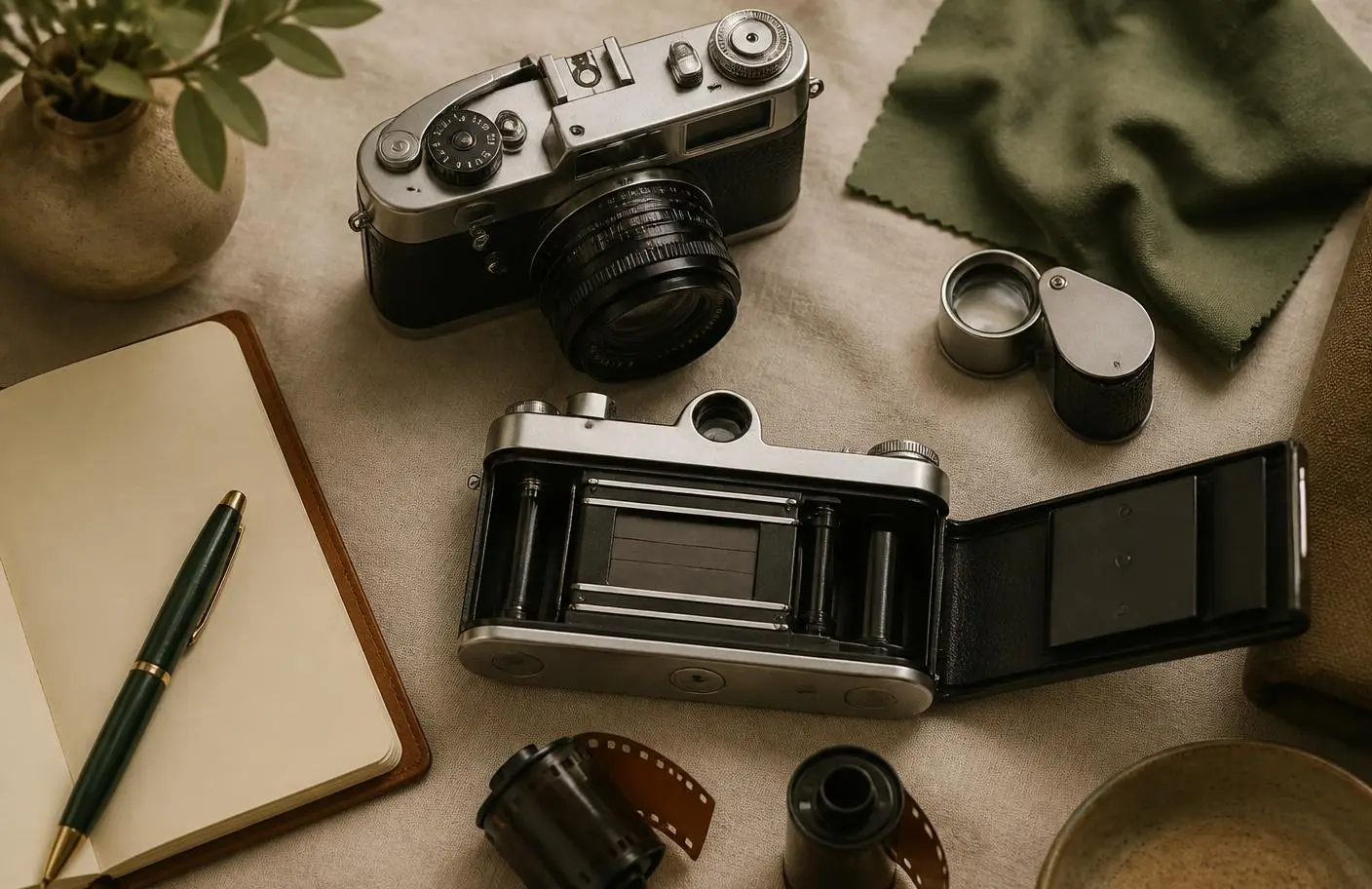
1. Look at the front lens element. Angle it toward a light source. Any of these three things is a lens-value killer:
- Fungus — spidery, spreading web patterns inside the lens.
- Haze — a milky film across the glass.
- Balsam separation — rainbow-oil-like patches at the edges of a lens element.
- Small dust specks inside a lens are normal and don't affect images. Do not walk away from those.
If steps 1–4 pass, buy the camera. The rest is fine-tuning your offer.
The lens is often worth more than the body
This is the single most-missed detail at estate sales. A Leica Summicron 50mm f/2 lens by itself sells for $700–$2,500. A random 1970s Minolta Rokkor prime sells for $40–$100. A Canon FD 50mm f/1.4 SSC is a $150–$220 lens on its own. A Nikon Nikkor 105mm f/2.5 AI — the lens Steve McCurry shot the "Afghan Girl" cover with — is $250–$500.
When you're pricing a camera at a table, you're often really pricing the lens. A working AE-1 with a scratched FD 50mm f/1.8 is a $90 sale. The same body with a clean FD 50mm f/1.4 SSC attached is a $250 sale. Learn the fast lenses (anything f/1.4 or wider, and any focal length that isn't 50mm) and you'll routinely find sellers charging body-only prices for a body-plus-a-$200-lens combination.
What Gen Z is actually buying (and why it matters for what you flip)

The film revival is real but it isn't uniform — it has very specific favorites. From the Phoblographer's coverage of the movement, a look at the Fortune analysis of the Gen Z film market, and eBay's own top-mover categories, the pattern is clear:
- Compact 35mm point-and-shoots are the fastest-appreciating category. Contax T2, Yashica T4, Olympus Stylus Epic, Nikon L35AF — these have doubled in the last two years and don't look like slowing down.
- Fully manual SLRs (K1000, OM-1, FM2, SRT-101) are the "learning cameras" — steady, predictable demand from students and hobbyists.
- Vintage Polaroids are back thanks to Polaroid's re-launched instant film.
- Zoom-lens plastic SLRs from the '90s (Canon Rebel, Minolta Maxxum) — the ones most people threw in a drawer twenty years ago — are the least desirable. Do not overpay for these.
The buyer for a working AE-1 in 2026 is not a nostalgic 55-year-old — it's a 22-year-old getting their first "real" camera. That informs how you price and photograph what you list.
What to skip (or price like it's practically free)
Not everything camera-shaped is worth carrying home:
- Any digital camera made 2005–2015. Compact digital cameras from that era are functionally worthless — a modern phone shoots better. (Exception: the CCD-sensor "digicam" trend — Canon PowerShot ELPH, early Sony Cybershots — has real demand right now among Gen Z shooters chasing the "2005 party photo" aesthetic. $30–$80 territory. Not much, but not zero.)
- Broken instant cameras with no film available. Old Polaroid packs (600, SX-70) still have film; but if the camera takes a discontinued proprietary pack film, skip it.
- Cameras with missing lens caps and no lens. Body-only can still be worth it — but be sure the mount is one you can pair with common lenses later.
- Camcorders, VHS-C, Hi8. Almost no collector market outside of very early 1980s "Portapaks." Pass.
- Movie projectors and Super 8 cameras. Small niche market. Buy at $5, not $50.
Where to actually find them at a sale
Cameras almost never make it into the estate sale's photo listing. Which is exactly the advantage — you can ask.
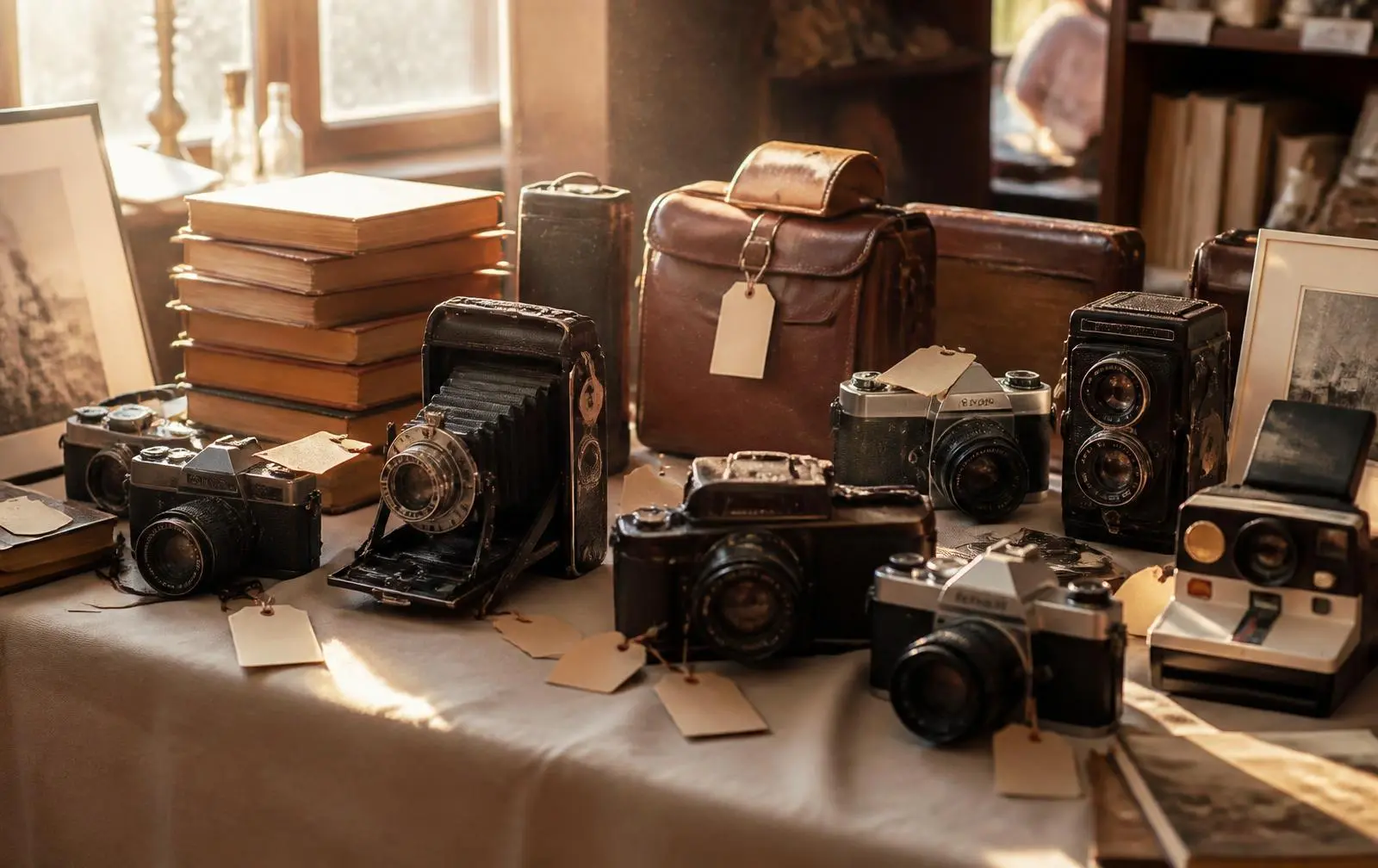
- Bedroom closets — top shelf. Especially in a man's room. Cameras were kept in their leather case in the closet next to the neckties.
- Home offices and dens — drawer of an old desk, behind books on a shelf.
- Basement bins — camera bags full of accessories, but often the body too.
- The "garage room" of a nice home — where an older photographer stashed the retired gear.
- Living room console cabinets — surprisingly often. Old family photographer kept the "good camera" out where they could grab it.
Best practical move at the top of a sale: ask the runner directly. "Do you know if there are any cameras in the house?" Half the time they'll walk you to a closet nobody else has been in.
How to make this into a repeat process, not a lucky Saturday
If you want to actually stack cameras — hit fifty sales a year, come home with ten cameras, resell six — you need three tools, not luck:
- Set wishlist alerts for terms like "camera," "35mm," "Canon," "Pentax," "Leica," "Nikon," "Polaroid." Any new nearby sale mentioning them pings your phone. Sellers who list "cameras" in the description are the goldmines.
- Plan your Saturday with the route planner — cameras are heavy, gas is expensive, and the difference between hitting five sales in the right order and five sales in random order is 45 minutes.
- Scan anything you're unsure about with the Ai Appraiser right at the table. It pulls live eBay sold comps in about ten seconds, so you're never overpaying and never leaving money on the shelf. Free for buyers.
Resellers already doing this can chain it with our companion guides on how to make money reselling from estate sales and the 13 vintage treasures antiques dealers always grab.
Questions & answers
Frequently asked questions
Are vintage cameras actually worth anything in 2026?
Yes — significantly more than five years ago. Kodak's film business grew 127% between 2020 and 2025, driven by Gen Z. A working Canon AE-1 with a 50mm lens has a median eBay sold price of $135 (range $77–$190). A Pentax K1000 sells for a $100 median ($65–$160). A Nikon FM2 clears $390 median. Even entry-level SLRs like the Minolta SRT-101 clear $45–$130. Estate sales are where most of these still surface for $15–$50.
How do I test a film camera at an estate sale?
Open the back to check for crumbly light seals (a cheap fix, not a dealbreaker), fire the shutter at both 1/1000 and 1 second to confirm the speeds actually differ, cock the film advance lever to check it moves smoothly, flip the aperture ring to make sure the blades snap cleanly at every f-stop, and hold the lens up to a light to look for fungus, haze, or scratches. If those five checks pass, buy it.
What's the difference between an SLR and a rangefinder?
An SLR (single-lens reflex) uses a mirror and prism so the viewfinder shows exactly what the lens sees — Canon AE-1, Pentax K1000, and Nikon FM2 are all SLRs. A rangefinder has a separate viewfinder window and focuses by overlapping two images in a bright patch — Leica M-series and folding cameras are rangefinders. Rangefinders are smaller and quieter; SLRs are more versatile with long lenses.
Is a Canon AE-1 with the "Canon cough" ruined?
No. The "cough" is a well-known squeak from dried mirror-mechanism grease and is fixed by a standard CLA (clean, lubricate, adjust) at a camera repair shop for typically $75–$150. A coughing AE-1 still shoots fine and is worth buying at estate sale prices — you'll come out well ahead after the service.
Is the lens or the body worth more on a vintage camera?
Often the lens. A Leica Summicron 50mm f/2 alone sells for $700–$2,500 — several times more than most bodies. Canon FD 50mm f/1.4 SSC lenses run $150–$220 on their own. Any fast prime (f/1.4 or wider) or non-50mm focal length is worth checking against sold comps separately — sellers often price the camera-and-lens pair based on the body value alone, which is where a lot of estate-sale bargains hide.
What film cameras should I skip at estate sales?
Skip 1990s–2000s zoom-lens plastic SLRs (Canon Rebel EOS, Minolta Maxxum) unless they're under $10, most digital point-and-shoots from 2005–2015 (a modern phone shoots better), camcorders, and cameras that use discontinued proprietary film formats with no current supply. Everything mechanical with a metal body from the 1960s–1980s is generally worth grabbing.
The bottom line
Vintage film cameras are the estate-sale category with the strongest structural tailwind right now: new buyers are being minted every day, the supply is fixed forever, and the people setting up sales still don't know what any of it is worth. You don't need to be a photographer to hunt them. You need to know the top five bodies cold, learn the 60-second table test, and get to the closets before anyone else.
Ready to hunt? Find estate sales near you this weekend, set a wishlist alert for "camera", and check any camera's value on the spot with the free Ai Appraiser. The Canon AE-1s and Pentax K1000s are still out there, still $25, still in leather cases on closet shelves. Go find them.
Keep exploring
Ready to start your own treasure hunt?
Discover estate sales near you and find incredible deals.
Explore Sales Near Me
About the author
Andy
Founder, EstateSaleFinder.net
Hi, I'm Andy — a retired commercial photographer turned developer with a five-year (and counting) obsession with estate sales. I started EstateSaleFinder.net because I knew there had to be an easier, smarter way to find and list estate sales. Now I get to chase treasure and build the tool I always wished existed.