Vintage Halloween Decorations Worth Money: What to Grab at Estate Sales This Fall
Old Halloween decorations hide in the same boxes every August: blow molds in the garage, a papier-mache pumpkin in the attic, a shoebox of paper die-cuts. Here's what's actually worth money, what it sells for, and how to tell 1930 from last October.

Halloween is the one holiday that hides in plain sight at estate sales. The boxes come out of attics and garages in August and September, they get labeled "Halloween decor" in one Sharpie stroke, and they get priced by the box.
Inside that box there might be a 2003 candy pail worth two dollars. There might also be a 1920s German pulp lantern that brought $650 at auction last year.
This is the guide for telling those apart — fast, standing up, in somebody's garage, with three other shoppers behind you.
The one-minute version
If you only remember five things:
- Paper beats plastic. Cardboard and pulp from before 1950 is where the real money lives, because almost nobody kept it.
- Age lives in the material, not the design. Reproductions copy the artwork perfectly and the paper stock badly.
- The face insert matters. A pulp lantern with its original printed paper face is worth multiples of the same lantern without it.
- Boxes matter on costumes. The box art *is* the collectible.
- Most blow molds are common. Buy those to enjoy, not to flip — unless the stamp on the back says something unusual.
1. Blow molds — fun, heavy, and mostly cheap
This is the category people most often overestimate. The lit plastic pumpkins, witches and skeletons on porches every October were made by the hundreds of thousands, and the ones you find at estate sales are usually 1990s or 2000s Union Products or General Foam pieces.
What they actually sell for: common used blow molds trade in the $15–$40 range, according to Antique Trader's 2025 look at the blow mold market. The exceptions are real but narrow — that same piece documents a vintage Union Products haunted house selling for $527 in October 2024, and scarce 1950s–60s Empire figures with unusual subjects carry asking prices in the high hundreds and up on collector sites (asking, not sold — treat those numbers carefully).
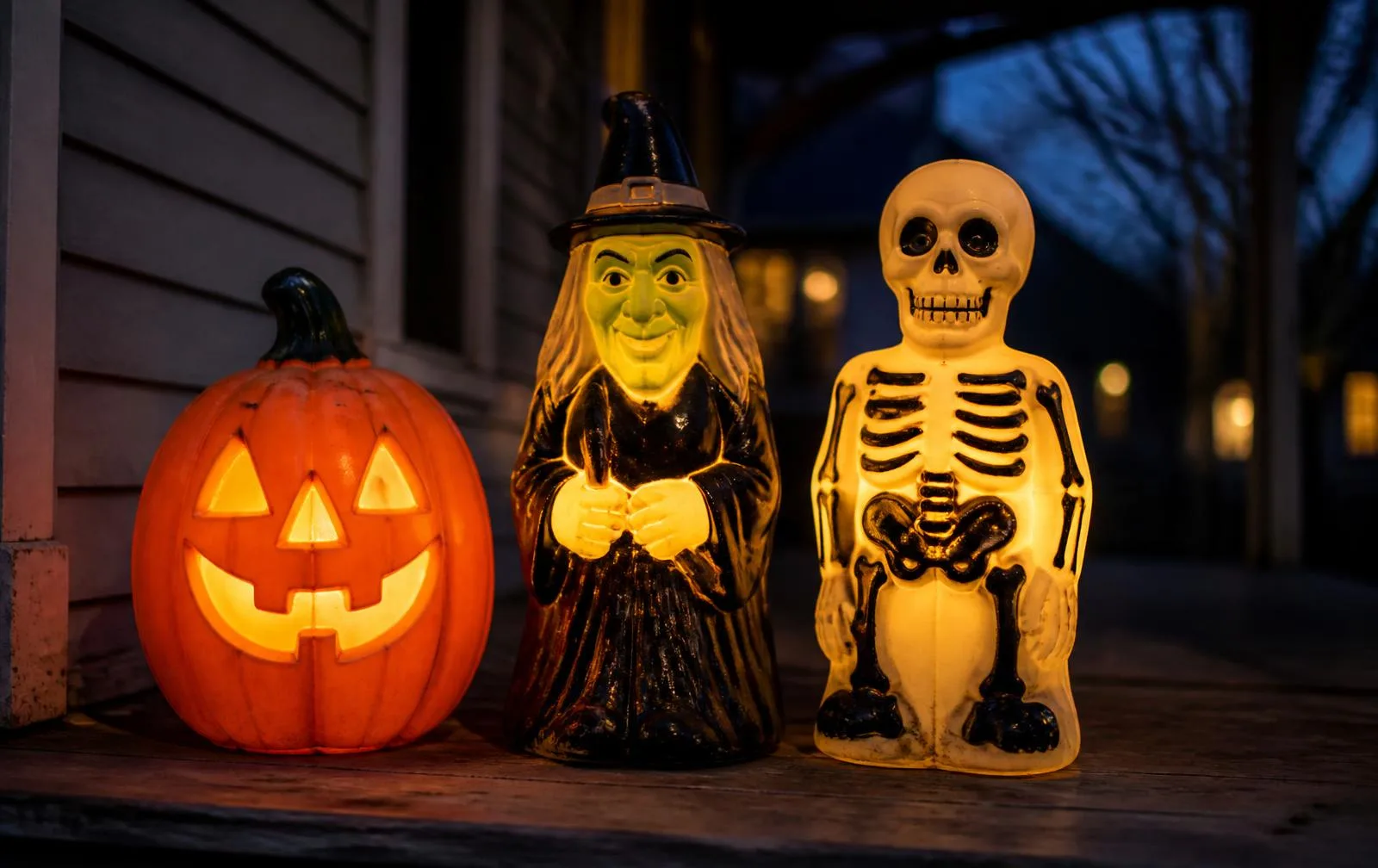
How to check one in ten seconds: flip it over. Makers embossed their name, often a copyright year and a mold number, into the back or base. Union Products pieces from the late 1960s on frequently carry a Don Featherstone signature. Cross-reference what you find against the catalog archive at blow-molded.com, which documents makers, catalog numbers and production years figure by figure, and check real sold results at the blow mold sold-price tracker.
Buy signals: unusual subject matter (not a plain pumpkin), pre-1970 makers, original cord and working socket, no sun-fade, no cracked seams, and — best case — the original box.
2. Papier-mache and pulp jack-o'-lanterns — the sleeper category
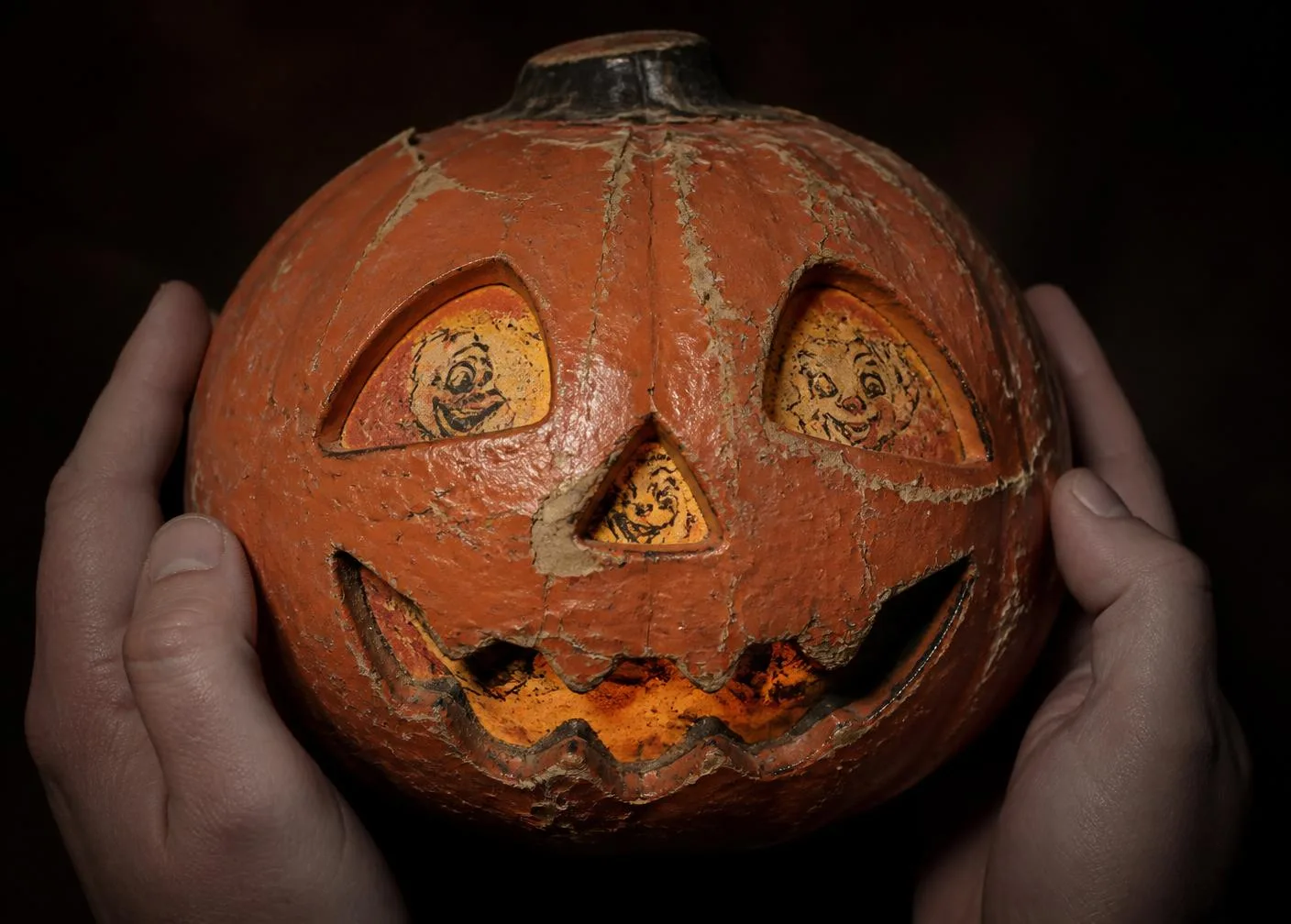
This is where estate sales genuinely outperform. Pulp lanterns are fragile, they were thrown away wet, and the survivors are usually sitting in an attic in the original tissue paper.
German, pre-WWII, is the top tier. In August 2025, Jeffrey S. Evans & Associates sold a German papier-mache jack-o'-lantern estimated at $50–$80 for $650. Smaller and more common German examples run lower — Dirk Soulis Auctions has sold them around the $100 mark.
Working ranges to keep in your head:
| Type | Typical range | What moves it up |
|---|---|---|
| Small German or Japanese pulp lantern | $75–$300 | Original insert, strong paint |
| Large or figural (witch, cat, boy head) | $300–$650+ | Unusual face, size, provenance |
| 1940s–50s American pulp | $40–$150 | Crisp paint, no crushing |
How to date one on the spot. Pre-war German pulp has a coarse, fibrous texture, thin dry paint that crazes into a fine web, and often a wire bail handle. Post-war Japanese and American pieces feel smoother and heavier-painted. Flaking black paint around the eyes is *normal* on 1920s pieces and doesn't wreck value — Mark Ledenbach, who has logged individual vintage Halloween sales for decades at halloweencollector.com, makes that point repeatedly in his write-ups of 1920s German candy containers.
Check for the insert. Hold it up to the light. If the eyes and mouth glow with a printed face rather than showing open holes, you're holding the version collectors pay for.
3. Beistle die-cuts — the diamond is the whole game
The Beistle Company started in Pennsylvania in 1900 after founder Martin Luther Beistle came home from Germany fascinated by German paper craft (company history; Beistle is still in business today). Their jointed skeletons, black cats and honeycomb centerpieces defined American Halloween decorating for fifty years.
The dating shortcut: Beistle's diamond-shaped logo was discontinued around 1930–31. A die-cut carrying the diamond mark is early, and early is where the money is — Ledenbach assigns a $375 guide value to a diamond-era skull-in-cauldron die-cut, and the scarcest embossed jointed skeletons have been offered at $3,000 (asking price, not a confirmed hammer).
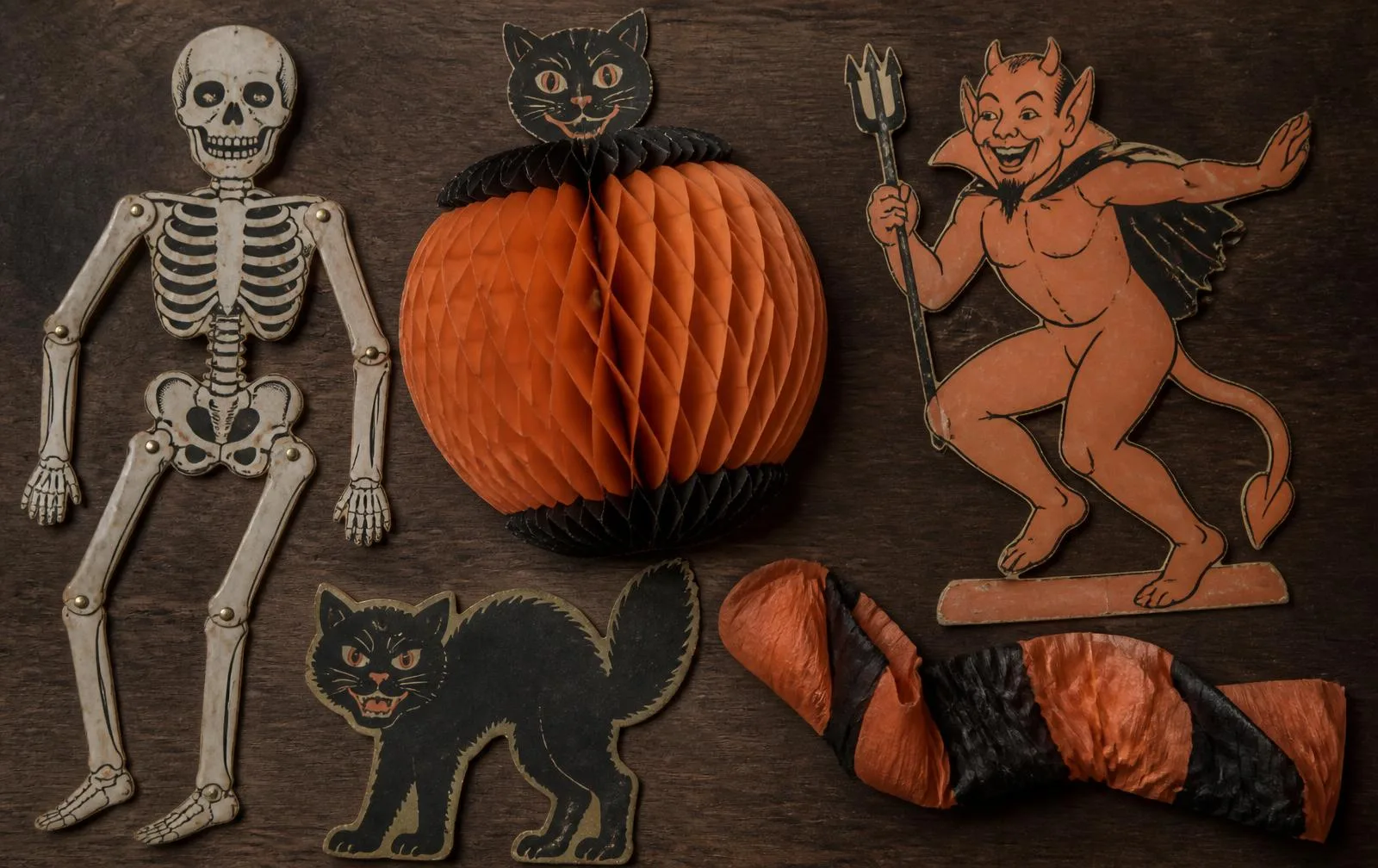
Condition punishes hard here. A jointed skeleton with a common orange background and real wear sold for $35.77 against a $75 guide value. So:
- Common small die-cuts (single cats, witches): $15–$60
- Jointed skeletons, good condition: $75–$400 depending on era and completeness
- Honeycomb centerpiece sets, complete: $50–$250
- Documented pre-1932 rarities: $375 and up
Grab-it checklist: all limbs present and still attached at the brads, no tape repairs, embossing still crisp, colors not sun-bleached to pink, and any honeycomb still opening cleanly without torn glue lines.
4. Hard plastic candy containers — small, light, and quietly valuable
Rosbro, E. Rosen, Best Plastics and Tico Toys made brightly colored 1950s hard-plastic figures: pumpkin-head men, witches on brooms, lollipop holders, pumpkins on wheels. They're the easiest category to carry out of a sale and the easiest to miss in a bin of kids' toys.
The benchmark piece is the Rosbro witch on a motorcycle. Ledenbach has tracked its price for thirty-plus years: roughly $150 in 1988, about $300 by 1993, and holding near $300 for the standard orange-and-green colorway since. Rare color combinations go far higher, and dealer retail on a clean example has been asked at $684.
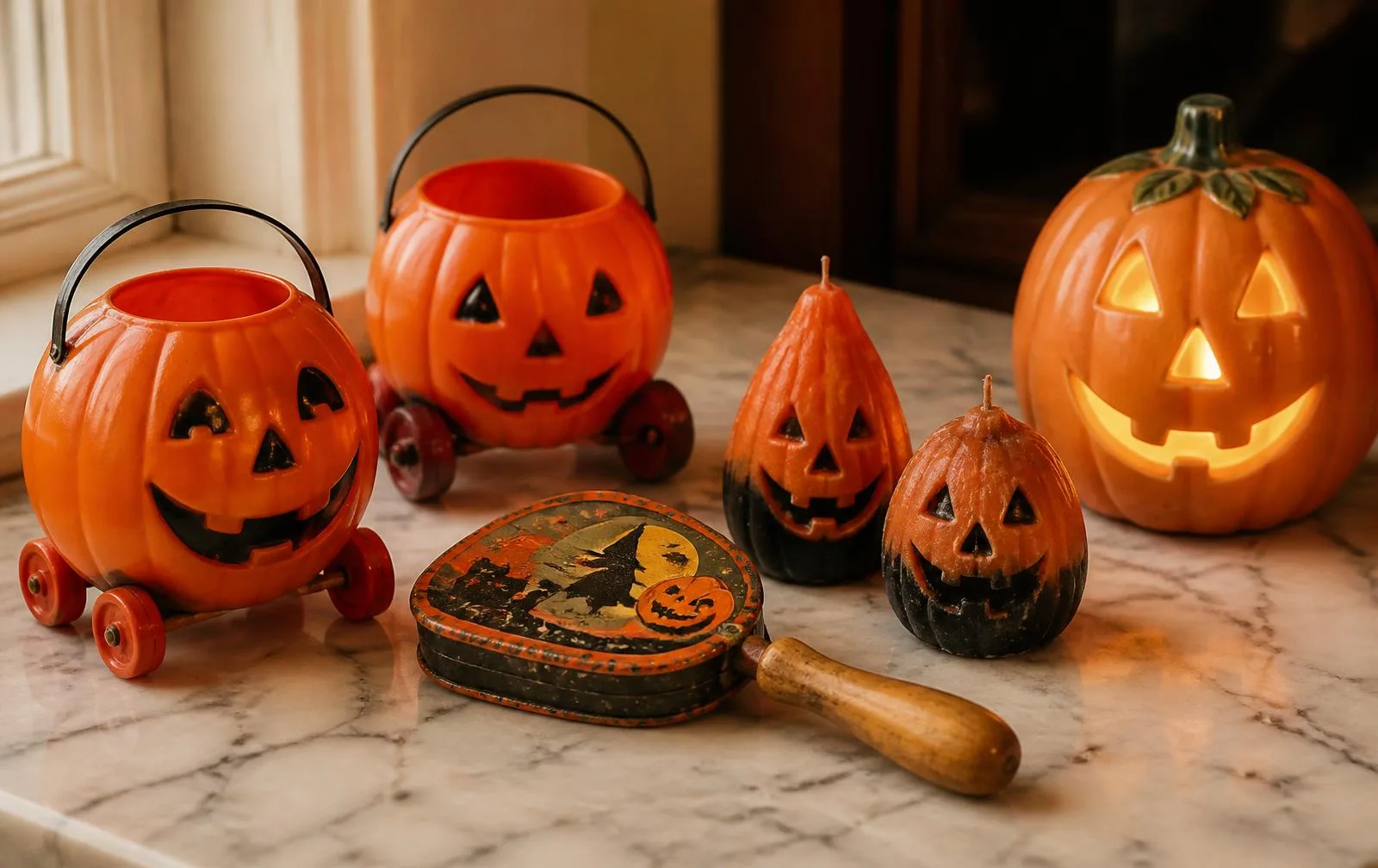
Working range: ordinary figures $30–$150; standout figurals and rare colorways $150–$700.
Tells: period hard plastic has a slightly waxy, brittle feel and thin mold seams; wheels are usually a contrasting color and often wood or hard plastic, not soft vinyl. Modern homages feel rubbery and too light.
5. Costumes and masks — the box is the collectible
A 1960s Ben Cooper or Collegeville boxed costume cost about $1.25 new. Today a boxed example generally brings $50–$150 depending on the character, and licensed characters run well past that at auction — Hake's regularly sells boxed Ben Cooper and Collegeville costumes for monsters, superheroes and TV properties, and their realized-price archive is the best free comp source in this category.
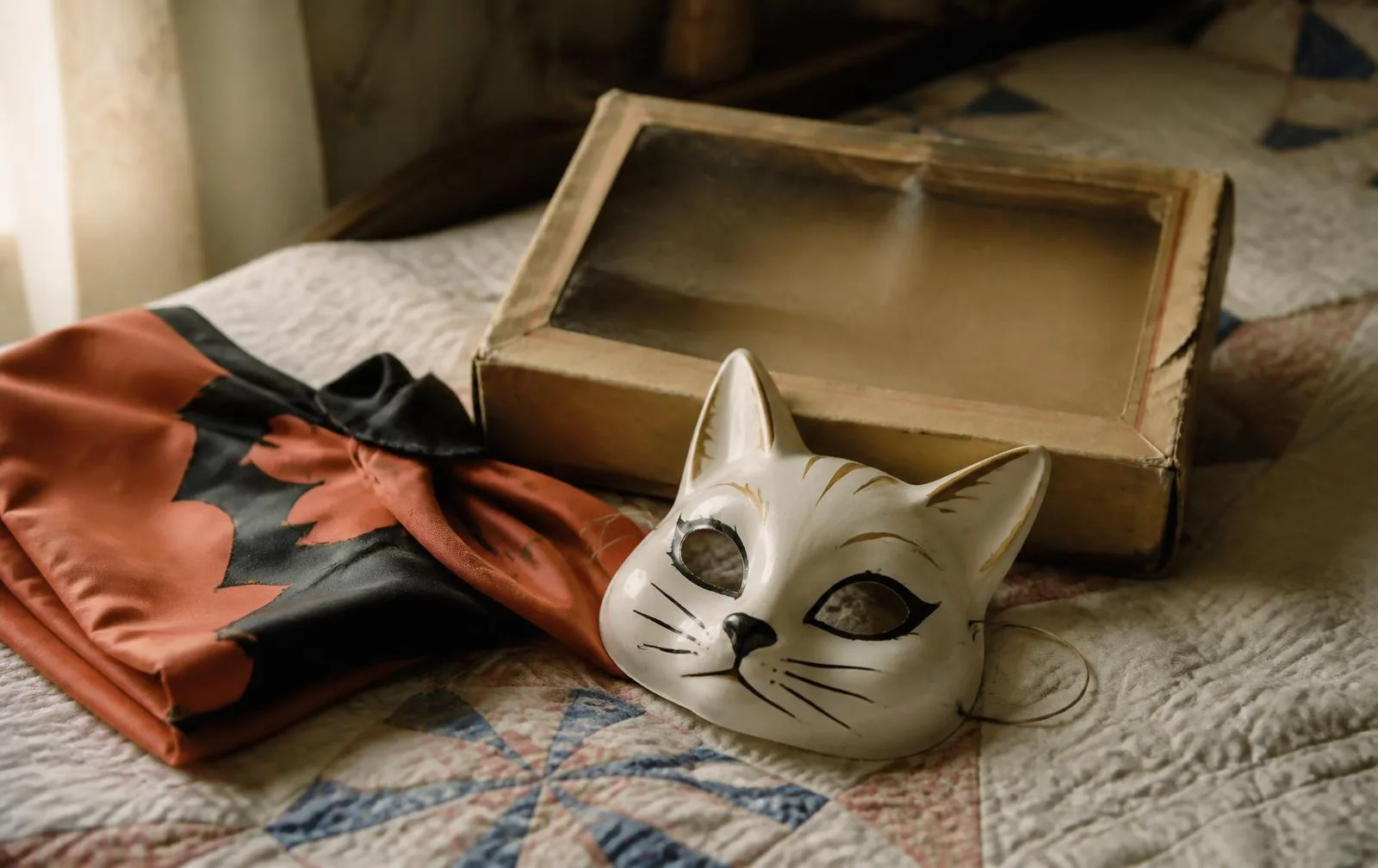
The pattern is simple: the box art carries most of the value, the licensed character carries the rest, and a loose smock with no mask is craft-bin material. Latex masks are their own world — Don Post Studios pieces have a deep collector following, and serious collections run into five figures.
Grab: any boxed costume with intact cellophane, any thin plastic mask with its original elastic band, and anything tied to a recognizable character.
6. The rest of the box: noisemakers, candles, postcards
Tin litho noisemakers. Mostly a soft market — Ledenbach has called the segment flat for two decades — but the good tambourines are an exception. In August 2025, a Chein black cat tambourine estimated at $50–$100 sold for $335.50 and a Chein witch tambourine estimated at $50–$80 sold for $520. Bright litho, no rust, working mechanism.
Gurley candles. The little wax witches, pumpkins and black cats sell in the $20–$50 range and were made in enormous numbers (history here). Never burned, still labeled, still boxed is what separates $10 from $50.
Postcards. Common unsigned Halloween postcards run $5–$25. Signed Ellen Clapsaddle and Frances Brundage cards run $20–$100, and signed mechanicals go higher — a c.1910 Clapsaddle mechanical sold for $200 against a $125–$150 estimate in 2023. Flip the card and look for the artist signature in the image, not the back.
Ceramic jack-o'-lanterns. The 1970s–80s lighted ceramics poured from Byron, Atlantic and Holland molds are lovely and *not* an investment: generally $20–$100, sometimes less. Buy those because you like them.
How to spot a reproduction
Vintage Halloween is heavily reproduced, and the reproductions are good-looking on purpose.
- Feel the paper. Reproduction die-cuts use modern bright-white or too-uniform stock. Period cardboard has a warm, slightly gray tone all the way through the cut edge.
- Look at the edges, not the front. A stamped die-cut edge from 1935 is soft and slightly fuzzy. Laser or modern die edges are clean.
- Distrust perfect. A ninety-year-old paper decoration with zero foxing, zero creases and full color saturation is a warning, not a win.
- "Artisan" is not "antique." New pieces made in the vintage style are a legitimate craft and a common source of confusion — the Halloween Collector's Society explains the distinction, and Ledenbach documents specific fakes as they surface on his Fakes page.
- Check the known reproduction lists before you spend real money on a lantern or candy container — Real Or Repro's Halloween article covers the usual suspects.
When in doubt, price it as if it's new. If it turns out to be old, that's upside.
What this looks like on a Saturday
The honest workflow at a sale:
- Go straight to the attic access, the garage shelves and the basement stairs. Seasonal decor is stored where it's inconvenient, which means it's rarely staged on the good tables.
- Ask for the holiday boxes. Companies frequently haven't opened them. "Do you have any Halloween or Christmas boxes not out yet?" is the single highest-yield sentence at a fall estate sale.
- Sort by material in the box, not by design. Paper and pulp to one side, plastic to the other.
- Check comps before you commit on anything over about $40. Search completed sales, not active listings — asking prices in this category are wildly optimistic.
- Buy the whole box when the box is cheap. Pulp lanterns hide under tangled lights.
If you want the pricing check done in the aisle, our Ai Appraiser will read a photo of the item and give you a suggested value range plus recent comparable sales — it's a suggestion to argue with, not a verdict, but it beats guessing on a $60 lantern.
Get first crack at the boxes
Halloween decor moves fastest in the first hour of the first day, because two people at every sale are looking for exactly this.
- Browse estate sales near you and scan the listing photos for orange and black before you drive.
- Set a wishlist alert for "Halloween," "blow mold," "Beistle" and "jack-o'-lantern" so new listings that mention them ping you automatically. Our guide to wishlist alerts walks through the setup.
- Plan your Saturday route so the sales with holiday photos are your first two stops, not your last.
FAQ
What vintage Halloween decorations are worth the most money?
Pre-1932 Beistle die-cuts with the diamond logo, pre-WWII German papier-mache lanterns with original paper face inserts, rare-color Rosbro hard plastic candy containers, and boxed licensed-character costumes are the top tiers. Documented results include $650 for a German pulp jack-o'-lantern at Jeffrey S. Evans in 2025, a $375 guide value on a diamond-era Beistle skull die-cut, and roughly $300 for a standard Rosbro witch on a motorcycle.
Are blow mold pumpkins worth anything?
Most are not. Common 1990s and 2000s Union Products and General Foam blow molds sell for about $15–$40 used. The value sits in scarce pre-1970 Empire pieces, unusual subjects, and large figures like haunted houses — one Union Products haunted house sold for $527 in 2024. Check the maker stamp on the back before assuming.
How can you tell if a Halloween decoration is really vintage?
Judge the material, not the artwork. Period cardboard is warm-toned through the cut edge with soft stamped edges; period pulp is fibrous with thin, finely crazed paint; period hard plastic feels brittle and slightly waxy. Reproductions copy the design accurately but use modern bright paper, clean laser-cut edges and rubbery plastic. Condition that looks too perfect for ninety years old usually is.
What is a Beistle diamond mark?
It is the diamond-shaped Beistle Company logo printed on their die-cut decorations, discontinued around 1930–31. Its presence dates a piece to the earliest and most collectible era of American Halloween decorations.
Why does the paper insert matter on a papier-mache jack-o'-lantern?
The printed tissue insert behind the cut-out eyes and mouth is what makes the face glow in color. It tears, fades and gets discarded, so intact original inserts are uncommon — auction listings call them out specifically, and lanterns that still have them consistently sell above the same lantern without one.
Are 1970s and 1980s ceramic jack-o'-lanterns valuable?
Generally no. Lighted ceramics poured from hobbyist Byron, Atlantic and Holland molds mostly sell in the $20–$100 range. They are a nostalgia and decor market rather than a serious collectible tier.
When is the best time to find vintage Halloween at estate sales?
August through early October, when families pull seasonal boxes out of attics ahead of the season, and again in January when post-holiday cleanouts start. Ask staff directly about unopened holiday boxes — a lot of it never makes it onto the tables.
Where can I check real prices for vintage Halloween?
Use completed auction results rather than asking prices. Hake's, Jeffrey S. Evans & Associates and Dirk Soulis Auctions publish realized prices, Mark Ledenbach's halloweencollector.com logs individual sales with commentary, and eBay's sold-listings filter shows what people actually paid.
Related reading:
- Vintage toys worth money at estate sales
- How to spot valuable items at estate sales
- Items secretly worth $500 or more
- How to appraise estate sale items
- The estate sale reseller glossary
One last thing. The best vintage Halloween I've ever seen at a sale was in a cardboard box labeled "XMAS MISC" on a garage shelf, under a string of lights, at 2pm on a half-price Sunday. Look in the wrong box too.